
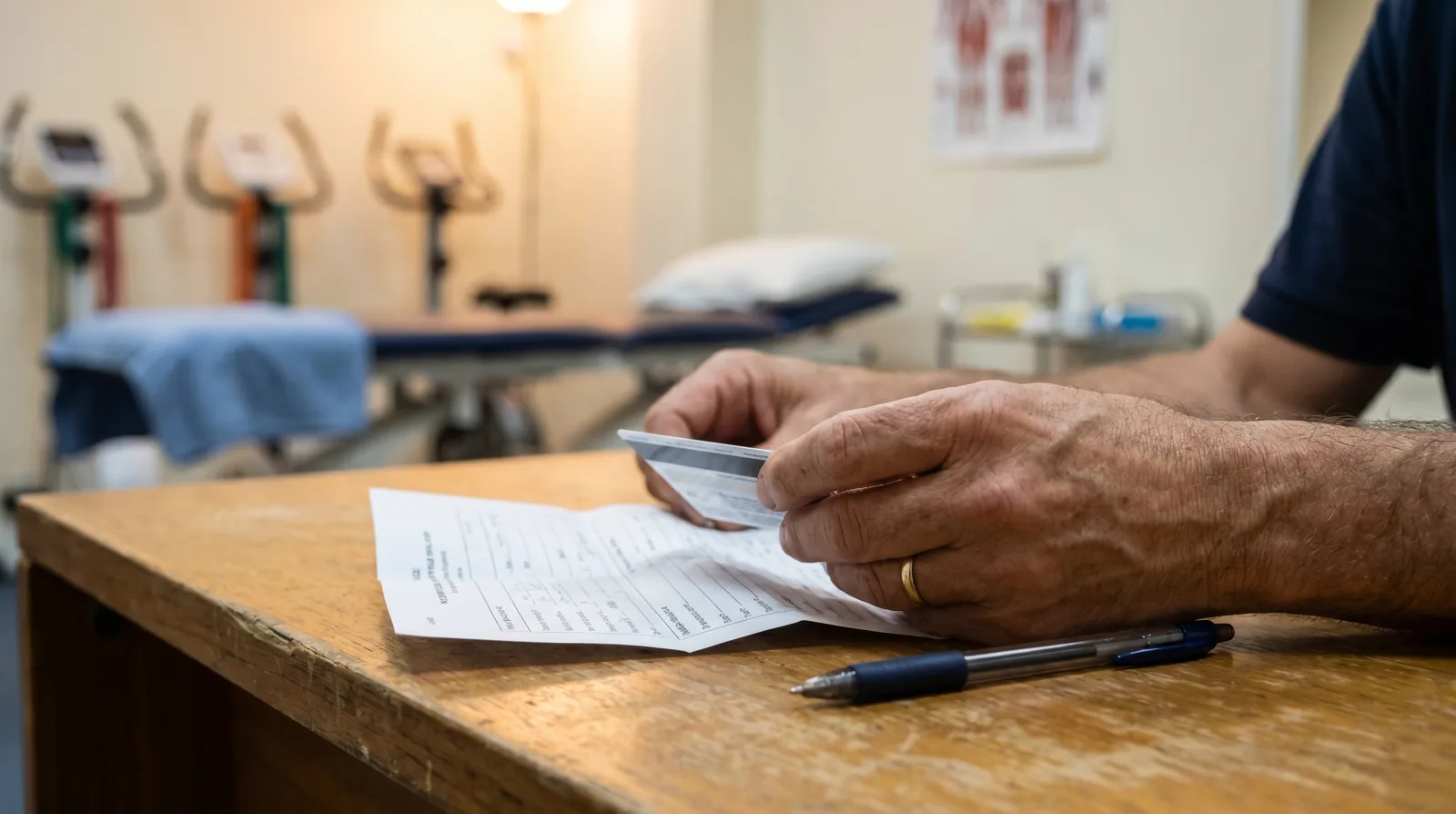
Your ICBC Claim Number and the First Physio Visit
The paperwork side of ICBC physio in BC is shorter than most people think. Here is what you need before session one, how direct billing actually clears, and what the first appointment usually looks like.
BY KEANE LEUNG
Part of our complete ICBC physiotherapy guide. Coverage, your first visit, choosing a clinician, recovery timelines, and extensions, all in one place.
Most of the friction around starting ICBC physio after a BC crash isn't clinical. It's procedural. People delay booking because they're not sure if they need a referral, whether they have to wait for an adjuster to call back, or what counts as proof that the visit is covered. This piece answers the procedural questions in the order they come up.
If you want the broader picture (visit counts, what 12 weeks of pre-approval covers, which clinician to start with) that lives in the ICBC physio guide.
The only document that matters is your claim number
Under ICBC's Enhanced Care model, which remains in effect as of 2026, anyone injured in a BC motor vehicle crash is pre-approved for a defined set of treatments, physiotherapy among them, in the first 12 weeks. Pre-approval means the clinic can bill ICBC directly. You don't need a doctor's referral. You don't need adjuster approval. You don't need a treatment plan signed before the visit.
What you do need is a claim number. The number is generated the moment you file a claim with ICBC, and that filing can happen online in roughly 15 minutes. Bring the number to the first visit and the clinic can direct-bill from session one.
If you haven't filed yet, file before you book. There's no clinical advantage to waiting, and many people lose a week of early-window rehab waiting for a call that doesn't change anything about whether they can start.
What to do before the first session
Once you have a claim number, the prep is short. The clinic will send an intake form ahead of the appointment. Fill it out before you arrive so the therapist has time to read it rather than read it to you on the clock.
Bring with you:
- Your ICBC claim number.
- A piece of government-issued photo ID, mainly to match the claim file.
- A list of any medications you're taking, including over-the-counter.
- The contact details for your family physician and any specialist already involved.
- Loose clothing you can move in. For neck and upper back injuries, a short-sleeve top is helpful. For lower back, hip, or knee, athletic shorts or pants you can roll up.
You do not need to bring a referral letter, prior imaging, or a written summary of the accident. The therapist will take that history at the appointment.
How direct billing actually clears
Direct billing for ICBC pre-approved physiotherapy is a clinic-to-ICBC transaction once a couple of administrative pieces are in place at session one. The clinic submits the claim using your file number and the visit clears through ICBC's provider portal. The current per-visit fees the clinic invoices to ICBC are published in ICBC's accessing-treatment guide.
You don't pay at the desk for pre-approved visits within the window. If your plan involves modalities or services outside ICBC's pre-approved scope, the therapist will flag that before booking the next session, so there are no surprises at checkout.
The two situations where direct billing pauses or requires extra steps:
- The claim number isn't active yet. If you booked the same day you filed, the file occasionally hasn't propagated to the provider portal yet. We'll either delay billing one cycle or, rarely, take payment and refund once the file activates.
- The visit count is approaching the pre-approval cap. Once you're near the end of your pre-approved allotment, the conversation about an extension starts. See how extensions work past 12 weeks.
What session one usually looks like
A first ICBC physiotherapy visit at Launch Rehab is 60 minutes, and most of that time is the clinician asking questions and watching how you move, not treating yet. The session has a predictable shape.
Screening for red flags. Concussion symptoms, severe neurological signs, fracture risk, anything that suggests the visit should be a physician or ER referral rather than physio. This isn't a formality. If something in the screen suggests imaging or medical review, the therapist will say so and route you accordingly.
Detailed history. Where it hurts, when it hurts, what positions calm it down, what aggravates it, what your job demands look like, how you slept last night. For neck injuries we grade the presentation using the Quebec Task Force whiplash classification, which is the BC standard. Most ICBC presentations are Grade I or II.
Objective assessment. Range of motion, strength testing, specific orthopedic tests for the tissues implicated, sometimes a basic neurological screen. The point is to identify what's actually driving symptoms, not to confirm a diagnosis you arrived with.
A plan in plain English. What we'll work on, how often we'll see you in the next few weeks, what you should be doing between sessions, and what would change the plan. Most of the value of physio happens between sessions, not during them. If the plan doesn't include things for you to do at home, ask why.
A small amount of treatment usually fits at the end of session one (manual therapy or a starting set of exercises) but in early-stage care, assessment and planning are the work. The handful of clients who arrive expecting an hour of hands-on treatment occasionally find this surprising. We say so up front because the plan is what determines how the next eleven weeks go.
After the first session
The clinic books the next two to three visits based on irritability (how reactive symptoms are to load). Higher irritability earns closer follow-up early on; lower irritability earns wider spacing. The frequency dial moves throughout care.
Between sessions, the work is the home program. Five to ten minutes a day, done daily, almost always beats an hour done once. Variability in symptoms is normal in the first six weeks. A flare-up after a tolerable session is information your therapist uses to adjust load, not a reason to stop.
If at any point you're unclear on what you're meant to be doing, message the clinic and we'll re-send the program or book a brief check-in. The plan only works if it's the plan you actually understand.
If symptoms get worse: what counts as a red flag
Most variability in the early weeks is part of recovery. A short list of changes is not, and those warrant a call to a physician or 911 rather than a physio booking:
- New or worsening numbness, weakness, or pins and needles in an arm or leg.
- Severe or escalating headache, especially with vomiting, vision changes, or confusion.
- Changes in bowel or bladder function.
- Fever alongside back or neck pain.
- Loss of consciousness after the crash that you only recently realized happened.
Bring these to your physician same-day. If the picture is acute, 911 or the ER. Physio is part of recovery; it's not the right first stop when the picture suggests something neurological or medical.
What to read next
If you're trying to decide whether to start with physio, RMT, or chiro, the scope-by-scope answer is in ICBC Physio vs RMT vs Chiro After a Crash. If you want a week-by-week sense of how the first 12 weeks unfold, What the First 12 Weeks Actually Look Like walks through it.
If you're ready to book, the contact page lists every studio and their direct booking link. Bring your claim number. We handle the rest.
This article is not a substitute for assessment by a regulated practitioner. If you're unsure whether your symptoms warrant physiotherapy or a physician review, book the assessment and we'll triage from there.
Frequently asked questions
Do I need my ICBC claim number before my first physio appointment?
Yes. ICBC direct billing cannot begin without a claim number. It is what connects the treatment sessions to your ICBC file. If you do not yet have a claim number (for example, you have not yet reported the accident), you can pay privately for the first session and be reimbursed once your claim number is issued. Report the accident to ICBC as soon as possible.
How do I get an ICBC claim number?
You get a claim number when you report your accident to ICBC. In BC, you can report online at icbc.com, by phone, or through a broker. ICBC will assign a claim number immediately and give you the name of your adjuster. You do not need a police report to open a claim. Any accident causing injury should be reported to ICBC.
Do I need a doctor's referral to start ICBC physiotherapy?
No. ICBC Enhanced Care pre-approves physiotherapy in the first 12 weeks after a crash without a physician referral. You need your ICBC claim number, not a referral. Bring the claim number to your first physiotherapy appointment and we handle the billing directly with ICBC. The first session still includes a red-flag screen, so if anything suggests a physician or ER visit instead, the therapist will say so and route you accordingly.
What if I do not have my ICBC claim number at my first appointment?
We can proceed with a private-pay session and apply the session to your ICBC claim retroactively once your number is issued, provided you have already reported the accident. Payment is collected at the time of service and ICBC typically reimburses within a few weeks. Confirm with your adjuster that retroactive billing is possible for your specific claim.
Can ICBC physio sessions be booked online?
Yes. Launch Rehab's online booking at launch.janeapp.com allows you to book physiotherapy directly. Select the ICBC session type when booking so the intake form captures your claim number and adjuster details before your first visit. You can also choose from any of our five Metro Vancouver studios when booking, and pick whichever one you can reach consistently for the weeks ahead.
Will I have to pay anything at my first ICBC physio visit?
For standard physiotherapy within ICBC's pre-approved scope, no. There is no surcharge on standard physiotherapy visits. Specialty services such as vestibular physiotherapy, IMS dry needling, or acupuncture may carry an additional fee even within the pre-approved window, so ask the clinic to confirm before the visit if your plan includes one of those.
What happens if I do not have a claim number yet at my first visit?
The clinic cannot direct-bill ICBC without an active claim number, since that number is what links the session to your file. If you have already reported the crash but the number has not yet appeared in ICBC's provider portal, the clinic may delay billing by one cycle or take payment and refund it once the file activates. Report the accident to ICBC before booking whenever possible to avoid this step.
Can I choose which studio I go to for ICBC physiotherapy?
Yes. Launch Rehab has five studios across Metro Vancouver (Lougheed, Coquitlam, Richmond, New Westminster, and North Burnaby), and ICBC pre-approval is not tied to a specific location. Pick the studio you can reach consistently, since regular attendance in the early weeks tends to matter more than which studio you chose.
How soon after a crash should I book my first physio visit?
As soon as you feel ready and have your claim number, since there is no clinical reason to wait for an adjuster call before starting. Early rehab within the pre-approved 12 week window is part of the standard Enhanced Care pathway, and delaying the first visit does not change whether treatment is covered.
Do I need to see a doctor before or instead of a physiotherapist after a crash?
Not instead of, though a physician assessment is still important for medical clearance, especially if there is any suspicion of a more serious injury such as a fracture or concussion. Physiotherapy is direct-access in BC, so you do not need a physician referral to book, and the first physiotherapy visit itself includes a red-flag screen that will route you to a physician or the ER if something in the screen warrants it.
WRITTEN BY
Keane LeungBSCPT, CAFCI, Vestibular and Concussion Therapy (HE/HIM/HIS)
Physiotherapist
Practical recovery and training notes from the clinicians at our five Metro Vancouver studios.
READ FULL PROFILEFOUND THIS USEFUL?
Share it with your network on LinkedIn. We wrote a ready-to-post version for you.
FILED UNDER
- icbc
- physiotherapy
- first-visit
- direct-billing
- metro-vancouver
- icbc-guide