
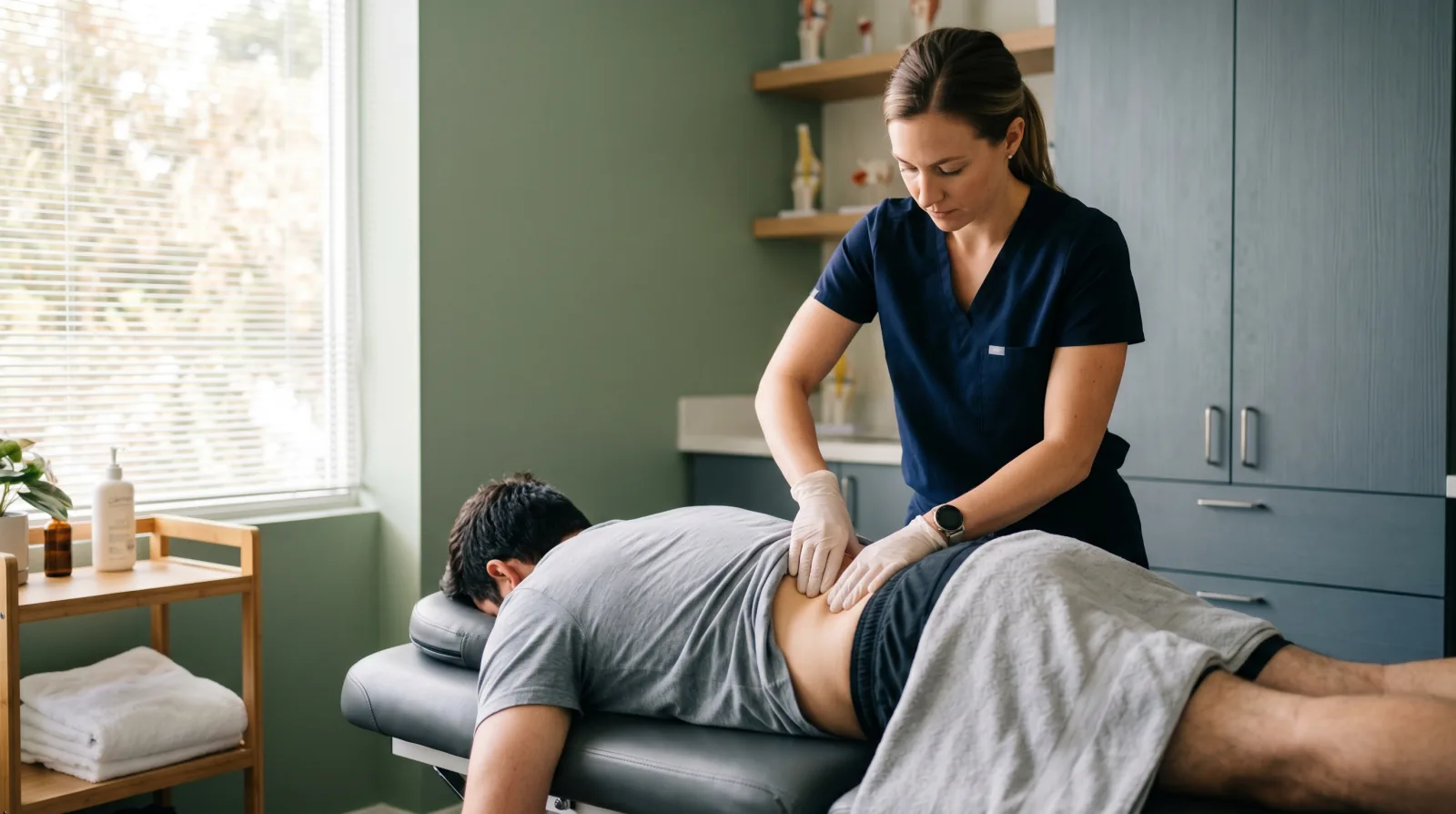
Lower Back Pain: How a Physiotherapist Tells Disc, Facet, and Muscular Apart
Most lower back pain is non-specific, but within that label sit three distinct mechanical sub-types. Sorting between them is one of the most useful things a physiotherapist does in a first session, because the treatment for each is genuinely different.
BY KEANE LEUNG
Roughly 80% of adults will experience clinically significant lower back pain at some point in their lives. The statistic is one of the more cited in physiotherapy, and it tends to come paired with another: most of that pain, around 85% in primary care, has no specific structural diagnosis on imaging or examination. The result is a clinical label, "non-specific low back pain," that gets applied to a vast number of presentations that are not actually all the same.
The label is useful in the sense that it correctly identifies what most lower back pain is not (a tumour, a fracture, an infection, a serious neurological compression). It is not useful for guiding what to do next. Within "non-specific" sit at least three distinct mechanical sub-types that respond to different treatment. Sorting between them is one of the more clinically useful things a physiotherapist does in a first session.
This post is the clinician's-eye view of that assessment. It is not a diagnosis-by-internet substitute for an actual examination. It is the framework that a competent first-session lower-back assessment in BC uses, and it explains why the treatment that worked for your friend's back pain may make yours worse.
The diagnostic baseline: red flags first
Before any movement-based sub-typing, a physiotherapist screens for the small subset of lower back pain that is not non-specific. The red flags adapted from Choosing Wisely Canada's low back pain guidance and HealthLink BC:
- Cauda equina symptoms: saddle-area numbness, new bladder or bowel dysfunction, significant new weakness in the legs. Emergency assessment, not physiotherapy.
- Significant unexplained weight loss, history of cancer, fever, or night sweats: requires medical workup for systemic cause.
- Significant trauma (high-energy mechanism in a younger patient, or low-energy in someone with osteoporosis): fracture screen needed.
- Progressive neurological deficit: worsening weakness, sensory loss, or reflex changes.
- Age over 50 or under 20 with non-mechanical pain pattern: warrants closer assessment for systemic cause.
If none of those are present, and in the large majority of cases none are, the assessment moves to mechanical sub-classification.
The three mechanical patterns
The framework here is widely used. It comes out of the McKenzie Method (MDT) and the related movement-classification approaches taught in modern manual-therapy programs, supported by the Lancet 2018 low back pain series and current JOSPT clinical practice guidelines.
Disc-pattern (often called derangement)
The classical presentation: pain worse with sitting, worse with forward bending, worse with getting out of a chair after a long sit. Often a "stuck" feeling on first standing. Pain may refer down a leg in a pattern that follows a nerve root (sciatic distribution). Coughing or sneezing can spike it.
The clinical test: repeated lumbar extension. With the patient prone or standing, the clinician guides repeated end-range backward bending of the lumbar spine. In a disc-pattern presentation, repeated extension often produces centralization (pain that was felt in the leg or distally moves toward the spine and reduces in intensity). Centralization is one of the cleaner predictive findings in lower back pain literature; it identifies patients who respond to extension-based self-management.
Treatment: repeated extension as a home program (often hourly through the day in the acute phase), postural management (avoiding prolonged slumped sitting), graded return to loading. Manual therapy and dry needling for symptom modulation. Most disc-pattern presentations improve substantially in 2 to 4 weeks with this approach.
Facet-pattern (extension-loading sensitive)
The classical presentation: pain worse with standing, worse with walking, worse with backward bending, worse with prolonged extension postures (carpentry overhead, walking with a heavy pack). Better with sitting. Better with forward bending. May refer to the buttock or upper thigh but rarely below the knee.
The clinical test: pain reproduced with combined extension and lateral flexion (Kemp's test) to the painful side. Local tenderness over the facet joints at the painful level.
Treatment: this presentation often responds to the opposite of what helps the disc pattern. Extension is provocative, not therapeutic. The home program emphasizes flexion-biased mobility, hip mobility (to reduce lumbar compensatory extension), and strengthening of the deep abdominal and gluteal musculature to offload the facets. Manual therapy targeting the facet joints. Most facet-pattern presentations improve in 3 to 6 weeks.
Predominantly muscular (loading-related)
The classical presentation: onset after heavy lifting, unaccustomed bending, a long day of yard work, or a flare from training. Pain feels diffuse, often described as a "spasm" or "seized up." Doesn't clearly worsen with extension or flexion specifically. It worsens with any sustained position. Improves with gentle movement.
The clinical test: there isn't a single positive test the way there is for disc or facet patterns. Instead, the clinician confirms by exclusion: the directional patterns of the disc and facet sub-types are absent, and the loading history fits.
Treatment: graded return to movement, soft-tissue work to reduce protective muscle guarding, IMS or dry needling if irritability is high, education on flare management, and a return-to-loading plan. Most muscular presentations improve in 1 to 3 weeks.
Why the sub-typing changes treatment
A specific example. The same generic advice ("core strengthening exercises, lots of bridges and planks, do some gentle stretching") produces three different outcomes depending on sub-type:
- For a disc-pattern presentation, bridges and planks are reasonable supporting work but don't address the directional preference. The patient improves more slowly than they would with extension-based self-management.
- For a facet-pattern presentation, bridges and back extensions may provoke symptoms because they load extension. The patient gets worse on the prescribed program and concludes "physio doesn't work."
- For a muscular presentation, both are roughly fine and the patient improves on most reasonable programs.
The generic program is right one time in three. The targeted program is right three times in three. The difference is the assessment.
This is also why "I tried physio for my back and it didn't help" is a common complaint that warrants a second look. Often the first physio applied a generic loading program without classifying the directional pattern. A reassessment with attention to movement-pattern testing changes the program.
What imaging does, and mostly doesn't, add
The guidelines on imaging for non-specific lower back pain are consistent across Choosing Wisely Canada, the American College of Physicians, and the NICE low back pain guideline:
- Imaging is not recommended as a first-line investigation for non-specific lower back pain.
- It does not improve outcomes when used routinely.
- It commonly identifies findings (disc bulges, facet arthropathy, mild stenosis, annular tears) that are equally present in pain-free populations of the same age. A 50-year-old with no back pain has roughly a 60 to 80% chance of having visible disc degeneration on MRI; the imaging finding doesn't equal the pain source.
- Imaging is reserved for red-flag presentations, progressive neurological deficit, or pre-surgical workup.
The implication for patients: a normal MRI does not mean the pain isn't real, and an MRI showing degenerative findings does not mean those findings caused the pain. The assessment of the pain-producing pattern matters more than the imaging.
A short field guide to your own pain pattern
This is not a diagnostic substitute. It is a way of thinking about your own pain before an assessment so the conversation is more efficient.
- Pain worse with sitting and forward bending, better with standing or walking: consider disc pattern.
- Pain worse with standing, walking, or backward bending; better with sitting: consider facet pattern.
- Pain that doesn't cleanly follow either, came on after loading or unaccustomed activity, and feels diffuse and seized: consider muscular pattern.
- Pain with new leg weakness, saddle numbness, bladder or bowel changes, or after significant trauma: skip the framework. Seek emergency assessment.
Bring this observation to the first session. It saves time and helps the clinician confirm or refute it with targeted testing.
What treatment looks like in BC
Lower back pain is treated across BC primarily by family physicians, physiotherapists, chiropractors, and RMTs. The scope-by-scope picture is in our physio vs RMT vs chiro piece. Coverage in BC:
- MSP: limited physiotherapy visits per calendar year for Supplementary Benefits enrolees. Family physician visits covered.
- Extended health: most plans cover physiotherapy and chiropractic at per-visit rates.
- ICBC: if back pain is related to a motor vehicle injury, Enhanced Care pre-approves treatment. Direct billing.
- WorkSafeBC: if back pain is a workplace injury, WorkSafeBC covers physiotherapy. The WorkSafeBC vs ICBC piece covers the difference.
When recovery stalls
Most mechanical lower back pain improves substantially within 4 to 6 weeks of appropriate treatment. The presentations that take longer often have one of these features:
- Mismatch between sub-type and treatment: the most common reason. Re-assess.
- Significant sensitization: pain has been present for months and the nervous system has up-regulated its sensitivity. Treatment shifts to graded exposure, education, and pacing.
- Bio-psycho-social load: high work demand, sleep disruption, stress, fear of movement, low mood. These are not psychological dismissals; they are documented contributors to pain persistence that benefit from direct attention.
- A specific structural driver that wasn't initially identified, such as significant stenosis, instability, or radiculopathy. Re-assessment and possible imaging referral.
At Launch Rehab, the first-session assessment uses directional testing and movement classification to identify which sub-type is driving the pain before any exercise program is written, because the extension-based program that resolves one pattern actively flares another.
The shortest version: most lower back pain is mechanical, classifies into one of a small number of sub-types, and improves with the right treatment in a few weeks. The trick is matching the treatment to the sub-type. If a recent physiotherapy course of "general core strengthening and stretches" didn't help, the most likely explanation is not that physiotherapy doesn't work. The most likely reason is that the wrong sub-type was assumed. The right assessment, repeated, usually finds the pattern.
Frequently asked questions
What is the most common cause of lower back pain?
Most lower back pain, around 85% in primary care, has no specific structural diagnosis on imaging. Within that "non-specific" category sit three mechanical sub-types: disc-pattern (worse sitting, better walking), facet-pattern (worse standing and extension, better sitting), and predominantly muscular (follows heavy loading, no clear flexion/extension pattern). Identifying which sub-type is driving the pain is what makes the first physiotherapy session clinically useful.
Should I get an MRI or X-ray for lower back pain?
Not as a first step for most people. Current guidelines from Choosing Wisely Canada and HealthLink BC advise against routine imaging for non-specific low back pain because imaging findings are commonly present in pain-free adults and rarely change the initial treatment plan. Imaging is warranted for red-flag presentations: saddle numbness, new bladder or bowel changes, progressive weakness, significant unexplained weight loss, or history of cancer.
How long does lower back pain take to resolve?
Most acute mechanical back pain improves substantially within 4 to 8 weeks with appropriate care. Recurring back pain, pain that settles and returns with certain activities, has a different arc and often has a specific driver worth identifying. Chronic back pain (present for more than 3 months) benefits from a more comprehensive assessment and often a combined physiotherapy and active rehabilitation approach.
Does exercise help lower back pain?
Yes. The current evidence strongly favours active care (specific exercise matched to the sub-type, manual therapy where indicated, and graded return to activity) over rest or passive treatment alone. The Lancet 2018 series on low back pain is explicit on this: bed rest is harmful, exercise is helpful, and the type of exercise should match the clinical picture.
Is physiotherapy covered by ICBC or WorkSafeBC for back pain?
If the back pain developed from a motor vehicle accident in BC, ICBC Enhanced Care pre-approves physiotherapy in the first 12 weeks. If it is a workplace injury, WorkSafeBC covers physiotherapy from the date of the claim. Most private extended health plans cover physiotherapy at a per-visit rate toward an annual maximum. No physician referral is needed to book in BC.
Can a physiotherapist tell which sub-type of back pain I have without imaging?
Usually yes. The disc, facet, and muscular sub-types are identified through movement-based testing, such as how symptoms respond to repeated extension or how pain changes with sitting versus standing, rather than through imaging. Imaging findings often correlate poorly with which sub-type is driving the pain, so a hands-on assessment is typically more useful than a scan for this purpose.
Is bed rest ever the right approach for lower back pain?
No, not for mechanical low back pain without red flags. The Lancet 2018 low back pain series is explicit that bed rest is harmful and delays recovery compared with staying active within a tolerable range. Short periods of reduced activity right after a flare can be reasonable, but extended rest allows deconditioning and does not address the mechanical pattern driving the pain.
Can lower back pain come back after it resolves?
Yes, recurrence is common with mechanical low back pain, particularly when the underlying pattern (disc, facet, or muscular) was not identified and addressed the first time. A recurrence after a period of feeling well is worth a reassessment rather than repeating whatever helped last time, since the driving pattern can shift between episodes.
Should I see a physiotherapist or a chiropractor for lower back pain?
Both physiotherapists and chiropractors can assess and treat mechanical low back pain within their respective scopes of practice, and the right choice often depends on personal preference and what has worked for you before. Our physio versus RMT versus chiro piece covers the scope differences in more detail, including which professions are appropriate for different presentations.
This article is general information, not personal medical advice. A regulated practitioner can confirm whether the patterns described apply to your specific presentation.
WRITTEN BY
Keane LeungBSCPT, CAFCI, Vestibular and Concussion Therapy (HE/HIM/HIS)
Physiotherapist
Practical recovery and training notes from the clinicians at our five Metro Vancouver studios.
READ FULL PROFILEFOUND THIS USEFUL?
Share it with your network on LinkedIn. We wrote a ready-to-post version for you.
FILED UNDER
- lower-back-pain
- disc
- facet
- lumbar
- physiotherapy
- assessment
- bc