Active Rehabilitation vs Physiotherapy: What Is the Difference and When Do You Need Each
Both involve exercise. Both happen in a clinic. But active rehabilitation and physiotherapy serve different purposes, are delivered by different regulated professionals, and are covered differently by ICBC and WorkSafeBC. Here is how to tell which one your situation calls for.
BY THE LAUNCH REHAB TEAM
Patients coming to our clinics after a workplace injury or car accident often arrive with two or three referrals and a question the referral letter does not answer: "Which of these should I start with, and what is the difference?" Active rehabilitation and physiotherapy appear on many of the same billing forms, are both delivered in physiotherapy clinics, and both involve exercise. Beyond that, they are meaningfully different.
What physiotherapy involves
Physiotherapy is an assessment-led service. A physiotherapist, regulated in BC by the College of Health and Care Professionals of BC (CHCPBC), begins with a detailed evaluation of your injury: testing range of motion, strength, neural sensitivity, and how structures respond to loading. That assessment produces a working clinical picture of what is injured and why it is not recovering on its own. Treatment then addresses the specific finding, manual therapy, dry needling, progressive exercise loading, and the physiotherapist monitors how the tissue responds and adjusts the plan accordingly.
Physiotherapy is appropriate when:
- The injury is recent and the exact problem has not been identified yet
- There is significant pain limiting daily function
- Neural symptoms are present (numbness, tingling, radiating pain)
- A manual therapy component is needed (joint mobilization, manipulation, soft-tissue release)
- Post-surgical rehabilitation requires careful tissue-tolerance monitoring
Physiotherapy is covered by most private extended health plans, and is pre-approved under ICBC's Enhanced Care model for the first 12 weeks after a motor vehicle crash. WorkSafeBC covers physiotherapy for accepted claims.
What active rehabilitation involves
Active rehabilitation, sometimes listed on billing forms as "kinesiology" or "active rehab", is a structured, exercise-based conditioning program. In BC, it is typically delivered by a kinesiologist, a professional trained in human movement and exercise science. The BC Association of Kinesiologists (BCAK) sets the professional standards; kinesiology is not a regulated college in BC, but ICBC and WorkSafeBC have specific requirements for the kinesiologists they fund.
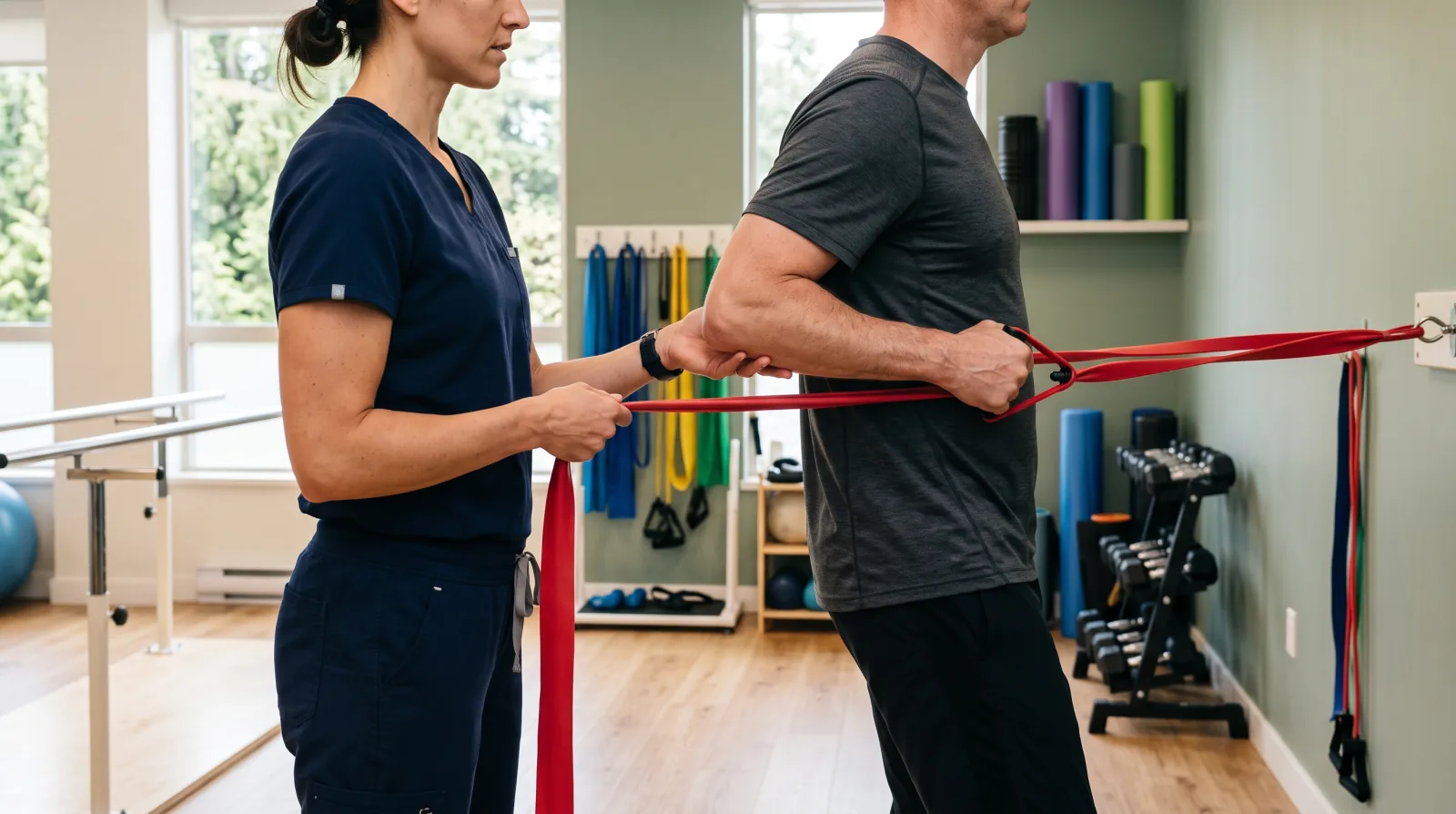
Active rehabilitation starts from a different place than physiotherapy. It assumes that the acute phase of injury is past, the pain is stable, the tissue is healing, and focuses on building back the strength, conditioning, and movement patterns needed to return to work, sport, or daily activity at the level you had before the injury. Sessions are typically longer and more exercise-focused than physiotherapy appointments. A kinesiologist coaches movement, progresses loading over a program, and monitors exertion and recovery.
Active rehabilitation is appropriate when:
- The acute injury phase is resolved and you are cleared for progressive loading
- ICBC or WorkSafeBC has recommended a formal conditioning program
- You are returning to a physically demanding job and need work-conditioning assessment
- You need a structured program to rebuild general fitness after a period of deconditioning
How ICBC funds each
Under ICBC's Enhanced Care model (in effect as of 2026), physiotherapy is pre-approved for the first 12 weeks after a crash. Active rehabilitation through a kinesiologist is also an approved treatment type and is funded separately from physiotherapy. The two services can run in parallel if clinically indicated, you can attend physiotherapy twice a week and kinesiology sessions twice a week if both are recommended in your treatment plan.
After 12 weeks, continued care requires ICBC case manager approval. Physiotherapy extensions and active rehabilitation programs are both eligible for extended funding, but require clinical documentation supporting the ongoing need.
For more detail on how ICBC funding works through the 12-week window and beyond, see our ICBC physiotherapy guide.
How WorkSafeBC funds each
WorkSafeBC (the provincial workers' compensation system) covers both physiotherapy and active rehabilitation for accepted injury claims. The pathway varies by injury severity and by what the treating physiotherapist recommends.
In April 2026, WorkSafeBC added kinesiology more formally to the Early Access to Physical Therapy (EAPP) program. Kinesiologists on the approved provider list can now deliver active rehabilitation and functional conditioning as part of an early intervention pathway. For the specific changes and what they mean for injured workers, see our WorkSafeBC kinesiology guide.
The typical injury pathway
For most musculoskeletal injuries, a soft tissue strain from a car accident, a back injury from a workplace incident, or a post-surgical knee, the sequence looks like this:
Weeks 1 to 6: Physiotherapy addresses the acute phase. Assessment establishes the diagnosis, manual therapy reduces pain and restores basic movement, and early exercises begin building tolerance.
Weeks 4 to 12: As pain settles and the tissue tolerates more load, physiotherapy transitions toward active exercise. A kinesiologist may begin active rehabilitation at this stage while physiotherapy continues with a focus on specific tissue recovery.
Weeks 8 onward: Active rehabilitation becomes the primary service. Conditioning, work-specific movement, and progressive strengthening are the focus. Physiotherapy may continue for specific manual therapy needs or if a complication arises.
This sequence is a general pattern, not a rule. Some injuries skip the active rehabilitation phase entirely. Some need physiotherapy and active rehabilitation running in parallel for longer. The kinesiologist and physiotherapist at your clinic should be coordinating throughout.
At Launch Rehab
At all five of our Metro Vancouver studios, physiotherapists and kinesiologists work under the same roof. If your situation needs both services, they are in the same clinic and can coordinate directly. We direct-bill ICBC and WorkSafeBC for both physiotherapy and active rehabilitation at all locations.
If you are unsure which service to start with, book a physiotherapy assessment first. The physiotherapist's assessment identifies what is injured, and their recommendation at the end of that first visit will clarify whether active rehabilitation is part of your plan, and when to start it.
Frequently asked questions
Can I do active rehabilitation and physiotherapy at the same time?
Yes, if both are clinically indicated for your injury. ICBC and WorkSafeBC both allow the two services to run in parallel, for example physiotherapy twice a week and kinesiology-led active rehabilitation twice a week, as long as your treatment plan supports it. Your physiotherapist and kinesiologist coordinate the plan together rather than working from separate files.
Who delivers active rehabilitation in BC?
Active rehabilitation is typically delivered by a kinesiologist, a professional trained in exercise science and human movement. Kinesiology is not a regulated college in BC, but the BC Association of Kinesiologists (BCAK) sets professional standards, and ICBC and WorkSafeBC have their own requirements for the kinesiologists they fund. This is a different regulated pathway from physiotherapy, which is overseen by the College of Health and Care Professionals of BC (CHCPBC).
Does MSP cover active rehabilitation or physiotherapy?
MSP, BC's Medical Services Plan, does not fund physiotherapy or active rehabilitation visits for most adults. Coverage for both services generally comes through ICBC, WorkSafeBC, or a private extended health plan. If you are relying on MSP alone, ask the clinic what your out-of-pocket options look like before booking.
Is active rehabilitation the same thing as "active exercise" in physiotherapy?
No. Active rehabilitation is a distinct, named ICBC and WorkSafeBC funded service, usually kinesiologist-led, that focuses on conditioning and return-to-function after the acute injury phase. Physiotherapy also uses active exercise as part of treatment, but that is a component of a physiotherapy session, not the same billed service as active rehabilitation. Mixing the two terms up on a claim form can cause confusion with your case manager.
How long does active rehabilitation typically last?
There is no fixed length. ICBC and WorkSafeBC programs are usually set up in blocks tied to your recovery goals and reassessed against progress. Your kinesiologist and physiotherapist review how you are tolerating load and adjust the program from there, and continued funding past an initial block generally needs supporting clinical documentation.
Do I need a doctor's referral to start active rehabilitation?
In most cases the referral comes through your ICBC or WorkSafeBC claim rather than a family doctor. ICBC's Enhanced Care model and WorkSafeBC's claims process both have their own approval pathways, and a physiotherapist's assessment often triggers the recommendation for active rehabilitation. Check with your case manager if you are unsure whether a separate physician referral applies to your specific claim.
What happens if my active rehabilitation program isn't working?
Tell your kinesiologist and physiotherapist directly. Because both clinicians are coordinating on your file, they can adjust the program, add physiotherapy sessions back in, or flag the lack of progress to your ICBC or WorkSafeBC case manager for review. A program that stalls without a clear explanation is worth raising rather than continuing unchanged.
Can I choose which clinic provides my active rehabilitation?
In most cases, yes. ICBC and WorkSafeBC claimants generally have some choice of provider, though the clinic needs to be registered with the funder to direct-bill. At Launch Rehab, physiotherapists and kinesiologists work at all five Metro Vancouver studios and direct-bill both ICBC and WorkSafeBC, so a referral between the two services happens inside the same clinic rather than requiring a new intake elsewhere.
ICBC and WorkSafeBC coverage rules change. The information above reflects program guidelines as of July 2026. Check with your claims adjuster or ask at your first appointment for the most current coverage details.
WRITTEN BY
The Launch Rehab Team
Practical recovery and training notes from the clinicians at our five Metro Vancouver studios.
FOUND THIS USEFUL?
Share it with your network on LinkedIn. We wrote a ready-to-post version for you.
FILED UNDER
- active-rehab
- kinesiology
- physiotherapy
- icbc
- worksafebc
- bc
- kinesiologist