Shoulder Impingement Exercises: A Physiotherapy Guide for BC Patients
Shoulder impingement responds well to targeted exercise when the right muscles are trained in the right order. Here are the six exercises a BC physiotherapist will use, the phases they fit into, and when to seek help rather than self-manage.
BY THE LAUNCH REHAB TEAM
A shoulder that aches when you reach overhead, catches at around mid-range of lifting, or nags after a swim session or a day of desk work is a familiar presentation. The underlying cause in many of those cases is subacromial impingement: the supraspinatus tendon (part of the rotator cuff) is getting compressed under the acromion, the bony shelf at the top of the shoulder joint, during shoulder elevation and reaching movements.
The good news is that shoulder impingement without a structural tear responds well to targeted physiotherapy. The exercises below form the core of what a physiotherapist will build a program around. Before getting to them, it helps to understand what is happening in the tissue and why the sequence of phases matters.
What shoulder impingement actually is
The supraspinatus tendon passes through a narrow channel between the top of the upper arm bone (the humeral head) and the acromion above it. When that space is adequate and the shoulder moves well, the tendon passes through cleanly. When the humeral head drifts upward during arm movement, because the rotator cuff muscles are not firing strongly or quickly enough to hold it centred, the tendon gets pinched between the two bony surfaces.
Pain tends to sit at the outside of the upper arm or at the tip of the shoulder. The most telling pattern is a painful arc: most people feel it between roughly 60 and 120 degrees of arm raise, with less pain at rest and sometimes less pain again at the top of the range. That painful arc is a useful clinical clue and is one of the patterns a physiotherapist looks for during an assessment.
Why it happens
The core mechanical problem is a mismatch between how hard the bigger muscles around the shoulder (like the deltoid) are pulling upward and how well the rotator cuff is holding the humeral head down and centred in the socket. When the cuff is weak, fatigued, or poorly timed, the ball rides too high, and the tendon gets caught.
Repetitive overhead work is the most common trigger: swimming, throwing sports, overhead pressing in the gym, or a job that involves reaching above shoulder height for hours at a time. A sudden jump in volume is often what tips a previously tolerant shoulder over the edge. Less commonly, a structural change in the shape of the acromion can reduce the available space regardless of muscle function, though the exercise response is often still strong in those cases.
When to see a physiotherapist rather than self-treat
Self-managing with gentle activity modification and the exercises below is reasonable for a mild, new presentation. There are situations where booking an assessment first is the better call.
See a physiotherapist if: pain has lasted more than two to three weeks without improving, pain wakes you at night (which shifts the picture toward a possible partial tear or significant inflammation), or you notice actual weakness alongside the pain rather than just pain with movement. Weakness in the shoulder, particularly difficulty lifting the arm away from your side against resistance, raises the question of a rotator cuff injury rather than pure impingement. If you also have numbness or tingling running down the arm, the neck and nerve tissue need to be screened before starting any shoulder-specific loading.
The distinction between impingement and a rotator cuff tear matters for the program design. The article on shoulder impingement vs rotator cuff tear walks through how a physiotherapist tells them apart.
The three rehab phases
Shoulder impingement rehab follows a logical sequence. Skipping ahead is the most common reason self-managed programs stall.
Phase 1: Calm the tissue (weeks 1 to 2)
The first goal is reducing irritation. This means backing off the activities that aggravate the shoulder (heavy overhead pressing, swimming fly, any repetitive reaching into the painful range) and using the early days to restore movement without loading the inflamed tissue.
Useful work in this phase: gentle pendulum swings (letting the arm hang and sway from trunk movement without active shoulder effort), a sleeper stretch to address posterior capsule tightness, and gentle scapular retraction movements to wake up the mid-back muscles without loading the shoulder. Isometric external rotation (pressing the back of the hand into a doorframe with the elbow bent at 90 degrees, with no visible movement) can begin the process of loading the rotator cuff at a level the tissue can tolerate.
Phase 2: Rebuild rotator cuff strength and scapular control (weeks 3 to 8)
This is the engine of recovery. The six exercises in the next section live here. The goal is to progressively load the rotator cuff and the muscles that move the shoulder blade (scapular stabilisers) so that the humeral head is held down and centred when the arm starts moving again.
Progress is guided by symptom response. Some discomfort during exercise is acceptable. Pain that persists for more than 24 hours after a session, or pain that scores above a 4 out of 10 during the movement itself, means the load needs to come down before progressing.
Phase 3: Return to full activity (weeks 8 to 12)
Once the shoulder is stronger and scapular control is better, overhead movements are reintroduced gradually. For a swimmer this might mean returning to backstroke before butterfly. For someone returning to pressing in the gym it means starting with incline positions before vertical overhead press. For an overhead worker it means graded return with attention to posture and shoulder position at the workstation.
The key principle is progressive exposure rather than avoidance. A shoulder that never loads overhead again is not a solved problem.
The six exercises
These are the exercises most commonly used in Phase 2 of impingement rehab. They are listed in a sensible sequence: the first three focus on the rotator cuff, the next two on scapular control, and the last one keeps the posterior capsule from tightening during the strengthening period.
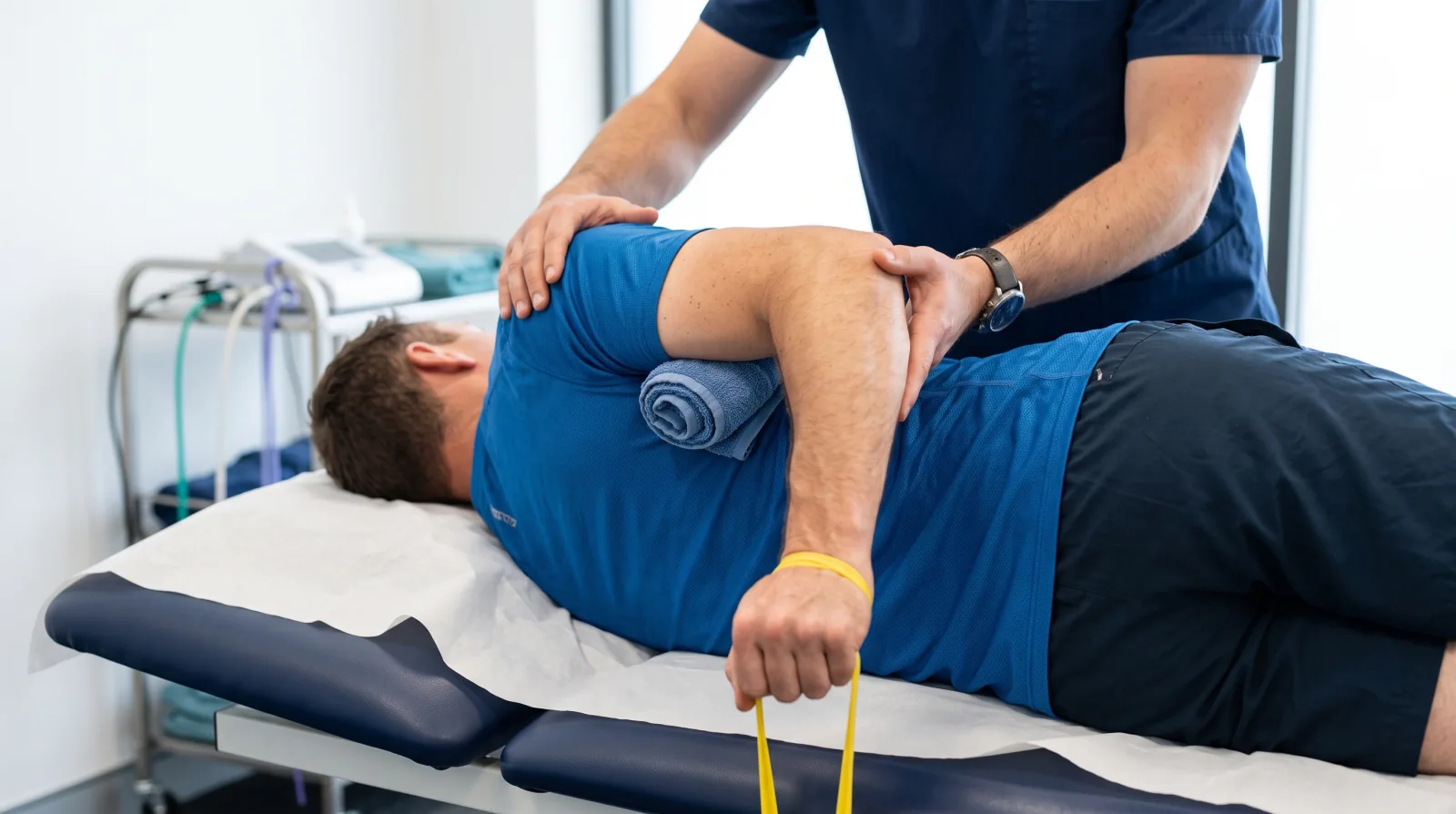
1. Side-lying external rotation
Lie on the uninvolved side with the affected arm on top. Bend the elbow to 90 degrees. The upper arm rests against your side. Slowly rotate the forearm upward toward the ceiling, pause, then lower with control.
Do 3 sets of 12 to 15 repetitions. Start with bodyweight. Progress to 1 to 2 kg when 15 reps feel easy across two sessions. The cue that matters most: do not let the elbow drift away from your side. Elbow stays in contact with the ribs throughout.
This is the primary exercise for supraspinatus and infraspinatus. It is the one most people skip because it looks too easy. It is not.
2. Scaption (shoulder elevation in the scapular plane)
Stand with the arm at your side, thumb pointing upward. Raise the arm to 90 degrees at roughly 30 degrees forward of the frontal plane (not directly to the side, not directly forward: somewhere between the two). This is the scapular plane, and it is the most natural angle for the shoulder joint during elevation.
Do 3 sets of 12 repetitions. The cue: do not shrug. The shoulder blade should glide smoothly upward and outward as the arm rises, but the shoulder itself should not hike toward the ear. If you are shrugging, the load is too heavy or the scapular stabilisers are not ready yet.
Start with no weight. Add 0.5 to 1 kg when the form is clean and the movement is pain-free.
3. Prone Y
Lie face-down on a table or firm surface with the arms overhead in a Y position, thumbs pointing upward toward the ceiling. Without shrugging, lift the arms a small distance off the surface by squeezing the muscles between the shoulder blades, particularly the lower trapezius.
Do 3 sets of 12 repetitions. The range of movement is small. The purpose is to activate the lower trapezius, which helps tilt the shoulder blade and open the subacromial space when the arm moves overhead. The cue: keep the neck long and the chin tucked, not craning upward.
4. Serratus anterior punch
Lie on your back with the arm pointed straight toward the ceiling at 90 degrees. Without moving the elbow or wrist, "punch the ceiling" by protracting the shoulder blade forward. The arm moves upward as the shoulder blade slides around the ribcage. Return with control.
Do 3 sets of 15 repetitions. The serratus anterior muscle holds the shoulder blade flat against the ribcage and rotates it upward when the arm rises. Without it, the scapula wings out and the subacromial space narrows. This is one of the most clinically useful exercises for impingement and one of the most frequently omitted.
5. Wall slide
Stand facing a wall, forearms resting against the surface with the elbows bent. Maintaining contact between the forearms and the wall, slide the arms upward slowly. Go as high as you can without losing contact or shrugging, then slide back down.
Do 3 sets of 10 repetitions. This trains the shoulder to move overhead with proper scapular upward rotation, which is the movement pattern that keeps the subacromial space open. The wall gives useful feedback: if the forearm loses contact, the scapula has stopped rotating and the humeral head is running out of space.
6. Sleeper stretch
Lie on the affected shoulder with the arm out in front of you, elbow bent to 90 degrees. Gently press the forearm toward the floor (toward external rotation, or as much as it comfortably goes), stretching the back of the shoulder capsule. Do not force the range.
Hold for 30 seconds, do 3 repetitions. A tight posterior capsule pushes the humeral head forward and upward, reducing subacromial space. This stretch addresses that. It should be a gentle, sustained pull, not a sharp stretch.
What to expect from recovery
For true subacromial impingement without a structural tear, most people see meaningful improvement within 6 to 8 weeks of targeted physiotherapy work done consistently. Night pain tends to resolve first. Painful arc at mid-range improves next. Full return to overhead sport or heavy pressing usually comes later and is the goal of Phase 3.
Improvement has ups and downs. A flare after a busy week or a harder session is normal and is information to adjust load.
When shockwave therapy or an injection might be discussed
For cases where calcific tendinopathy (calcium deposits in the tendon) is confirmed on imaging, or for shoulders that have not responded to 8 to 12 weeks of proper physiotherapy, additional options are sometimes discussed. Shockwave therapy for shoulder pain is one route used for calcific and chronic tendinopathy. Corticosteroid injection into the subacromial space can reduce inflammation enough to make exercise tolerable when irritability is too high to load through. Both reduce the barrier to participating in the exercise program.
A note on self-management versus professional assessment
The exercises above are grounded in the evidence base for subacromial impingement and are routinely used in physiotherapy practice. They are starting points. A physiotherapist (regulated in BC by the College of Health and Care Professionals of BC) will assess the full picture: which specific structures are involved, whether there is any evidence of a tear, what the scapular pattern looks like, and what the load progression should be based on your symptoms and demands.
If you have been managing a sore shoulder for more than a few weeks and it is not improving, booking an assessment is the better use of your time than adding exercises and hoping. The assessment tells you whether you are treating the right thing. Our shoulder pain physiotherapy page explains how we assess and treat shoulder problems.
Frequently asked questions
How long does shoulder impingement take to heal with physiotherapy?
Most people with subacromial impingement and no structural tear notice meaningful improvement within 6 to 8 weeks of targeted physiotherapy done consistently. Return to full overhead activity or sport typically takes 10 to 12 weeks. The timeline depends on how irritable the shoulder was at the start and how consistently the program is followed.
Can I keep training while I have shoulder impingement?
Often yes, with modification. The goal is to keep the tissue loaded at a level it can tolerate while progressively building strength, since stopping training entirely tends to decondition the shoulder rather than protect it. This usually means reducing overhead volume, avoiding the most painful ranges, and substituting exercises that do not load the subacromial space directly, such as horizontal pressing or rowing patterns kept below shoulder height.
Are these exercises safe to do without seeing a physiotherapist first?
For a mild, recent-onset presentation without weakness or night pain, the exercises above are generally safe to trial. If pain is significant, has lasted more than two to three weeks, or is accompanied by weakness, numbness, or tingling, getting an assessment first will give you a more targeted program and rule out a rotator cuff tear.
What is the difference between shoulder impingement and a rotator cuff tear?
Impingement describes tendon compression with no structural damage. A rotator cuff tear is actual fiber disruption in the tendon. They can coexist, and chronic impingement can contribute to a degenerative tear over time. The comparison of shoulder impingement versus rotator cuff tear covers how a physiotherapist tells them apart.
Which sleeping position is best for shoulder impingement?
Sleeping on the unaffected side, with a pillow supporting the affected arm to keep the shoulder from rolling forward, tends to be more comfortable than sleeping directly on the painful shoulder. Compression from lying on the involved side can aggravate an already irritated subacromial space. If pain wakes you at night regardless of position, that is one of the signals worth raising at an assessment rather than continuing to self-manage.
Can poor posture cause shoulder impingement?
Posture is a contributing factor for some people. A rounded, forward-shoulder position can change how the shoulder blade sits and reduce the available subacromial space during overhead movement. Posture alone rarely explains a case fully, since rotator cuff strength and scapular control usually matter more, which is why the exercise program targets those directly rather than posture cues alone.
How long should I wait before adding weight to these exercises?
Most people progress from bodyweight or light resistance once they can complete the prescribed sets and reps with clean form and no pain above a mild level, which is often within the first two to three weeks for side-lying external rotation and scaption. Adding weight too early, before scapular control is established, tends to reproduce the same compensatory pattern that caused the impingement, so form comes before load.
Is shockwave therapy an option for shoulder impingement in BC?
Shockwave therapy is sometimes used for calcific tendinopathy or shoulders that have not responded to 8 to 12 weeks of proper physiotherapy. At Launch Rehab, shockwave is delivered by physiotherapists and chiropractors. It is an adjunct that can reduce the barrier to loading, not a substitute for the exercise program, and your clinician can advise whether your presentation is a reasonable candidate.
Can shoulder impingement come back after it resolves?
Yes, particularly if the volume of overhead activity increases again without a matching increase in rotator cuff and scapular strength. Recurrence is one of the reasons Phase 3 of rehab emphasizes a gradual return to full activity rather than an abrupt jump back to previous training levels. Maintaining the phase 2 exercises at a lower dose after discharge is a reasonable way to protect the gains.
This article is general information, not personal medical advice. A regulated physiotherapist can confirm whether the patterns described apply to your situation.
Sources
- Diagnosing, Managing, and Supporting Return to Work of Adults With Rotator Cuff Disorders: A Clinical Practice Guideline (JOSPT, 2022)
- The Efficacy of Exercise Therapy for Rotator Cuff-Related Shoulder Pain According to the FITT Principle: A Systematic Review With Meta-analyses (JOSPT, 2024)
- College of Health and Care Professionals of BC: Physical Therapists
WRITTEN BY
The Launch Rehab Team
Practical recovery and training notes from the clinicians at our five Metro Vancouver studios.
FOUND THIS USEFUL?
Share it with your network on LinkedIn. We wrote a ready-to-post version for you.
FILED UNDER
- shoulder-pain
- shoulder-impingement
- rotator-cuff
- physiotherapy
- exercises
- bc
- subacromial-impingement