Shockwave Therapy vs Cortisone Injection for Tendon Pain
Both shockwave and cortisone can reduce tendon pain. They work differently, carry different risks, and are indicated at different stages of a tendinopathy. Here is what the evidence says about each.
BY KEANE LEUNG
Tendinopathy, persistent tendon pain that doesn't respond to rest, is one of the more frustrating presentations in musculoskeletal care. It tends to plateau. Rest helps briefly; returning to activity brings it back. Two interventions often come up in this conversation: shockwave therapy and cortisone (corticosteroid) injections. Patients are regularly offered one or the other, sometimes without a clear explanation of why one was chosen over the other.
This piece lays out the difference in mechanism, the evidence base, and the clinical decision factors that determine which is appropriate.
Quick comparison:
| Shockwave Therapy | Cortisone Injection | |
|---|---|---|
| How it works | Acoustic waves stimulate healing in degenerated tendon | Steroid suppresses local inflammation |
| Short-term pain relief | Moderate, builds over sessions | Fast, often within days |
| Long-term outcome | Better at 3 to 6 months in most tendon trials | Inferior at 3 to 6 months vs shockwave in most trials |
| Tissue risk | None documented with standard protocols | Structural tendon weakening with repeated injections |
| Who delivers it in BC | Physiotherapist or chiropractor | Physician or radiologist (image-guided) |
| Referral needed | No | Usually yes (physician-ordered) |
| Right phase | Chronic tendinopathy (6 to 12 weeks plus) | High pain blocking the loading program |
What shockwave therapy is
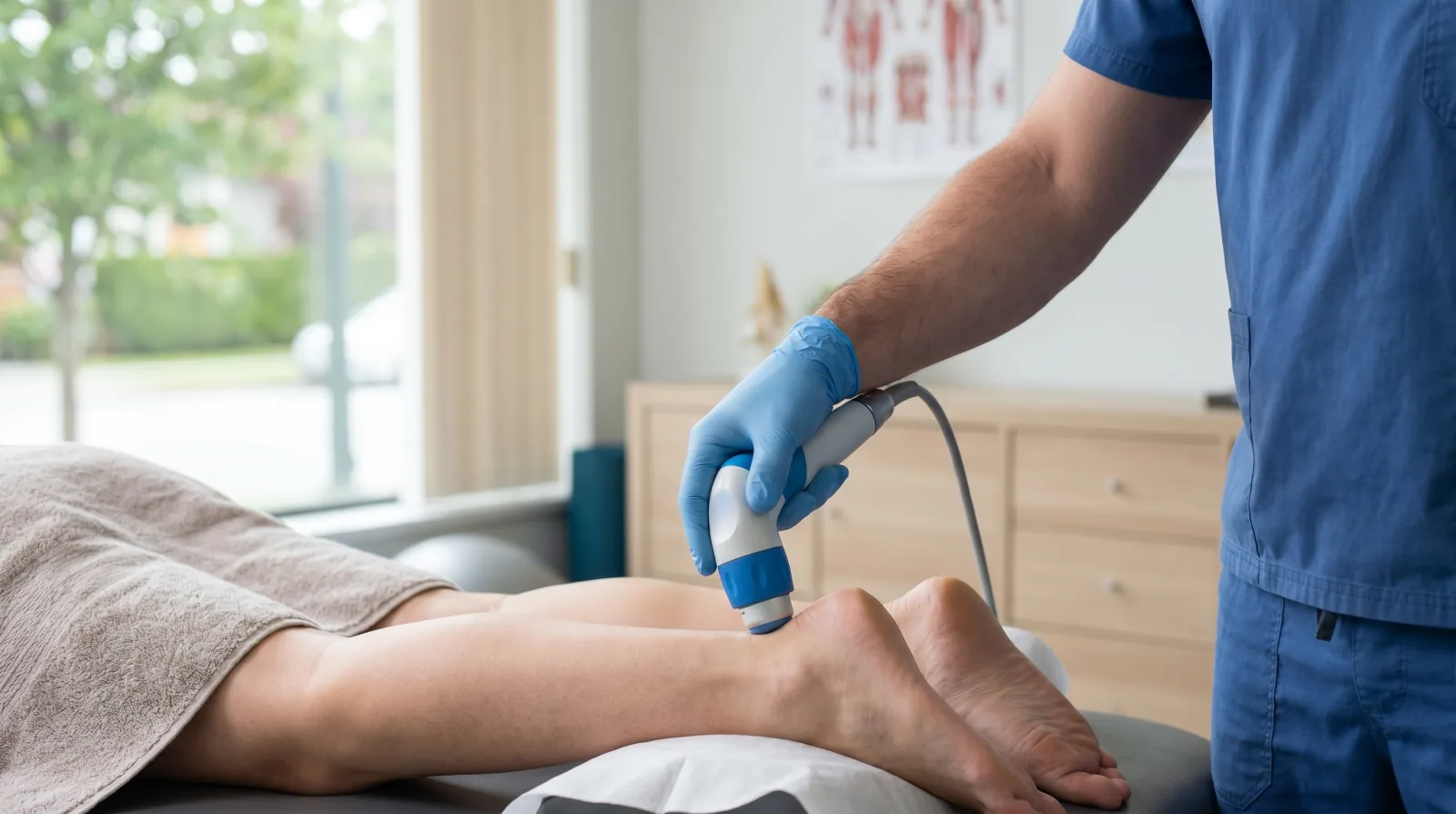
Radial shockwave therapy (RSW) delivers high-energy acoustic waves through a pneumatic handpiece pressed against the skin over the target tendon. The waves travel radially outward through the tissue. The mechanical stimulus is thought to promote a biological response in degenerated tendon tissue: increasing blood flow, stimulating tenocyte activity, and disrupting calcific deposits when present. The mechanism is not fully settled in the research literature, but the tissue-stimulating rather than tissue-suppressing direction is consistent across current models.
In BC, shockwave therapy is performed by physiotherapists at all of our studios, and by chiropractors at our Richmond, New Westminster, and North Burnaby studios. It is not an injection and does not require a physician referral. A standard course is typically three to five sessions spaced one week apart, though the number varies by presentation. The treatment is uncomfortable during application; most clients describe it as tolerable with moderate intensity settings.
Common tendinopathies where shockwave is used in practice include:
- Achilles tendinopathy (mid-portion and insertional, though the evidence is stronger for mid-portion)
- Plantar fasciitis / plantar fasciopathy
- Rotator cuff tendinopathy (including calcific tendinopathy)
- Patellar tendinopathy (jumper's knee)
- Lateral epicondylalgia (tennis elbow)
- Gluteal tendinopathy (lateral hip)
What cortisone injection is
A corticosteroid injection delivers a synthetic steroid (typically betamethasone, triamcinolone, or methylprednisolone) into or around the target structure under ultrasound guidance or anatomical landmark guidance. The steroid is a potent anti-inflammatory. It reduces pain quickly, often within days.
In BC, corticosteroid injections are administered by physicians, sports medicine doctors, and some other regulated providers with the appropriate procedural scope. Physiotherapists do not perform injections. A referral to a sports medicine physician or your family physician is the entry point if a cortisone injection is under consideration.
How the evidence compares
The research base for both interventions is active and evolving. For tendinopathy specifically, a 2020 systematic review and meta-analysis published in the British Journal of Sports Medicine (Fitzpatrick et al., 2019) comparing shockwave, cortisone, and conservative management for Achilles tendinopathy found:
- Shockwave produced better outcomes than cortisone at 12-week and 6-month follow-up
- Cortisone produced faster pain reduction at 4 to 6 weeks but worse outcomes at 3 to 6 months compared to wait-and-see
- Tendon tissue structure showed worse changes after repeated cortisone use
For plantar fasciitis, a 2017 Cochrane review (Lourenco et al. / Thomson et al., multiple trials) noted that shockwave showed a moderate short-term benefit, though the effect size varied across trials and dosing protocols.
The consistent finding across multiple tendinopathies is that cortisone is more effective in the short term (weeks) and shockwave or structured loading protocols tend to outperform cortisone at medium-term follow-up (months). Cortisone also carries a documented risk of tendon weakening with repeated injections. The American College of Rheumatology and sports medicine guidelines generally recommend limiting corticosteroid injections to no more than two to three per year in the same site.
When cortisone makes sense
Cortisone is appropriate when:
- The acute pain level is high enough that the person cannot tolerate any load, making a progressive loading program impossible to start
- There is a confirmed inflammatory component rather than pure degenerative tendinopathy (e.g., bursitis alongside a tendinopathy, or an acutely irritated enthesis)
- There is a specific short-term window (a competitive event, a job commitment) where short-term pain reduction is the priority and the person understands the medium-term tradeoff
- The tendinopathy has a strong calcific deposit component and ultrasound-guided barbotage (needle aspiration of the calcium) combined with cortisone is the planned approach
The key caveat: cortisone as a standalone intervention without a concurrent loading and exercise program is unlikely to produce lasting outcomes. Most sports medicine clinicians pair an injection with a physiotherapy-directed loading program that begins once the pain window has settled.
When shockwave makes sense
Shockwave is appropriate when:
- The tendinopathy has been present for at least 6 to 12 weeks (acute tendon irritations typically respond better to load modification and early progressive exercise than to shockwave)
- The person has already tried a structured loading program and plateaued
- The goal is tissue-level change rather than short-term pain suppression
- The person wants to avoid injection and is willing to tolerate the discomfort of shockwave application for a better medium-term result
- There is a calcific deposit (calcific tendinopathy): shockwave has a specific evidence base for breaking down calcification in the rotator cuff, supported by Bannuru et al. (2014) in Physical Therapy
Shockwave is not appropriate in the acute phase of a tendon rupture, over areas with poor circulation (e.g., peripheral arterial disease), during pregnancy, or over open growth plates in skeletally immature clients. Your clinician will screen for contraindications before starting.
What the two approaches are not
Neither shockwave nor cortisone is a substitute for a structured progressive loading program. The strongest evidence for tendinopathy management overall (whether Achilles, patellar, rotator cuff, or lateral hip) places progressive tendon loading as the primary intervention, with adjuncts like shockwave or injection filling specific roles at specific stages.
If you have been offered a cortisone injection or referred for shockwave without a plan for progressive loading afterward, ask what the exercise component looks like. An injection or shockwave course without follow-on loading is incomplete treatment.
What to expect during a shockwave session
Most people who have heard of shockwave therapy have not been told what the session actually feels like. It is uncomfortable. This is worth being direct about.
The clinician applies a coupling gel to the skin over the target tendon and presses the handpiece firmly against the tissue. The device delivers rapid pulses of pneumatic energy. You feel a rapid tapping or percussive sensation that intensifies as the pressure is increased. Most clinicians start at a low setting and increase to therapeutic intensity over the first minute or two. At full intensity, the sensation is often described as a deep, rhythmic ache that most people find tolerable but unmistakably unpleasant. Sessions typically run 5 to 10 minutes of active treatment time.
Post-treatment soreness in the treated area is expected for 24 to 48 hours. Some patients have a temporary increase in pain immediately after the session that settles back to baseline within a day. If soreness persists longer than 48 to 72 hours, or is significantly worse than baseline, flag it at the next session. The clinician may need to adjust the pressure or dosing.
Activities are not usually restricted after shockwave, but the protocol for most tendinopathies includes avoiding high-intensity loading of the treated tendon in the 24 hours post-session to allow the tissue response to settle. For the same reason, avoid icing the treated area and avoid anti-inflammatory medication (NSAIDs such as ibuprofen or naproxen) for 24 hours afterward. Shockwave works by provoking a healing inflammatory response in the tendon, and cooling the area or suppressing that response with anti-inflammatories can blunt the treatment's effect.
The role of progressive loading alongside both interventions
This is the clinical point most often missed when patients receive either shockwave or cortisone: neither works well as a standalone treatment without concurrent progressive tendon loading.
The evidence base for tendinopathy management, including the 2019 JOSPT clinical practice guidelines for Achilles tendinopathy and the Cook and Purdam continuum model, places progressive tendon loading as the primary intervention. Shockwave and cortisone are adjuncts that address different barriers to loading:
- Cortisone reduces the acute inflammatory response enough that the patient can tolerate the start of a loading program. Once the pain window has settled, typically 2 to 4 weeks post-injection, the loading program should begin. Cortisone without loading is likely to produce a short-term improvement followed by return of symptoms at the same level.
- Shockwave stimulates the biological environment of a degenerated tendon to respond more favourably to the loading work the patient is already doing. It is most effective when combined with a structured progressive loading program, not when used as the sole treatment.
If you are receiving either of these interventions without a concurrent exercise program, one that progressively increases load on the affected tendon over weeks, ask specifically what the loading component looks like.
What happens when the first course doesn't work
Some tendinopathies are slow to respond even with appropriate combined treatment. When a full course of shockwave (typically three to five sessions, each one week apart) has been completed with concurrent loading and there is less than expected improvement, the clinical conversation shifts.
Common explanations for poor response:
- The loading protocol was too light. Heavy slow resistance training, using enough load that the last repetitions are genuinely difficult, is what drives tendon remodelling. Bands and bodyweight work are starting points, not endpoints.
- A contributing biomechanical factor was not addressed. For Achilles tendinopathy, this is often limited ankle dorsiflexion. For rotator cuff tendinopathy, it may be scapular dyskinesis or thoracic stiffness. For gluteal tendinopathy, often hip-drop gait mechanics.
- The tendon is more degenerated than initially assessed. Some tendons (particularly those with large intratendinous tears or significant lipoid degeneration) have limited capacity to respond to conservative treatment. These warrant sports medicine physician consultation for imaging review and consideration of procedural options.
- The classification was incorrect. Lateral hip pain attributed to gluteal tendinopathy sometimes reflects bursitis, referred lumbar pain, or a different structural source. A re-assessment with updated history and objective testing is warranted before escalating treatment.
What happens when the first cortisone injection doesn't hold
Cortisone wears off. In many tendinopathy presentations, the pain reduction is real for 4 to 8 weeks and then gradually returns, particularly if the loading program was not started during the pain window. A second injection is sometimes considered, but most guidelines recommend limiting the number of injections to the same site, typically no more than two to three per year, given the cumulative risk to tendon structure.
If the first injection produced meaningful but temporary relief, the most useful question is whether an appropriate loading program was running during that relief window. If it was not, the second injection buys a second opportunity to start the loading program during the pain-free period. If a progressive loading program was running and relief was still only temporary, the conversation shifts toward shockwave or referral to sports medicine for further investigation.
What to tell your clinician at the first session
If you arrive for a physiotherapy assessment reporting tendon pain, the following information helps the clinician classify the stage and select the right intervention:
- How long has the tendon been painful, and what initially triggered it?
- Does the pain warm up with activity and return after, or does it worsen throughout activity?
- Have you had any injections to this area? How many? When was the last one?
- Have you done a structured exercise program for this tendon? What did it involve?
- What is your training or loading history (volume, intensity, recent changes)?
- What is your goal (returning to a specific sport, a job demand, pain-free daily function)?
This history is what drives the staging decision between shockwave, cortisone referral, loading only, or combined approaches.
What this means for ICBC and WorkSafeBC claims
For clients with a motor vehicle injury or WorkSafeBC claim, shockwave administered by a physiotherapist (or by a chiropractor at our Richmond, New Westminster, or North Burnaby studios) is billed to ICBC or WSBC with no charge to you (pre-approval required). See our rates page for the current billing structure.
Cortisone injections from a physician are covered under MSP for eligible BC residents. Sports medicine consultations may require a referral from your family physician depending on your regional health authority.
How to decide
The starting question is not "shockwave or cortisone." It is "what stage is this tendinopathy at, and what is keeping it stuck?"
If you have had tendon pain for more than two months and have not been assessed, a physiotherapy assessment is the right first step. We will grade the severity, screen for whether the tendon is reactive or degenerative, and map out the options, including whether shockwave is appropriate at our clinic or whether a sports medicine referral for injection makes more clinical sense for your presentation.
We offer shockwave therapy at our Lougheed, Coquitlam, Richmond, New Westminster, and North Burnaby studios. If shockwave is indicated, it can often be scheduled alongside your regular physiotherapy appointments. At Launch Rehab, the shockwave decision is made at your physiotherapy or chiropractic assessment rather than at a separate consult. The clinician who builds your loading program is the same one who decides whether the tendon is at the right stage for shockwave to add anything.
Frequently asked questions
Does shockwave therapy hurt?
Shockwave therapy is uncomfortable rather than painful in the way an injection is. The handpiece delivers rapid pneumatic pulses against the skin, felt as a deep, rhythmic tapping that intensifies as the clinician increases pressure over the first minute or two. Most people tolerate a full session, and soreness in the treated area for 24 to 48 hours afterward is expected.
Can I have shockwave and a cortisone injection at the same time?
Combining the two in the same treatment window is not typical practice, since cortisone's anti-inflammatory effect can blunt the healing inflammatory response shockwave is meant to provoke. Sequencing is a clinical decision: some clients use cortisone to get through an acute pain window first, then move to shockwave once loading is tolerable. Your physiotherapist or chiropractor will map out the order that fits your presentation.
Who provides shockwave therapy at Launch Rehab?
Shockwave therapy at Launch Rehab is provided by physiotherapists at all five studios, and by chiropractors at our Richmond, New Westminster, and North Burnaby studios. Both professions are regulated in BC (physiotherapists by CHCPBC, chiropractors by CCHPBC) and screen for contraindications before starting a course.
How many shockwave sessions does a typical course involve?
A standard course is typically three to five sessions spaced about a week apart, though the exact number depends on the tendon involved and how it responds. Some presentations need a second course if progress plateaus. Your clinician will reassess after the initial sessions and adjust the plan.
What should I avoid in the 24 hours after a shockwave session?
Avoid high-intensity loading of the treated tendon, avoid icing the area, and avoid anti-inflammatory medication such as ibuprofen or naproxen for 24 hours. Shockwave works by provoking a healing inflammatory response in the tendon, and icing or NSAIDs can blunt that response. Light activity is otherwise fine.
Is cortisone covered by MSP in BC?
Cortisone injections administered by a physician are covered under MSP for eligible BC residents. A referral to a sports medicine physician or your family doctor is usually the entry point, since physiotherapists and chiropractors do not perform injections in BC. Sports medicine consultations may require that referral depending on your regional health authority, so check with your family physician first.
Does ICBC or WorkSafeBC cover shockwave therapy?
For clients with an active motor vehicle injury or WorkSafeBC claim, shockwave administered by a physiotherapist, or by a chiropractor at our Richmond, New Westminster, or North Burnaby studios, is billed directly to ICBC or WorkSafeBC with pre-approval required. See our rates page for the current billing structure.
Can shockwave therapy make a tendon worse?
Shockwave is not appropriate during the acute phase of a tendon rupture, over areas with poor circulation, during pregnancy, or over open growth plates in skeletally immature clients. Outside those situations, a properly staged course rarely worsens a tendinopathy, though some people notice temporary soreness that settles within a day or two. Screening for contraindications happens before the first session.
This article is not a substitute for assessment by a regulated practitioner.
WRITTEN BY
Keane LeungBSCPT, CAFCI, Vestibular and Concussion Therapy (HE/HIM/HIS)
Physiotherapist
Practical recovery and training notes from the clinicians at our five Metro Vancouver studios.
READ FULL PROFILEFOUND THIS USEFUL?
Share it with your network on LinkedIn. We wrote a ready-to-post version for you.
FILED UNDER
- shockwave
- tendinopathy
- cortisone
- achilles
- rotator-cuff
- plantar-fascia