Golfer's Elbow: What Actually Rebuilds Medial Elbow Pain
If the inside of your elbow flares every time you grip, lift, or flex your wrist, the choice usually comes down to rest, physio, or a cortisone shot. Here is what the tendon is actually doing, why loading is the part that rebuilds it, and why the injection that feels best early often ages the worst.
BY KEANE LEUNG
If the inside of your elbow hurts when you grip a bag, turn a screwdriver, or flex your wrist, you are probably weighing the same three options most people do: rest it, see a physiotherapist, or get a cortisone shot. The honest version is that rest alone rarely finishes the job, loading is the part that rebuilds the tendon, and the injection that feels best in the first month is often the one that leaves you worse off a year later.
What golfer's elbow actually is
Golfer's elbow has little to do with golf and little to do with inflammation. The clinical name is medial epicondylitis, though medial epicondylalgia is the more accurate term, because the "-itis" implies an inflammatory fire that usually is not there. The pain comes from the common flexor-pronator origin, the point on the inner elbow where the wrist flexor and forearm pronator tendons anchor to the bone.
Under a microscope the problem is degeneration, not active inflammation. StatPearls describes medial epicondylitis as a tendinosis with disorganized collagen and new blood-vessel growth rather than the inflammatory cells a true "-itis" would show. The same source notes the muscles most often involved are the pronator teres and flexor carpi radialis at that shared origin. That one fact sets the plan. A tendon stalled in a degenerative state does not need to be calmed down. It needs to be reloaded so it can rebuild.
This is the inner-elbow mirror of tennis elbow, which sits on the outside of the joint. We cover that counterpart in tennis elbow, and the loading logic is close to identical. Golfer's elbow is the less common of the two. StatPearls puts medial epicondylitis at roughly 7 to 10 times less frequent than the lateral version, which is part of why fewer people recognize the inner-elbow pattern when it shows up.
Why resting it usually backfires
Rest feels like the obvious move. The elbow hurts when you use it, so you stop, and the pain quiets. The catch is that quiet is not the same as healed. An unloaded tendon loses tolerance. It gets weaker, and the threshold at which it complains drops lower. You return to your normal grip and lift, the tendon is now less capable than before, and the pain comes straight back, often worse.
This is the trap behind "I rested it for a month and it was fine until I picked up the toolbox again." Total rest manages the symptom in the short term and erodes capacity in the background. What the tendon responds to is the opposite of avoidance. Relative rest, meaning backing off the activities that spike the pain while keeping the tendon working at a tolerable level, is closer to the right idea than the couch.
Progressive loading is the part that rebuilds it
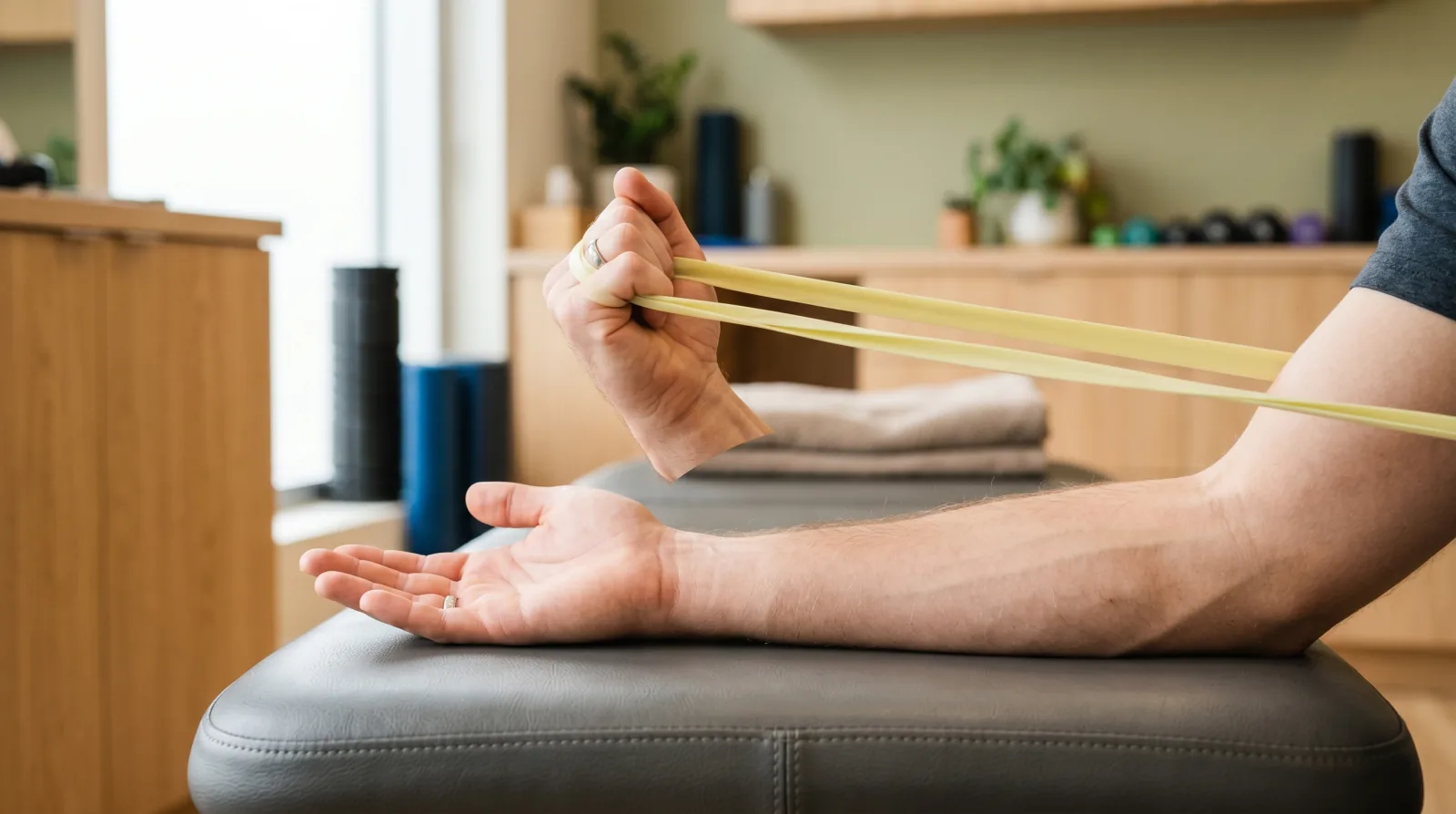
For a degenerative tendon, controlled loading is the treatment that changes the tissue, not just the symptom. The work is gradual and specific to the wrist flexors and pronators that anchor at the inner elbow, and it usually moves through a sequence: settling an irritable tendon with gentle isometric holds, then adding slow, heavier wrist-flexion and pronation loading as tolerance improves.
The evidence for loading is most developed in stubborn cases. A study in the International Journal of Sports Physical Therapy added eccentric wrist-flexor loading for golfer's elbow that had already failed other treatment, and reported marked improvement in disability scores over roughly six weeks. The honest caveat is that this is a small case series, not a large randomized trial, and high-quality evidence specific to medial epicondylitis is thinner than for the lateral version. That is a known gap in the literature, not a reason to skip the loading. The principle that a degenerative tendon adapts to graded load is well established across tendinopathy.
In our clinic, the loading conversation is not about a single exercise. It is about finding the dose your tendon tolerates today, adding to it on a schedule your symptoms can absorb, and adjusting when a session flares. A flare is not a setback. It is information your physiotherapist uses to set the next week's load. Most of the value lives in that progression, not in any one movement. A physiotherapy assessment is where the starting load gets set.
Why the cortisone shot ages badly
A corticosteroid injection is tempting because it works fast. The problem is what happens after the first month. The clearest evidence comes from the elbow's outer-tendon cousin, where the trials are larger. A 2013 randomized controlled trial in JAMA compared corticosteroid injection, physiotherapy, and both for lateral epicondylalgia. At one year the injection group had lower complete recovery (83 percent versus 96 percent for placebo) and far higher recurrence (54 percent versus 12 percent).
That pattern is consistent with how tendinopathy behaves. The injection quiets the pain signal, but it does not rebuild a degenerative tendon, and the early relief tends to send people back to full load before the tissue can carry it. Medial epicondylitis is the same kind of tendon problem on the other side of the joint, so the same caution applies. A shot can have a role in a narrow set of situations, but as a first move for a gripping-related tendon, the long view favours loading. We laid out the broader trade-off in shockwave versus cortisone.
On shockwave specifically, we will be straight with you. The evidence for extracorporeal shockwave therapy at the elbow is weaker than it is for conditions like plantar fasciitis, and the data for the medial side is thinner still, as we noted in our shockwave write-up. It is not a first-line tool for golfer's elbow, and any clinic offering it on day one is getting ahead of what the tendon needs.
When the symptoms point to the nerve, not the tendon
The inner elbow has a structure worth respecting: the ulnar nerve runs in a groove right behind the medial epicondyle, in the cubital tunnel. StatPearls notes that ulnar nerve symptoms commonly accompany medial epicondylitis, which means the two can travel together and need to be told apart.
Tendon pain is usually a local ache over the bony point, worse with gripping and resisted wrist flexion. Nerve involvement reads differently. Tingling, numbness, or an electric feeling running into the ring and little fingers, or weakness in the hand, points toward the nerve rather than the tendon alone. That distinction changes the plan, and it is a reason to get assessed rather than self-manage. If you are getting numbness, pins and needles, or hand weakness alongside the elbow pain, that is worth flagging early so screening can sort out what is driving it.
What recovery usually looks like
We will not give you a fixed week count, because an honest timeline depends on the tendon's irritability, how long it has been going on, your age and load demands, and how early consistent rehab starts. A tendon that has been sore for three weeks and one that has been sore for a year do not move on the same clock.
What is more reliable than a number is the shape of the recovery. Progress on a tendon is rarely a straight line. Good weeks and stubborn weeks alternate, and the trend that matters is the multi-week one, not the day-to-day. At Launch Rehab, the golfer's elbow program matches the starting load to how irritable the flexor-pronator tendons are at the first assessment (isometric holds for a reactive tendon, progressive resistance sooner for a less irritable one) rather than starting everyone at the same point. The strongest outcomes we see come from people who keep the loading consistent, resist the urge to test it with a heavy day the moment it feels better, and treat the occasional flare as a dosing signal rather than a failure. Cost and coverage for a course of visits sit on our rates and FAQ page, where they stay current.
Frequently asked questions
Is golfer's elbow the same as tennis elbow?
No. They are the same kind of degenerative tendon problem, but on opposite sides of the elbow. Golfer's elbow (medial epicondylitis) is on the inner side at the flexor-pronator tendons. Tennis elbow (lateral epicondylitis) is on the outer side at the extensor tendons. Golfer's elbow is also the less common of the two, and the loading approach that rebuilds the tendon is close to identical for both.
Should I rest my elbow until the pain goes away?
Not completely. Total rest quiets the pain but lets the tendon lose tolerance, so it often comes back when you resume normal use. Relative rest, easing off the painful spikes while keeping the tendon working at a level it can handle, is closer to what rebuilds it.
Will a cortisone injection fix golfer's elbow?
It usually helps in the first weeks, but the long-term picture is less kind. In a JAMA trial on the related lateral elbow tendon, the injection group had higher one-year recurrence than placebo. For a gripping-related tendon, loading tends to age better than the shot.
When should I see a physiotherapist about inner elbow pain?
If the pain has lasted more than a couple of weeks, keeps returning when you grip or lift, or comes with tingling, numbness, or weakness in the hand, that is worth an assessment. The nerve symptoms in particular need screening, since the ulnar nerve sits right at the inner elbow.
How long does golfer's elbow take to recover?
It depends on how irritable the tendon is, how long it has been going on, and how consistently the loading happens. Rather than a fixed timeline, expect a multi-week progression with good weeks and stubborn weeks. Your physiotherapist will set expectations after the first assessment.
How is golfer's elbow different from carpal tunnel or an ulnar nerve problem?
Golfer's elbow pain sits over the bony point on the inner elbow and worsens with gripping or resisted wrist flexion. The ulnar nerve runs in a groove right behind that same bony point, so tingling, numbness, or an electric feeling into the ring and little fingers points toward nerve involvement rather than the tendon alone. StatPearls notes ulnar nerve symptoms commonly travel alongside medial epicondylitis, which is why an assessment screens for both rather than assuming the tendon is the only source.
Does shockwave therapy work for golfer's elbow?
The evidence is weaker here than for conditions like plantar fasciitis, and data specific to the medial elbow is thinner still. Shockwave is not a first-line treatment for golfer's elbow at Launch Rehab. Progressive tendon loading remains the treatment with the stronger evidence base, and shockwave is considered later if loading alone stalls.
Is golfer's elbow actually caused by golf?
Rarely. The clinical name, medial epicondylitis, describes degeneration at the flexor-pronator tendon origin on the inner elbow, and most people we see for it have never swung a club. Repetitive gripping, lifting, and wrist flexion from typing, carrying, or manual work load the same tendon and produce the identical pattern.
This article is general information, not personal medical advice. A regulated practitioner can confirm whether the patterns described apply to you.
Sources
- StatPearls: Medial Epicondylitis (Golfer's Elbow), 2024
- Coombes et al.: Effect of corticosteroid injection, physiotherapy, or both on clinical outcomes in unilateral lateral epicondylalgia, JAMA 2013
- Tyler et al.: Clinical Outcomes of the Addition of Eccentrics for Rehabilitation of Previously Failed Treatments of Golfers Elbow, International Journal of Sports Physical Therapy 2014
- College of Health and Care Professionals of BC (CHCPBC): Physical Therapists
WRITTEN BY
Keane LeungBSCPT, CAFCI, Vestibular and Concussion Therapy (HE/HIM/HIS)
Physiotherapist
Practical recovery and training notes from the clinicians at our five Metro Vancouver studios.
READ FULL PROFILEFOUND THIS USEFUL?
Share it with your network on LinkedIn. We wrote a ready-to-post version for you.
FILED UNDER
- golfers-elbow
- medial-epicondylitis
- elbow-pain
- tendinopathy
- physiotherapy
- bc