Tennis Elbow: Why Rest Alone Won't Fix It
If your outer elbow has hurt for weeks every time you grip, lift, or hold a mouse, the choice usually comes down to rest, physio, or a cortisone shot. Here is what the tendon is actually doing, why rest stalls it, and why the shot that feels best at first often ages the worst.
BY KEANE LEUNG
If the outside of your elbow has hurt for weeks, and it flares every time you grip a kettle, lift a grocery bag, or hold a mouse, you are probably weighing three options: rest it, see a physiotherapist, or get a cortisone injection. The honest answer is that rest alone rarely finishes the job, and the injection that feels best in the first month is the one most likely to leave you worse off a year later.
What tennis elbow actually is
Tennis elbow has almost nothing to do with tennis and almost nothing to do with inflammation. The clinical name is lateral epicondylitis, though the more accurate term is lateral epicondylalgia, because the "-itis" suffix implies inflammation that is not there. The pain comes from the common extensor origin, the point on the outer elbow where the wrist and finger extensor tendons anchor to the bone. The tendon most often involved is the extensor carpi radialis brevis.
Under a microscope, the problem is degeneration, not an active inflammatory fire. Tissue samples from these tendons show disorganized collagen, an excess of fibroblasts, and new blood-vessel growth, with a notable lack of the inflammatory cells you would expect from a true "-itis." That one fact changes the plan. A tendon that has stalled in a degenerative state does not need to be calmed down. It needs to be reloaded so it rebuilds. The same pattern shows up on the inside of the elbow as golfer's elbow, which we cover in golfer's elbow, and the loading logic is close to identical.
Why resting it usually backfires
Rest feels like the obvious move. The elbow hurts when you use it, so you stop using it, and the pain quiets down. The catch is that quiet is not the same as healed. A degenerative tendon that is unloaded loses tolerance. It gets weaker, and the threshold at which it complains drops lower. You then return to your normal grip and lift, the tendon is now less capable than before, and the pain comes straight back, often worse.
This is the trap behind "I rested it for a month and it was fine until I picked up my toddler again." Total rest manages symptoms in the short term and erodes capacity in the background. What the tendon responds to is the opposite of avoidance: a controlled, gradual reintroduction of load. Relative rest, meaning backing off the activities that spike the pain while keeping the tendon working at a tolerable level, is closer to the right idea than the couch.
The cortisone injection trap
A corticosteroid injection is the treatment most likely to make you feel like a genius in week four and a fool by month twelve. The short-term relief is real. The long-term cost is the problem, and the evidence here is unusually strong.
A 2013 randomized controlled trial in JAMA followed people with tennis elbow given either a corticosteroid injection or a placebo injection. The steroid group felt better early. At one year, they had a 54 percent recurrence rate, compared with 12 percent in the placebo group, and lower rates of complete recovery. An earlier 2006 randomised trial in the BMJ found the same paradox: cortisone outperformed both physiotherapy and a wait-and-see approach at six weeks, then reversed, with roughly three-quarters of the injection group relapsing by 52 weeks while the physiotherapy and wait-and-see groups did far better.
So the honest framing is this. If a tendon is degenerative rather than inflamed, an anti-inflammatory injection treats a problem the tendon does not have. It quiets pain by acting on the local tissue, but it appears to interfere with the tendon's own repair, which is why the relapse rate climbs once the effect wears off. A shot can have a narrow role for someone who genuinely cannot function and needs a short window, but as a default first move for ordinary tennis elbow, the data argues against it.
Progressive loading is the first-line plan
The treatment with the best long-term record is also the least glamorous: progressive loading. You ask the tendon to do gradually more work over weeks, in a way that stays within tolerable symptoms, and it remodels to meet the demand. A 2022 review in the Journal of Clinical Medicine makes the case that no single exercise style is the sole answer, and that the better approach loads the whole arm as a chain rather than drilling one tendon in isolation.
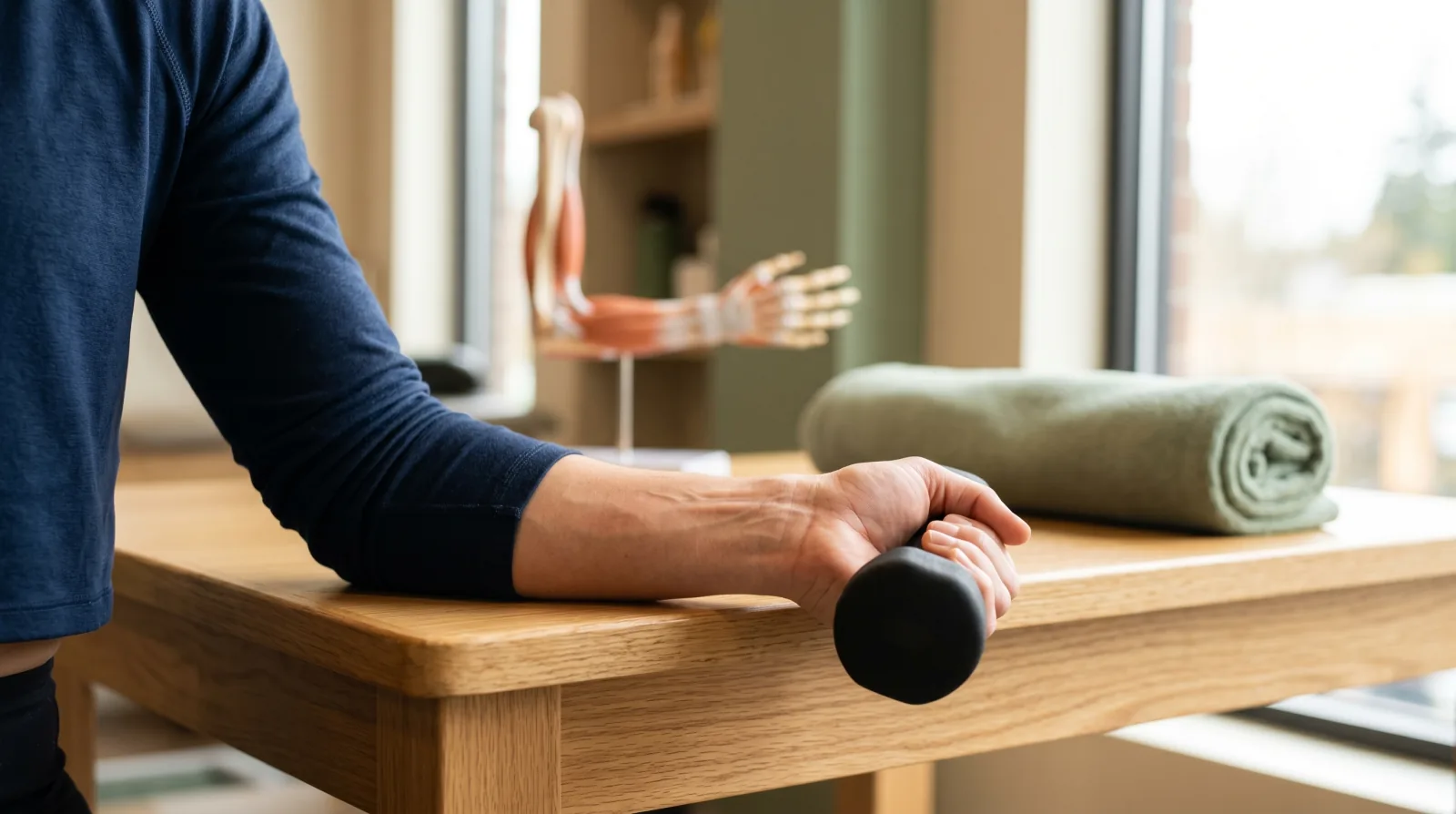
In practice a loading program for the outer elbow tends to move through stages. Isometric holds, where the muscle works without the joint moving, are often useful early because they can settle an irritable tendon while still loading it. As tolerance improves, the program adds slower, heavier resistance through the wrist extensors, then grip and forearm rotation work, and usually some shoulder and scapular strengthening, because a weak link further up the chain keeps overloading the elbow. The grip itself is a big part of the picture, since gripping is what loads those extensor tendons, which is why the simple act of carrying a coffee can be the most provocative thing in your day.
The reason this beats rest is that it answers the actual problem. Load is the signal the tendon uses to rebuild. The physiotherapist's job is to find the dose that is high enough to drive change and low enough that the tendon does not flare, then nudge it up as capacity returns. A short flare after a session is information about dose, not a sign the plan is wrong. We assess and load-manage these tendons as a routine part of physiotherapy, and the first visit is mostly about finding your current ceiling and where the load is leaking in from your day.
Where shockwave fits, honestly
Shockwave therapy comes up a lot for stubborn tendons, and it has a real role for some of them. For tennis elbow specifically, the evidence is weaker and messier than the marketing suggests. A systematic review and meta-analysis of shockwave for lateral epicondylitis found some benefit for pain and grip strength, but the authors were upfront that the quality and quantity of the trials were limited, with a lot of variation between studies. That is a noticeably softer conclusion than the one for plantar fasciitis, where the evidence is more convincing. We covered that contrast in shockwave therapy for plantar fasciitis.
The practical takeaway is that shockwave is not a first move for an elbow, and it is not a substitute for loading. It can be a reasonable add-on for a tendon that has plateaued after a genuine, honest run of progressive loading, the same way we use it for stubborn heels. If a clinic offers it on day one, before any loading plan, that is the version of shockwave the evidence does not support.
What this looks like in BC
In British Columbia, physiotherapists are regulated by the College of Health and Care Professionals of BC, which absorbed the former College of Physical Therapists of BC. A physiotherapist can assess the elbow, screen for the less common causes of outer-elbow pain, and build and progress the loading program. That assessment matters, because not every ache at the outer elbow is a cracked-and-classic tennis elbow, and the plan changes if something else is driving it.
On cost and coverage, most extended health plans reimburse physiotherapy visits under their physiotherapy pool, and current figures live on our rates page, where they stay accurate. The thing worth budgeting for is consistency over a few weeks rather than a single dramatic intervention, because loading works through repetition, not a one-time fix.
When to start, and what to expect
If your elbow pain is recent and mild, you can reasonably begin by backing off the most provocative gripping and lifting for a short stretch, without going to total rest. If it has hung around for weeks, keeps interrupting work or sleep, or keeps relapsing every time you return to normal use, that is the point to get it assessed and loaded properly rather than waiting it out again. And if you are noticing numbness, pins and needles into the hand, or weakness that feels neurological rather than just sore, that is worth flagging to a clinician, because it points away from a simple tendon problem.
Recovery timelines for tennis elbow vary widely, and they depend on how long it has been going on, how irritable the tendon is, how much daily gripping your work demands, and how consistently the loading gets done. Your physiotherapist will set realistic expectations after the first assessment rather than promise a number. At Launch Rehab, the tennis elbow assessment includes a workload review (the hours per day spent gripping, the tools used, the weight of materials lifted) because the loading program is calibrated against what the tendon has to tolerate at work, not just in the gym. The strongest outcomes we see are not from the people who found the cleverest treatment. They are from the people who loaded the tendon steadily and resisted the urge to either rest it into weakness or shortcut it with a shot.
Frequently asked questions
Will tennis elbow heal on its own if I just rest it?
Sometimes the pain settles with rest, but rest alone tends to leave the tendon weaker, so it often relapses when you return to normal gripping and lifting. Controlled loading rebuilds the tendon's capacity, which is what actually holds up over time. Relative rest, backing off the activities that spike pain while keeping the tendon working at a tolerable level, is closer to the right idea than stopping entirely.
Is a cortisone shot a good idea for tennis elbow?
Usually no, as a default. A JAMA trial found corticosteroid injections felt better early but had far higher one-year recurrence than placebo, at 54 percent versus 12 percent. It may have a narrow role when someone genuinely cannot function, but it is not a first-line move for ordinary tennis elbow.
Why does my elbow hurt when it is the tendon, not the joint?
The pain comes from the common extensor origin, where the wrist and finger extensor tendons anchor to the outer elbow. Gripping loads those tendons, so gripping is often the most painful thing you do all day. Tissue samples from these tendons show disorganized collagen and new blood-vessel growth rather than active inflammation, which is why the plan focuses on reloading rather than calming the area down.
Are tennis elbow exercises supposed to hurt?
A mild, tolerable ache during and shortly after loading is usually fine and expected. Sharp pain or a flare that lingers for a day or two means the dose was too high, and your physiotherapist will adjust it down. A short flare after a session is information about dose, not a sign the loading plan itself is wrong.
Should I try shockwave therapy for my elbow?
Not first, and not instead of loading. The evidence for shockwave on the elbow is limited, so it is better considered as an add-on for a tendon that has plateaued after a real run of progressive loading. At Launch Rehab, shockwave is delivered by physiotherapists and chiropractors as part of a treatment visit, not as a standalone service.
Is it tennis elbow or golfer's elbow?
Tennis elbow is pain on the outside of the elbow, golfer's elbow is on the inside. They are the same kind of problem on different tendons, and both usually respond to the same progressive loading approach rather than rest. We compare them directly in golfer's elbow.
Who can diagnose and treat tennis elbow in BC?
A physiotherapist, regulated in BC by the College of Health and Care Professionals of BC, can assess the outer elbow, rule out other causes of the pain, and build a loading program. Physiotherapists are trained to screen for the less common problems that can mimic tennis elbow before starting treatment.
Should I keep working while my elbow heals?
In most cases, yes, with some changes to how you grip and lift during the day. Backing off the most provocative gripping tasks while staying otherwise active tends to work better than stopping the arm entirely, and a physiotherapist can help identify which specific tasks are loading the tendon the most.
How long before tennis elbow starts feeling better with treatment?
There is no fixed timeline. Recovery depends on how long the pain has been present, how irritable the tendon is, how much daily gripping the job demands, and how consistently the loading program gets done. Your physiotherapist sets realistic expectations after the first assessment rather than promising a number of weeks.
Does grip strength predict how bad my tennis elbow is?
A drop in grip strength on the affected side is common with tennis elbow, since the wrist extensor tendons that anchor at the outer elbow are the same ones doing the gripping. Grip strength is one of the measures a physiotherapist tracks over the loading program to confirm the tendon is actually rebuilding capacity, not just feeling less sore.
This article is general information, not personal medical advice. A regulated practitioner can confirm whether the patterns described apply to you.
Sources
- Lateral Epicondylitis (Tennis Elbow), StatPearls, NCBI Bookshelf
- Coombes et al. Effect of corticosteroid injection, physiotherapy, or both on clinical outcomes in unilateral lateral epicondylalgia, JAMA 2013
- Bisset et al. Mobilisation with movement and exercise, corticosteroid injection, or wait and see for tennis elbow, BMJ 2006
- Stasinopoulos. Progressive loading for lateral elbow tendinopathy, Journal of Clinical Medicine 2022
- Efficacy of extracorporeal shock wave therapy for lateral epicondylitis: systematic review and meta-analysis
- College of Health and Care Professionals of BC: Physical Therapists
WRITTEN BY
Keane LeungBSCPT, CAFCI, Vestibular and Concussion Therapy (HE/HIM/HIS)
Physiotherapist
Practical recovery and training notes from the clinicians at our five Metro Vancouver studios.
READ FULL PROFILEFOUND THIS USEFUL?
Share it with your network on LinkedIn. We wrote a ready-to-post version for you.
FILED UNDER
- tennis-elbow
- lateral-epicondylitis
- elbow-pain
- tendinopathy
- physiotherapy
- bc