Vestibular Migraine Physiotherapy: Assessment and Management in BC
Episodes of dizziness that come with headache, light sensitivity, or visual disturbance, lasting anywhere from minutes to days, point toward a specific and underdiagnosed cause. Here is how vestibular migraine differs from BPPV and cervicogenic dizziness, and where physiotherapy fits.
BY THE LAUNCH REHAB TEAM
If dizziness keeps showing up alongside a headache, or with sensitivity to light and sound, and it lasts anywhere from a few minutes to a few days, the pattern points to a specific and often overlooked cause: vestibular migraine. It behaves differently from the two other common causes of recurring dizziness, and knowing which one you have changes what treatment actually helps.
What vestibular migraine is
Vestibular migraine is a form of migraine where the main symptom is dizziness or a sense of imbalance, rather than head pain. The condition has formal diagnostic criteria published jointly by the Committee for Classification of Vestibular Disorders of the Barany Society and the Migraine Classification Subcommittee of the International Headache Society. To meet the criteria, someone needs at least five episodes of moderate to severe vestibular symptoms, each lasting somewhere between 5 minutes and 72 hours, along with a current or past history of migraine. At least half of those episodes also need to come with a migraine feature: a one-sided, pulsing headache that worsens with activity, sensitivity to light or sound, or visual aura.
That last requirement matters because vestibular migraine does not always come with head pain during the dizzy spell. Some people get the vertigo with almost no headache at all, which is part of why the condition gets missed. A 2022 review of vestibular migraine notes it is likely the most common cause of recurrent vertigo in adults, with an estimated prevalence between 1 and 2.7 percent of the adult population, and that it occurs about four times more often in women than men, typically starting in a person's late thirties.
Why vestibular migraine gets confused with other dizziness
Dizziness has several common causes in a physiotherapy clinic. Vestibular migraine is one of the harder ones to spot because it has no single confirming test the way BPPV does. We covered the other two major differentials in earlier posts, so it is worth being specific about where vestibular migraine sits next to them.
BPPV, benign paroxysmal positional vertigo, is a mechanical problem: displaced inner-ear crystals that trigger brief spinning, usually seconds to about two minutes, set off by a specific head position like rolling over in bed. It is confirmed with the Dix-Hallpike test and treated with a repositioning maneuver, often resolving in one or two sessions.
Cervicogenic dizziness comes from the neck rather than the inner ear. Disrupted signals from the upper cervical joints and muscles, often after whiplash, create a mismatch with vestibular and visual input that the brain reads as dizziness or unsteadiness. It tends to track with neck pain and sustained postures like driving or desk work.
Vestibular migraine is different from both. Episodes last much longer than BPPV, from minutes up to three full days, and are not reliably triggered by a single head position. They come with migraine features rather than neck symptoms, and the person usually has a personal or family history of migraine headaches even if the dizzy episodes themselves are headache-light. A study comparing vestibular migraine to Meniere's disease notes the two conditions share enough overlapping symptoms, including nausea and sound sensitivity, that misdiagnosis between them is common even in specialist settings, which is one reason a careful history matters as much as any single test.
Why the same triggers can point either way
One of the confusing parts of vestibular migraine is that its episodes are sometimes brought on by things that also aggravate cervicogenic dizziness, like screen time, stress, or poor sleep. But the underlying triggers described in migraine literature are broader: hormonal shifts, certain foods, dehydration, and disrupted sleep patterns all show up as reported triggers for vestibular migraine attacks specifically, separate from any neck involvement.
This is why we do not diagnose by trigger alone. A desk worker with dizziness after a long day at a screen could have cervicogenic dizziness from sustained neck posture, a vestibular migraine attack from screen glare and eye strain, or both at once. A symptom description cannot settle that on its own. The assessment can.
What physiotherapy can and cannot do for vestibular migraine
Physiotherapists in BC are regulated through the College of Health and Care Professionals of BC, and vestibular assessment and rehabilitation sit within that scope. At Launch Rehab, vestibular physiotherapy is available at all five Metro Vancouver studios.
What a physiotherapist can address is the vestibular and balance-system side of the condition. Vestibular rehabilitation therapy uses gaze stability exercises, habituation training (repeated, controlled exposure to the specific movements or visual scenes that provoke symptoms), and balance retraining to reduce the disability that comes with chronic dizziness. A review of vestibular rehabilitation for vestibular migraine found every included study showed improvement, with reduced dizziness handicap scores and better daily function. The same review is direct about the evidence quality: the available studies mostly lack control groups and randomization, so the authors call the results promising rather than conclusive, and note that more rigorous trials are still needed.
What physiotherapy alone does not do is manage the underlying migraine mechanism. Vestibular migraine is a migraine variant. Migraine prevention and abortive treatment (medication used to stop an attack once it starts) are within a physician's or neurologist's scope, not a physiotherapist's. The same review found that people who combined anti-migraine medication with physical therapy had better outcomes than either approach in isolation. In our clinic, when someone's symptom pattern and history fit vestibular migraine, physiotherapy runs the vestibular rehabilitation piece while we recommend the person also see their family physician or a neurologist about migraine-specific management, particularly if attacks are frequent enough that preventive medication is worth discussing.
When to loop in a physician first, not last
Two situations call for medical involvement before or alongside physiotherapy rather than after it. The first is diagnostic uncertainty. Vestibular migraine has no single confirming lab test or imaging finding. The diagnosis rests on the pattern of episodes matching the Barany Society and International Headache Society criteria and on ruling out other causes, and a physician or neurologist is often the right person to formally establish that diagnosis, especially on a first presentation.
The second is any red flag that suggests a more serious or urgent cause. A sudden severe headache unlike any before, double vision, slurred speech, new weakness or numbness, trouble walking, or vertigo that is constant rather than episodic are signs that need same-day medical assessment, not a physiotherapy booking. Migraine with brainstem aura, a related but distinct diagnosis, can present with symptoms that overlap red-flag territory, which is another reason a physician should be involved when the picture is not a clean fit for straightforward vestibular migraine. When you book vestibular care with us, screening for these signs is the first step in the assessment, and we refer out rather than proceed with vestibular rehabilitation if something does not fit.
What a vestibular migraine assessment looks like at the first visit
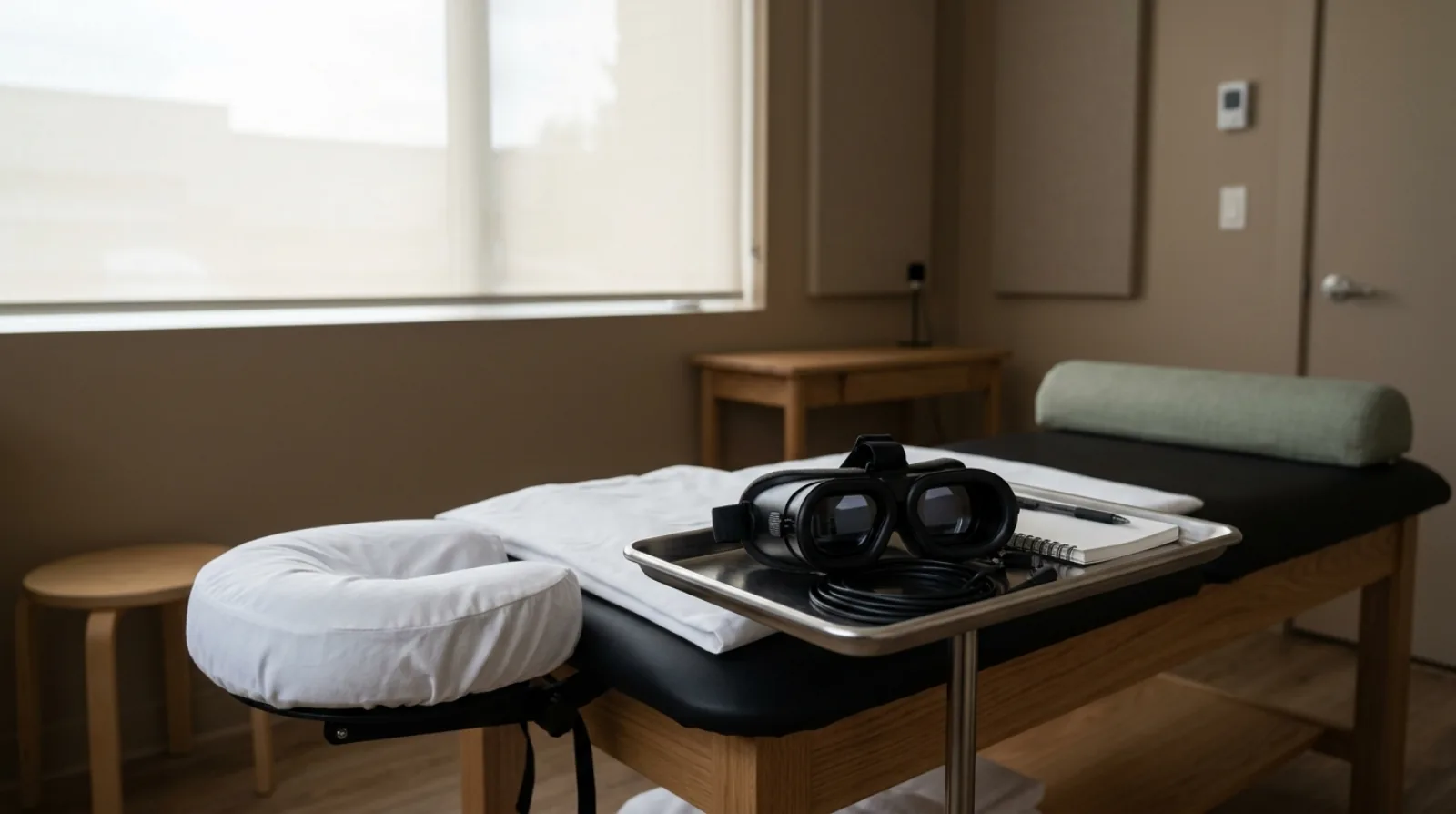
The first session is mostly history and screening rather than immediate treatment. A physiotherapist trained in vestibular assessment will ask about the character of the dizziness (spinning versus swaying versus light-headedness), how long episodes last, what comes with them, and whether there is a personal or family history of migraine headaches, even ones that have nothing to do with dizziness.
Positional testing, including the Dix-Hallpike test used for BPPV, is usually part of the same visit, both to rule BPPV in or out and because the two conditions can coexist. Oculomotor and balance testing helps establish a baseline for how the vestibular system is functioning between episodes. If the pattern fits vestibular migraine and there is nothing pointing to an urgent cause, the plan typically combines vestibular rehabilitation exercises tailored to avoid over-provoking symptoms with a recommendation to discuss migraine management with a physician.
Vestibular assessment and treatment are billed as physiotherapy visits, and current figures live on our rates and FAQ page, where they stay accurate. If your dizziness comes with headache, light sensitivity, or a personal migraine history, and it does not fit the brief, positional pattern of BPPV, a vestibular assessment is a reasonable place to start sorting out what is actually happening.
This article is general information, not personal medical advice. A regulated practitioner can confirm whether the patterns described apply to you.
Frequently asked questions
Can physiotherapy cure vestibular migraine?
No. Vestibular rehabilitation can reduce the dizziness and balance disability that comes with vestibular migraine, but the underlying migraine mechanism is usually managed by a physician or neurologist, often alongside physiotherapy rather than instead of it. A review of vestibular rehabilitation found people who combined anti-migraine medication with physical therapy had better outcomes than either approach alone.
How is vestibular migraine different from BPPV?
BPPV episodes are brief, seconds to about two minutes, and triggered by a specific head position. Vestibular migraine episodes last much longer, from minutes to up to three days, are not tied to one position, and come with migraine features like headache, light sensitivity, or visual aura in at least half of episodes.
Do I need a headache to have vestibular migraine?
Not during every episode. The diagnostic criteria require migraine features in at least half of vestibular episodes, but that can include light sensitivity or visual aura instead of headache pain. A personal or family history of migraine still needs to be present, which is one reason the condition is easy to miss in someone whose dizzy spells arrive with little or no head pain.
Should I see my doctor or a physiotherapist first for recurring dizziness with headache?
Either is a reasonable starting point, but if there are red flags such as sudden severe headache, double vision, slurred speech, weakness, or constant rather than episodic vertigo, see a physician the same day. A vestibular physiotherapy assessment can also screen for these and refer you on if something does not fit.
Can vestibular migraine and BPPV happen at the same time?
Yes. The two conditions can coexist, and a vestibular assessment typically includes positional testing for BPPV even when the history points more toward migraine, since treating one does not resolve the other. BPPV episodes are brief and tied to a specific head position, while vestibular migraine episodes last much longer and come with migraine features, so a careful history helps separate what each one is contributing.
Which studios offer vestibular physiotherapy at Launch Rehab?
Vestibular physiotherapy is available at all five Metro Vancouver studios: Lougheed, Coquitlam, Richmond, New Westminster, and North Burnaby. Unlike some specialty services that run from a single location, you do not need to travel across the region for this one. Book at whichever studio is closest to home or work.
Does vestibular migraine only affect adults?
Vestibular migraine is most often diagnosed in adults, typically starting in a person's late thirties, and it occurs about four times more often in women than men. Migraine-related dizziness can also occur in children under a related diagnosis, but that presentation and its management sit outside the scope of adult vestibular physiotherapy covered in this article.
Can diet or lifestyle changes reduce vestibular migraine episodes?
Migraine literature identifies dehydration, disrupted sleep, hormonal shifts, and certain foods as reported triggers for some people, but which triggers apply is individual. A physician or neurologist is the right clinician to guide trigger management and any preventive medication, while physiotherapy focuses on the vestibular rehabilitation side of the condition.
How long does vestibular rehabilitation for migraine-related dizziness take?
Timelines vary because the studies on vestibular rehabilitation for vestibular migraine mostly lack control groups, which limits how precisely a course length can be predicted. Your physiotherapist sets expectations after the assessment based on how your symptoms respond to gaze stability and habituation exercises, rather than promising a fixed number of sessions.
Sources
- Vestibular migraine: Diagnostic criteria (Update), Barany Society and International Headache Society consensus document
- Vestibular migraine: clinical and epidemiological aspects, PMC review
- Effects of Vestibular Rehabilitation in the Management of Vestibular Migraine: A Review, PMC
- Differentiating vestibular migraine from Meniere's disease, PMC
- College of Health and Care Professionals of BC: Physical Therapists
WRITTEN BY
The Launch Rehab Team
Practical recovery and training notes from the clinicians at our five Metro Vancouver studios.
FOUND THIS USEFUL?
Share it with your network on LinkedIn. We wrote a ready-to-post version for you.
FILED UNDER
- vestibular-migraine
- dizziness
- vertigo
- vestibular-therapy
- migraine
- physiotherapy
- bc