ACL Return to Sport: What Physiotherapy Tests Tell You Before You Go Back
Nine months is the minimum, not the clearance. ACL return to sport is decided by objective testing, not the calendar. What the criteria are, what the tests involve, and how physiotherapy and kinesiology share the work of getting there.
BY THE LAUNCH REHAB TEAM
The question comes up at almost every ACL recovery visit: when can I go back?
It is the wrong question, or at least it is framed the wrong way. The useful version of the question is not about when. It is about whether the knee is ready, measured by specific tests, and at what point the test results say the answer is yes.
This article is about what those tests are, why they matter, and what the research says about what happens when athletes skip them.
Why the date is not the decision
The recovery after ACL reconstruction is structured by milestones because the graft, the tissue used to replace the torn ligament, matures at a biological rate that the calendar tracks only approximately. A graft placed at surgery reaches its weakest point at around six to twelve weeks and gradually gains strength over twelve to eighteen months. The nine-month figure that most surgeons and physiotherapists use as a minimum for return-to-sport testing reflects the graft maturation timeline, not a guarantee of readiness.
What nine months means is: before this point, the graft tissue is unlikely to be mechanically ready even if everything else is. After this point, the graft may or may not be ready, depending on whether the surrounding strength, movement quality, and control have recovered. Time is necessary but not sufficient.
The evidence for this distinction is specific. The Delaware-Oslo ACL Cohort Study, published in the British Journal of Sports Medicine, followed 103 athletes who had ACL reconstruction and returned to cutting and pivoting sports. Athletes who returned to sport without meeting all six return-to-sport criteria had a re-rupture risk approximately four times higher than those who met the criteria first. The re-rupture rate was 25 percent for athletes who did not meet criteria, compared to 6 percent for those who did. These are not small numbers.
A separate analysis found that for every month of delay in return to pivoting sports (up to nine months post-surgery), re-rupture risk decreased by approximately 51 percent. Patience has a biological return.
What the return-to-sport criteria are
Current best practice in ACL rehabilitation is criteria-based return to sport, where a battery of objective tests determines readiness rather than the date of surgery. The components vary slightly between protocols, but the consensus framework includes the following.
Quadriceps strength symmetry. Quad strength on the reconstructed leg is compared to the uninjured leg. The threshold most commonly used is 90 percent or above (a limb symmetry index of 90 or higher). This is typically measured by an isokinetic dynamometer or by a handheld dynamometer in a standardised position. Quad strength below this threshold is one of the strongest predictors of re-rupture in the research.
Single-leg hop test battery. Four tests are used together. The single-leg hop for distance (how far can you hop on one leg). The triple hop for distance (three consecutive hops). The crossover hop for distance (three hops crossing a line). The 6-metre timed hop (how fast can you cover 6 metres on one leg). Each test compares the reconstructed leg to the uninjured leg as a percentage. A common threshold is 90 percent symmetry across all four tests.
Movement quality. Landing mechanics during the hop tests and on sport-specific drills are assessed for knee valgus (inward collapse), trunk lean, and control under load. A knee that lands in valgus during a hop test is showing a compensation pattern that increases the risk of re-injury regardless of what the strength numbers say.
Psychological readiness. The ACL-Return to Sport after Injury (ACL-RSI) scale is a validated questionnaire that measures confidence, emotions, and risk appraisal related to returning to sport after ACL injury. Athletes who score low on psychological readiness have higher re-injury rates even when physical criteria are met. Fear of re-injury is a real outcome variable, not just a soft one.
Sport-specific movement testing. Before full return to training and then to competitive sport, progressive exposure to sport-specific movements (cutting, pivoting, jumping, contact) with supervision is standard. Many protocols require a graded return through training before full match play.
What physiotherapy and kinesiology contribute
The testing itself is typically led by a physiotherapist, who has the clinical assessment background to interpret what is driving a deficit and adjust the program accordingly.
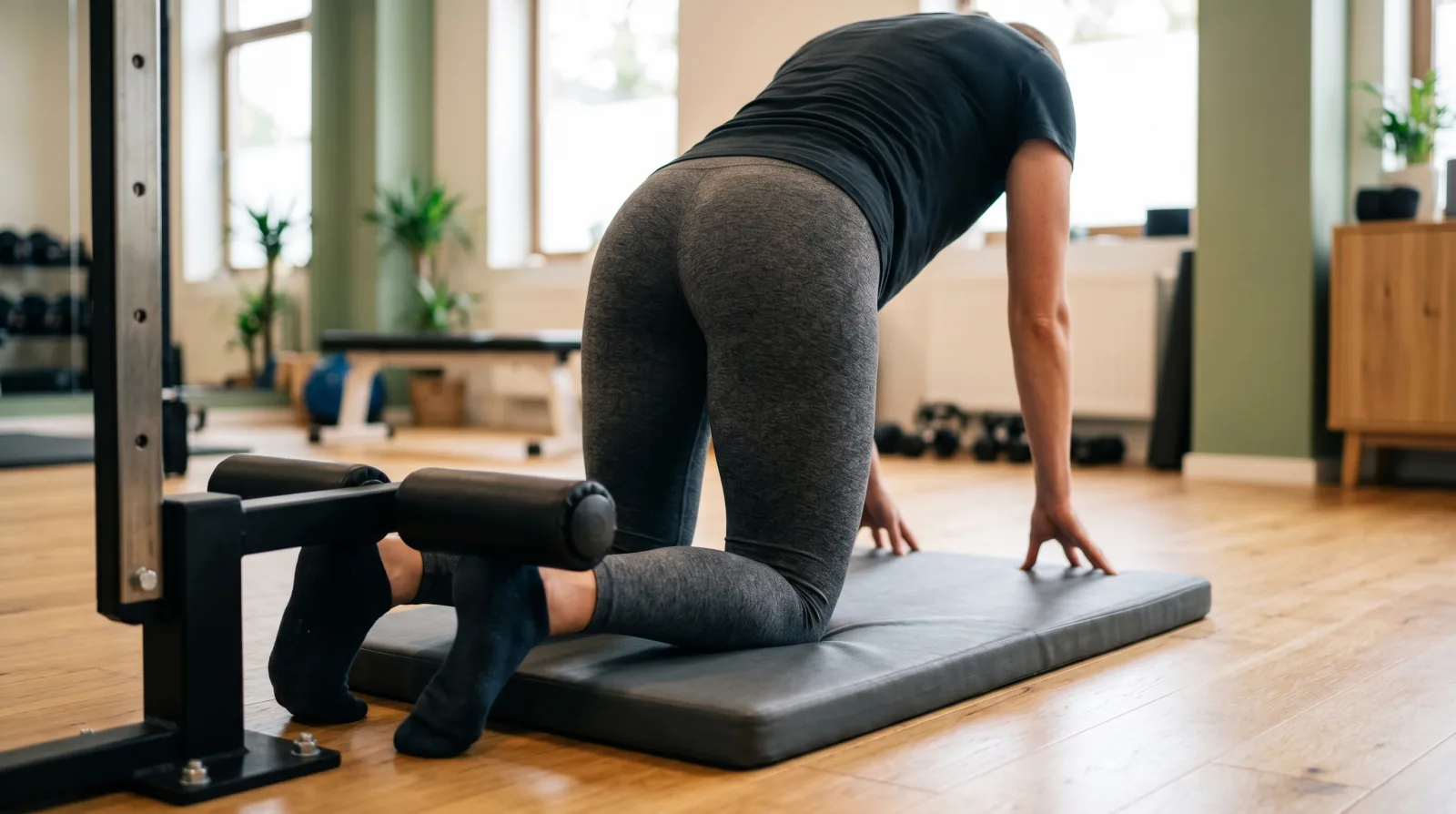
The volume work of reaching the criteria, the strength program, the neuromuscular training, the progressive running and jumping progressions, is often managed in combination with a kinesiologist, particularly in the later phases when the work looks more like a supervised training program than a clinical treatment. Our kinesiology and active rehabilitation service is well suited to the active rehab phase that runs from roughly four months post-surgery to the return-to-sport testing window.
This shared model, physiotherapist assessing and directing, kinesiologist managing the training volume, is common in BC because it gives patients more supervised training time at a lower hourly cost than pure physiotherapy care throughout.
What to ask before you are cleared
Not all physiotherapy practices test for all criteria before clearing an athlete for sport. Some rely primarily on time and reported symptoms. If you are approaching a return date and have not had objective quad strength testing and hop testing, it is worth asking your clinician directly what the clearance process involves.
Questions worth asking:
- Has my quadriceps limb symmetry index been measured against my uninjured leg? What is the number?
- Have I completed the four-test hop battery? What were my results on each leg?
- What movement quality assessment has been done for my landing mechanics?
- Has psychological readiness been formally assessed?
If the answers are vague, requesting a return-to-sport assessment from a physiotherapist who specifically does this testing is a reasonable step. The testing takes a single session. The information it provides materially changes the decision about when to return.
The ACL-specific post: a note on complementary reading
This article focuses on the return-to-sport testing and decision. The full arc of ACL rehabilitation, from the immediate post-surgical phase through strength rebuilding and the return-to-running progression, is covered in our article on ACL reconstruction recovery and rehab timeline. For hamstring-related sport return decisions, the criteria share some structure with what is described here: hamstring strain return to sport covers that specific situation.
Frequently asked questions
My surgeon said I could go back at nine months. Is that clearance?
Surgeon clearance at nine months typically means the graft is mature enough to be tested, not that you are necessarily ready. Surgeons generally focus on the surgical outcome, not the functional readiness. The strength and hop testing is the physiotherapy step that follows surgical clearance, not a replacement for it.
I feel fine and my knee feels stable. Is that enough?
Subjective feeling of stability does not correlate well with objective strength symmetry. A knee can feel stable and still have a quad strength gap that significantly increases re-rupture risk. The hop tests are designed to reveal the deficit that self-assessment misses, and movement quality on landing can flag a compensation pattern before it shows up as pain or hesitation.
What happens if I fail the hop tests but want to go back anyway?
The criteria are not a gate that stops you. They are the information your physiotherapist uses to tell you what the risk is. Some athletes return before criteria are met for practical reasons (a contract, an important final, a competition window). The conversation at that point is about informed decision-making with the actual risk numbers, not about whether you are allowed.
How long does return-to-sport testing take?
A dedicated return-to-sport assessment is typically 60 minutes. Some clinicians integrate the testing into regular sessions over a few weeks. The formal hop testing and strength comparison can happen in a single session once you are in the right phase, and it usually covers quadriceps strength symmetry, the four-test hop battery, and a check of landing mechanics under load.
Can I return to recreational sport sooner than competitive sport?
Yes. The criteria thresholds are designed for cutting and pivoting sport, where re-injury risk is highest. Return to recreational activities with lower demand (swimming, cycling, light jogging) typically follows a lower threshold and can happen earlier. Your physiotherapist can advise what applies to the specific activity you are returning to.
What is the ACL-RSI questionnaire and why does it matter?
The ACL-Return to Sport after Injury scale is a validated questionnaire that measures confidence, emotion, and risk appraisal about returning to sport after ACL injury. It matters because athletes who score low on psychological readiness have higher re-injury rates even when their strength and hop test numbers meet the physical criteria, so it is treated as a real part of the clearance decision rather than an afterthought.
Who actually runs the hop test battery, a physiotherapist or a kinesiologist?
The testing itself is typically led by a physiotherapist, who has the clinical background to interpret what a deficit means and adjust the program in response. A kinesiologist often manages the volume of strength and conditioning work that gets the knee ready for that testing, particularly in the later phases of rehab, working inside the boundaries the physiotherapist sets.
What is a limb symmetry index and how is it measured?
It is a way of comparing the reconstructed leg to the uninjured leg on a specific test, expressed as a percentage. For quadriceps strength, it is typically measured with an isokinetic or handheld dynamometer. For hop tests, it is the distance or time on the reconstructed leg divided by the uninjured leg. A limb symmetry index of 90 percent or higher is the threshold most commonly used across both strength and hop testing.
Does age affect when I can be tested for return to sport?
Age itself is not one of the six return-to-sport criteria, and the testing framework applies the same thresholds regardless of age. What can change with age is how long it takes to reach those thresholds, since strength and neuromuscular control can take longer to rebuild in an older athlete. Your physiotherapist tracks progress against the criteria rather than against an age-based expectation.
This article is general information, not personal medical advice. The specific timing and criteria that apply to your situation depend on your surgery, your progress, and your sport.
Sources
- Delaware-Oslo ACL Cohort Study: British Journal of Sports Medicine (2016)
- CHCPBC: College of Health and Care Professionals of BC
- ACL reconstruction recovery and rehab timeline
- Hamstring strain return to sport
- Kinesiology and active rehabilitation at Launch Rehab
WRITTEN BY
The Launch Rehab Team
Practical recovery and training notes from the clinicians at our five Metro Vancouver studios.
FOUND THIS USEFUL?
Share it with your network on LinkedIn. We wrote a ready-to-post version for you.
FILED UNDER
- acl
- return-to-sport
- knee-rehab
- physiotherapy
- kinesiology
- bc
- criteria-based