Deep Tissue vs Relaxation Massage: Which One Is Right for Your Situation
Both are delivered by a registered massage therapist. Both feel good afterward. But deep tissue and relaxation massage are built for different goals, and choosing the wrong one for your situation means slower results and sometimes more discomfort. Here is how to decide.
BY THE LAUNCH REHAB TEAM
When you call to book a registered massage therapy session, the question usually comes: "What kind of massage are you looking for?" If you pause on that question, you are not alone. Most people have a vague sense that "deep tissue" means serious work and "relaxation" means a lighter experience, but the actual clinical difference matters for what you get out of the session.
This guide explains what each type involves, when each one is the better choice, and what to expect during and after both.
What relaxation massage actually does
Relaxation massage, sometimes called Swedish massage, uses smooth, flowing strokes applied at moderate pressure across large muscle groups. The pace is slower and more rhythmic than therapeutic work. The goal is to help the body settle: reducing muscle tension and moving from an alert state toward a resting state.
The best-studied effect is on anxiety. A meta-analysis of 37 randomized trials found that a single massage session reduced state anxiety, blood pressure, and heart rate, and that a course of treatment reduced trait anxiety and depression (Moyer, Rounds and Hannum, Psychological Bulletin, 2004). The same research group later reviewed the stress hormone cortisol and found that massage's effect on it is very small and, in most cases, not statistically distinguishable from zero (Moyer et al., Journal of Bodywork and Movement Therapies, 2011), so cortisol does not explain the benefit. Anxiety relief matters for people under chronic workload or in high-stress periods.
What relaxation massage does not do especially well: release a specific chronically overloaded muscle, work through thick fascia to the tissue underneath, or address a pain pattern tied to a particular structure. The technique is not built for that goal.
Choose relaxation massage when:
- You are under significant stress and your whole body feels tense without a specific injury
- Sleep quality has declined and you need your body to settle
- You are in a high-stimulus week (deadline, travel, poor sleep) and need a reset
- You have no specific physical complaint, general tension only
- You want a restorative experience before or after a long-haul flight or demanding travel schedule
What deep tissue massage involves
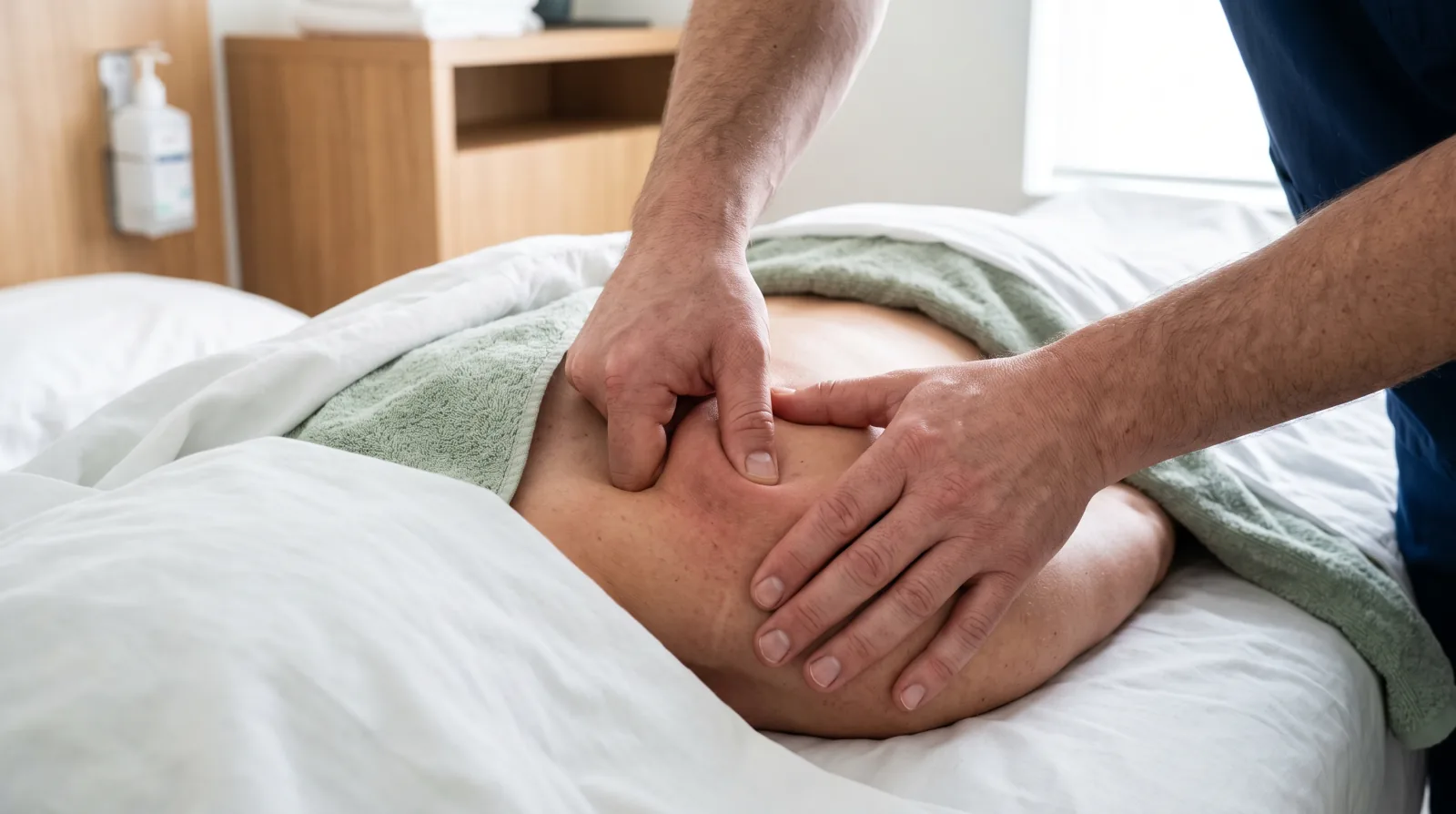
Deep tissue massage uses slower strokes and sustained, focused pressure applied to specific structures, a muscle belly, a fascial layer, a tendon attachment. The therapist works into the tissue through the surface layers rather than across them. Techniques include trigger point compression (sustained pressure into a specific point that reliably reproduces your pain), cross-fiber friction (working across the grain of a muscle), myofascial release (sustained tension across a fascial line), and active release (you contract and relax the muscle while the therapist maintains pressure).
Deep tissue sessions are more interactive. You may be asked to breathe into a tight area, resist pressure with a specific muscle, or report when a point of pressure reproduces a familiar pain. The therapist is gathering information as they treat, the response of the tissue guides where they spend time.
Deep tissue work is often uncomfortable during the session. The uncomfortable sensation should feel like a productive discomfort, pressure on a tight structure, not sharp pain or a burning sensation. If it crosses into sharp pain, tell your therapist and they will adjust. There is no clinical value in working through actual pain, and it signals the tissue is being loaded beyond what it can currently tolerate.
After a deep tissue session, soreness in the worked areas for a day or two is common, similar to the soreness after a hard workout. Gentle movement and heat on sore areas the following day often feel better. If you are unsure, ask your RMT.
Choose deep tissue massage when:
- A specific muscle or region will not release on its own despite stretching and foam rolling
- You have a recurring pain pattern in a known location
- Movement is restricted in a specific direction (turning your neck left, reaching overhead, bending forward)
- You are an athlete recovering from training load or managing an overuse issue
- You are recovering from a soft tissue injury in the sub-acute phase (pain is stable, not acutely inflamed)
- A physiotherapist has recommended massage as part of your treatment plan
The pressure misconception
The most common misconception about deep tissue massage is that harder always means better. It does not. The goal of deep tissue work is to find the tissue layer that is restricted and apply the right amount of sustained pressure to create a release response in that layer. Working harder than the tissue can tolerate can leave you sorer for longer. Working too lightly misses the layer entirely.
The skill in deep tissue massage is knowing how much pressure produces a response in this person, in this tissue, on this day. An RMT who asks how the pressure feels and adjusts based on your feedback is being accurate.
Can you combine both in one session?
Yes. Many RMTs will split a session: 20 minutes of targeted deep work on the areas with specific restrictions, followed by 20 minutes of lighter relaxation work to help the nervous system settle after the treatment. This is worth requesting explicitly when you book, particularly if you have one or two problem areas plus a general stress response. Tell the RMT your priorities at the start of the session and they can allocate time accordingly.
Which should you choose right now?
If you have a specific physical problem, a recurring muscle that tightens, a pain pattern with a known location, a restricted movement, deep tissue massage directed at that structure is the better match than a relaxation session. If you have general tension without a specific problem, or you are in a high-stress period and need your body to settle, a relaxation session is the more appropriate choice.
If you are not sure whether your problem is "just tension" or something more specific, book a physiotherapy assessment first. The physiotherapist can identify whether there is a structural cause behind the tension, and recommend the type of massage that will be most useful in your case. Our RMTs and physiotherapists at all Launch Rehab studios coordinate directly, a referral between them takes one conversation at the front desk.
Both styles of session are available from our RMTs at every studio: massage therapy in Richmond, RMT in Coquitlam at Town Centre, massage therapy in New Westminster, RMT at Lougheed, and RMT in North Burnaby at the Heights. Sessions run 45, 60, 75 or 90 minutes.
Frequently asked questions
Does deep tissue massage hurt more than relaxation massage?
Deep tissue massage is often uncomfortable during the session, since it applies sustained, focused pressure into specific structures like a muscle belly or fascial layer. That discomfort should feel like productive pressure on a tight structure, not sharp or burning pain, and a registered massage therapist (RMT) will adjust pressure if it crosses that line. Relaxation massage uses moderate, flowing pressure and is not built to produce the same tissue response.
How sore should I expect to be after a deep tissue massage?
One to two days of soreness in the areas worked is a normal response, similar to delayed onset muscle soreness after a hard workout. Gentle movement and heat on sore areas the following day often feel better. Soreness that is sharp, worsening, or lasting well beyond two days is worth mentioning to your RMT.
Can I ask for both deep tissue and relaxation techniques in one massage session?
Yes. Many RMTs will split a session, for example 20 minutes of targeted deep work on a specific problem area followed by 20 minutes of lighter relaxation work to help the nervous system settle afterward. Tell the RMT your priorities at the start of the session so they can allocate the time accordingly, particularly if you have both a specific physical complaint and general stress.
Who is qualified to perform deep tissue and relaxation massage in BC?
Both types of massage at Launch Rehab are delivered by registered massage therapists (RMTs) regulated by the College of Complementary Health Professionals of BC (CCHPBC). RMTs are trained in soft-tissue assessment and treatment for pain, range of motion, and post-injury recovery, which covers both the therapeutic and relaxation-focused techniques described here.
Is relaxation massage just as effective as deep tissue for stress relief?
Yes, for stress-related goals, relaxation massage is the more appropriate choice. A meta-analysis of 37 randomized trials found that a single massage session reduced state anxiety, blood pressure, and heart rate, and a course of treatment reduced trait anxiety and depression (Moyer, Rounds and Hannum, Psychological Bulletin, 2004). Deep tissue massage is built for a different goal, working into a specific restricted structure, and is not inherently more effective just because the pressure is firmer.
Should I get a physiotherapy assessment before booking a massage?
If you are not sure whether your problem is general tension or something more specific, a physiotherapy assessment first is a reasonable step. A physiotherapist can identify whether there is a structural cause behind the tension and recommend which type of massage will be most useful for your situation. At Launch Rehab, RMTs and physiotherapists coordinate directly, so a referral between them takes one conversation at the front desk.
Does massage therapy direct-bill extended health insurance in BC?
Most Launch Rehab massage therapy sessions direct-bill major extended health plans, which means you typically do not pay out of pocket and wait for reimbursement. Coverage details vary by insurer and plan, so it is worth confirming your specific benefits with the clinic before your first visit.
How long should a massage therapy session be?
Session length depends on what you are treating. Sessions at Launch Rehab run 45, 60, 75, or 90 minutes, with a longer session generally needed to address more than one problem area or to combine deep tissue and relaxation work in the same visit. Your RMT can advise on the right length once they understand your goals for the session.
All massage therapy at Launch Rehab is delivered by registered massage therapists (RMTs) regulated by the College of Complementary Health Professionals of BC. Sessions direct-bill most extended health plans.
Sources
- A meta-analysis of massage therapy research, Psychological Bulletin, 2004
- Does massage therapy reduce cortisol? A comprehensive quantitative review, Journal of Bodywork and Movement Therapies, 2011
- CCHPBC: Registered Massage Therapists
WRITTEN BY
The Launch Rehab Team
Practical recovery and training notes from the clinicians at our five Metro Vancouver studios.
FOUND THIS USEFUL?
Share it with your network on LinkedIn. We wrote a ready-to-post version for you.
FILED UNDER
- rmt
- deep-tissue-massage
- relaxation-massage
- registered-massage-therapy
- bc
- massage-therapy