IMS vs Acupuncture: Same Needle, Different Scope
IMS and acupuncture use the same thin needle but they come from different colleges, follow different clinical logic, and treat different problems. Here is how to tell which one fits your presentation.
BY KELVIN YEUNG
The question comes up often in our clinics: "Is IMS the same as acupuncture?" The needle is the same. The visual is nearly identical. But the clinical logic, the regulatory scope, and the conditions each technique is best suited for are not.
This piece explains the difference so you can have an informed conversation with your clinician about which approach fits your presentation.
What IMS is: who can perform it
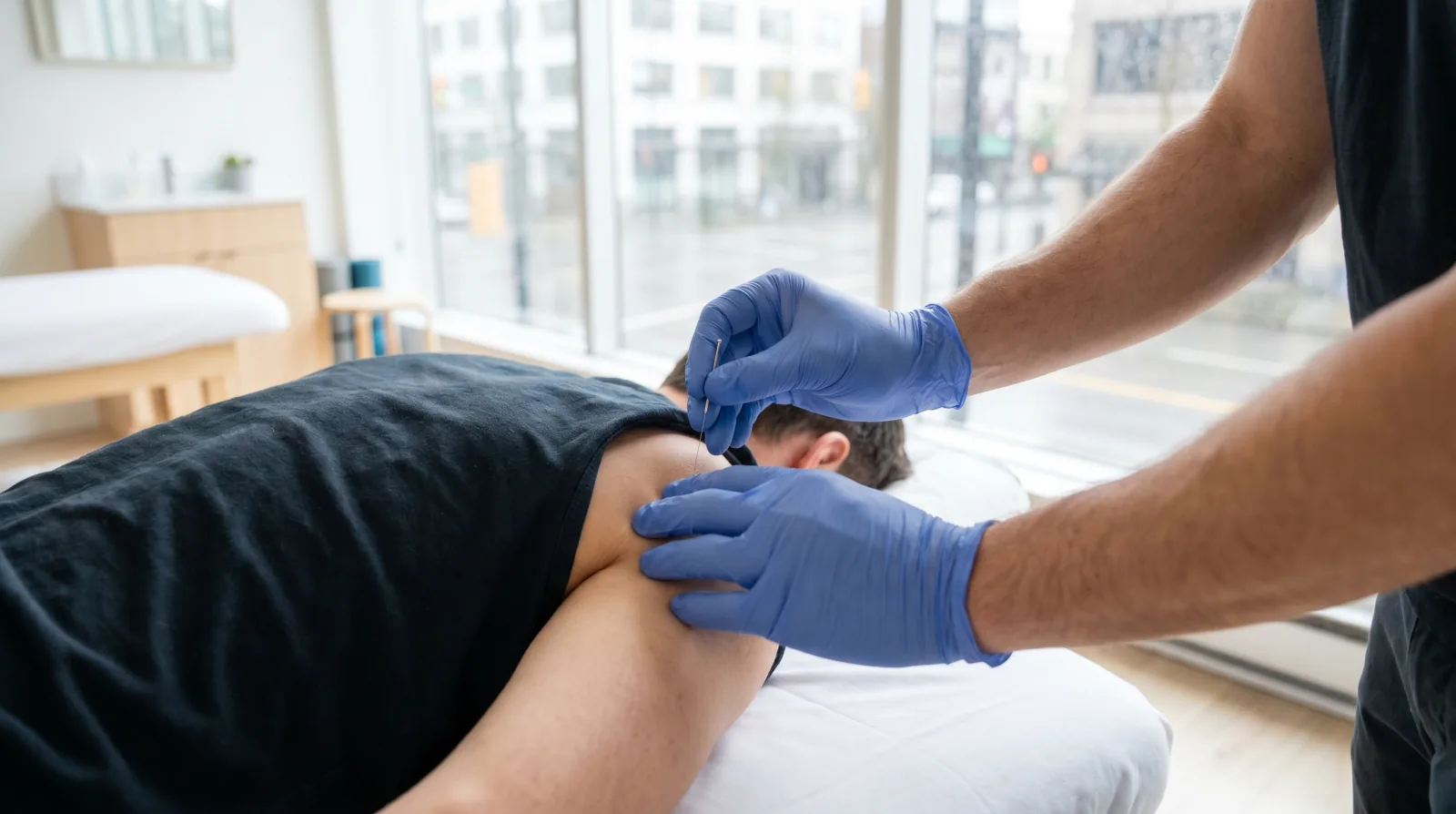
IMS stands for intramuscular stimulation. It is a dry-needling technique developed by Dr. Chan Gunn and taught through the University of British Columbia continuing professional development program. A fine filiform needle, the same type used in acupuncture, is inserted into a shortened, overactive muscle band (often called a trigger point or tender point) to produce a twitch response and cause the muscle to relax.
The regulatory point that matters: in BC, IMS is performed by physiotherapists who have completed additional post-graduate certification. It falls within physiotherapy scope under the College of Health and Care Professionals of BC (CHCPBC) for registered members who hold the required training. Not every physiotherapist is certified in IMS. It is an add-on credential, not a baseline one. If you are looking for IMS specifically, confirm the clinician is IMS-certified before booking. (There are several recognized IMS training routes; the specific program matters less than that the physiotherapist holds current certification.)
Kinesiologists do not needle, dry needling and IMS are outside kinesiology scope in BC. The scope details vary by profession and certification, verify with the individual clinician. For the broader comparison between dry needling as a category and traditional acupuncture, including who is allowed to needle in BC, see dry needling vs acupuncture.
What acupuncture is: who can perform it
Traditional acupuncture is a practice regulated under the College of Complementary Health Professionals of BC (CCHPBC), the body that now encompasses registered acupuncturists in BC. Registered acupuncturists complete a multi-year diploma program. Their scope encompasses the full spectrum of Traditional Chinese Medicine acupuncture, including meridian-based point selection, herbal recommendations (within their scope), and contemporary acupuncture.
Physiotherapists and some other regulated clinicians may also perform acupuncture within their scope if they hold the relevant certification. This is sometimes called "contemporary acupuncture" or "medical acupuncture" in physiotherapy contexts, and it draws on neuroanatomy-based point selection rather than meridian-based logic.
Both traditions use the same filiform needle. The clinical model used to select points and explain the mechanism differs.
How the technique differs in practice
| IMS | Traditional Acupuncture | |
|---|---|---|
| Needle target | Shortened muscle band / trigger point | Acupuncture point (meridian or contemporary anatomical) |
| Primary mechanism model | Muscle twitch response, neurophysiological relaxation | Varied: meridian-based, endorphin release, gate-control theory |
| Insertion depth | Into the muscle belly, guided by palpation | Point-depth varies by body region and clinical goal |
| Expected sensation | Local twitch, cramping, or dull ache in the muscle | De qi (heaviness, distension, mild ache) or minimal sensation |
| Session length | Often 20 to 40 min (combined with physio) | 30 to 60 min standalone |
| Who performs it in BC | IMS-certified physiotherapists | Registered acupuncturists; physios and others with acupuncture certification |
The twitch response in IMS is often more pronounced than in traditional acupuncture. Some people find it uncomfortable; others report significant immediate relief in the treated muscle. Post-treatment soreness lasting 24 to 48 hours is common with IMS and is expected. It is a sign the target tissue responded.
When IMS is the better fit
IMS works best when the driving problem is muscular, specifically a shortened, overactive muscle that is not releasing despite stretching, massage, or exercise. Common presentations where our physiotherapists consider IMS:
- Chronic neck and upper trapezius tightness that has plateaued with manual therapy
- Low back pain where paraspinal guarding is limiting the ability to load and progress exercises
- Lateral hip pain with persistent gluteal tightness
- Tennis elbow or golfer's elbow with a muscular component alongside the tendon issue
- Headaches driven by suboccipital or cervical muscle tension
IMS fits inside a physiotherapy plan of care. It is not a standalone treatment at our clinics. The session still includes exercise prescription, movement retraining, or manual therapy. The needle addresses the barrier; the rest of the session builds on what the needle opened up.
When acupuncture is the better fit
Traditional acupuncture, performed by a registered acupuncturist within CCHPBC scope, is often a better fit when:
- The goal is systemic pain modulation alongside or instead of local muscle work
- The client prefers a more relaxation-oriented session structure
- The clinical picture includes conditions where traditional acupuncture has a stronger evidence base, such as chemotherapy-induced nausea, chronic headache, or certain chronic pain presentations (NICE Clinical Guidelines on chronic pain include acupuncture as an option for chronic primary pain)
- The client has had a good response to acupuncture in the past and wants to continue with a registered acupuncturist rather than a physio-delivered approach
Acupuncture within physiotherapy scope (contemporary acupuncture) covers similar musculoskeletal ground to IMS and may be appropriate when the referral goal is pain modulation alongside active rehab.
Insurance and ICBC coverage in BC
In BC, IMS delivered by a physiotherapist is billed as part of the physiotherapy session. It is not a separately itemized service at most clinics. The $5 IMS add-on at Launch Rehab (see our rates page) applies per session when IMS is included in the treatment.
Acupuncture delivered by a registered acupuncturist is a separate billing line. ICBC pre-approves acupuncture visits for motor vehicle injury claims alongside physiotherapy. Your acupuncture pre-approval count is separate from your physiotherapy count. See ICBC treatment access guidelines for the current approved visit structure.
Extended health plans typically cover both. Verify whether your plan separates physiotherapy and acupuncture into different annual pools, as many do.
What to expect during and after an IMS session
People often arrive at their first IMS session uncertain about what "getting needled by a physio" will feel like. The experience is distinct enough from both traditional acupuncture and regular physiotherapy that it is worth describing plainly.
The physiotherapist palpates the target muscle first, finding the shortened, taut band by feel and confirming the tissue is a candidate for needling. The needle is inserted quickly through the skin and into the muscle. The sensation on insertion is typically a sharp prick lasting a fraction of a second. What follows, the local twitch response, is the part most people find surprising. It is an involuntary muscle contraction, often described as a "jumping" or "grabbing" sensation that lasts one to two seconds. It can feel intense or crampy in the moment.
Post-treatment soreness is expected and normal. The treated area typically feels bruised or deeply sore for 24 to 48 hours afterward. This is a sign the tissue responded, not a sign of damage. Many patients report a meaningful reduction in resting muscle tightness starting around the 48-hour mark. The "soreness then release" pattern is characteristic of IMS when it is working.
The number of IMS sessions needed varies. For chronic neck or shoulder tightness that has plateaued with other treatment, a typical course is three to five sessions, each incorporated into a physiotherapy appointment. For more complex presentations (longstanding paraspinal guarding, for example) the course may be longer.
What to expect during and after an acupuncture session
A session with a registered acupuncturist has a different structure and texture than IMS within physiotherapy.
The first visit typically begins with a detailed intake covering not only the presenting complaint but also general health, sleep, digestion, and stress, areas that inform Traditional Chinese Medicine diagnosis even when the primary complaint is musculoskeletal. The clinician develops a treatment strategy that may involve multiple body areas, not just the local site of pain.
Needle insertion in traditional acupuncture is gentle and fine. The characteristic sensation is "de qi": a dull ache, heaviness, or mild distension at the point. It is less sharp than the IMS twitch response and less likely to produce post-treatment soreness.
Sessions typically run 30 to 60 minutes, with needles left in place for part of that time. Some acupuncturists combine needling with moxibustion (heat), cupping, or tui na (massage techniques).
For musculoskeletal complaints, a typical course of traditional acupuncture is six to twelve sessions, with some benefit usually perceptible within the first three or four. For systemic or chronic pain management goals, the course may be longer and more open-ended.
Which should you ask for?
The answer usually comes from the assessment. A physiotherapist who is IMS-certified will identify whether the muscle response warrants dry needling based on palpation and movement testing. A registered acupuncturist will assess through their own clinical lens.
If you are already in physiotherapy care and a specific muscle is not releasing with manual work, ask whether your clinician is IMS-certified and whether the presentation warrants a needling session. If you want acupuncture-focused care as its own modality, especially from a registered acupuncturist with a full Traditional Chinese Medicine scope, book with a registered acupuncturist.
Registered acupuncturists work at our New Westminster, North Burnaby, Coquitlam, and Richmond (Broadmoor) studios. Several of our physiotherapists across all five studios hold IMS certification. If you are not sure which fits your presentation, book a physiotherapy assessment and raise the question in session.
Frequently asked questions
Is IMS the same as acupuncture?
No. Both use the same thin filiform needle, but the clinical logic is different. IMS targets a shortened, overactive muscle band to produce a twitch response, while traditional acupuncture, regulated under the College of Complementary Health Professionals of BC, works from meridian-based or contemporary point selection for a broader effect.
Who is allowed to perform IMS in BC?
IMS is performed by physiotherapists who hold additional post-graduate IMS certification, under the College of Health and Care Professionals of BC (CHCPBC). Not every physiotherapist is IMS-certified, so confirm the specific clinician holds current certification before booking if you are looking for IMS by name.
Can a kinesiologist perform dry needling or IMS in BC?
No. Dry needling and IMS fall outside kinesiology scope in BC. Kinesiologists design and deliver exercise programs, but needling of any kind, including IMS and acupuncture, is not part of their regulated scope of practice, so a kinesiologist will refer you to an IMS-certified physiotherapist or a registered acupuncturist if needling is appropriate for your presentation.
Is post-treatment soreness after IMS normal?
Yes, in most cases. The treated area typically feels bruised or deeply sore for 24 to 48 hours after an IMS session, and many patients report a meaningful reduction in resting muscle tightness starting around the 48 hour mark. This soreness-then-release pattern is considered a sign the tissue responded, not a sign of damage.
How many IMS sessions does a typical course involve?
It varies by presentation. For chronic neck or shoulder tightness that has plateaued with other treatment, a typical course is often three to five sessions, each incorporated into a physiotherapy appointment, though more complex presentations such as longstanding paraspinal guarding may need a longer course.
Does ICBC cover both IMS and acupuncture after a crash?
Yes, but on separate billing lines. ICBC pre-approves acupuncture visits for motor vehicle injury claims alongside physiotherapy, and your acupuncture pre-approval count is separate from your physiotherapy count, which is where IMS is typically billed since it is delivered within a physiotherapy session. Both specialty services may carry an additional fee on top of what ICBC funds, so ask before booking.
Which Launch Rehab studios have a registered acupuncturist?
Registered acupuncturists work at our New Westminster, North Burnaby, Coquitlam, and Richmond (Broadmoor) studios, four of our five Metro Vancouver locations. Several of our physiotherapists across all five studios hold IMS certification, so if you are not sure which service fits your presentation, book a physiotherapy assessment and raise the question in session.
Does IMS hurt more than acupuncture?
The sensations are different rather than one being simply more painful. IMS produces a local twitch response that can feel intense or crampy for one to two seconds, while traditional acupuncture typically produces de qi, a dull ache or heaviness at the point, which is less sharp and less likely to cause post-treatment soreness.
Is there an extra fee for IMS at Launch Rehab?
Yes. IMS is billed as part of the physiotherapy session rather than as a separate service, and Launch Rehab applies a $5 IMS add-on per session when IMS is included in treatment. Check our rates page for the current figure before booking, since the amount can change and the rates page is the source of truth.
This article is not a substitute for assessment by a regulated practitioner.
WRITTEN BY
Kelvin YeungMPT, BSc.Kin, CAFCI, CGIMS, Dip.AIM, FCAMPT (HE/HIM/HIS)
Physiotherapist
Practical recovery and training notes from the clinicians at our five Metro Vancouver studios.
READ FULL PROFILEFOUND THIS USEFUL?
Share it with your network on LinkedIn. We wrote a ready-to-post version for you.
FILED UNDER
- ims
- acupuncture
- dry-needling
- physiotherapy
- scope-of-practice
- bc