Dry Needling vs Acupuncture: What's Actually Different in BC
Dry needling and acupuncture use the same thin needle, but they are regulated differently in BC, trained differently, and chosen for different reasons. Here is how to tell which one your presentation calls for.
BY KELVIN YEUNG
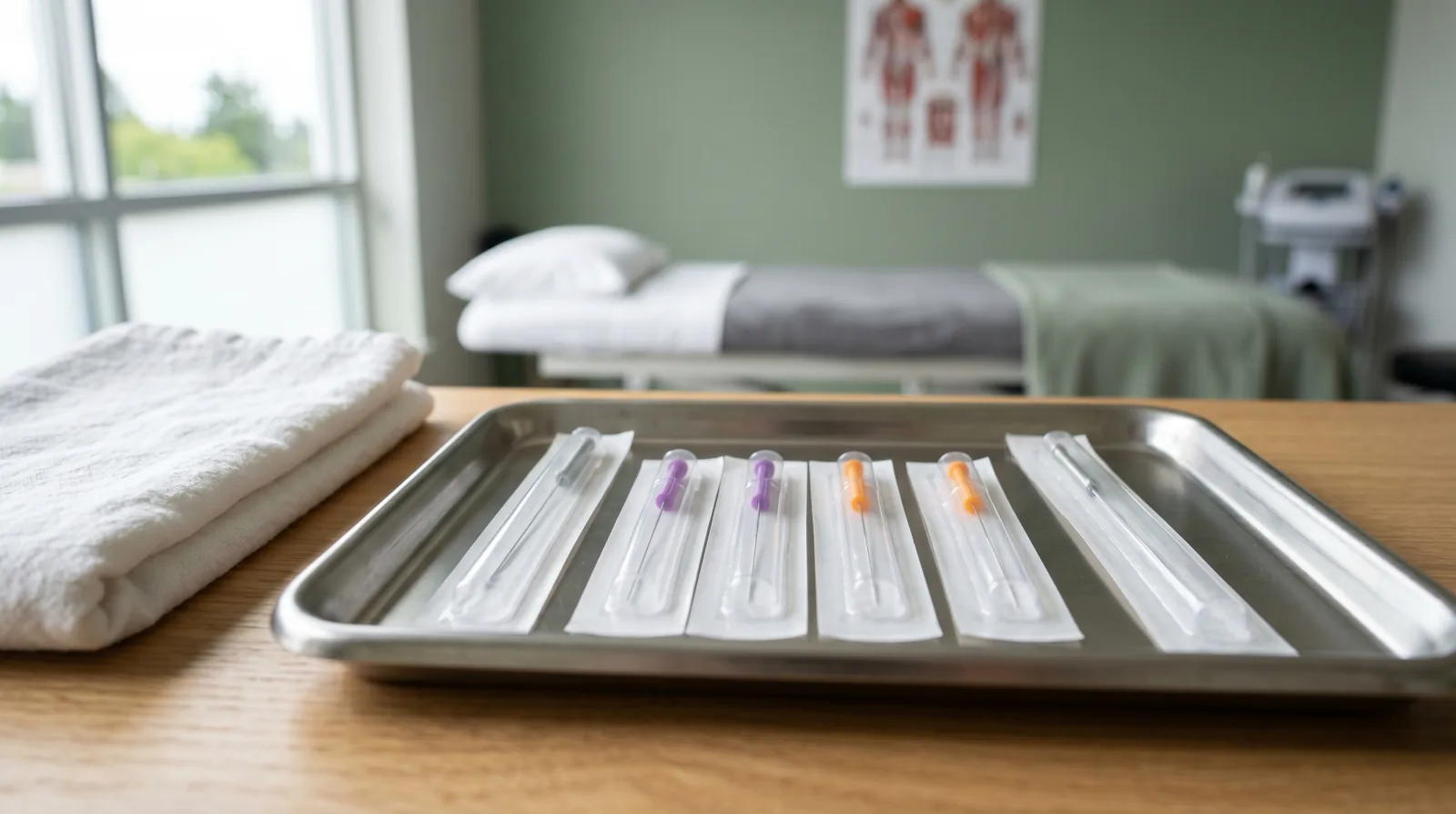
If a clinician has suggested needling for a stubborn muscle or a chronic pain problem, you have probably run into both terms: dry needling and acupuncture. From the treatment table they look identical. The needle is the same thin, solid filament. What differs is the regulation, the training, the clinical logic, and the situations each fits best.
This guide covers the BC picture: who is allowed to needle you, what their training looks like, what the research supports, and how we decide between the two approaches in our clinics.
Quick comparison:
| Dry Needling / IMS | Traditional Acupuncture | |
|---|---|---|
| Who delivers it | Physiotherapist (post-graduate IMS training) | Registered Acupuncturist / TCM Practitioner |
| Regulator in BC | CHCPBC | CCHPBC |
| Primary target | Specific muscle trigger point | Meridian or neuroanatomy-based point selection |
| Goal | Release contracted muscle, reduce referred pain | Pain modulation, systemic and stress effects |
| Best fit | Tight muscle with localised or referred pain | Chronic or widespread pain, systemic effects wanted |
| ICBC coverage | Under physiotherapy ($5 surcharge) | Pre-approved (separate acupuncture pool) |
| Extended health | Covered under physiotherapy benefit | Usually covered (acupuncture pool) |
What dry needling is
Dry needling is a treatment technique that uses solid filament needles to puncture the skin for therapeutic purposes. "Dry" just means nothing is injected through the needle. The most common version in BC physiotherapy targets trigger points: taut, overactive bands of muscle that have not released with manual therapy or exercise.
The regulator's own definition is broader than most people expect. The College of Health and Care Professionals of BC's dry needling policy describes dry needling as a range of approaches that includes trigger point dry needling, intramuscular stimulation (IMS), and even acupuncture techniques delivered within physiotherapy practice. In other words, "dry needling" is the umbrella term for needling done by a physiotherapist; IMS is the specific method most of our physiotherapists use under that umbrella. We wrote a separate guide on how IMS compares to acupuncture if you want the deeper dive on that technique.
The target is muscular. The physiotherapist palpates for the shortened band, inserts the needle into the muscle belly, and looks for a local twitch response: a brief, involuntary contraction that tends to reset the muscle's resting tension. The sensation is distinct: a quick cramp or grab, often followed by a day or two of deep soreness in the treated muscle.
What acupuncture is
Traditional acupuncture comes from a different system entirely. In BC, registered acupuncturists are regulated by the College of Complementary Health Professionals of BC (CCHPBC), alongside traditional Chinese medicine practitioners. Acupuncture has been a designated health profession in BC since 1996, and registered acupuncturists complete multi-year diploma training before they can use the title.
The session logic is different from dry needling. Point selection draws on Traditional Chinese Medicine assessment, which considers the whole presentation rather than a single muscle. Needle insertion is typically gentler, the characteristic sensation is a dull ache or heaviness rather than a twitch, and needles are usually left in place for part of the session. Many treatments address several body regions, not just the painful one.
Some physiotherapists also hold acupuncture certification and deliver what is often called contemporary or medical acupuncture, which uses anatomically based point selection inside a physio session. That is a different service from seeing a registered acupuncturist, whose training and scope cover the full Traditional Chinese Medicine system.
Who is allowed to needle you in BC
This is where the difference stops being academic. In BC, a physiotherapist cannot pick up a needle just because they are registered. Under the CHCPBC policy, a physiotherapist who wants to perform dry needling must have at least two years of practice experience and a minimum of 3,900 practice hours, must complete an approved training program, and must apply to the College before needling a single patient. Approved programs include the UBC Gunn IMS certification course, which is the route most of our needling physiotherapists have taken.
There is a practical payoff for you in that process: approval adds an annotation to the physiotherapist's entry on the College's public register. If you want to confirm your physio is cleared to needle, you can look them up before booking. The same goes for acupuncturists. CCHPBC maintains a public registry where you can verify the R.Ac. title.
One naming note. The College of Physical Therapists of BC (CPTBC) amalgamated into the multi-profession College of Health and Care Professionals of BC in June 2024, so older articles and clinic pages still reference CPTBC. The dry needling rules carried over into the new college's policy.
What the evidence supports, and where it is honest to hedge
The research on dry needling is broad but uneven. A 2023 umbrella review in the Journal of Clinical Medicine, which synthesized 36 systematic reviews, found consistent evidence that dry needling reduces musculoskeletal pain in the short term compared with sham treatment or no treatment, across body regions. The same review found no clear superiority of dry needling over other active treatments, and noted that mid- and long-term data remain limited.
That maps onto how we actually use it. Dry needling is not the plan. It is a tool inside the plan. The reviews that show the strongest results pair needling with exercise and movement retraining rather than using it alone, and that is how our physiotherapists structure sessions.
Acupuncture has its own evidence base, strongest in chronic pain. The NICE guideline on chronic primary pain includes a course of acupuncture as a recommended option, which is a meaningful endorsement from a conservative guideline body. For a specific tight muscle that is blocking rehab progress, the trigger point literature is the more relevant body of work.
Neither technique is a guaranteed fix, and anyone who promises one is overreaching. Response varies with the tissue involved, how long the problem has been there, and what else the plan includes.
How we choose between them in our clinics
The decision usually falls out of the assessment rather than the menu. A few patterns we see often:
- A specific muscle that will not release despite manual therapy and progressive loading (such as chronic upper trapezius tightness, paraspinal guarding, or gluteal tightness with lateral hip pain). That points to dry needling inside a physiotherapy plan.
- A chronic, widespread, or systemic pain presentation, or a client who responds well to a whole-body treatment approach. That points to a registered acupuncturist.
- A client who wants needling but finds the IMS twitch response too intense. Traditional acupuncture is gentler, and for some presentations it is a reasonable substitution.
- A rehab plan that is progressing well without needles. Then we do not add them. Needling earns its place when something is blocking progress, not by default.
There is also a sequencing question. Dry needling is one part of a physio session that includes exercise prescription and load progression, so the needle work compounds with the rest of the visit. An acupuncture session with a registered acupuncturist is its own appointment with its own logic. Some clients run both in the same week on different days. Both are available at Launch Rehab. Our acupuncture and IMS dry needling service page lists what each studio offers, and our registered acupuncturists currently work out of the New Westminster, North Burnaby, Coquitlam, and Richmond (Broadmoor) studios.
What it costs and how billing works
IMS dry needling at Launch Rehab is billed as part of the physiotherapy session with a small add-on, and acupuncture with a registered acupuncturist is billed as its own service line. Current figures are on the rates page. We keep them there rather than in articles so they stay accurate.
For ICBC motor vehicle claims, physiotherapy and acupuncture are pre-approved as separate disciplines with separate visit counts, so using one does not draw down the other. Extended health plans usually separate them into different annual pools as well. It is worth checking your plan's acupuncture line before assuming the physio pool covers needling. It does, but only when the needling happens inside a physiotherapy session.
Start with the assessment, not the needle
If you already know a specific muscle is the problem, book a physiotherapy assessment and ask whether the clinician is approved for dry needling, or check the public register first. If your pain is chronic, widespread, or you simply want the traditional approach from a practitioner trained in the full system, book directly with one of our registered acupuncturists. And if you are not sure, book the physio assessment and raise the question in session. Triage is part of the job, and the strongest outcomes we see happen when the technique is chosen to fit the presentation rather than the other way around.
Frequently asked questions
Is dry needling the same as acupuncture?
No. They use the same solid filament needle, but dry needling targets muscle trigger points using anatomical reasoning, while traditional acupuncture uses Traditional Chinese Medicine assessment and point selection. In BC they are also regulated under different colleges, with different training routes behind each title.
Who can legally perform dry needling in BC?
Physiotherapists who have at least two years and 3,900 hours of practice, have completed a College-approved course, and have been approved by CHCPBC, per the College's dry needling policy. Approval is annotated on the public register, so you can verify before booking. Some chiropractors also dry needle under a separate scope set by their own college.
Does dry needling hurt?
The insertion is a brief prick. The twitch response feels like a quick cramp, and the treated muscle often feels deeply sore for a day or two afterward. Most people find it intense but tolerable, and your physiotherapist adjusts the dose to your response. Minor bruising at the insertion point can happen occasionally, similar to other needle-based treatments.
Is IMS the same as dry needling?
IMS is one method of dry needling: the Gunn IMS approach taught through UBC, most commonly delivered by IMS-certified physiotherapists at Launch Rehab. Several other training routes to dry needling certification exist beyond the Gunn IMS course, and what matters for scope in BC is holding current certification rather than which specific program a clinician trained through. Our IMS vs acupuncture guide covers it in detail.
Will ICBC or my extended health plan cover it?
ICBC pre-approves physiotherapy and acupuncture as separate disciplines after a motor vehicle crash. Extended health plans usually hold separate annual pools for each. Dry needling inside a physio session bills against physiotherapy; treatment by a registered acupuncturist bills against acupuncture, so it is worth checking your plan's acupuncture line before assuming the physio pool covers needling too.
Can a chiropractor perform dry needling in BC?
Some chiropractors do dry needle, in addition to physiotherapists. Chiropractors are regulated by the College of Complementary Health Professionals of BC, and their scope for dry needling is set separately from the CHCPBC policy that governs physiotherapists. Confirm with the individual practitioner or their college register whether they hold the specific approval before booking.
Can a kinesiologist do dry needling or acupuncture?
No. Dry needling and acupuncture both sit outside kinesiology's scope of practice in BC, since kinesiology is not a regulated college and needling is not among the services a kinesiologist is trained or authorized to provide. A kinesiologist can support your recovery through exercise-based conditioning, but any needling has to come from a physiotherapist, chiropractor, or registered acupuncturist working within their own college's rules.
Which studios offer registered acupuncture at Launch Rehab?
Registered acupuncturists currently work out of the New Westminster, North Burnaby, Coquitlam, and Richmond (Broadmoor) studios. IMS dry needling is delivered by approved physiotherapists as part of a physiotherapy session and is not tied to the same four-studio list, so check the acupuncture and IMS dry needling service page for which service runs at which location.
Does dry needling leave marks or bruising?
Some soreness in the treated muscle for a day or two is common, and minor bruising at the insertion point can happen occasionally, similar to other needle-based treatments. Serious complications are rare when performed by an approved, trained practitioner. Tell your physiotherapist about any bleeding disorder, blood thinner use, or needle phobia before the session so they can adjust the plan.
How many dry needling or acupuncture sessions will I need?
There is no fixed number. It depends on how your tissue responds, whether needling is paired with exercise and load progression, and what else the plan includes, and your clinician will set expectations after the first one or two sessions show how you respond. Needling is used as one tool inside a broader plan rather than as a stand-alone course of treatment.
Book dry needling or acupuncture
Launch Rehab offers both under one roof, so you can try either without switching clinics. Book acupuncture and dry needling in New Westminster, IMS dry needling in Lougheed, or acupuncture in Richmond. No referral is needed.
This article is general information, not personal medical advice. A regulated practitioner can confirm whether the patterns described apply to you.
Sources
- CHCPBC: Performing Dry Needling policy, effective June 28, 2024
- CCHPBC: Traditional Chinese Medicine Practitioners and Acupuncturists
- Journal of Clinical Medicine, 2023: Clinical Effectiveness of Dry Needling in Patients with Musculoskeletal Pain: An Umbrella Review
- NICE NG193: Chronic pain: assessment and management
- CHCPBC: About the College (June 2024 amalgamation)
- UBC Gunn IMS Training Program: UBC Continuing Professional Development
WRITTEN BY
Kelvin YeungMPT, BSc.Kin, CAFCI, CGIMS, Dip.AIM, FCAMPT (HE/HIM/HIS)
Physiotherapist
Practical recovery and training notes from the clinicians at our five Metro Vancouver studios.
READ FULL PROFILEFOUND THIS USEFUL?
Share it with your network on LinkedIn. We wrote a ready-to-post version for you.
FILED UNDER
- dry-needling
- acupuncture
- ims
- physiotherapy
- scope-of-practice
- bc