Sports Massage for Athletic Recovery: What the Research Says About RMT Sessions
A 2020 meta-analysis of 29 randomised trials found small improvements in flexibility and delayed onset muscle soreness after massage, and no evidence of gains in strength, jump, sprint, endurance or fatigue. Here is what that means for an RMT session in a training plan.
BY THE LAUNCH REHAB TEAM
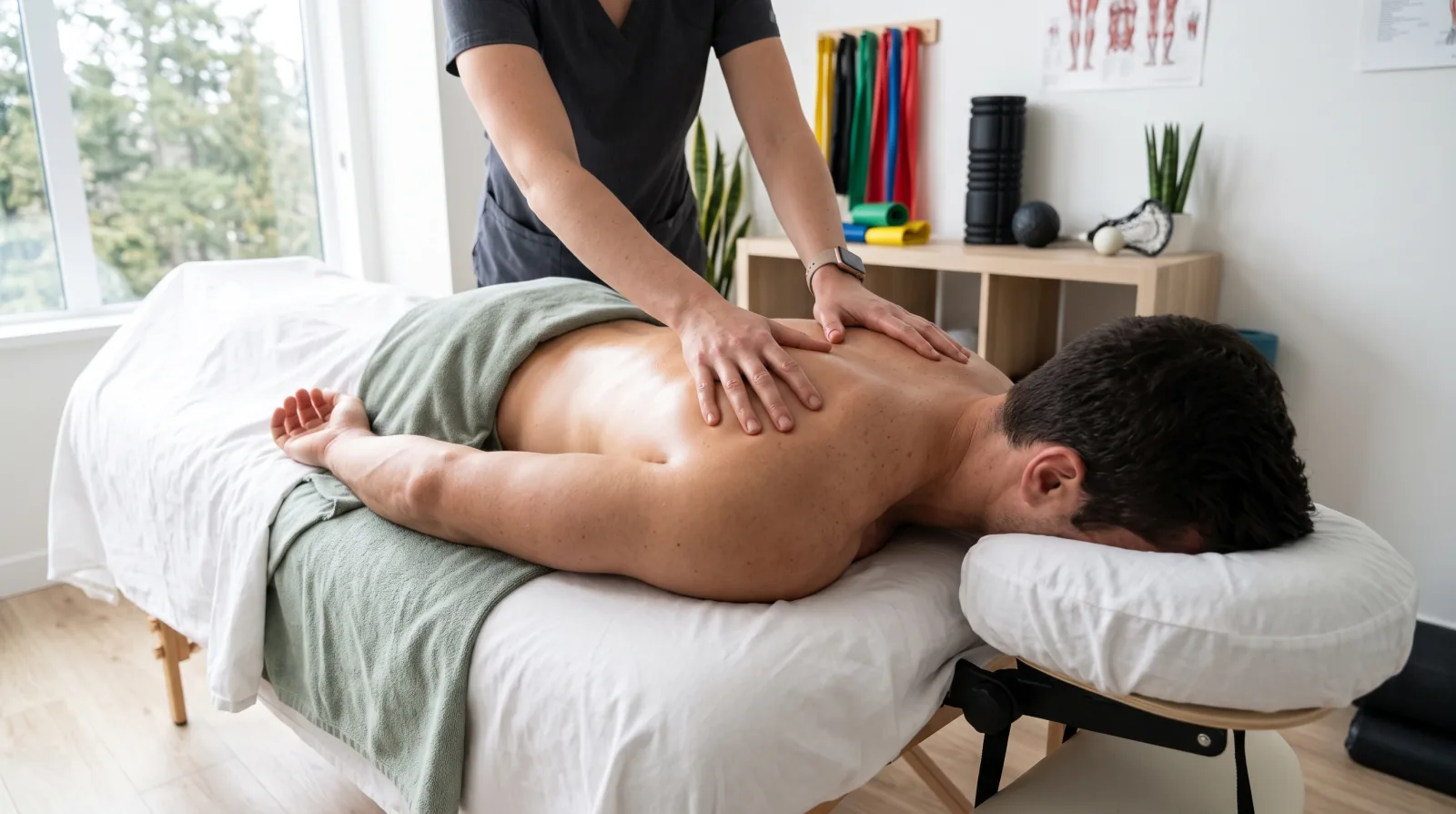
A sports massage booked as part of a training plan has a different purpose from a post-race relaxation session. This post covers what a sports-focused session with a registered massage therapist (RMT) involves, what the research found about it, and how to use it in a training plan alongside physiotherapy.
What an RMT Does in a Sports Session
A registered massage therapist in BC is regulated by the College of Complementary Health Professionals of BC (CCHPBC). A sports-focused session starts with an intake: your sport, current training volume and phase, recent events, what limits you now, and what you have already tried, such as foam rolling, stretching, physiotherapy or earlier massage. The intake decides where the session time goes.
Manual treatment then addresses tissue that is overloaded or restricted. The techniques commonly used are:
- Deep tissue work. Sustained pressure into muscle and the layers around it.
- Trigger point release. Sustained pressure on a tender spot within a muscle.
- Myofascial release. Slow, sustained tension across connective tissue.
- Stretching during treatment. The therapist takes a muscle through its range while applying pressure.
Pressure can feel intense. Tell your therapist if it is more than you want, because the pressure can be changed.
What the Research Found
The most useful single source is a 2020 systematic review and meta-analysis by Davis, Alabed and Chico in BMJ Open Sport & Exercise Medicine. It pooled 29 randomised studies with 1,012 participants and separate analyses for strength, jump, sprint, endurance, flexibility, fatigue and delayed onset muscle soreness (DOMS).
The authors found no evidence that massage improves measures of strength, jump, sprint, endurance or fatigue. They found small but statistically significant improvements in flexibility and DOMS. Their conclusion is that sports massage shows no evidence of improving performance directly, but may improve flexibility and DOMS.
For your training, this means massage has trial evidence for two things: easing muscle soreness after hard sessions and a small gain in flexibility. Gains in speed, strength or endurance come from training.
Massage also does not diagnose or repair a structural problem such as a torn labrum, a partial rotator cuff tear or a stress fracture. If a problem keeps returning after treatment, a physiotherapy assessment looks for the cause.
Where RMT Fits in a Training Plan
Which sessions suit you depends on your sport and phase:
- During a build phase. Soreness and tight muscles are common when volume or intensity rises. An RMT can work on the areas that are loaded in your sport.
- After a competition or hard block. Soreness often peaks in the days after. Tell your therapist how recently you competed so the pressure suits tender tissue.
- For a pattern that keeps returning. A tight hip flexor after long runs or a shoulder that tightens in heavy overhead weeks are examples. If treatment does not hold, ask for a physiotherapy assessment.
- While you train through a minor injury. Adjust your load and see a physiotherapist if the injury needs a diagnosis and a loading plan.
How often to book depends on your sport, your training phase and how you respond. Your RMT sets the interval with you.
How to Pair RMT With Physiotherapy
Physiotherapy looks for the mechanical cause of a problem and builds a plan to address it. RMT treats soft tissue while that plan runs. For example, a runner with pain on the outside of the knee may be assessed by a physiotherapist who finds hip weakness and prescribes strengthening. The runner may book RMT alongside it for the tight muscles around the hip. The physiotherapy plan addresses the cause, and the RMT sessions address how the tissue feels in the meantime.
If you are unsure which to book first, see our guide: RMT vs physio, which to book first.
After a Session
Follow your therapist's advice for the rest of the day, which can depend on what was treated and how firm the pressure was. Tell your RMT at the next visit what changed, such as a movement that is easier or soreness that appeared the next day. That helps them adjust the next session.
Coverage in BC
Many extended health plans cover registered massage therapy, and the annual limit and rules differ by plan, so check yours before you book a series of sessions. Most plans require the therapist to be a registered massage therapist. Our extended health benefits guide explains how the benefits work for physiotherapy, RMT and chiropractic.
ICBC pre-approves 12 registered massage therapy sessions in the first 12 weeks after a crash, as set in the Enhanced Accident Benefits Regulation (B.C. Reg. 59/2021). Launch Rehab does not accept WorkSafeBC claims for massage therapy. Our rates page lists private, ICBC and MSP rates for RMT.
RMT appointments are available at all five Launch Rehab studios, including RMT in North Burnaby and registered massage therapy in Richmond.
Frequently asked questions
Does sports massage improve athletic performance?
A 2020 meta-analysis of 29 randomised trials (1,012 participants) in BMJ Open Sport & Exercise Medicine found no evidence that massage improves strength, jump, sprint, endurance or fatigue measures. It found small but statistically significant improvements in flexibility and delayed onset muscle soreness. Gains in performance come from the training itself.
Does massage reduce muscle soreness after hard training?
Yes, to a small degree. The 2020 Davis meta-analysis of 29 randomised trials found a small but statistically significant improvement in delayed onset muscle soreness after massage, compared with control conditions. The same review found no evidence of improvement in strength, jump, sprint or endurance measures, so soreness is the better-supported reason to book.
How often should an athlete book sports massage?
There is no fixed interval. How often depends on your sport, your training phase, how sore you get, and how you respond to treatment. Your registered massage therapist sets the interval with you and can change it as your training load changes through the season. Check your extended health plan limit before booking a recurring series.
Is sports massage the same as a relaxation massage?
A sports session starts with an intake about your sport, training phase and limitations, and the treatment targets the structures your sport loads. A relaxation massage has a different aim and plan. Both can be delivered by a registered massage therapist, and you can tell the therapist which one you want when you book.
Can RMT replace physiotherapy for a recurring injury?
No. Massage treats soft tissue and does not diagnose a structural or movement cause. If a problem keeps returning after massage, a physiotherapy assessment looks for the cause and builds a plan. RMT and physiotherapy can run side by side, with the physiotherapist setting the plan and the RMT treating tissue between sessions.
Does ICBC cover sports massage after a car accident?
ICBC pre-approves 12 registered massage therapy sessions in the first 12 weeks after a crash, as set in B.C. Reg. 59/2021. That allowance covers RMT treatment within your ICBC claim. Massage you book privately for sport falls outside the claim, and our rates page lists the private rates.
Does WorkSafeBC cover registered massage therapy at Launch Rehab?
No. Launch Rehab does not accept WorkSafeBC claims for massage therapy, according to the rates page. If you are on an active WorkSafeBC claim, you can book RMT privately or through your extended health plan, and your physiotherapist can still treat you under the claim where Launch Rehab accepts it.
Do I need a doctor's referral to book sports massage at Launch Rehab?
No referral is needed to book registered massage therapy at Launch Rehab. You can book directly online with an RMT at any of the five studios. Some extended health plans ask for a physician's note before they reimburse massage, so check your plan's rules if you plan to claim.
If you have a specific athletic problem that keeps coming back, a physiotherapy assessment is usually the right starting point, and the RMT and physiotherapy plans can then be coordinated from there.
Sources
- Davis HL, Alabed S, Chico TJA, Effect of sports massage on performance and recovery: a systematic review and meta-analysis, BMJ Open Sport & Exercise Medicine, 2020
- College of Complementary Health Professionals of BC
- Enhanced Accident Benefits Regulation, B.C. Reg. 59/2021
WRITTEN BY
The Launch Rehab Team
Practical recovery and training notes from the clinicians at our five Metro Vancouver studios.
FOUND THIS USEFUL?
Share it with your network on LinkedIn. We wrote a ready-to-post version for you.
FILED UNDER
- rmt
- sports-massage
- registered-massage-therapy
- athletic-recovery
- performance
- bc
- training