Diastasis Recti After Pregnancy: What It Is and When Physiotherapy Helps
A 2016 cohort of 300 first-time mothers found a separation of the abdominal muscles in 33.1% at 21 weeks of pregnancy, 60.0% at 6 weeks after birth, and 32.6% at 12 months. Here is what the research says about exercise, back pain, and when to see a pelvic floor physiotherapist.
BY THE LAUNCH REHAB TEAM
A separation of the abdominal muscles after pregnancy is common, and the numbers are easy to misquote. In a 2016 cohort of 300 first-time mothers, the separation was found in 33.1% at week 21 of pregnancy, 60.0% at 6 weeks after birth, 45.4% at 6 months, and 32.6% at 12 months. A gap at the six-week check is therefore common, and many women still have one later in the first year.
This post covers what diastasis recti is, what the research says about exercise and back pain, and when a pelvic floor physiotherapist can help.
What Diastasis Recti Is
Diastasis recti is a separation of the linea alba, the band of connective tissue that runs vertically down the centre of the abdomen. It connects the two sides of the rectus abdominis (the paired muscles that run from the ribs to the pelvis), and the muscles themselves stay intact. The tissue between them stretches as the uterus expands during pregnancy.
The clinical term for the gap is the inter-rectus distance. Studies define diastasis in different ways, which is part of why the literature can look contradictory. The 2016 cohort above defined it as a palpated separation of two finger-widths or more, at 4.5 cm above, at, or 4.5 cm below the navel.
How Common It Is, and When It Closes
The same 2016 study, Sperstad and colleagues in the British Journal of Sports Medicine, followed the women from pregnancy to 12 months after birth. Prevalence at each point was:
- 33.1% at week 21 of pregnancy
- 60.0% at 6 weeks after birth
- 45.4% at 6 months after birth
- 32.6% at 12 months after birth
Those figures describe a group of first-time mothers in one study, and they used a finger-width examination. They show that a gap at the six-week check is common, and that for a third of the women it was still present at 12 months. The authors reported that heavy lifting 20 or more times a week was linked to higher odds of a separation (odds ratio 2.18, 95% confidence interval 1.05 to 4.52).
What the Gap Width Does and Does Not Tell You
Rehabilitation for diastasis recti has often aimed to reduce the inter-rectus distance. A 2016 ultrasound study by Lee and Hodges in the Journal of Orthopaedic and Sports Physical Therapy looked at a second measure, how much the linea alba distorts when the abdominal muscles work. In 26 women with diastasis and 17 controls, a natural curl-up narrowed the gap in the women with diastasis but also increased distortion of the linea alba. Activating the transversus abdominis (a deep abdominal muscle) before the curl-up gave less distortion. The authors describe the distortion measure as needing further validation, and the study was observational.
For you, this means a finger-width count measures one thing. A physiotherapy assessment looks at the gap, how the tissue between the muscles responds when you load it, and how you breathe and brace during everyday movement.
What the Research Says About Exercise
Two recent systematic reviews looked at exercise for postpartum diastasis:
- A 2025 meta-analysis in the British Journal of Sports Medicine (65 studies, 21,334 participants) found low-certainty evidence of a greater reduction in inter-rectus distance after abdominal muscle training than after no exercise. It describes the evidence on the effect of exercise on the risk of diastasis recti itself as limited. It also found moderate-certainty evidence that pelvic floor muscle training reduced the odds of urinary incontinence by 37% (odds ratio 0.63).
- A 2025 review in Medicine (34 randomised trials) found very low certainty evidence that abdominal exercises reduced inter-rectus distance by 6.82 mm compared with no intervention. Its authors say the results should be interpreted with caution.
Both reviews rate the certainty of the evidence as low or very low. Which exercises suit you depends on what an assessment finds.
Does Diastasis Recti Cause Back Pain?
The evidence is mixed. In the 2016 cohort, women with and without diastasis reported the same amount of lumbopelvic pain at 12 months after birth. A 2023 systematic review in World Neurosurgery of 13 studies (2,820 patients) found that 5 studies reported a link between diastasis and low back pain and 8 reported no link. Its authors say better studies are needed.
If you have back pain, pelvic girdle pain, or pain at the pubic bone that is not settling, that is a reason to be assessed whatever the gap measures.
Signs That Warrant a Physiotherapy Assessment
Whether you need treatment depends on your symptoms and findings. Consider an assessment if you notice any of the following:
- Doming or coning. The tissue at the midline pushes up in a ridge or dome when you sit up from lying down or do an abdominal exercise.
- Pelvic floor symptoms. Leaking when you run, jump, cough or sneeze, a feeling of heaviness in the pelvis, or bladder urgency.
- Weakness that persists. Your core still feels unable to take load several months after birth.
- Pain. Low back pain, pelvic girdle pain, or pain around the pubic bone.
- A bulge you are unsure about. A hernia is a gap in the abdominal wall through which tissue can protrude, and a medical assessment can tell the two apart.
What a Physiotherapy Assessment Covers
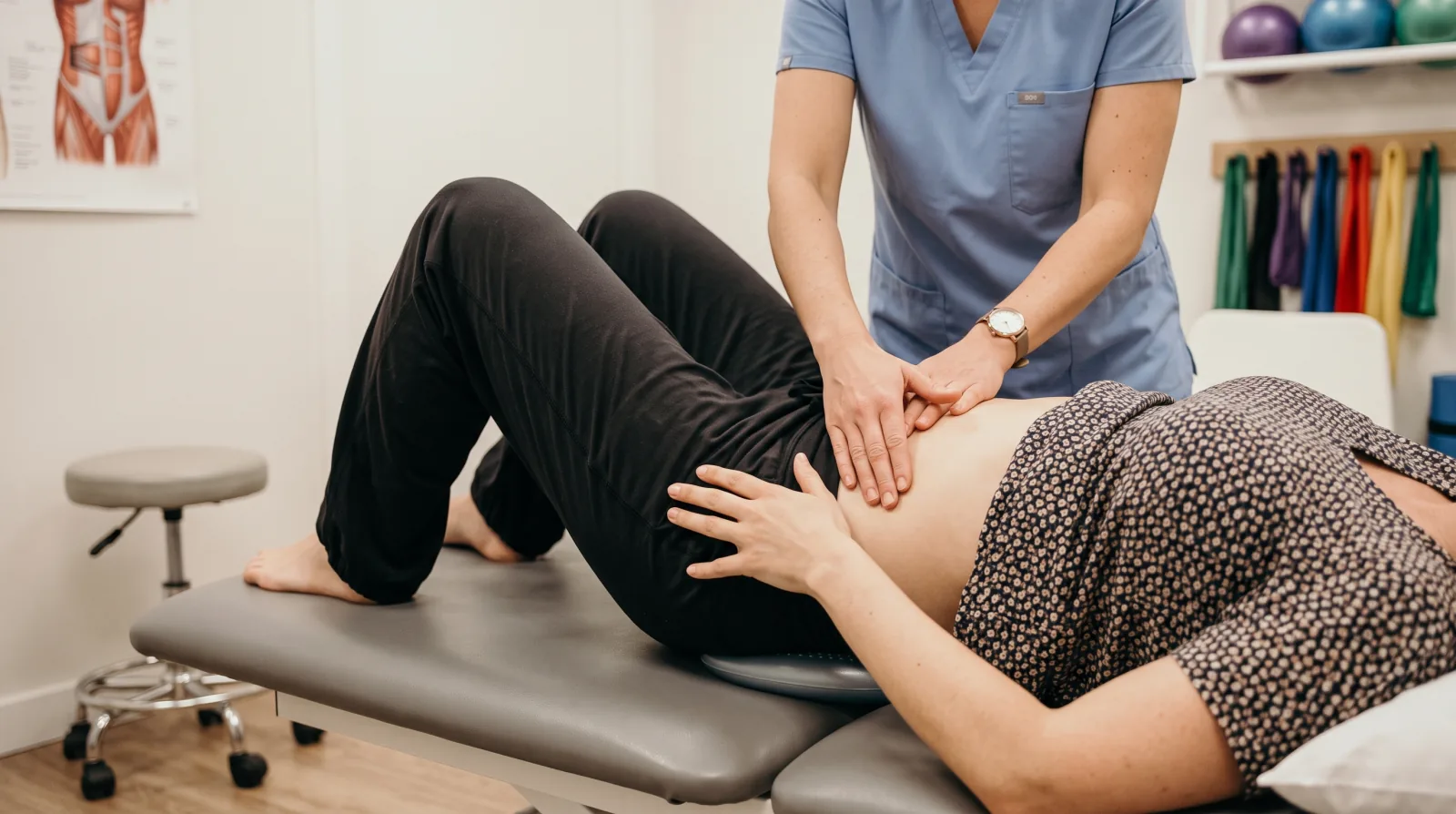
A pelvic floor physiotherapy assessment for diastasis recti looks at:
- The width of the gap and how the tissue along the midline responds to load
- How the deep abdominal muscles work with the pelvic floor
- How you breathe and brace during lifting, getting up from the floor and carrying
- Any pelvic floor symptoms, back pain or pelvic pain that go with the separation
The program is then built around your findings, from breathing and low-load movement towards the lifting, running or sport you want to return to.
Cost and Billing at Launch Rehab
Many extended health plans cover physiotherapy, and plans differ in what they pay. Launch Rehab accepts direct billing to participating insurance providers when available, but coverage cannot be guaranteed, so check your plan or call your studio before you book.
Booking at Launch Rehab
Our pelvic floor physiotherapists work from three of our Metro Vancouver studios: Lougheed, Coquitlam and North Burnaby. You can book at launch.janeapp.com and choose the studio closest to you. When you book a physiotherapy initial assessment, say that your concern is postpartum core or pelvic health.
Diastasis recti also occurs outside pregnancy, and we cover that in our post on diastasis recti in men.
Frequently asked questions
How common is diastasis recti after pregnancy?
In a 2016 cohort of 300 first-time mothers, a separation of two finger-widths or more was found in 60.0% of women at 6 weeks after birth, 45.4% at 6 months and 32.6% at 12 months. The study used a finger-width examination, and other studies use different definitions, so figures vary between studies.
What is the difference between diastasis recti and a hernia?
Diastasis recti is a stretching of the linea alba, the connective tissue down the middle of the abdomen. A hernia is a gap in the abdominal wall through which tissue can protrude. A bulge during core loading can look like either one, which is a reason to have a physiotherapist or doctor examine it if you are unsure.
Does the six-week postpartum check tell me everything about my core?
No single check does. A finger-width check measures the gap, and a 2016 ultrasound study of 26 women with diastasis found that the linea alba can distort when the abdominal muscles work, which a width measure does not capture. A physiotherapy assessment looks at the gap, the tissue response to load, breathing and pelvic floor symptoms.
Can exercise reduce the gap in diastasis recti?
Possibly. A 2025 meta-analysis in the British Journal of Sports Medicine found low-certainty evidence that abdominal muscle training reduced inter-rectus distance more than no exercise. A 2025 review in Medicine found very low certainty evidence of a 6.82 mm reduction. The reviews rate the certainty of the evidence as low or very low, and the 2025 Medicine review recommends caution in reading its results.
Does diastasis recti cause back pain?
The research is mixed. A 2016 cohort found no difference in lumbopelvic pain at 12 months between women with and without diastasis. A 2023 systematic review of 13 studies found a link in 5 and no link in 8. If you have back or pelvic pain that is not settling, a physiotherapy assessment is worth booking.
When should I see a pelvic floor physiotherapist for diastasis recti?
Consider an assessment if you notice doming or coning when you sit up, leaking or pelvic heaviness, bladder urgency, weakness that persists several months after birth, or pain in the low back, pelvis or pubic bone. An assessment shows whether your core and pelvic floor are coping with load.
Does pelvic floor training help after childbirth?
Yes for some outcomes. A 2025 meta-analysis in the British Journal of Sports Medicine (65 studies, 21,334 participants) found moderate-certainty evidence that pelvic floor muscle training reduced the odds of urinary incontinence by 37% and, in one trial of 123 women, the odds of pelvic organ prolapse by 56%, compared with control groups.
Which Launch Rehab studios offer pelvic floor physiotherapy?
Pelvic floor physiotherapy is available at the Lougheed, Coquitlam and North Burnaby studios. You can book through the online booking page and choose one of those studios. Launch Rehab accepts direct billing to participating insurance providers when available, and coverage cannot be guaranteed, so check your plan before the first visit.
Is diastasis recti only something that happens during pregnancy?
No. A separation of the linea alba can also develop in people who have never been pregnant. Our post on diastasis recti in men covers the causes there. Whatever the cause, an assessment of the tissue and of how you move is the starting point for deciding on a program.
This post is for general education. It is not a substitute for assessment or advice from a regulated health professional.
Sources
- Sperstad JB et al., Diastasis recti abdominis during pregnancy and 12 months after childbirth: prevalence, risk factors and report of lumbopelvic pain, British Journal of Sports Medicine, 2016
- Lee D, Hodges PW, Behavior of the Linea Alba During a Curl-up Task in Diastasis Rectus Abdominis: An Observational Study, Journal of Orthopaedic and Sports Physical Therapy, 2016
- Beamish NF et al., Impact of postpartum exercise on pelvic floor disorders and diastasis recti abdominis: a systematic review and meta-analysis, British Journal of Sports Medicine, 2025
- de Oliveira LC et al., Effects of conservative approaches for treating diastasis recti abdominis in postpartum women: a systematic review and meta-analysis, Medicine, 2025
- Sokunbi G et al., Is Diastasis Recti Abdominis Associated With Low Back Pain? A Systematic Review, World Neurosurgery, 2023
WRITTEN BY
The Launch Rehab Team
Practical recovery and training notes from the clinicians at our five Metro Vancouver studios.
FOUND THIS USEFUL?
Share it with your network on LinkedIn. We wrote a ready-to-post version for you.
FILED UNDER
- pelvic-health
- postpartum
- diastasis-recti
- core
- physiotherapy
- bc