Runner's Knee in BC: Why Patellofemoral Pain Keeps Coming Back, and What Actually Rebuilds It
Patellofemoral pain, runner's knee, is one of the most over-rested and under-rebuilt injuries we see. Rest reduces the pain. It rarely resolves the problem. The rebuild that does is a graded loading program targeting the hip as much as the knee.
BY KEANE LEUNG
Patellofemoral pain (runner's knee, anterior knee pain, chondromalacia, "PFP" in the literature) is one of the most common injuries in any clinic that treats runners. It is also one of the most frustrating, because the natural treatment that most people try first works just well enough to keep them stuck in the cycle.
The cycle: pain develops in the front of the knee during or after a run. The runner rests, often for a few weeks. The pain settles. The runner returns to running. Within a few weeks of returning, often at the same weekly mileage they stopped at, the pain comes back. Rinse and repeat.
What rest actually does is reduce the load on an aggravated joint. What rest does not do is address the reason the load became aggravating in the first place. This post is the longer version of why patellofemoral pain keeps returning and the rebuild plan that breaks the cycle. The short version is at the bottom.
What patellofemoral pain is
Patellofemoral pain is pain at or around the kneecap, usually worse with running (particularly downhill), stair descent, prolonged sitting with the knee bent ("theatre sign"), and squatting deeper than 90 degrees. It is a clinical diagnosis. Imaging is usually not required and rarely changes management. The 2018 international PFP consensus and the 2019 JOSPT clinical practice guidelines both make this explicit.
What patellofemoral pain is not:
- A tear of the patellar tendon or quadriceps tendon (those are distinct injuries with their own management).
- Meniscal pathology (different mechanism of pain, different testing).
- A "tracking" problem that requires special braces or insoles in most cases.
- Pre-arthritic damage that warrants imaging in a young runner with otherwise typical symptoms.
The condition is a load-tolerance mismatch. The patellofemoral joint is being loaded faster than it can tolerate, and the loading pattern (often hip-driven) increases the stress on a specific area of the joint surface.
Why hip strength is the lever
The single most replicated intervention finding in patellofemoral pain research over the last 15 years is that hip abductor and external rotator strengthening reduces pain and improves function more than knee-isolated work (Lack et al, BJSM 2015; JOSPT 2019 CPG). The mechanism, simplified:
- Weak hip abductors and external rotators allow the femur to adduct and internally rotate during single-leg loading. The running stride and stair descent are both single-leg loading tasks.
- That adduction-and-internal-rotation pattern moves the femur underneath the patella in a way that increases compressive stress on the lateral patellar facet.
- Over thousands of cycles in a run, the cumulative stress exceeds the joint's repair capacity. Pain emerges.
Stronger hip abductors and external rotators control the femur's position during loading. The patella tracks better, the loading pattern shifts, the joint stops being overloaded in the same way, and pain resolves.
This is why the rebuild program for patellofemoral pain in a competent physiotherapy clinic looks more like a strength program for the hips and posterior chain than a "knee program." The knee is the symptom site. The hip is the load source.
What does and doesn't work in the literature
Drawing from the JOSPT 2019 clinical practice guideline, the interventions with the strongest support:
- Hip and knee strengthening exercises combined: strong evidence for pain and function improvement.
- Patellar taping or bracing in the short term: moderate evidence for short-term pain reduction during the rebuild phase, not as a stand-alone treatment.
- Foot orthoses for a subset of patients: moderate evidence specifically for runners with substantial foot pronation. Not a universal recommendation.
- Gait retraining for selected runners: emerging evidence for runners with specific kinematic patterns. Not first-line for everyone.
- Manual therapy as a stand-alone intervention: not supported as a primary treatment.
- Knee-isolated exercises alone: less effective than combined hip and knee work.
- Patellofemoral mobilization: limited support.
- Modalities (ultrasound, laser, etc.): not supported as primary treatments.
- Stretching alone: limited support as a primary intervention.
The takeaway: a rebuild based on graded strength training, particularly hip-and-quad combined work, with appropriate return-to-run progression. Other modalities are adjuncts at most.
The structured rebuild program
A typical 6 to 12 week patellofemoral pain rebuild in our clinics, simplified:
Weeks 1 to 2: De-load and re-orient
- Run volume reduced to a level that doesn't significantly aggravate pain in the 24 hours after. For many patients this is half their current weekly volume, occasionally zero for the first week if pain is severe at rest or daily.
- Begin strength work 2 to 3 times per week. Starting exercises typical for this phase: side-lying clamshells, single-leg bridges, side-lying hip abduction, isometric quad work in pain-free range, calf raises.
- Address obvious training-error contributors: shoe age, recent volume jump, new terrain (lots of downhill running, new hill training), recent introduction of speed work.
Weeks 3 to 6: Build the base
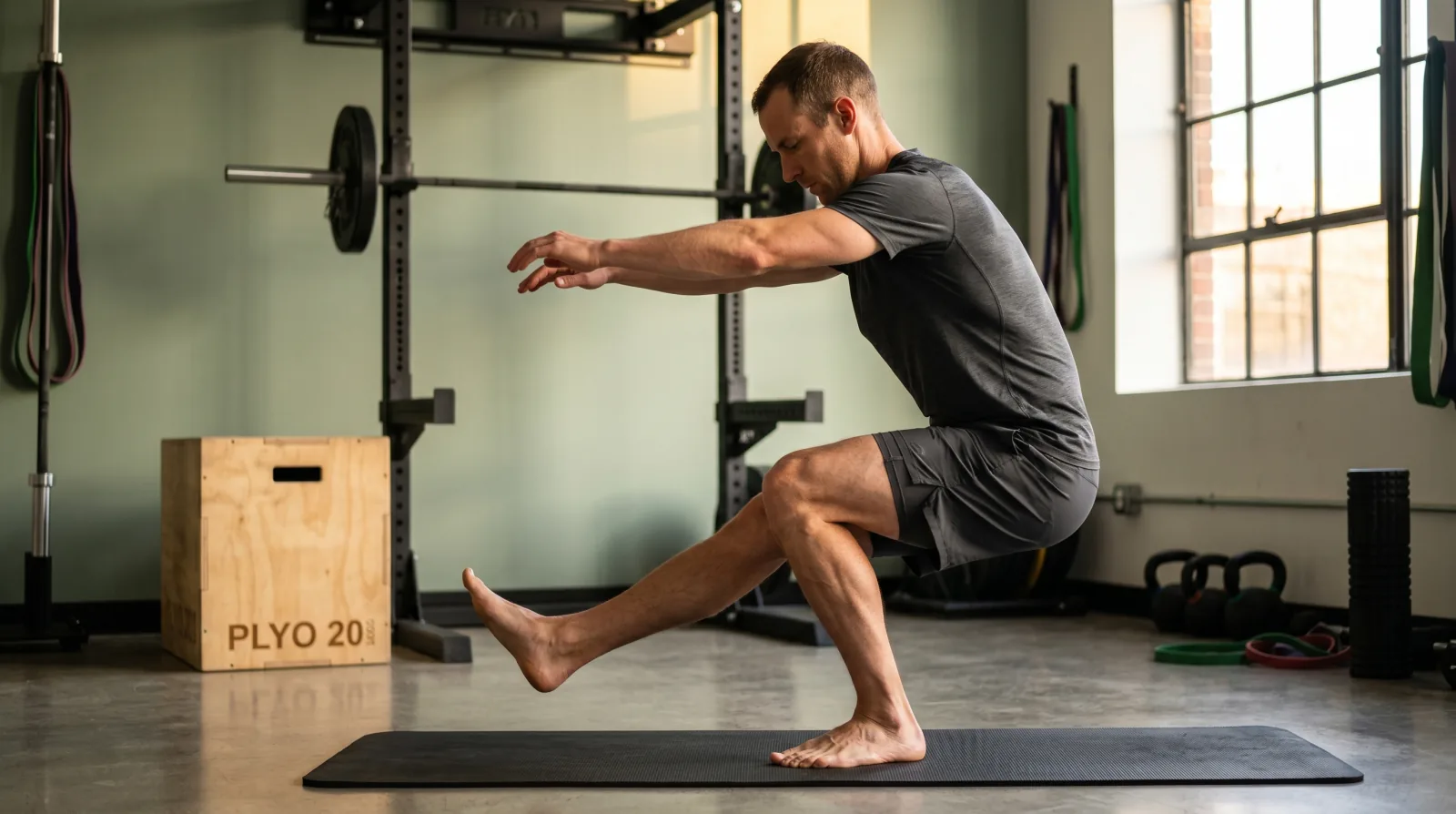
- Strength sessions progress from bodyweight to loaded. Key exercises in our typical program: single-leg squats to a box, step-ups, split squats, hip thrusts, single-leg Romanian deadlifts, side-plank with hip abduction, calf raises with progressing load.
- Strength work moves to 3x/week, with two heavier sessions and one lighter session.
- Running, if tolerated, follows a 10%-per-week progression on weekly volume. Pain during running is acceptable at a low level (2 to 3 out of 10) if it doesn't worsen across the run and settles within 24 hours. Pain that worsens across the run, or persists into the next day, is a signal to back off volume.
Weeks 7 to 12: Re-introduce load complexity and return to full volume
- Strength work continues with progression. The endpoint isn't a specific exercise list. It is the ability to load the hip and quad to a level meaningfully greater than the demands of the running goal.
- Running progression continues with 10%-per-week volume increases, with a "back-off" week every fourth week at 70% of the prior week's volume.
- Speed work, hill work, and downhill running are reintroduced gradually in the second half of this phase.
The 12-week mark is not a hard cutoff. Some patients with longer-standing PFP take 4 to 6 months to fully resolve. Some resolve in 4 to 6 weeks. The variability is normal.
Where patients often go wrong
A handful of patterns we see often, none of which are subtle:
- Rest only. Pain settles in 2 weeks, the runner returns to the same mileage, the pain returns. Rest without rebuilding is a cycle.
- Returning to volume too fast. The classic 10%-per-week guideline is a useful ceiling. Faster increases reliably aggravate PFP.
- Strength work that's too light to be useful. Banded clamshells are a fine starting point. They are not the rebuild. Single-leg squats with weight, split squats, and hip thrusts at meaningful loads are the rebuild.
- Stretching as the main intervention. Calf and quad stretching may help if range of motion is restricted, but stretching is not a rebuild program for a strength-deficit-driven condition.
- Replacing physio with a brace or orthotic. Both can help in the right circumstances as adjuncts. Neither replaces the rebuild.
- No back-off weeks. Linear weekly increases without recovery weeks reliably stall.
When to seek assessment
Most patellofemoral pain resolves with the rebuild program. The signs that warrant earlier physiotherapy assessment (or, in some cases, sports medicine physician assessment):
- Pain that is severe at rest, wakes you at night, or is associated with significant swelling.
- A specific traumatic mechanism (a fall onto the knee, a twist with a pop) rather than a gradual onset.
- Locking, catching, or giving way of the knee, which suggests internal joint pathology.
- Failure to improve after 6 to 8 weeks of appropriate rehabilitation.
- Bilateral simultaneous onset in a younger athlete (sometimes a marker for a systemic contributor).
Coverage in BC
Patellofemoral pain treatment in BC is typically covered as standard physiotherapy:
- Extended health insurance: most private plans cover physiotherapy at a per-visit rate.
- MSP: limited visits per year for Supplementary Benefits enrolees.
- ICBC: if the patellofemoral pain is related to a motor vehicle crash (direct trauma to the knee, or compensatory loading from a leg injury) Enhanced Care covers physiotherapy.
- WorkSafeBC: covers work-related onset.
Where this connects
Knee pain that turns out to be neck-or-back-driven, hip-driven, or part of a larger crash recovery sometimes shares roots with topics we've covered. The lower back pain post covers the trunk-loading side. The ICBC physio guide covers crash-related coverage. And if knee pain has been treated as if it were a quad-only or stretch-only problem, the IMS vs acupuncture piece is worth a look. IMS is a useful adjunct for the protective muscle guarding that PFP often produces, though it is never the primary treatment.
At Launch Rehab, the patellofemoral assessment includes a treadmill gait review when the presentation suggests a running-mechanics contribution, because hip-drop at midstance is often the load source that no amount of clamshell work at home will fix on its own.
The shortest version: runner's knee is a load-tolerance problem, not a tissue-tear problem. Rest is the first move, not the rebuild. The rebuild is hip-focused strength work plus a controlled return-to-run progression. Done well, it usually resolves in 6 to 12 weeks. Done poorly, it cycles.
Frequently asked questions
How long does runner's knee take to heal?
Most cases of patellofemoral pain resolve meaningfully in 6 to 12 weeks with a structured hip and quad strengthening program plus a controlled return-to-run progression. Cases with prolonged history or high weekly mileage at the time of onset typically take toward the longer end. The cases that don't progress are usually those where training load was maintained through the strengthening phase.
Can I keep running with runner's knee?
Often yes, with a reduction in volume and intensity. Cutting mileage by 30 to 50% while starting the strengthening program is a reasonable starting point. Running to the point where pain spikes above 3/10 and lingers past the session is the signal that load is too high. Your physiotherapist will set a more specific return-to-run plan based on the assessment findings.
Is patellofemoral pain the same as patellar tendinopathy?
No. Patellofemoral pain (runner's knee) is pain around and behind the kneecap from load-sharing problems between the patella and the groove it tracks in. Patellar tendinopathy is pain at the patellar tendon itself, lower on the kneecap, worse with jumping and explosive loading. Both respond to loading programs but the specifics differ, which is why an accurate assessment matters before starting a program.
What exercises are best for runner's knee?
Hip abductor and external rotator strengthening is the most evidence-supported approach: side-lying clams, resistance band walks, single-leg glute bridges, and lateral step-downs. Quad strengthening through a comfortable range complements the hip work. The Petersen protocol (single-leg decline squat) is effective for more advanced stages. All exercises are progressively loaded.
Do I need a referral to book physiotherapy for runner's knee in BC?
No. Physiotherapy is direct-access in BC. Book directly without a physician referral. If you are managing an ICBC or WorkSafeBC claim that includes the knee, bring your claim number to the first visit and we will handle the billing. A referral from a family physician can still be useful for extended health plans that require one, but it is never a requirement to be seen.
Do knee braces or taping help with patellofemoral pain?
They can help in the short term. Patellar taping and bracing have moderate evidence for reducing pain during the rebuild phase, which can make the strengthening program more tolerable to start. Neither is a stand-alone treatment. Relying on tape or a brace without the underlying hip and quad strength work tends to leave the same load-tolerance problem unresolved once the support comes off.
Why does runner's knee often affect both legs?
Bilateral patellofemoral pain is common because the hip strength deficits that drive the condition, particularly weak hip abductors and external rotators, are often symmetric across both sides. A runner whose training volume and mechanics have outpaced their strength on one side has frequently done the same to the other, even if one knee became symptomatic first.
Can foot type or shoe choice cause runner's knee?
Sometimes, but it is not the primary driver for most people. Foot orthoses have moderate evidence specifically for runners with substantial foot pronation, and a poor-fitting or badly worn shoe can be a contributing factor. For most patellofemoral pain presentations, though, hip strength explains more of the loading pattern than foot type does, which is why orthotics alone rarely resolve the condition.
Is patellofemoral pain more common in women than men?
Yes. A 2018 systematic review in PLOS One pooled the available epidemiology and reported annual prevalence in the general adult population at 29.2 percent for women and 15.5 percent for men (Smith et al, PLOS One 2018). The review's authors caution that case definitions vary between studies, so treat those as the best available figures rather than settled ones. Differences in hip and pelvic mechanics are one proposed explanation, and the mechanism is still debated. The rehab approach, hip-focused strengthening with a graded return to running, is the same regardless of sex.
This article is general information, not personal medical advice. A regulated practitioner can confirm whether the patterns described apply to your specific presentation.
WRITTEN BY
Keane LeungBSCPT, CAFCI, Vestibular and Concussion Therapy (HE/HIM/HIS)
Physiotherapist
Practical recovery and training notes from the clinicians at our five Metro Vancouver studios.
READ FULL PROFILEFOUND THIS USEFUL?
Share it with your network on LinkedIn. We wrote a ready-to-post version for you.
FILED UNDER
- runners-knee
- patellofemoral
- running-injury
- physiotherapy
- rehab
- knee
- bc