
Carpal Tunnel Syndrome: Conservative Care Before Surgery
Numb thumb and fingers that wake you at 3am usually point to the median nerve, not the whole hand. Here is what conservative care can do before anyone reaches for a scalpel, and the signs that mean surgery should not wait.
BY KEANE LEUNG
If your thumb, index, and middle finger go numb and tingly, and it is worst in the middle of the night, that pattern usually points to one nerve at one spot. The question most desk and trades workers ask first is whether they can settle it without surgery. For mild-to-moderate cases, the honest answer is often yes, and the work starts well before anyone discusses an operation.
Why the pattern points to the median nerve
Carpal tunnel syndrome (CTS) is compression of the median nerve where it passes through a narrow channel at the front of the wrist. The Journal of Orthopaedic & Sports Physical Therapy clinical practice guideline on carpal tunnel syndrome describes the classic picture: numbness, tingling, and sometimes weakness in the part of the hand that nerve supplies, which is the thumb, index, middle, and half of the ring finger. The little finger is supplied by a different nerve, so true CTS usually spares it.
The night pattern is the giveaway most people recognise. Symptoms that wake you and ease when you shake the hand out are common with CTS, and many people sleep with the wrist curled, which narrows the tunnel further. A burning or numb hand at 3am, relieved by hanging the arm off the bed, is a story we hear in the clinic almost weekly.
One thing worth saying plainly: a physiotherapist can assess the pattern, but the formal diagnosis often involves a physician. Nerve conduction studies, which measure how well the nerve carries signal, are ordered by a doctor, not by us. A physiotherapy assessment screens the presentation, rules out other sources, and decides whether conservative care is reasonable or whether you need that physician referral first.
What conservative care actually means
For mild-to-moderate CTS, the first line of treatment is the unglamorous stuff, and it has reasonable support. A 2023 Cochrane review on splinting for carpal tunnel syndrome found that night-time splinting may produce a higher rate of overall short-term improvement than no treatment. The authors are careful: the evidence is low-certainty and rests on a small study, so we present splinting as a low-risk option worth trying, not a guarantee.
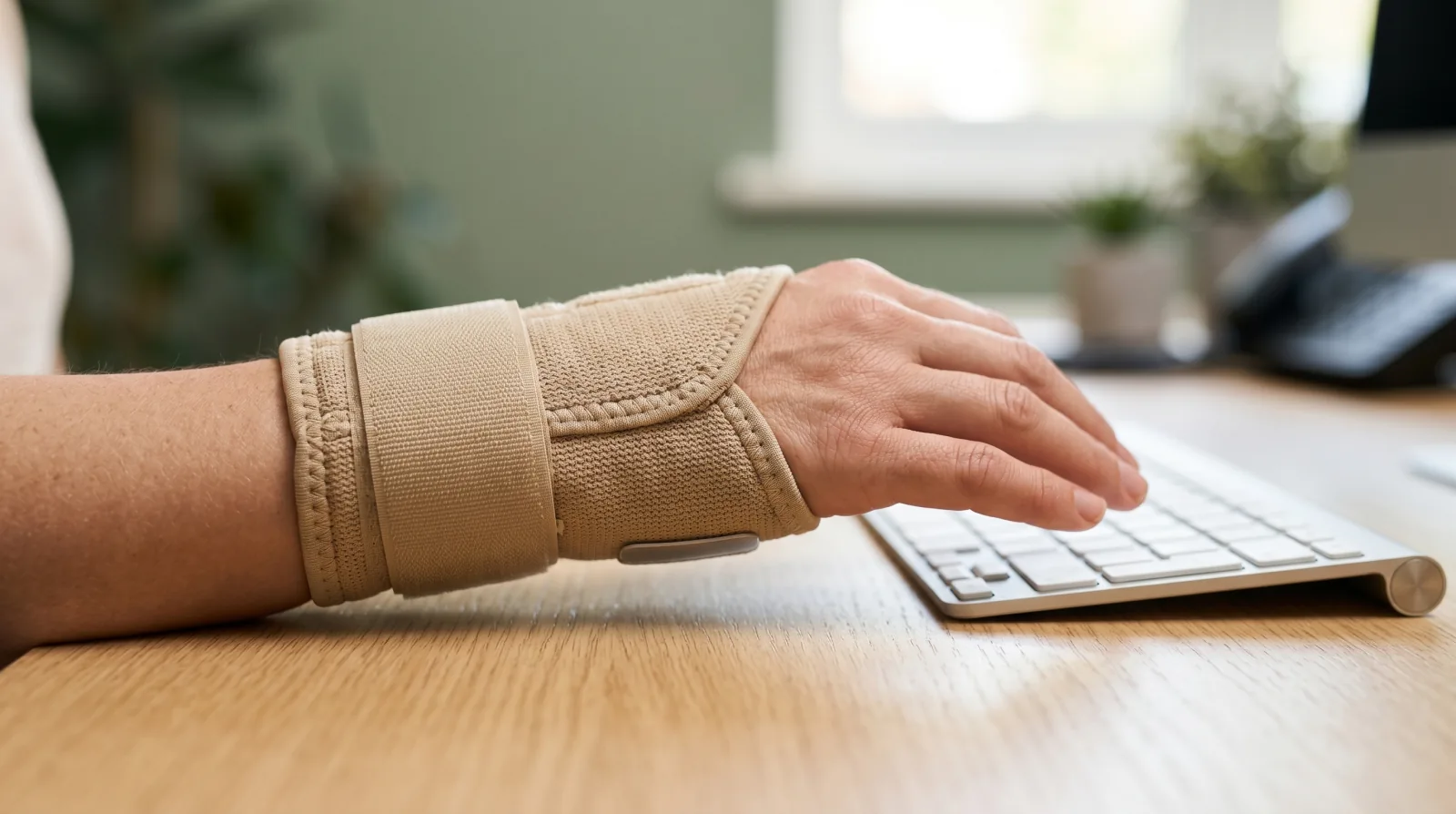
The logic is simple. A neutral wrist splint worn at night stops you curling the wrist while you sleep, which is when many people compress the nerve most. It does not fix anything structural. It removes a nightly insult so the nerve gets a calmer few hours, and that often translates into fewer night-time wakings within the first weeks. Splints are inexpensive and carry little downside, which is why they tend to lead the plan.
Beyond the splint, conservative care usually adds activity and ergonomic modification, plus movement work. The point of ergonomic changes is not a perfect desk. It is reducing the hours per day the wrist spends bent or loaded at end range.
Movement and manual therapy have a supporting role
Nerve and tendon gliding exercises are gentle movements that help the median nerve and the tendons beside it slide more freely through the tunnel. A 2015 systematic review of randomized trials in the Journal of Physical Therapy Science found that gliding exercises, when added to conventional treatment, may improve symptoms and function compared with conventional treatment alone. The signal is favourable rather than definitive, and the review notes the exercises look better as an add-on than as the whole plan.
That matches how we use them. Gliding work, light manual therapy to the wrist and forearm, and targeted strengthening sit alongside splinting and load changes rather than replacing them. We pick the combination based on what the assessment finds, including how irritable the nerve is, your work demands, and whether your symptoms are mostly at night or all day. A kinesiologist can help build the work-specific loading and habit changes once the acute irritability has settled.
We avoid putting a fixed timeline on this. Recovery from CTS depends on how long it has been compressed, how severe it is, your general health, and how much you can modify the aggravating activity. Your therapist will set expectations after the first assessment rather than promising a number we cannot stand behind.
The signs that mean surgery should not wait
Conservative care is the right starting point for mild-to-moderate CTS. It is the wrong starting point for severe CTS, and the difference matters. When the nerve has been compressed long and hard enough, the muscle at the base of the thumb can start to waste, a sign clinicians call thenar atrophy. Constant numbness that no longer comes and goes, and obvious hand weakness, point the same way.
Those features push the decision toward a surgical opinion sooner rather than later, because a nerve that has sustained damage may not fully recover even after the pressure is released. The American Academy of Orthopaedic Surgeons clinical practice guideline on carpal tunnel syndrome is the reference for surgical management. Our job at the conservative-care stage is to recognise when your presentation has crossed out of it and to get you back to your physician promptly.
This is also why we screen before we treat. A few weeks of splinting and gliding for a hand that actually needs a surgical referral is a few weeks wasted on a nerve that does not have them to spare. The assessment exists to sort which group you are in.
How this fits with the rest of your body's signals
Hand numbness does not always start at the wrist. Tingling that follows a different finger pattern, that involves the neck or shoulder, or that changes with neck position can come from higher up. We wrote about that overlap in tech neck and persistent neck pain, because a desk setup that strains the neck and a desk setup that strains the wrist often arrive together. Part of a good hand assessment is checking that the neck is not the real driver, or not the only one.
If your symptoms are clearly the classic CTS pattern, are mild-to-moderate, and have not responded to a few weeks of honest splinting and activity change, that is a reasonable point to book a physiotherapy assessment and have us reassess the plan. At Launch Rehab, the assessment also checks whether the neck or shoulder is contributing to the hand symptoms, since desk-driven nerve irritation rarely starts at just one point. If they are severe, getting worse, or involve thumb-muscle wasting, that is a physician conversation about surgery, not a physio booking. Either way, the assessment decides the path. Coverage and fee questions are answered on our rates and FAQ page.
Frequently asked questions
Can carpal tunnel be treated without surgery?
Often, yes, for mild-to-moderate cases. Night splinting, activity and ergonomic changes, and nerve gliding are the usual first-line options, and many people improve enough to avoid an operation. Severe cases with constant numbness or thumb-muscle wasting are a different story and need a surgical opinion.
Do night splints really help carpal tunnel?
A 2023 Cochrane review found night splinting may improve symptoms more than no treatment in the short term, though the certainty of that evidence is low. Splints are cheap and low-risk, so they usually lead the plan even if the effect varies between people. A neutral wrist splint works by stopping you curling the wrist while you sleep, which is when compression tends to be worst.
Will a physiotherapist diagnose my carpal tunnel?
No, not formally. A physiotherapist assesses the symptom pattern and decides whether conservative care is reasonable, but the diagnosis often involves a physician, and nerve conduction studies, which measure how well the nerve carries signal, are physician-ordered. We coordinate with your doctor when testing or a referral is needed.
Are carpal tunnel exercises enough on their own?
Usually not on their own. A 2015 systematic review found nerve and tendon gliding exercises work better as an add-on to other conservative care than as the whole treatment. We combine them with splinting, load changes, and manual therapy based on what the assessment shows.
When is carpal tunnel surgery actually necessary?
When the nerve shows signs of lasting damage. Constant numbness, hand weakness, and wasting of the muscle at the base of the thumb point toward surgery, and delaying can mean a poorer recovery. The AAOS guideline is the reference for that decision, made with your physician.
How long until carpal tunnel symptoms settle with conservative care?
There is no fixed timeline. It depends on how long and how severely the nerve has been compressed, your general health, and how much you can change the aggravating activity. Your therapist will give you a realistic expectation after the first assessment rather than a number we cannot stand behind.
Should I wear a wrist splint during the day or only at night?
Night splinting has the clearest support, since it stops the wrist curling while you sleep, which is when compression tends to be worst. Daytime splinting can help during specific aggravating tasks, but wearing it all day can reduce grip strength and get in the way of work, so your therapist will usually target it to sleep and to the activities that flare your symptoms.
Is carpal tunnel syndrome caused only by typing and keyboard use?
Not only. Repetitive wrist bending and gripping contribute, but carpal tunnel syndrome is also linked to pregnancy, diabetes, thyroid conditions, and other factors that increase pressure in the tunnel or affect the nerve directly. A physiotherapy assessment considers your broader health picture, not just your workstation, when building a plan.
Can carpal tunnel symptoms be a WorkSafeBC claim?
If the repetitive strain that caused your symptoms happened on the job, it may qualify as a WorkSafeBC claim, with physiotherapy covered from an accepted claim. Report the injury to your employer and to WorkSafeBC as early as possible, since that starts the process that determines what care is covered.
What happens if conservative care for carpal tunnel does not work?
If splinting, activity changes, and gliding exercises have not eased symptoms after a fair trial, or if signs like constant numbness or thumb weakness appear, the next step is a physician conversation about nerve conduction studies and a possible surgical referral. Conservative care and surgery are not opposing choices. They are sequential steps depending on how the nerve responds.
This article is general information, not personal medical advice. A regulated practitioner can confirm whether the patterns described apply to you.
Sources
- Hand Pain and Sensory Deficits: Carpal Tunnel Syndrome, JOSPT clinical practice guideline, 2019 (PubMed record)
- American Academy of Orthopaedic Surgeons: Management of Carpal Tunnel Syndrome clinical practice guideline
- Splinting for carpal tunnel syndrome: Cochrane systematic review, 2023
- Efficacy of tendon and nerve gliding exercises for carpal tunnel syndrome: systematic review of randomized controlled trials, Journal of Physical Therapy Science, 2015
WRITTEN BY
Keane LeungBSCPT, CAFCI, Vestibular and Concussion Therapy (HE/HIM/HIS)
Physiotherapist
Practical recovery and training notes from the clinicians at our five Metro Vancouver studios.
READ FULL PROFILEFOUND THIS USEFUL?
Share it with your network on LinkedIn. We wrote a ready-to-post version for you.
FILED UNDER
- carpal-tunnel
- hand-pain
- nerve-pain
- physiotherapy
- splinting
- bc