Lateral Hip Pain: The Truth About Gluteal Tendinopathy
Pain on the outside of the hip that flares when you lie on that side or stand up after sitting is rarely the bursitis it gets called. Here is what it usually is, why an injection often is not the answer, and how the loading actually works.
BY THE LAUNCH REHAB TEAM
Pain on the outside of the hip, the kind that bites when you lie on that side at night or stand up after a long sit, gets called bursitis far more often than it should. The more accurate name changes the plan, because what helps a tendon problem is different from what most people picture when they hear the word bursitis.
Why "bursitis" is usually the wrong label
For years, lateral hip pain was blamed on an inflamed bursa, the small fluid sac that sits over the bony point of the hip. That picture has shifted. The umbrella term clinicians now use is greater trochanteric pain syndrome, and a review of its diagnosis and management in general practice describes the syndrome as attributable to tendinopathy of the gluteus medius and/or minimus, with or without coexisting bursal pathology. In plain terms, the main problem is usually the gluteal tendons where they attach to the bone, not the bursa.
That distinction matters because it changes what helps. A tendon that has lost its tolerance for load does not get better by resting and waiting for inflammation to settle. It gets better by being asked to carry load again, gradually, in a way it can handle. The bursa may be irritated alongside the tendon, but treating the bursa alone tends to leave the underlying problem untouched.
What lateral hip pain usually feels like
The classic pattern is pain over the bony point on the outside of the hip, sometimes spreading down the outer thigh. People often report it is worst lying on the affected side in bed, which is why sleep is one of the first things it disrupts. Standing up after sitting, climbing stairs, and standing on one leg to pull on trousers are common aggravators.
It shows up most in two groups. One is women around or past menopause, where it is a frequent cause of stubborn hip pain. The other is runners and walkers who have ramped up distance, hills, or cambered surfaces quickly. The thread connecting both is load that outpaced what the tendon could tolerate. None of this is a diagnosis you can make from a description alone. An assessment screens for hip joint problems, low back referral, and other causes that can mimic the same area, which is part of why we examine before we treat.
What compresses the tendon, and why position matters
The gluteal tendons run over the bony point of the hip. They get compressed when the thigh crosses the midline of the body, a movement called hip adduction. Positions that pull the knee toward or across the centre line load the tendon against the bone and tend to keep an irritable tendon irritable.
This is why a few everyday habits matter more than they seem. Sitting with legs crossed, standing with your weight slumped onto one hip, sleeping on the painful side, and sleeping on the good side with the top knee dropped across to the mattress all compress the tendon. Early on, the most useful changes are often the dull ones: stop crossing the legs, stand with weight even through both feet, and put a pillow between the knees in side-lying so the top leg stays in line with the hip rather than dropping across. These do not fix the tendon. They stop you provoking it between sessions so the loading work has room to do its job.
What the evidence says about exercise versus injection
This is where the research is unusually clear for a musculoskeletal condition. The LEAP trial, published in the BMJ in 2018, randomised people with gluteal tendinopathy of more than three months into three groups: education plus exercise, a single corticosteroid injection, or a wait-and-see approach. At eight weeks, the education-plus-exercise group reported global improvement in about 77 percent of cases, compared with roughly 59 percent for the injection group and 29 percent for wait-and-see.
The longer follow-up is the part worth sitting with. At 52 weeks, the education-plus-exercise group still reported better global improvement, around 78 percent, than the injection group at about 57 percent. The trial's authors concluded that education plus exercise performed better than corticosteroid injection use. An injection can quiet symptoms in the short term, but in this trial it did not match a structured loading programme over the year that followed, and at one year the wait-and-see group had largely caught up to the injection group on improvement. That is a strong argument for putting the loading work first rather than leading with a needle.
We have seen the same theme in other tendon-driven problems, including the loading-first approach we describe for runner's knee and patellofemoral pain. The tissue is different, the principle holds.
How loading the gluteal tendon actually works
The "exercise" in that trial was not a generic stretch routine. It was progressive loading of the hip abductors, the muscles that hold the pelvis level, paired with education on avoiding the compressive positions above. Stretching the outside of the hip, which feels intuitive, often pulls the tendon back into the compressed position that aggravates it, so it is usually not the place to start.
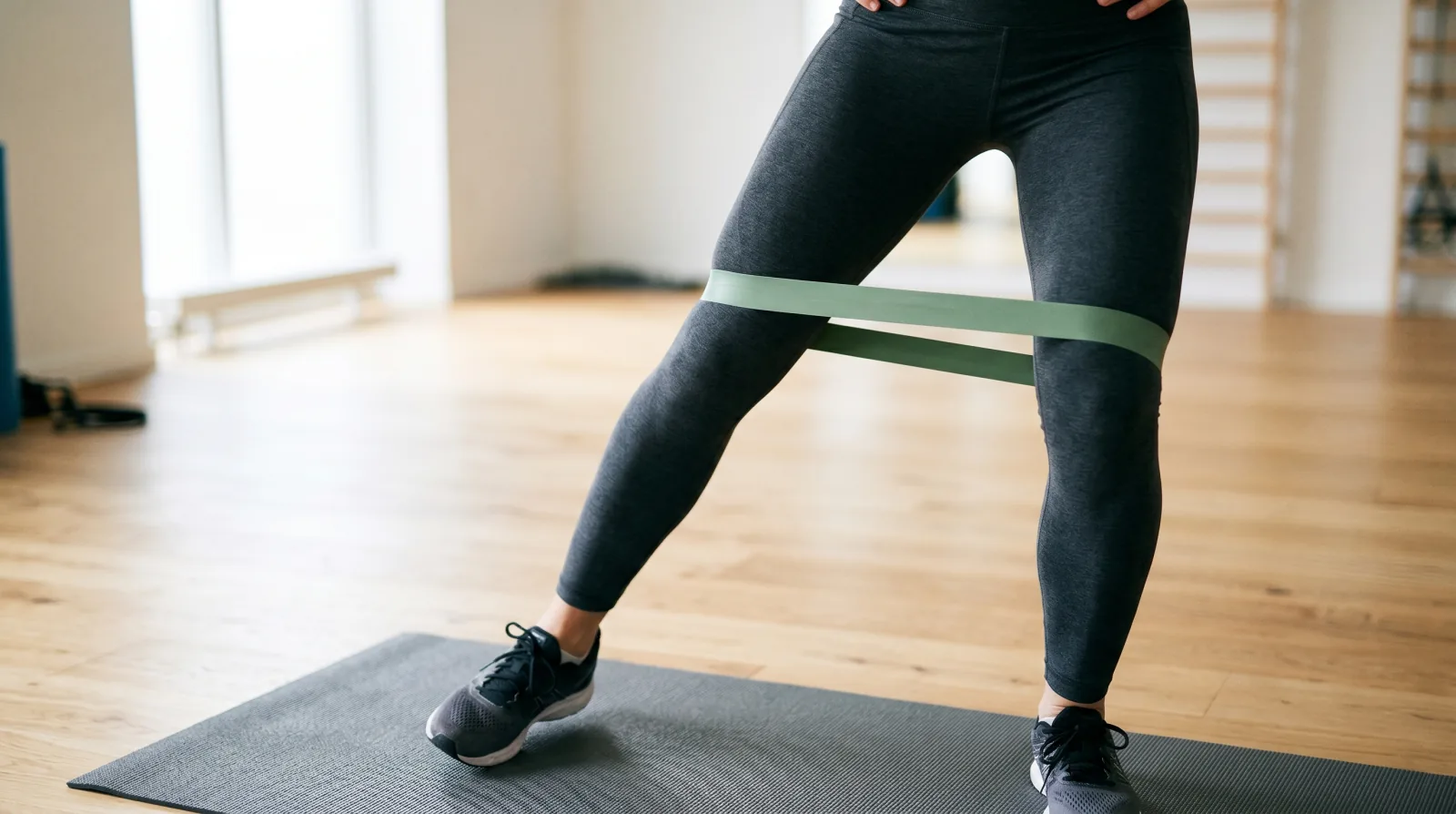
In our clinic, the early phase tends to focus on isometric holds, steady contractions of the hip muscles without much movement, which many people find calms an irritable tendon enough to begin. From there the load builds toward exercises that ask the muscle to control the pelvis through more range and eventually under the demands of walking, stairs, and for runners a graded return to running. A physiotherapist sets the starting point based on how irritable the tendon is at assessment, and a kinesiologist can carry the progression forward once the plan is stable and the work shifts to building capacity. The reason we stage it this way is simple: too much too soon flares the tendon, and too little never challenges it enough to change.
Timelines depend on how long the tendon has been irritable, your baseline activity, body composition, and how consistently the provoking positions are avoided between sessions. Tendons respond to load over weeks to months, not days, and progress is rarely a straight line. A flare after a busy day is information your therapist uses to adjust the load, not proof the plan has failed.
When to get it assessed, and what coverage applies
If the outside of your hip has hurt for more than a few weeks, is disrupting your sleep, and is not settling with the position changes above, that is a reasonable point to get it looked at. At Launch Rehab, the first session for lateral hip pain distinguishes gluteal tendinopathy from hip joint referral and low back referral before the loading plan is set, because treating the wrong source adds weeks to a recovery that already moves slowly. The value of an assessment is partly ruling things out. Hip joint arthritis, low back referral, and tears within the gluteal tendons can present in the same region and change the plan. Sudden weakness, numbness, fever, or pain after a significant fall are reasons to contact your physician rather than book rehab.
Physiotherapists in BC are regulated by the College of Health and Care Professionals of BC (CHCPBC), which oversees the protected titles and standards of practice for the profession. That regulation is part of why an assessment leads with screening before any treatment begins. For what physiotherapy and kinesiology cost, and how extended health, ICBC, or other plans tend to apply, current figures live on our rates and FAQ page, where they stay accurate.
If lateral hip pain has been nagging for months and resting it has not worked, that pattern fits a tendon that needs graded load rather than more rest. Book a physiotherapy assessment and we will screen it, confirm whether the picture matches gluteal tendinopathy, and set a starting load you can actually tolerate.
Frequently asked questions
Is lateral hip pain the same as hip bursitis?
Usually no. The condition is now understood mainly as gluteal tendinopathy, a problem with the gluteus medius and minimus tendons, with the bursa irritated alongside in some cases rather than being the main driver. The distinction matters because a tendon problem responds to graded loading, while treating the bursa alone often leaves the underlying tendon issue untouched and the pain returns.
Should I get a cortisone injection for gluteal tendinopathy?
It may ease pain in the short term, but in the LEAP trial a structured education-and-exercise programme produced better global improvement than a single corticosteroid injection at both eight weeks and one year. Most people are better served starting with loading work, since the injection does not change how much load the tendon can tolerate and can encourage a return to the same compressive habits that caused the problem.
Why does it hurt more when I lie on that side at night?
Lying on the painful side compresses the gluteal tendons against the bony point of the hip. A pillow between the knees in side-lying, and avoiding sleeping on the sore side, often reduces the night pain while the tendon recovers. Standing with weight slumped onto one hip and sitting with legs crossed compress the same tendon during the day, so those habits are worth adjusting too.
Should I stretch my hip if it hurts on the outside?
Often not, at least not the way most people stretch it. Pulling the knee across the body compresses the tendon and can keep it irritable. Progressive strengthening of the hip muscles, usually starting with isometric holds before building toward exercises that control the pelvis through more range, is the better-supported approach for calming an irritable gluteal tendon.
How long does gluteal tendinopathy take to settle?
It depends on how long it has been irritable, your activity demands, and how consistently the provoking positions are avoided. Tendons respond to load over weeks to months, and your therapist will set expectations after the assessment. Progress rarely moves in a straight line, and a flare after a busy day is information used to adjust the load rather than a sign the plan has failed.
Who gets gluteal tendinopathy most often?
Gluteal tendinopathy shows up most in two groups: women around or past menopause, where it is a frequent cause of stubborn lateral hip pain, and runners or walkers who have ramped up distance, hills, or cambered surfaces quickly. Both groups share the same underlying pattern, load on the gluteal tendon that outpaced what it could tolerate at the time.
What everyday habits make gluteal tendinopathy worse?
Sitting with legs crossed, standing with your weight slumped onto one hip, and sleeping on the painful side all compress the gluteal tendon against the bony point of the hip. Putting a pillow between the knees in side-lying, so the top leg stays in line with the hip rather than dropping across, is one of the simplest changes that stops provoking the tendon between sessions.
When should lateral hip pain be checked by a doctor instead of a physiotherapist first?
Sudden weakness, numbness, fever, or hip pain following a significant fall are reasons to contact your physician rather than book physiotherapy. Otherwise, an assessment at Launch Rehab distinguishes gluteal tendinopathy from hip joint referral and low back referral before any loading plan is set, since those causes can present in the same area and change what treatment is needed.
This article is general information, not personal medical advice. A regulated practitioner can confirm whether the patterns described apply to you.
Sources
- Mellor et al., Education plus exercise versus corticosteroid injection use versus a wait and see approach on global outcome and pain from gluteal tendinopathy (LEAP trial), BMJ 2018
- Greater trochanteric pain syndrome: a review of diagnosis and management in general practice, 2016
- College of Health and Care Professionals of BC (CHCPBC): Physical Therapists
WRITTEN BY
The Launch Rehab Team
Practical recovery and training notes from the clinicians at our five Metro Vancouver studios.
FOUND THIS USEFUL?
Share it with your network on LinkedIn. We wrote a ready-to-post version for you.
FILED UNDER
- gluteal-tendinopathy
- lateral-hip-pain
- greater-trochanteric-pain
- hip-pain
- physiotherapy
- bc