Spinal Stenosis: Why Walking Hurts and What Helps
If your legs ache or feel heavy after a few minutes of walking, then ease the moment you sit or lean on a cart, that pattern has a name. Here is what lumbar spinal stenosis usually looks like, how it differs from a circulation problem, and where physio fits.
BY THE LAUNCH REHAB TEAM
If your legs ache, cramp, or feel heavy after a few minutes of walking, and the feeling eases the moment you sit down or lean forward over a grocery cart, that pattern is worth understanding. In an older adult it often points to lumbar spinal stenosis, and the good news is that this pattern is recognizable and, for many people, manageable without surgery.
What spinal stenosis actually is
Stenosis means narrowing. Lumbar spinal stenosis is narrowing of the space inside the lower spine where the nerves travel. The narrowing develops slowly over years, usually from the ordinary changes of aging: thickened ligaments, bulging discs, and bony spurs from arthritic joints. It is common in people over 60 and uncommon in younger adults, which is part of why it gets confused with other causes of back and leg pain.
When the narrowed space crowds the nerves, the result is often a set of symptoms called neurogenic claudication. "Claudication" just means a limp or pain brought on by walking. "Neurogenic" means the source is nerve compression rather than poor circulation. People describe heaviness, aching, cramping, pins and needles, or weakness in the buttocks, thighs, or calves that builds with walking or standing and settles with rest.
The flexion-relief pattern is the giveaway
The detail that points most clearly toward stenosis is posture. Leaning forward opens up the narrowed space and relieves pressure on the nerves. Standing tall or leaning back narrows it further and makes symptoms worse. According to the StatPearls clinical reference on spinal stenosis and neurogenic claudication, pain is typically brought on by walking, standing, or upright activity, and eased by sitting, leaning forward, squatting, or lying down.
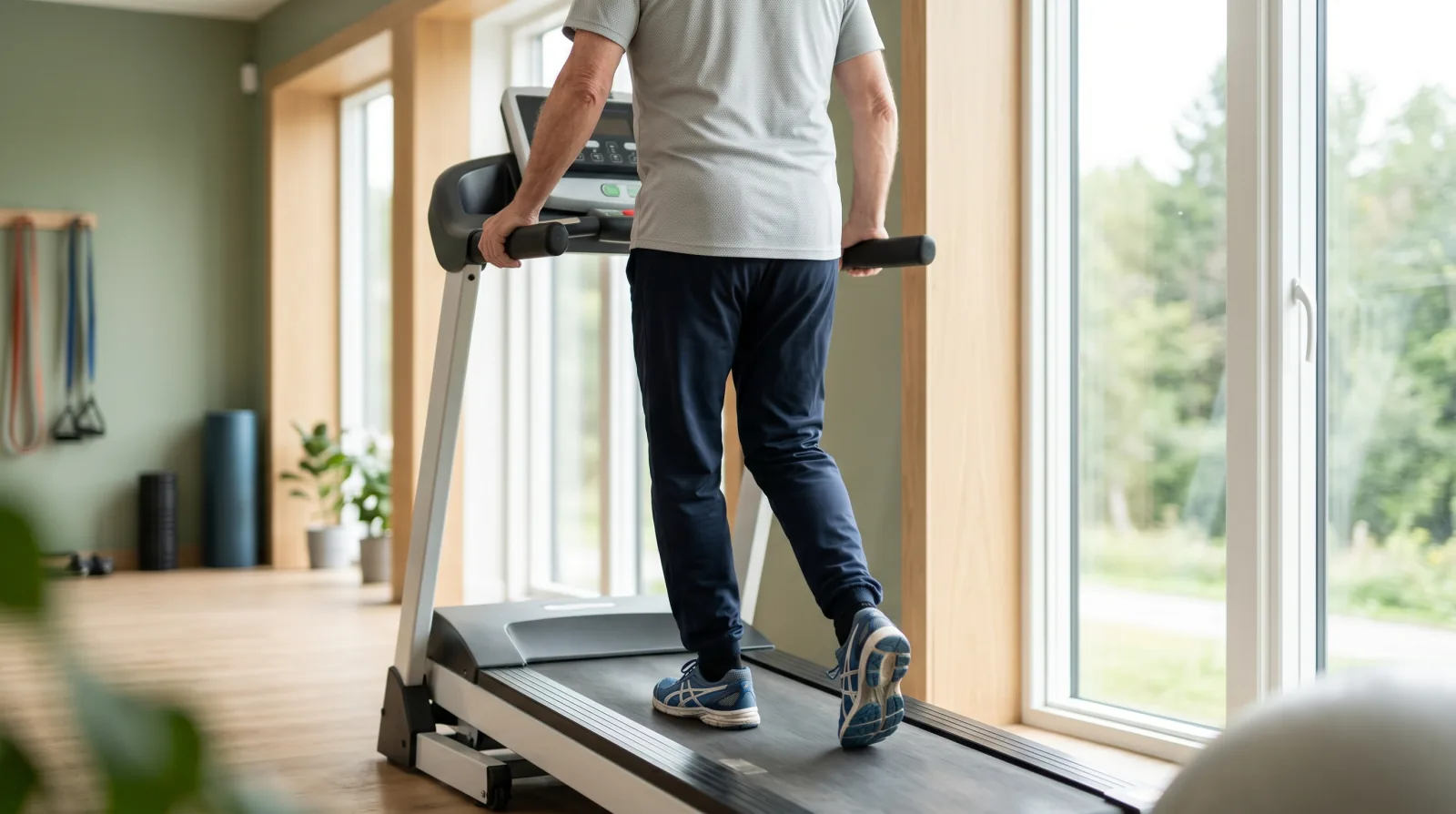
This is why so many people with stenosis can walk much further at the grocery store than around the block. Leaning on the cart bends the spine forward. It is also why many find a stationary bike comfortable while a treadmill is not, and why walking uphill is often easier than downhill. The spine flexes going up and extends going down. None of this is a diagnosis on its own, but the pattern is consistent enough that a physiotherapist will ask about it directly.
How it differs from a circulation problem
The most important thing to sort out early is whether the leg symptoms come from the nerves or from the blood vessels. Narrowed leg arteries cause a similar walking pain called vascular claudication, and the treatment is completely different. The distinguishing features are well described in the StatPearls reference.
Neurogenic claudication tends to depend on posture. Bending forward helps even if you keep moving, the leg pulses are normal, and symptoms can take several minutes to settle after you stop. Vascular claudication tends to depend on effort, not posture. It eases simply by standing still regardless of how you hold your back, it often comes with cold feet or weak pulses, and the same walking distance brings it on each time. A clinician screens for both, because the two can also coexist in an older adult, and a vascular cause needs a physician, not a physiotherapist.
Why conservative care is usually the first step
For many people, the first line of management is conservative care: exercise, education, activity adjustment, and sometimes hands-on treatment. This is not a fallback for people too frail for surgery. It reflects what the evidence supports. A 2021 clinical practice guideline in The Journal of Pain recommends a trial of multimodal non-surgical care, including education, advice, home exercise, manual therapy, and rehabilitation, for people with stenosis causing neurogenic claudication.
A 2022 systematic review in BMJ Open found moderate-quality evidence that a combined approach of manual therapy and exercise, with or without education, is effective for neurogenic claudication, and that it outperformed standard medical care or self-directed exercise alone. The same review was honest about the limits: most other treatments had only low or very low quality evidence behind them, and it called for better studies. We treat that honesty as the point. Conservative care is a reasonable, evidence-supported starting place, not a guarantee.
What physio for stenosis usually involves
The practical work tends to lean on the same posture principle that gives relief in daily life. A flexion-biased program favours positions and movements that open the spine. That often means core and hip strengthening, graded walking practice built up in tolerable doses, and using a forward-leaning option like a stationary bike or a walker to extend the distance you can cover comfortably. The aim is to improve what you can do, not to widen the canal, which exercise does not do.
A physiotherapy assessment starts by confirming the pattern, screening for red flags and for a vascular cause, and ruling in or out the conditions that mimic stenosis. Leg pain in an older adult is not always stenosis. A pinched nerve from a single disc, an arthritic facet joint, or a muscular source can produce overlapping symptoms, and we walk through how those differ in our guide to the common sources of lower back pain. True nerve-root pain down one leg has its own pattern, which we cover in the post on sciatica. Sorting which one is driving your symptoms is most of the value of the first visit.
The red flags that change everything
Most stenosis is a slow, stable, frustrating problem. A small number of presentations are emergencies, and they are worth memorizing. The combination to watch for is cauda equina syndrome: new numbness in the saddle area (the parts that touch a bike seat), new trouble controlling your bladder or bowels, or rapidly worsening weakness in the legs. The StatPearls reference flags new bladder dysfunction and rapidly progressive neurological deficits as urgent surgical situations.
If you notice those, this is not a physio booking. It is a same-day trip to an emergency department, because delay can cause permanent damage. Steady leg pain with walking that has been building for months is not this. New saddle numbness or loss of bladder or bowel control is.
When surgery enters the conversation
Surgery, usually a decompression to make more room for the nerves, is generally reserved for people whose symptoms are severe, disabling, or not improving after an honest run of conservative care. The evidence comparing the two is genuinely uncertain. A 2016 Cochrane review concluded there was not enough good-quality evidence to say whether surgery or conservative care produces better results, and noted that surgical complications occurred in 10 to 24 percent of cases while no side effects were reported for conservative treatment.
A separate 2018 systematic review and meta-analysis of 897 patients found no significant difference between exercise therapy and surgery on disability at 6 months or 1 year, with a small advantage for surgery at 2 years. The reasonable read is that a course of conservative care first is sensible for most people, that surgery is a real option when symptoms stay severe, and that the decision belongs to you, a spine surgeon, and your physician together. We are happy to be part of that conversation, but we do not make that call.
Frequently asked questions
Is spinal stenosis the reason my legs hurt only when I walk?
Possibly, if the pain or heaviness eases when you sit or lean forward and you are over 60. That posture pattern is the classic sign of neurogenic claudication from stenosis, but a circulation problem can mimic it, so it needs a proper screen before anyone is sure.
Can physiotherapy cure spinal stenosis?
No. Exercise does not reverse the narrowing itself. What conservative care can do, with moderate-quality evidence behind a combined manual-therapy-and-exercise approach per a 2022 BMJ Open review, is improve walking tolerance and reduce symptoms for many people. A flexion-biased program of core and hip strengthening plus graded walking practice is the usual starting point, and your physiotherapist will set realistic expectations after the first assessment.
Do I need surgery?
Not for most cases, at least not first. A 2016 Cochrane review found the evidence too uncertain to say surgery beats conservative care, and surgery carries a real complication rate. It tends to be considered when symptoms are severe or not responding after a genuine trial of conservative care.
How long until I feel better?
There is no fixed timeline. Recovery depends on how narrowed the space is, how long symptoms have been present, your other health conditions, and how consistently you do the program. Your physiotherapist will set realistic expectations after the first assessment rather than promise a date.
What symptoms mean I should go to emergency, not book physio?
New numbness in the saddle area, new loss of bladder or bowel control, or quickly worsening leg weakness. Those can signal cauda equina syndrome, which is a surgical emergency, so go to an emergency department the same day. Steady leg pain with walking that has built up slowly over months is a different, far more common picture, and that one is appropriate for a physiotherapy assessment.
Will I have to stop walking?
Usually not. The goal is the opposite. Most programs build walking back up in tolerable doses, often using a forward-leaning aid like a stationary bike or a walker so you can cover more ground before symptoms start. Many people also find they can walk further at the grocery store than around the block, since leaning on a cart bends the spine forward and relieves pressure on the compressed nerves.
How is spinal stenosis different from a herniated disc?
Spinal stenosis is a gradual narrowing of the space around the nerves in the lower spine, usually from thickened ligaments, bulging discs, and bony spurs that build up over years, most common in people over 60. A herniated disc is a more sudden bulge of disc material pressing on a single nerve root, and it produces sciatica that often behaves differently, easing with some positions and worsening with others rather than following the walking-and-sitting pattern typical of stenosis. Our guide to sciatica, disc, and piriformis causes covers that presentation directly.
Does swimming or water exercise help spinal stenosis?
Aquatic exercise is a reasonable option for many people with neurogenic claudication, since the buoyancy of water reduces load on the spine while still allowing walking-pattern movement and cardiovascular conditioning. It fits the same flexion-friendly, load-tolerant principle behind a stationary bike or a forward-leaning walker. Whether it is the right starting point for you depends on your specific presentation, which a physiotherapy assessment establishes.
Is spinal stenosis the same as sciatica?
No. Sciatica is leg pain that travels along the sciatic nerve, most often from a disc compressing a single nerve root, and it can happen at any adult age. Spinal stenosis is a narrowing of the spinal canal that develops slowly with age and typically produces neurogenic claudication, leg symptoms brought on by walking or standing and eased by sitting or leaning forward. The two can share some features, which is part of why an assessment is needed to sort out the actual source.
What happens if lumbar spinal stenosis is left untreated?
For most people, stenosis is a slow, stable condition rather than one that reliably worsens toward an emergency, though symptoms and walking tolerance can gradually decline without any management. The exception is the red-flag presentation, cauda equina syndrome, which needs same-day emergency care regardless of how long other symptoms have been present. Outside of that, an untreated case simply means missing out on the walking-tolerance gains conservative care and exercise can offer.
This article is general information, not personal medical advice. A regulated practitioner can confirm whether the patterns described apply to you.
What to do with this
If your legs slow you down after a few minutes on your feet and a bench or a lean over the cart sets things right, that is a recognizable pattern worth assessing. The first step is sorting nerve from circulation, and stenosis from the other things that cause leg pain in older adults. At Launch Rehab, the stenosis assessment includes a specific check for vascular claudication signs before any exercise program is written, because the two conditions require completely different care and can look similar enough in an older adult to be genuinely confusing. Book a physiotherapy assessment and we will screen, confirm the pattern, and build a walking-tolerance plan, or refer you on if your presentation needs a physician or surgeon first. Coverage and current fees live on our rates and FAQ page. And if you ever notice saddle numbness or a change in bladder or bowel control, skip the booking and go to emergency.
Physiotherapists in BC are regulated by the College of Health and Care Professionals of BC (CHCPBC), which sets the screening and scope standards a physio works within.
Sources
- Non-Surgical Interventions for Lumbar Spinal Stenosis Leading to Neurogenic Claudication: A Clinical Practice Guideline, The Journal of Pain, 2021
- Non-operative treatment for lumbar spinal stenosis with neurogenic claudication: an updated systematic review, BMJ Open, 2022
- Surgical versus non-surgical treatment for lumbar spinal stenosis, Cochrane plain-language summary, 2016
- Exercise therapy versus surgery for lumbar spinal stenosis: a systematic review and meta-analysis, 2018
- Spinal Stenosis and Neurogenic Claudication, StatPearls, updated 2023
- College of Health and Care Professionals of BC (CHCPBC), physical therapists
WRITTEN BY
The Launch Rehab Team
Practical recovery and training notes from the clinicians at our five Metro Vancouver studios.
FOUND THIS USEFUL?
Share it with your network on LinkedIn. We wrote a ready-to-post version for you.
FILED UNDER
- spinal-stenosis
- neurogenic-claudication
- lower-back
- leg-pain
- older-adults
- physiotherapy
- bc