Clinical Pilates vs Mat Pilates in BC: What Is the Difference?
The word Pilates appears on studio class schedules, in physio clinics, and on extended health claim forms. These are not the same thing. Here is what separates them, who each one suits, and whether your extended health plan covers it.
BY THE LAUNCH REHAB TEAM
The word "Pilates" turns up in three different places in British Columbia: the schedule board at a fitness studio, the treatment room of a physiotherapy clinic, and the eligible expense list on your extended health plan. Many people assume these are the same thing at different price points. They are not. Understanding the difference before you book saves money and helps you pick the option that will actually move your situation forward.
Is clinical Pilates covered by health insurance in BC? Often yes, when a registered physiotherapist bills the session as physiotherapy. It then draws from the physiotherapy benefit in your extended health plan, up to your plan's per-session rate and annual maximum. Mat Pilates is generally not covered, because the instructor is not a regulated health professional billing under a recognized discipline. Plans differ, so confirm with your insurer before booking. At Launch Rehab, clinical Pilates at the Lougheed and Coquitlam studios is delivered within the physiotherapy billing framework.
What mat Pilates is
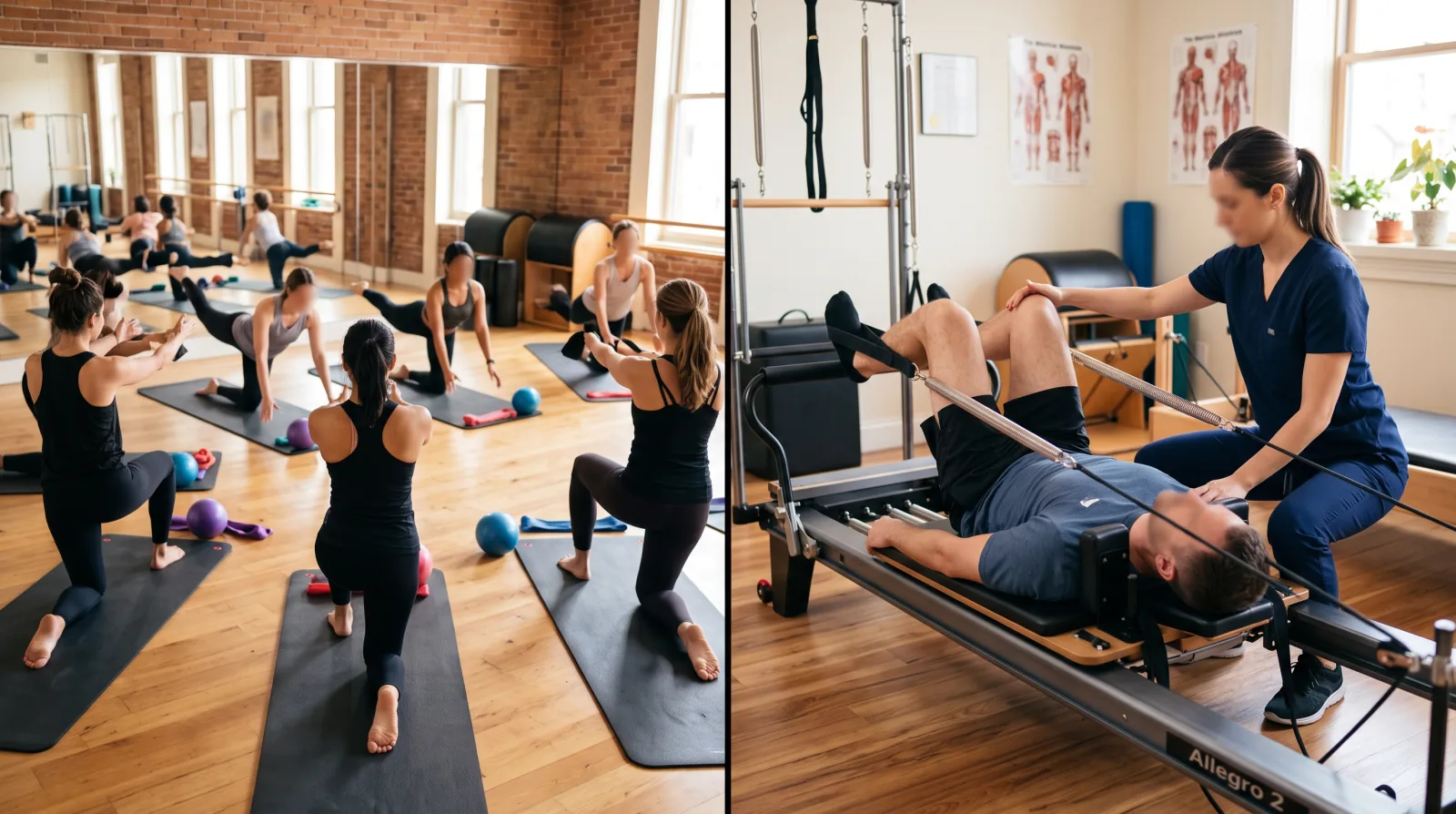
Mat Pilates is a group fitness format. Sessions are led by a certified Pilates instructor, typically in a studio setting, on a mat or sometimes a reformer shared with a class. The program is designed for general fitness: core conditioning, flexibility, posture, and overall body awareness. It is accessible to most healthy adults, requires no medical assessment, and is well suited to people who want a challenging movement practice without the structure of a gym.
Instructors in this setting are trained to teach movement. They are not regulated health professionals, they do not hold a clinical scope of practice, and they are not expected to diagnose or prescribe. The format is built for wellness, and it does that well.
Mat Pilates is generally not covered by extended health benefits, because sessions are not provided by a regulated health professional billing under a recognized discipline, insurers do not count them toward your physiotherapy or allied health pool.
What clinical Pilates is
Clinical Pilates is a treatment delivered by, or under the direct supervision of, a registered physiotherapist. The session begins with a physiotherapy assessment: your injury history, movement patterns, strength and control gaps, surgical or medical background, and what you are trying to recover or build. Your program grows out of those findings. No two programs look identical because no two injury histories are identical.
The equipment used, including the reformer, tower, and Wunda chair, allows the physiotherapist to adjust resistance precisely using the spring system. A post-surgical client who cannot safely load a movement at full bodyweight can work at a fraction of that load and progress over weeks in small, measurable steps. A mat or free-weight environment does not offer the same level of control at the lower end of the load range, which is exactly where many recovering clients need to spend the most time.
For a detailed look at who clinical Pilates suits across different conditions and recovery stages, see our post on who clinical Pilates is for.
Three practical differences
1. Who runs the session
Mat Pilates: a certified Pilates instructor. Clinical Pilates: a physiotherapist registered with the College of Health and Care Professionals of BC (CHCPBC), or a clinician supervised by one. This distinction determines what can happen in the room. A physiotherapist can clinically reason about why a movement is causing pain, modify the program accordingly, and document the change as part of a treatment record.
2. How the program is designed
A mat Pilates class follows a set structure adapted for the fitness level of the group. An instructor may offer modifications, but the program is not built around any individual's injury or medical history.
A clinical Pilates program starts from scratch at the assessment and is rebuilt at every session based on how the client responded since last time. If something flared, the next session accounts for it. If strength improved, the program advances. That loop of assessment and adjustment is the core of clinical reasoning, and it is what makes clinical Pilates a treatment rather than a fitness class.
3. Whether extended health covers it
- Mat Pilates: generally not covered by extended health plans.
- Clinical Pilates, when billed by a registered physiotherapist: often draws from your physiotherapy extended health benefit, depending on your plan.
The key word is "billed by." If a session is run by a kinesiologist or a clinical Pilates instructor who is not a registered physiotherapist, coverage depends on your specific plan and is often unavailable. The service and the billing provider must match what your plan recognizes.
Confirm with your insurer before booking if coverage is a deciding factor. At Launch Rehab, clinical Pilates sessions are delivered within the physiotherapy billing framework at our Lougheed studio and Coquitlam studio, so those sessions are claimable through your physiotherapy benefit when your plan includes one.
Who clinical Pilates is right for
Certain presentations show up repeatedly in clinical Pilates programs. These are not the only ones, but they illustrate why someone would choose the clinical route over a fitness studio.
Back injury or spinal surgery recovery. Graded, supervised movement is a core part of returning to function after back injury. Clinical Pilates allows the physiotherapist to introduce load incrementally, starting well below what a gym environment would require. Our article on lower back pain gives context on the structures involved and why graded loading matters. For non-specific low back pain, a Cochrane review of 10 randomised trials (510 participants) found low- to moderate-quality evidence that Pilates reduces pain and disability compared with minimal intervention, and no conclusive evidence that it beats other forms of exercise (Yamato et al., Cochrane Database of Systematic Reviews, 2015). The case for clinical Pilates is the supervised, adjustable load. The evidence does not show Pilates beating other forms of exercise.
Postnatal clients rebuilding core control. The weeks and months after delivery require a careful return to abdominal and pelvic loading. Clinical Pilates pairs naturally with postnatal pelvic floor physiotherapy because both work within a physio-supervised framework and can be sequenced together. The reformer's spring assistance allows early loading of the core before a client is ready to work against full bodyweight.
Hypermobility. People whose joints move beyond a typical range of motion are managed mainly with strength and control work, which our post on hypermobility spectrum disorder and physiotherapy covers. Clinical Pilates can supply that stability and control work, and the physiotherapist can screen for the movement faults that hypermobility tends to create.
Athletes returning from lower-limb injury. Hip and trunk control are commonly assessed when a lower-limb injury keeps recurring. A physiotherapist running a clinical Pilates program can target the specific stability deficits identified at assessment before the athlete returns to full sport loading. This is a middle step between clinic-based rehab and a return to sport, not a replacement for either.
Older adults building functional strength in a low-impact format. Getting up from the floor, carrying loads without compensating, balance reactions: all are trainable on reformer-based equipment at whatever load is appropriate for the individual. The spring assistance means the work can start at low resistance and progress systematically.
The reformer: what it actually does
The reformer is a spring-loaded sliding platform. It is not inherently harder than mat work. In some positions it makes an exercise easier by assisting the movement; in others it makes it harder by increasing resistance. The physiotherapist controls the spring configuration to match the load to what the client can safely manage at each stage of recovery.
This adjustability is what makes the reformer useful in clinical settings rather than just in fitness ones. A mat exercise has one load: bodyweight. The reformer gives the clinician a dial, and that dial is especially important for clients who are not yet ready to work at full bodyweight but are ready to do more than clinic exercises with a band.
Can I bill clinical Pilates to extended health?
The short answer: usually yes, when the session is billed by a registered physiotherapist, and usually no when it is not.
Most extended health plans in BC include a physiotherapy benefit with a per-session rate and an annual maximum. When a physiotherapist bills a clinical Pilates session as physiotherapy, it draws from that pool the same way a manual therapy or exercise rehab session does. The plan pays its covered portion; you pay the remainder.
When a session is delivered by someone other than a registered physiotherapist, including a certified clinical Pilates instructor without a physiotherapy registration, coverage depends entirely on your plan. Some plans have a kinesiology line that may apply; many do not.
Practical steps before booking: call your extended health provider, confirm whether physiotherapy sessions are covered, and ask whether reformer-based physiotherapy falls under that benefit. Plans differ, so confirm before you assume.
WorkSafeBC and ICBC funding follow separate rules. If your injury is work-related or from a motor vehicle crash, your coverage pathway is different. Check with your claims adjuster or the clinic's billing team before your first session.
How to get started
You do not need to know anything about Pilates before booking. You do not need any Pilates experience, and you do not need to have seen a physiotherapist before.
Book a physiotherapy assessment. That appointment is where the clinician determines whether clinical Pilates fits your recovery plan, what specific program to build, and how many sessions are likely appropriate. If clinical Pilates is the right tool, reformer sessions are prescribed from that point as part of your overall physiotherapy plan. If something else suits you better, the assessment clarifies that too.
Clinical Pilates is available at our Lougheed studio and Coquitlam studio. Book the initial physiotherapy assessment at either location to get started.
Frequently asked questions
Is clinical Pilates more expensive than mat Pilates?
The per-session cost is often higher because clinical Pilates is billed as a physiotherapy service delivered by a registered physiotherapist, not a fitness class. But when your extended health plan covers physiotherapy, clinical Pilates draws from that benefit, while mat Pilates is not eligible for reimbursement under most plans. Confirm current session fees on our rates page.
Do I need a referral to book clinical Pilates?
No physician referral is required to book a physiotherapy assessment, which is the entry point for clinical Pilates at Launch Rehab. Some extended health plans require a doctor's note for reimbursement purposes, so check your specific plan if that matters to your coverage before your first appointment.
Can a kinesiologist run a clinical Pilates session?
At Launch Rehab, clinical Pilates sessions are delivered by, or under the direct supervision of, a registered physiotherapist. If a session is run by someone without a physiotherapy registration, coverage under most extended health plans is uncertain, since the billing provider needs to match what your plan recognizes as a physiotherapy service.
How is a clinical Pilates program different each week?
The program is rebuilt at every session based on how you responded since the last one. If a movement flared up, the next session accounts for it. If strength improved, the resistance or complexity advances. That ongoing assessment and adjustment is what makes it a treatment rather than a fixed class structure.
Is clinical Pilates safe during pregnancy or after spinal surgery?
Clinical Pilates is used with both postnatal clients rebuilding core control and people recovering from spinal surgery, because the reformer's spring resistance lets the physiotherapist load movement in small, controlled steps. Whether it is appropriate for your specific situation depends on findings at your physiotherapy assessment, which screens for any contraindications first.
Does ICBC or WorkSafeBC cover clinical Pilates?
WorkSafeBC and ICBC funding follow separate rules from extended health, so coverage for clinical Pilates under either claim type depends on what your claims adjuster or the clinic's billing team confirms for your specific case. Check before your first session if your injury is work-related or from a motor vehicle crash.
How long before I see results from clinical Pilates?
Recovery timelines depend on the underlying condition, how long symptoms have been present, and how consistently the program is followed. Your physiotherapist sets expectations after the initial assessment based on what they find, rather than a fixed number of sessions that applies to everyone. Progress is reviewed and the program adjusted at each visit.
Can I switch from mat Pilates to clinical Pilates later?
Yes. Many people start with mat Pilates for general fitness and move to clinical Pilates if a specific injury, surgery, or persistent limitation needs a supervised, assessment-driven program. The switch starts with a physiotherapy assessment, since clinical Pilates is built around your findings rather than a general class structure.
This article is general information, not personal medical advice. Coverage rules vary by plan. A registered physiotherapist can confirm what applies to your situation.
Sources
- Pilates for low back pain, Cochrane Database of Systematic Reviews, 2015
- CHCPBC: Physical Therapists
WRITTEN BY
The Launch Rehab Team
Practical recovery and training notes from the clinicians at our five Metro Vancouver studios.
FOUND THIS USEFUL?
Share it with your network on LinkedIn. We wrote a ready-to-post version for you.
FILED UNDER
- clinical-pilates
- physiotherapy
- exercise-rehab
- extended-health
- metro-vancouver