Golf and Physiotherapy: The Most Common Swing-Related Injuries and How to Fix Them
Golf injuries rarely come from one bad swing. They come from thousands of repetitions of the same mechanical pattern until something gives. Here are the five injuries we see most often in Metro Vancouver golfers, what drives each one, and how physiotherapy and a professional swing assessment address the root cause.
BY THE LAUNCH REHAB TEAM
Golf loads the body differently than most sports. The swing compresses the lumbar spine while rotating it. The lead hip must absorb force at ball contact. The trail shoulder internally rotates at high speed and then decelerates across the body. Do this over 18 holes, twice a week, for years, and small mechanical inefficiencies accumulate into predictable injuries.
The injuries we see in Metro Vancouver golfers follow consistent patterns. The five most common golf injuries are:
- Lower back pain, usually from restricted hip or thoracic rotation
- Lead elbow pain (lateral epicondyle), usually from high grip tension through impact
- Golfer's elbow on the trail side (medial epicondylitis), usually from wrist flexor overload on the downswing
- Hip pain at the lead hip (hip impingement), usually from restricted hip internal rotation
- Rotator cuff irritation at the trail shoulder, usually from restricted posterior capsule flexibility
What drives each one, what a physiotherapy assessment finds, and how treatment addresses the cause:
1. Lower back pain
Lower back pain is the most common golf injury at every level of the game. The golf swing demands significant lumbar rotation under load, and when rotation is restricted at the hips or thoracic spine, the lumbar spine compensates by rotating more than it should.
What drives it: Restricted hip internal rotation (especially lead hip), poor thoracic rotation, or both. When the lead hip cannot complete its rotation at impact, the lumbar spine picks up the slack, rotating into end range under load, repeatedly.
What a physio assessment finds: Hip rotation range on both sides, thoracic rotation range in sitting (isolating the thorax from the hips), and the movement pattern at impact. Often the painful area (lower back) is not the restricted area. Treating the low back alone without restoring hip and thoracic mobility produces short-term relief and long-term recurrence.
Treatment: Hip mobility work, thoracic rotation exercises, glute strength to support pelvic control at impact, and specific exercise progressions that allow the swing pattern to change as mobility improves.
2. Lead elbow pain (lateral epicondyle)
Pain on the outside of the lead elbow, the left elbow in a right-handed golfer, most often develops from impact stress at the moment of ball contact. At impact, the lead arm is in maximum extension and absorbs a large ground reaction force through the grip. Repeated over hundreds of swings, this loads the lateral elbow, particularly the extensor carpi radialis group.
What drives it: Grip tension that is too high throughout the backswing, impact, and follow-through. Gripping harder during the swing rather than allowing a firm but dynamic contact. This over-recruits the wrist extensors and keeps them loaded when they should be recovering.
What a physio assessment finds: Tenderness over the lateral epicondyle, often with a positive Mill's test (resisted wrist extension with the elbow extended). Grip force testing and observation of grip pattern during a practice swing.
Treatment: Load-management (temporary reduction in swing volume), eccentric wrist extensor strengthening (the same approach used for tennis elbow), manual therapy to the extensor muscle bellies and their tendon attachments, and advice on grip pressure during the swing. Shockwave therapy has good evidence for lateral epicondyle tendinopathy that does not resolve with exercise alone. See our shockwave therapy page for more detail on that treatment.
3. Golfer's elbow on the trail side (medial epicondylitis)
Pain on the inside of the trail elbow, the right elbow in a right-handed golfer, is what actually produces the condition called "golfer's elbow" clinically. It comes from wrist flexor overload at the medial epicondyle, typically from the downswing and the acceleration phase before impact.
What drives it: Overuse of the wrist flexors to generate clubhead speed, often combined with restricted shoulder external rotation on the trail side limiting the body's ability to use the larger trunk muscles to generate speed.
What a physio assessment finds: Medial elbow tenderness, positive resisted wrist flexion test, and often restricted shoulder external rotation on the trail side. Wrist and forearm strength testing.
Treatment: Progressive wrist flexor loading, shoulder mobility work on the trail side, manual therapy to the flexor muscle group, and a graded return to full swing volume. For more detail on golfer's elbow treatment specifically, see our golfer's elbow post.
4. Hip pain at the lead hip (hip impingement)
The lead hip undergoes significant internal rotation and compression at impact as the pelvis clears and the weight shifts onto that side. In golfers with reduced hip joint mobility or early hip impingement (femoroacetabular impingement, FAI), this compression produces groin pain or anterior hip pain that worsens with the follow-through.
What drives it: Restricted hip internal rotation range, often combined with a relatively flat swing path that increases the rotation demand at the hip. Sometimes an underlying labral irritation is present.
What a physio assessment finds: Hip impingement testing (FADIR test), internal and external rotation range comparison between sides, and assessment of hip strength, particularly hip abductor and external rotator strength.
Treatment: Hip mobility restoration, glute strengthening to reduce impingement forces, and swing modifications that reduce hip rotation demand while strength and mobility are being built. If labral involvement is suspected, imaging may be recommended. For more background on hip impingement, see our hip impingement post.
5. Rotator cuff irritation at the trail shoulder
The trail shoulder externally rotates through the backswing and then internally rotates at high speed through the downswing and impact. Deceleration after impact loads the posterior rotator cuff, particularly the infraspinatus and teres minor, which must slow the arm after ball contact. Over time, combined with reduced posterior shoulder flexibility, this loading pattern produces posterior shoulder pain.
What drives it: Restricted posterior shoulder capsule flexibility, reduced internal rotation range, and often a swing path that increases the eccentric demand on the trail shoulder during deceleration.
What a physio assessment finds: Posterior shoulder tenderness, internal rotation range comparison between sides, and rotator cuff strength testing. In long-term cases, imaging may show partial thickness rotator cuff changes.
Treatment: Posterior capsule stretching (the sleeper stretch and cross-body stretch), rotator cuff strengthening with a focus on the external rotators and the posterior cuff, and swing assessment to identify the path changes that reduce deceleration load.
The role of a golf assessment
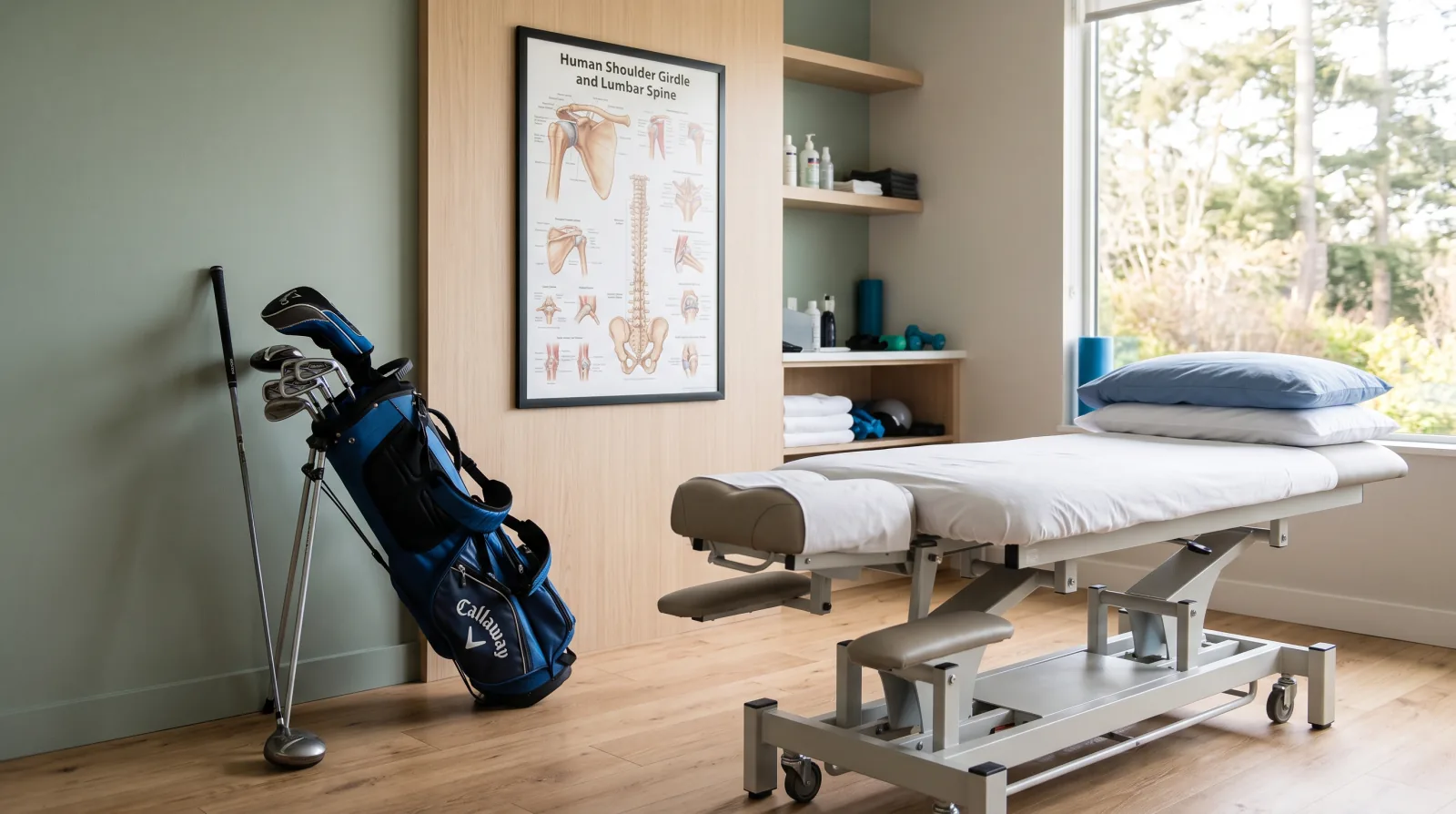
A standard physiotherapy appointment addresses the painful tissue. A golf-specific assessment goes further: it combines the clinical examination with a movement screen designed for the golf swing, identifying restrictions in shoulder rotation, thoracic rotation, hip mobility, and hip-to-shoulder separation that drive swing compensations. The assessment can also include video analysis of the swing if available.
Our golf assessment runs from the Lougheed studio and is delivered by a registered massage therapist with golf-specific training. The assessment identifies both the injury and the movement limitations creating it, and produces a treatment and exercise plan targeted to both. For more detail or to book, visit our golf assessment page.
Frequently asked questions
What is the most common golf injury?
Lower back pain is the most common golf injury at every level of the game. The swing demands significant lumbar rotation under load, and when rotation is restricted at the hips or thoracic spine, the lumbar spine compensates by rotating more than it should, repeatedly, over hundreds of swings.
Why does golfer's elbow affect the trail arm and not the lead arm?
Golfer's elbow, medial epicondylitis, is what develops on the trail elbow (the right elbow in a right-handed golfer) from wrist flexor overload during the downswing and acceleration phase before impact. Pain on the lead elbow instead usually points to a different structure, lateral epicondyle stress from the ground reaction force absorbed at impact.
Is the painful area always where the golf injury actually starts?
Often not. A physiotherapy assessment frequently finds that the painful area is not the restricted area driving it. Lower back pain in golfers is often a hip rotation problem, and lead elbow pain is often a wrist and forearm problem, so treating only the painful spot without addressing the restriction above or below it is a common reason golf injuries keep coming back.
What does a golf-specific physiotherapy assessment involve that a standard appointment does not?
A golf-specific assessment combines the clinical examination with a movement screen designed for the golf swing, checking shoulder rotation, thoracic rotation, hip mobility, and hip-to-shoulder separation for the restrictions that drive swing compensations. It can also include video analysis of the swing if footage is available, which a standard physiotherapy appointment does not typically include.
Where does Launch Rehab's golf assessment run and who delivers it?
The golf assessment runs from the Lougheed studio and is delivered by a registered massage therapist with golf-specific training. It identifies both the painful tissue and the movement limitations creating it, and produces a treatment and exercise plan targeted to both. If the assessment finds a mechanical restriction outside RMT scope, such as a joint that needs a physiotherapy-led loading program, the plan is coordinated with a physiotherapist rather than treated in isolation.
Can shockwave therapy help golf-related elbow pain?
Shockwave therapy has evidence supporting its use for lateral epicondyle tendinopathy that has not resolved with exercise alone, which is relevant to lead elbow pain in golfers. It is not typically the first treatment tried and usually follows an initial course of load management and targeted strengthening.
What causes hip pain on the lead side during a golf swing?
The lead hip undergoes significant internal rotation and compression at impact as the pelvis clears and weight shifts onto that side. In golfers with reduced hip joint mobility or early hip impingement, that compression produces groin or anterior hip pain that worsens through the follow-through, often combined with a flatter swing path that increases the rotation demand at the hip.
How does a swing assessment help with recurring golf injuries?
A swing assessment identifies the specific mechanical restriction, such as limited hip internal rotation or reduced posterior shoulder mobility, that is loading the painful structure repeatedly. Addressing only the painful tissue without correcting the restriction driving it tends to produce short-term relief followed by the same injury returning once golf resumes at full volume.
Golf injuries respond well to physiotherapy when the mechanical driver is addressed alongside the painful tissue. This article is general information, not personal medical advice. A regulated practitioner can confirm whether the patterns described apply to you.
Golf injuries respond well to physiotherapy when the mechanical driver is addressed alongside the painful tissue. If you have a recurring swing-related pain that has come back multiple times despite treatment, a full golf assessment is usually the most efficient path to a lasting solution.
WRITTEN BY
The Launch Rehab Team
Practical recovery and training notes from the clinicians at our five Metro Vancouver studios.
FOUND THIS USEFUL?
Share it with your network on LinkedIn. We wrote a ready-to-post version for you.
FILED UNDER
- golf
- golf-injury
- physiotherapy
- sports-injury
- bc
- metro-vancouver
- golf-assessment
- swing