Hip Impingement and Labral Tears: Rehab, Surgery, and How to Choose
Deep front-of-hip and groin pain that pinches in a deep squat or after a long drive is often femoroacetabular impingement, sometimes with a labral tear. Here is what the condition is, what the evidence says about rehab versus surgery, and how the decision gets made.
BY THE LAUNCH REHAB TEAM
Deep pain at the front of the hip or in the groin, the kind that pinches when you drop into a squat, sit low for too long, or pull the knee toward the chest, is a common reason active adults come in. In many cases the pattern points to femoroacetabular impingement, and sometimes to a tear of the ring of cartilage inside the hip. Both have real treatment options, and the choice between them is more open than most people assume.
What femoroacetabular impingement actually is
Femoroacetabular impingement, usually shortened to FAI, describes a shape mismatch inside the hip. The ball or the socket, or both, carry extra bone, and at the end of certain movements the two surfaces contact sooner than they should. The international consensus statement on the condition, the Warwick Agreement published in the British Journal of Sports Medicine in 2016, settled on the term "FAI syndrome" to make one point clear: the bony shape alone is not the diagnosis. Plenty of people have cam or pincer shapes on imaging and no symptoms at all.
FAI syndrome, per that consensus, needs three things together: symptoms, clinical signs a therapist can reproduce on examination, and imaging findings that match. As a 2022 review in Orthopedic Reviews puts it, the condition is "a triad of specific symptoms, clinical signs, and particular bony deformities." An image on its own does not settle whether the hip shape is the source of your pain.
What the symptoms usually feel like
The typical complaint is pain in the hip or groin that tracks with movement or position. People often point to a spot deep at the front of the hip, sometimes cupping a hand around it, a gesture clinicians see so often it has a nickname. The same 2022 review describes "hip/groin pain aggravated by activity or sitting, commonly with referral to the buttocks, thighs, or knees," along with "clicking, catching, locking, stiffness."
The pattern that brings runners and racket-sport players in is a deep pinch at the end of hip flexion: the bottom of a squat, a lunge, driving a knee up to sprint, or getting out of a low car seat after a long drive. Prolonged sitting is a common aggravator. None of this is a diagnosis on its own, which is the point. Several other things, including hip osteoarthritis and referred pain from the low back, can produce overlapping symptoms, so the examination matters.
How a labral tear fits into the picture
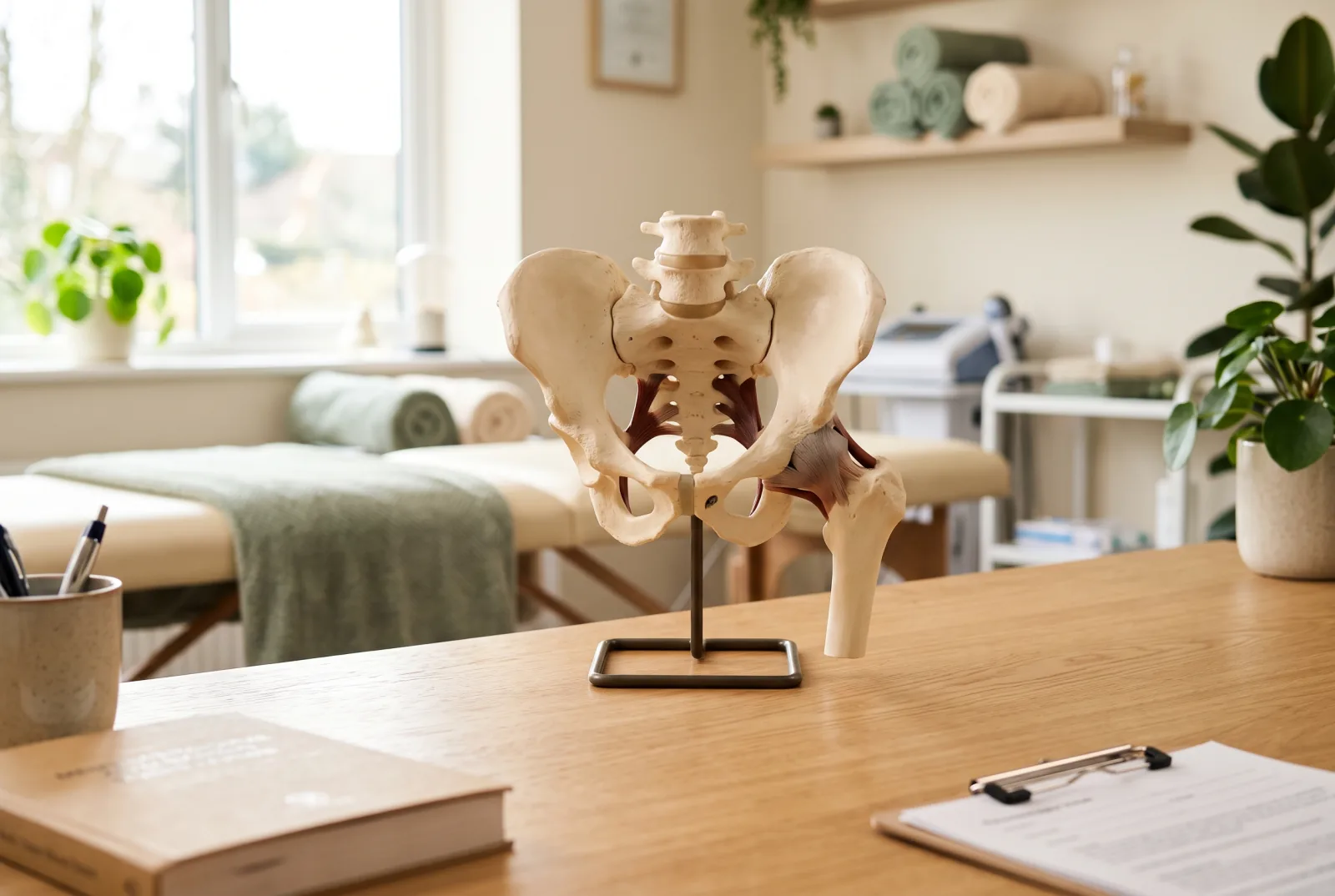
The labrum is a rim of cartilage around the edge of the hip socket that adds depth and helps seal the joint. When the hip shape drives repeated contact at the socket edge, that rim takes the load. The 2022 review notes that cam-type impingement can cause "detachment of the labrum," and that pincer lesions "lead to direct impingement of the acetabular labrum itself." In other words, a labral tear is often downstream of the same shape problem, not a separate accident.
Two things are worth holding onto here. Labral changes show up on scans in people with no hip pain at all, so a tear on an MRI does not automatically explain your symptoms. And a labral tear does not automatically mean surgery. Whether it matters depends on the whole picture, which is exactly what a hands-on assessment is for.
What a physiotherapy program targets
Physiotherapy for FAI syndrome can change how well the muscles around the hip control the joint through the ranges that provoke symptoms, and how much load the hip tolerates before it complains. A program is built after examination, so the specifics vary, but the common ingredients are strengthening the hip and trunk muscles, restoring controlled movement in the ranges you can tolerate, and staging a return to the activities that flared things up. In our clinic, that last part is where a lot of the work sits: the goal is to rebuild capacity in the squat, the lunge, or the stride without provoking the pinch each session.
Because much of this rests on graded loading and movement retraining, physiotherapy is a natural fit for the condition. In BC, physiotherapists are regulated by the College of Health and Care Professionals of BC, and the decision to operate belongs to an orthopaedic surgeon. Those are different lanes, and a good rehab plan is written to work alongside a surgical opinion, not instead of one.
What the evidence says about rehab versus surgery
This is the question most people arrive with, and the honest answer is that both are legitimate. The most-cited trial here is the UK FASHIoN study, published in The Lancet in 2018, which randomly assigned 348 people with FAI syndrome to either hip arthroscopy, a keyhole operation to reshape the hip, or a physiotherapist-led conservative program.
At twelve months, both groups improved on the trial's main measure of hip-related quality of life. The surgery group improved more, by an average of 6.8 points on a 100-point scale, and the trial team judged that difference statistically and clinically meaningful. So the fair summary is not "surgery wins" or "rehab is just as good." It is closer to this: most people improve either way, surgery produced a modest additional gain on average in that trial, and neither path is a guaranteed fix. The Warwick consensus itself lists conservative care, rehabilitation, and arthroscopic or open surgery as the recognised options, which is another way of saying there is no single default.
That average also hides real variation. A trial reports the middle of the group; you are one person. How irritable the hip is, how much your goals depend on deep-flexion loading, how the hip responds to a genuine rehab trial, and your own preference about surgery all move the decision.
How the decision gets individualized
In practice the decision is rarely made in one visit. A common sequence is a proper trial of rehabilitation first, because it carries less risk than an operation and, for many people, is enough. If a well-run program does not shift symptoms over a fair trial and the hip keeps limiting the things that matter to you, that is useful information to bring to a surgical consult. The factors that tend to tilt the conversation include how the hip responds to loading, how much your sport or work depends on the exact ranges that provoke it, imaging that fits the clinical picture, and how you weigh the modest average benefit of surgery against its recovery and risk.
We deliberately avoid quoting a recovery timeline here, because for this condition it depends on which path you take, how irritable the hip is at the start, and your baseline activity. Your therapist or surgeon will set expectations once the picture is clear. What we can say is that a structured rehab trial gives you information either way: it is often the treatment, and when it is not, it sharpens the surgical question.
If deep hip or groin pain is pinching your squat, your stride, or your patience after a long drive, a physiotherapy assessment is a sensible first step to test the movement directly and build a plan. For runners, the same deep-flexion loading shows up in gait, and a running assessment can locate where in the stride the hip is getting loaded. Booking and coverage details are on our rates and FAQ page. If the pain sits more on the outside of the hip with morning stiffness that eases as you move, that pattern points elsewhere, and our note on hip osteoarthritis and physiotherapy before a replacement may be the better read. If it refers from the low back, our breakdown of disc, facet, and muscular back pain covers that overlap.
This article is general information, not personal medical advice. A regulated practitioner can confirm whether the patterns described apply to you.
Frequently asked questions
Does hip impingement always need surgery?
No. The UK FASHIoN trial found that both a physiotherapist-led program and keyhole surgery improved hip-related quality of life at twelve months, and conservative care is a recognised first-line option in the Warwick Agreement. Many people do well with rehabilitation, and surgery is one path rather than the default.
Is physiotherapy as good as surgery for FAI?
Both helped in the FASHIoN trial. Surgery produced a modest additional average improvement that the researchers judged meaningful, but rehab also improved outcomes and carries less risk, so the right choice depends on your hip, your goals, and your preference rather than a single winner.
Can a hip labral tear heal without surgery?
A torn labrum does not knit back together the way a scraped knee does, but many people manage the symptoms well without an operation by improving how the muscles control and load the hip. Whether a tear needs surgery depends on the whole clinical picture, not the scan alone.
Why does my hip pinch when I sit or squat deeply?
Deep hip flexion is exactly where an impinging hip shape tends to make contact, so a pinch at the bottom of a squat or after prolonged sitting is a classic FAI-pattern complaint. It is not a diagnosis on its own, which is why an examination matters.
Should I get an MRI before seeing a physiotherapist?
Usually not first. Cam, pincer, and labral changes show up on scans in people with no pain at all, so imaging is interpreted alongside your symptoms and examination. A physiotherapist can assess the movement and advise whether imaging or a referral would change anything. The Warwick Agreement, the international consensus on FAI syndrome, lists rehabilitation among the recognised options.
Can physiotherapists in BC decide whether I need hip surgery?
No. In BC, physiotherapists are regulated by the College of Health and Care Professionals of BC and work in the rehabilitation and exercise lane. The decision to operate belongs to an orthopaedic surgeon, and a good rehab plan is written to work alongside a surgical opinion.
What does a physiotherapy program for hip impingement actually involve?
It can change how well the hip and trunk muscles control the joint through the ranges that provoke symptoms. The common ingredients are strengthening the hip and trunk, restoring controlled movement in tolerable ranges, and staging a return to the squat, lunge, or stride that flared things up in the first place. The specifics vary because the program is built after a hands-on examination.
How long should I try physiotherapy before considering hip surgery?
There is no fixed timeline, and we deliberately avoid quoting one because it depends on how irritable the hip is, how the hip responds to a genuine rehab trial, and how much your sport or work depends on the exact ranges that provoke symptoms. A common approach is a proper trial of rehabilitation first, since it carries less risk than surgery, with the results of that trial informing whether a surgical consult makes sense.
Are cam and pincer findings on an MRI the same thing as hip impingement?
Not on their own. The Warwick Agreement, the international consensus on this condition, states that FAI syndrome needs three things together: symptoms, clinical signs a therapist can reproduce on examination, and imaging findings that match. Cam or pincer bone shapes show up on scans in plenty of people with no hip pain at all, so the image alone does not settle whether the hip shape is the source of your pain.
Sources
- 2016 international consensus on femoroacetabular impingement syndrome: the Warwick Agreement, British Journal of Sports Medicine (2016)
- Hip arthroscopy versus best conservative care for the treatment of femoroacetabular impingement syndrome (UK FASHIoN): a multicentre randomised controlled trial, The Lancet (2018)
- An Updated Review of Femoroacetabular Impingement Syndrome, Orthopedic Reviews (2022)
- College of Health and Care Professionals of BC, physiotherapist regulation
WRITTEN BY
The Launch Rehab Team
Practical recovery and training notes from the clinicians at our five Metro Vancouver studios.
FOUND THIS USEFUL?
Share it with your network on LinkedIn. We wrote a ready-to-post version for you.
FILED UNDER
- hip-impingement
- fai
- labral-tear
- hip-pain
- physiotherapy
- bc