Jumper's Knee: Rebuilding the Patellar Tendon Under Load
Pain right at the bottom of your kneecap, worse when you jump or decelerate, is rarely about rest. It is a load-capacity problem, and the fix is staged loading done patiently. Here is the honest version for jumping and court athletes.
BY THE LAUNCH REHAB TEAM
If you play a jumping or court sport and feel a sharp, localized ache right at the bottom of your kneecap, worse when you land or change direction, that pattern usually points to the patellar tendon rather than the joint. The good news and the hard news are the same: this is a load-capacity problem, and load is also the treatment.
What jumper's knee actually is
Patellar tendinopathy, the clinical name for jumper's knee, is a problem with how much load the tendon can tolerate, not an inflamed tissue waiting to calm down. The 2015 JOSPT clinical commentary by Malliaras and colleagues describes its two hallmark features: pain localized to the lower pole of the kneecap, and pain that rises with demand on the knee extensors, especially in movements that store and release energy in the tendon. Jumping, landing, and decelerating are exactly those movements.
The older mental model was that rest lets the tendon heal. The current understanding is closer to the opposite. The tendon has become a poor manager of load, and resting it for weeks reduces its capacity further. That is why people who shut down completely often feel fine on the couch and then flare the moment they return to sport. The tendon never got stronger. It got more sensitive to less.
How we tell it apart from runner's knee
The most common condition it gets confused with is patellofemoral pain, the diffuse aching around or under the kneecap that we cover in our runner's knee guide. The distinction matters because the rehab differs.
Patellar tendinopathy pain is usually pinpoint, sitting right at the lower edge of the kneecap where the tendon attaches, and it tracks tightly with load: worse the heavier the jump or the steeper the decline. Patellofemoral pain tends to spread diffusely around the kneecap and flares with sustained sitting, stairs, and hills. The Malliaras commentary notes that a single palpation test is not specific enough to separate the two on its own, which is part of why a hands-on physiotherapy assessment matters. A clinician maps where it hurts, what loads provoke it, and how it behaves over the following day before settling on a plan.
Why isometrics often come first
Early on, the priority is usually to bring pain down enough to load the tendon at all, and isometric holds are a reasonable first tool. A 2015 British Journal of Sports Medicine study by Rio and colleagues found that a single bout of isometric quadriceps contractions reduced patellar tendon pain immediately and held that relief for at least 45 minutes in athletes, more than an isotonic comparison. It is one study in volleyball players, so we treat it as a useful starting tactic rather than a guarantee.
In practice that means heavy, sustained holds, often on a leg-extension machine or a wall sit variation, used to settle a reactive tendon and let you keep training the rest of the body. The holds are not the cure. They buy a calmer window to do the work that builds capacity.
What rebuilds the tendon's capacity
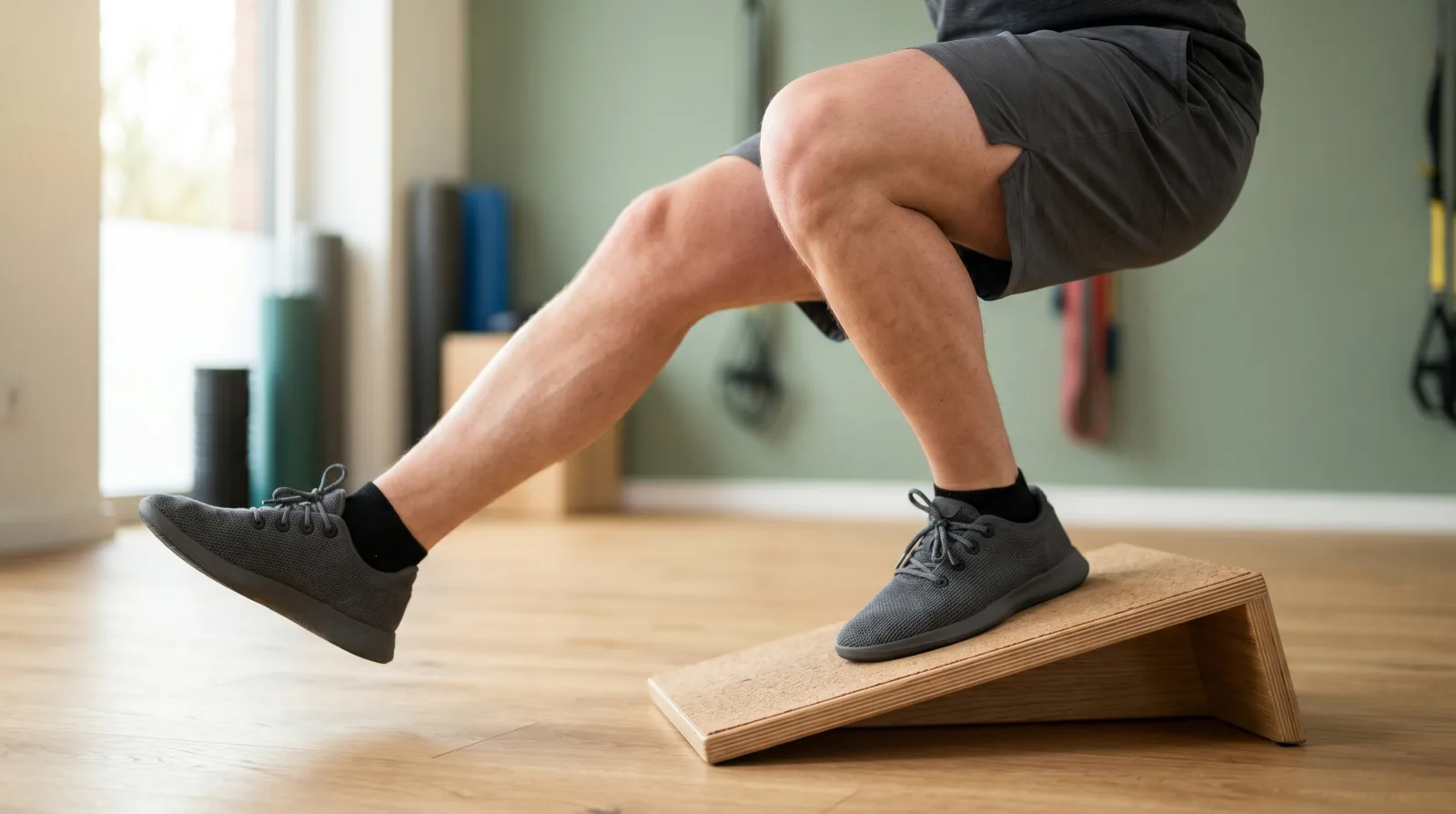
The part that actually changes the tendon is progressive strengthening, added in stages. A 2020 review of patellar tendinopathy rehabilitation by Muaidi lays out a staged progression: isometrics for pain and early load, then heavy slow resistance and eccentric work to build strength and change the tendon's properties, then sport-specific and plyometric loading to prepare for jumping and landing again.
Heavy slow resistance means controlled, heavy strength work through a full range, done slowly, two or three times a week. The same review notes it can improve tendon mechanical properties and is well tolerated. The progression is gated by symptom response, not by the calendar. We use a simple rule most clinicians share: pain during loading that stays low and settles by the next morning is acceptable and means the dose is roughly right. Pain that climbs through a session or lingers into the next day means we back the load off. A flare is not a failure. It is information your physiotherapist uses to adjust the next session.
The last stage is the one athletes skip and pay for: returning the tendon to the spring-like jumping and landing demands of the actual sport. Strength in the gym does not automatically transfer to a hard landing under fatigue. The plyometric and sport-specific phase rebuilds that tolerance gradually so the first real game is not the first hard load the tendon has seen in months.
Where shockwave and other adjuncts sit
Shockwave therapy comes up often, usually pitched as a shortcut. The honest read is more modest. The 2020 rehabilitation review describes the evidence for shockwave in patellar tendinopathy as promising but mixed, alongside other adjuncts like taping and bracing. None of these replaces loading. At best they are tools that may help a stubborn, plateaued tendon tolerate the strengthening that does the real work.
That mirrors what we see across tendons. In our shockwave for plantar fasciitis post we make the same point: shockwave earns a place at a specific moment, when a tendon has had a genuine run of progressive loading and stalled, not on day one. Used early, it mostly adds cost and discomfort to a recovery that loading was already driving. If your knee has not had a real loading program yet, that is the gap to close first, not the machine to book.
Why the timeline is slow, and what shortens it
Tendons remodel slowly, and patellar tendinopathy in jumping athletes tends to be stubborn. The Malliaras commentary specifically warns against unrealistic rehabilitation time frames and overreliance on passive treatment. We will not put a fixed number of weeks on your recovery, because it depends on how long it has been there, your sport's demands, how much you can deload competition while you rebuild, and how consistent the loading is. Honest, boring consistency beats intensity here.
What reliably shortens it is starting loading early rather than resting and waiting, keeping the dose in the range the tendon can recover from overnight, and not abandoning the program the week the pain eases. The pain usually settles well before the tendon's capacity catches up. Stopping at the first sign of relief is the most common reason jumper's knee comes back the next season.
If it has plateaued, get it assessed
If your knee pain is new and load-related, the move is to start staged loading and give it an honest run rather than resting into deconditioning. At Launch Rehab, the patellar tendon program starts with a palpation test to confirm the insertion point and map how the tendon behaves the following day, then builds the loading dose from that baseline rather than applying a generic protocol. If you have already trained through it for months and it keeps flaring, or you cannot find a load that settles by morning, that is the point to book a physiotherapy assessment so we can confirm the pattern, check your sport-specific demands, and set a realistic loading progression. Coverage and current fees live on our rates and FAQ page. The same staged-loading logic drives recovery in the Achilles tendon, so if you have dealt with that before, the approach will feel familiar.
Frequently asked questions
Should I rest my knee until the pain goes away?
No. Complete rest usually reduces the tendon's load capacity and sets up a flare when you return to sport. The current approach is to keep loading within a tolerable range and build capacity gradually, guided by how the knee responds the next day. Isometric holds are often used early to settle a reactive tendon while the heavier strengthening work begins.
Is jumper's knee the same as runner's knee?
No. Jumper's knee is patellar tendinopathy, with pinpoint pain at the lower kneecap that tracks with load. Runner's knee usually means patellofemoral pain, a more diffuse ache around the kneecap. The rehab differs, so the distinction is worth confirming at an assessment, since a single palpation test is not always specific enough to separate the two on its own.
Can I keep playing while I rehab it?
Often, with managed load. The decision depends on how irritable the tendon is and what your season demands. Many athletes keep training a reduced or modified load while rebuilding capacity, but that call is made after a clinician sees how the knee behaves under and after load.
Does it hurt to load the tendon during rehab?
Some pain during loading is acceptable as long as it stays low and settles by the next morning. Pain that climbs through a session or lingers into the next day means the dose is too high, and your physiotherapist will adjust it. A flare during rehab is information your physiotherapist uses to fine-tune the next session's load.
Will shockwave fix it faster?
Not on its own. The evidence for shockwave in patellar tendinopathy is mixed, and reviews position it as an adjunct for a plateaued tendon, not a replacement for loading. The strengthening program is what rebuilds capacity. Used before a real course of progressive loading has been tried, shockwave mostly adds cost and discomfort without changing the outcome.
How long until I am back to jumping?
There is no fixed timeline. Tendons remodel slowly, and recovery depends on how long it has been there, your sport, and how consistent the loading is. A clinician will set expectations after seeing your knee and your demands. Starting loading early and keeping the dose in a range the tendon can recover from overnight tends to shorten the path back to jumping.
What is heavy slow resistance training and why does it matter for jumper's knee?
Heavy slow resistance means controlled, heavy strength work through a full range of motion, done slowly, usually two or three times a week. A 2020 review of patellar tendinopathy rehabilitation notes this approach can improve the tendon's mechanical properties and is well tolerated, making it the stage that rebuilds the tendon's actual capacity after isometrics settle early pain.
Why do isometric holds come before heavier strengthening?
A 2015 British Journal of Sports Medicine study found a single bout of isometric quadriceps contractions reduced patellar tendon pain immediately, with relief lasting at least 45 minutes in athletes tested. That makes isometrics a useful early tool for settling a reactive tendon and creating a calmer window to train, though the study was limited to volleyball players and isometrics alone do not rebuild tendon capacity.
How do I know if my patellar tendinopathy needs imaging?
A physiotherapy assessment usually starts with a palpation test to confirm the pain is coming from the tendon's insertion point at the lower kneecap, rather than the joint itself. Imaging is not always the first step, but if the pattern is unclear, if pain does not track with load the way patellar tendinopathy typically does, or if a course of staged loading is not helping, that is worth raising with your physiotherapist or physician to decide if imaging is appropriate.
This article is general information, not personal medical advice. A regulated practitioner can confirm whether the patterns described apply to you.
Sources
- Malliaras P, Cook J, Purdam C, Rio E. Patellar Tendinopathy: Clinical Diagnosis, Load Management, and Advice for Challenging Case Presentations. JOSPT, 2015
- Rio E, et al. Isometric exercise induces analgesia and reduces inhibition in patellar tendinopathy. British Journal of Sports Medicine, 2015
- Muaidi QI. Rehabilitation of patellar tendinopathy. Journal of Musculoskeletal & Neuronal Interactions, 2020
- College of Health and Care Professionals of BC (CHCPBC): Physical Therapists
WRITTEN BY
The Launch Rehab Team
Practical recovery and training notes from the clinicians at our five Metro Vancouver studios.
FOUND THIS USEFUL?
Share it with your network on LinkedIn. We wrote a ready-to-post version for you.
FILED UNDER
- patellar-tendinopathy
- jumpers-knee
- knee-pain
- tendon-loading
- return-to-sport
- physiotherapy
- bc