Achilles Tendinopathy: Load It, Don't Just Rest It
If your Achilles is stiff and sore for the first ten minutes every morning and resting only buys a few good days before it flares again, you are treating it like the wrong problem. Here is why a tendon that hurts usually needs load, not time off.
BY THE LAUNCH REHAB TEAM
What is Achilles tendinopathy and how is it treated?
Achilles tendinopathy is a load-capacity problem in the tendon, not an active inflammation. The recommended treatment is progressive calf-loading exercise (eccentric heel drops or heavy slow resistance training), not extended rest. A structured loading programme lasting 8 to 12 weeks is the current standard of care per the 2024 JOSPT clinical practice guideline for mid-portion Achilles tendinopathy.
If your Achilles is stiff and sore for the first ten minutes every morning, then loosens up, then flares again whenever you push the mileage, you probably have Achilles tendinopathy. The instinct is to rest it. For most people that instinct quietly makes the tendon worse.
Why "tendinitis" is the wrong word
The old name was Achilles tendinitis, and the "-itis" implied active inflammation that rest and anti-inflammatories would settle. The current understanding is different. A tendon that has hurt for weeks or months is usually showing a load-capacity problem, not a hot inflammatory one. The tissue has been asked to do more than it can currently tolerate, and it has started to change in structure rather than simply swell.
That is why the term shifted to tendinopathy, and why the current clinical guidance frames management around restoring the tendon's capacity rather than chasing inflammation. It matters for treatment, because the fix for a structure that cannot carry enough load is to rebuild the load it can carry. Total rest does the opposite. It detrains the tendon and the calf around it, so the tissue you return to is weaker than the one you stopped on.
This is not permission to ignore pain. It is a reason to stop treating an aching Achilles as something you wait out.
Mid-portion and insertional are not the same problem
Where the tendon hurts changes the plan, so it is the first thing we sort out. The two common patterns are mid-portion and insertional, and people often assume they have one when the picture points to the other.
Mid-portion tendinopathy sits in the body of the tendon, a few centimetres above the heel bone. The typical presentation is pain roughly two to six centimetres above where the tendon attaches, coming on gradually, and tender when you pinch that stretch of tendon. This is the version most loading research has studied.
Insertional tendinopathy sits lower, right where the tendon meets the heel bone. It tends to be grumpier with positions that compress the tendon against the bone, which is part of why deep heel drops off a step, the classic mid-portion exercise, can aggravate an insertional tendon. The loading principle is the same for both, but the range you work through and the speed of progression differ. Getting this wrong is a common reason a sensible-looking rehab plan stalls. If you are not sure which one you have, that distinction is one of the first things a physiotherapy assessment is for.
Loading is the first-line treatment, and the evidence is decent
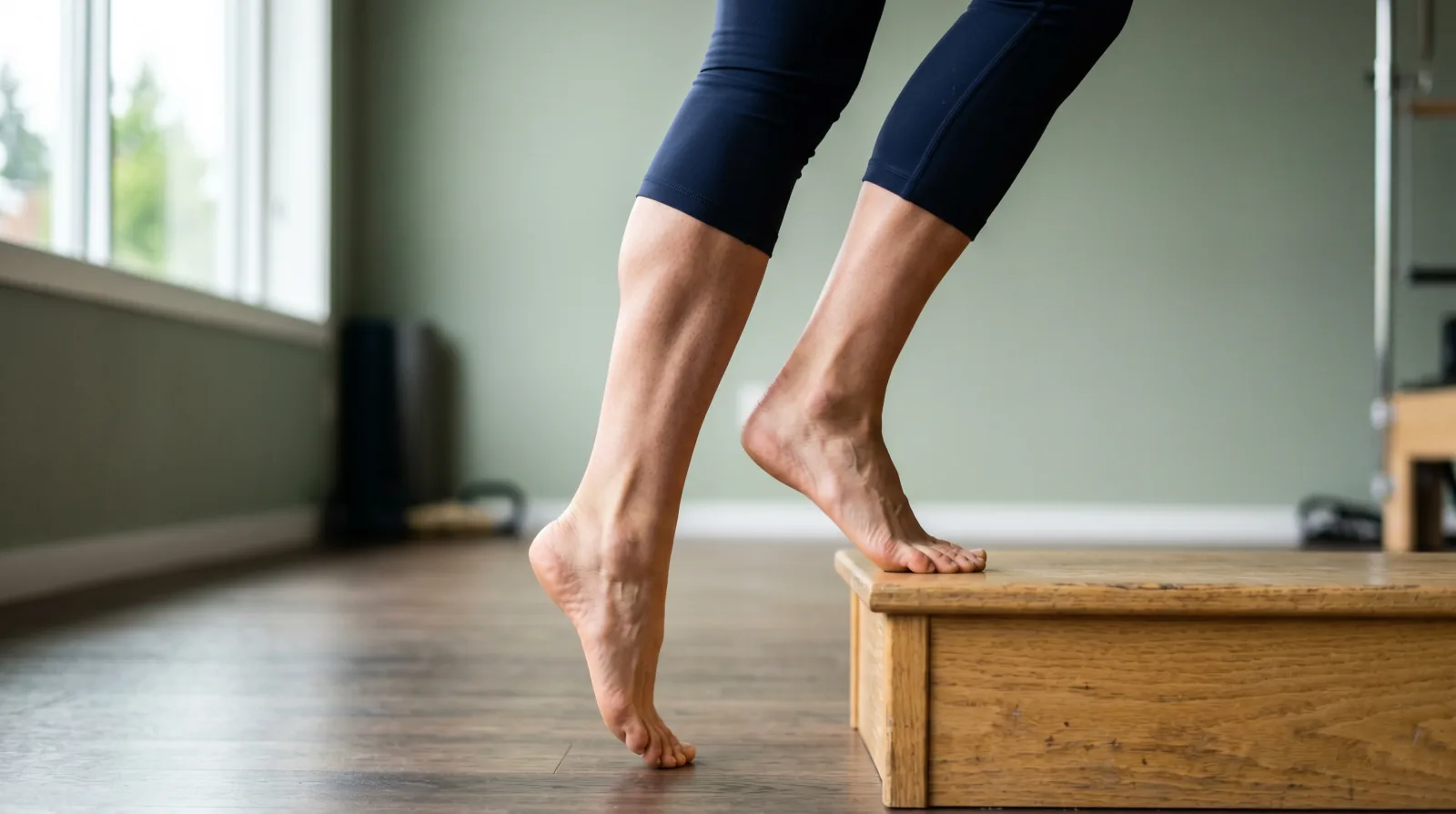
The unglamorous core of Achilles rehab is progressive strengthening of the calf and tendon. Two protocols dominate the research. The older one is Alfredson's eccentric programme, where you lower slowly under load through heel drops. The newer one is heavy slow resistance, where you load the calf through both the lifting and lowering phases against progressively heavier resistance, fewer reps, slower tempo.
Both work. A 2023 systematic review and meta-analysis in BMC Sports Science, Medicine and Rehabilitation found eccentric exercise produced meaningful pain improvement in mid-portion Achilles tendinopathy compared with rest or other conservative care, while noting heavy slow resistance performed similarly in several trials. A 2015 randomized controlled trial in the American Journal of Sports Medicine compared the two directly and found equally good lasting results, with higher patient satisfaction and adherence in the heavy slow resistance group at twelve weeks. The practical read is that the best protocol is often the one you will actually keep doing, which is why we match it to your schedule, equipment, and how the tendon behaves rather than prescribing one by default.
A few things that surprise people. Some discomfort during loading is acceptable and does not mean damage. We watch how the tendon settles by the next morning, not how it feels mid-exercise, and we use that morning stiffness as the dial for progressing or holding. Runners and active adults often keep some running going through rehab rather than stopping cold, with volume and surface adjusted to symptom response. The aim is to load the tendon enough to provoke adaptation without tipping it into a flare it cannot recover from overnight.
Where shockwave and other add-ons fit
Shockwave therapy comes up often, usually for a tendon that has plateaued. The honest version of the evidence is that it can help, mostly as an addition to loading rather than instead of it. A 2022 systematic review in Cureus found extracorporeal shockwave therapy can reduce pain and improve function in mid-portion Achilles tendinopathy, and concluded the best results came from combining it with eccentric exercise, not from using it alone.
The evidence is also weaker for insertional tendinopathy than for mid-portion, and the trial quality across the board is modest. So we treat shockwave the way we treat it for heel pain, as a tool for a stubborn tendon that has had a genuine run of loading and stalled, not a day-one shortcut. We walked through the costing and session-count side of that decision in our shockwave plantar fasciitis post, and the same principle applies here. Coverage and current pricing for any add-on live on our rates page.
Other adjuncts, including hands-on treatment, isometric holds for pain relief on a flared day, and footwear or heel-lift tweaks for insertional cases, have a place. None of them replace the loading programme. They make it tolerable enough to keep going.
How long this actually takes
Tendons are slow tissue. They respond to load over months, not days, and rushing the progression is the fastest way to restart the clock. We are deliberately not putting a week count on recovery here, because honest timelines depend on how long it has been sore, which pattern you have, your training demands, and how consistently the loading gets done.
What we can say from clinic experience is that the people who recover well are rarely the ones who rested longest. They are the ones who loaded consistently, progressed patiently, and treated each flare as feedback to adjust the dose rather than a signal to stop. The tendon that gets stronger is the one that keeps being asked to work, just within a ceiling that rises week by week.
Running mechanics and training load matter too, because a tendon that keeps getting reloaded the same way it broke down tends to keep breaking down. A running assessment looks at cadence, footwear, and how fast you have been ramping mileage, which is often where the original overload came from.
When to get it looked at
Most Achilles pain is tendinopathy, but not all of it. Sudden sharp pain with a sense that something snapped, a feeling of being kicked in the back of the ankle, or a sudden inability to push off needs same-day medical assessment, not a loading programme, because that pattern can mean a tendon rupture. Pain that is worse at night and unrelated to activity, or swelling with redness and warmth, also deserves a physician's eyes first.
For the more typical grumbling, stiff-in-the-morning Achilles that keeps interrupting your training, the strongest outcomes happen when loading starts early and stays consistent. At Launch Rehab, the loading dose is calibrated session by session using morning stiffness as the gauge: if the tendon has not settled overnight, the next session backs off rather than pushes through. If yours has plateaued after an honest run of rehab, or you are not sure whether you are dealing with mid-portion or insertional pain, book a physiotherapy assessment and we will sort out the pattern and the plan. The same staged, load-it-don't-rest-it logic applies to other lower-limb tendons too, including the patellar tendon in jumper's knee and the broader rebuild work in runner's knee.
Frequently asked questions
Should I rest my Achilles tendon until the pain goes away?
No. Complete rest tends to deload the tendon and the calf, so you return weaker. The 2024 JOSPT clinical practice guideline for mid-portion Achilles tendinopathy specifically recommends progressive loading exercise rather than waiting the pain out, though the dose has to be calibrated to your symptoms and the pattern you have.
Is it okay to exercise through some Achilles pain?
Often, yes. Some discomfort during loading is acceptable as long as the tendon settles back down by the next morning and the pain does not climb session over session. We use morning stiffness as the main gauge for whether to progress the load or hold it steady, rather than how the tendon feels in the middle of the exercise itself.
What is the difference between mid-portion and insertional Achilles tendinopathy?
Mid-portion pain sits in the body of the tendon a few centimetres above the heel, while insertional pain sits right where the tendon meets the heel bone. They share the same loading principle but differ in the range and speed you progress, so deep heel drops that help one can aggravate the other.
Does shockwave therapy fix Achilles tendinopathy?
Not on its own. A 2022 Cureus review found shockwave can reduce pain and improve function in mid-portion cases, with the best results when it is combined with loading exercise rather than used alone. We reserve it for a tendon that has stalled after a real loading effort.
How long does Achilles tendinopathy take to recover?
It varies, and honestly it is usually months rather than weeks. The timeline depends on how long it has been sore, the pattern you have (mid-portion or insertional), your activity demands, and how consistently you load it week to week, so your physiotherapist will set realistic expectations once they have actually assessed the tendon in front of them.
Can I keep running with Achilles tendinopathy?
Frequently, yes, with adjustments. Many active adults keep some running going through rehab, with volume, pace, and running surface scaled back to a level the tendon can tolerate rather than stopping outright. A running assessment helps find the specific training load or running mechanics that caused the overload in the first place, so the plan fixes the cause and not just the symptom.
How do I know if I ruptured my Achilles tendon instead of just straining it?
A rupture usually announces itself: sudden sharp pain, a sensation of being kicked in the back of the ankle, and a sudden inability to push off the foot. That pattern needs same-day medical assessment, not a loading programme. Tendinopathy, by contrast, tends to build gradually as morning stiffness and activity-related soreness rather than a single dramatic moment.
Should I get an ultrasound or MRI for Achilles tendinopathy?
Not usually as a first step. Mid-portion and insertional Achilles tendinopathy are typically diagnosed from your history and a physical assessment, since imaging findings do not always match symptoms and rarely change the initial loading-based treatment plan. Imaging becomes more useful when recovery has stalled after a genuine loading effort, or when a rupture is suspected.
What exercises are used to treat Achilles tendinopathy?
Heel raises and heel drops, progressed from isometric holds to slow eccentric and heavy slow resistance loading, are the backbone of treatment, with a 2015 randomized controlled trial finding heavy slow resistance training as effective as eccentric loading for mid-portion cases. The exact exercise, range, and speed depend on whether the pain is mid-portion or insertional, since one pattern can aggravate the other.
Get a loading plan built for your tendon
A physiotherapist can grade the load, track how the tendon responds, and adjust week to week. Book physiotherapy in Richmond, physiotherapy in New Westminster, or start with a running assessment in Coquitlam to find what caused the overload.
This article is general information, not personal medical advice. A regulated practitioner can confirm whether the patterns described apply to you.
Sources
- JOSPT 2024 Clinical Practice Guideline: Achilles Pain, Stiffness, and Muscle Power Deficits, Midportion Achilles Tendinopathy Revision
- JOSPT 2018 Clinical Practice Guideline: Achilles Pain, Stiffness, and Muscle Power Deficits, Midportion Achilles Tendinopathy
- Eccentric exercise is more effective than other exercises in the treatment of mid-portion Achilles tendinopathy: systematic review and meta-analysis, 2023
- Heavy Slow Resistance Versus Eccentric Training as Treatment for Achilles Tendinopathy: A Randomized Controlled Trial, 2015
- The Effectiveness of Extracorporeal Shockwave Therapy for Midportion Achilles Tendinopathy: A Systematic Review, 2022
WRITTEN BY
The Launch Rehab Team
Practical recovery and training notes from the clinicians at our five Metro Vancouver studios.
FOUND THIS USEFUL?
Share it with your network on LinkedIn. We wrote a ready-to-post version for you.
FILED UNDER
- achilles-tendinopathy
- achilles-tendon-pain
- running-injury
- tendon-loading
- physiotherapy
- bc