Plantar Fasciitis: The First Six Weeks of Treatment That Actually Works
Plantar fasciitis is one of the most over-treated and under-rebuilt conditions in foot and ankle physiotherapy. Rolling the foot on a frozen water bottle isn't the rebuild. Calf-and-foot strengthening, calibrated load management, and time are.
BY KEANE LEUNG
Plantar fasciitis, heel pain that is worst with the first few steps in the morning and after periods of inactivity, is among the most common foot complaints we see. It is also one of the more poorly rehabilitated conditions in general practice, not because the rehabilitation is complicated but because the standard advice usually stops at "rest, ice, stretch, and orthotics" and skips the strength rebuild that actually drives recovery.
This post is a clinician's-eye view of what the first 6 weeks of plantar fasciitis treatment should look like. It draws on current evidence and the protocols we use in our Metro Vancouver studios. It does not promise a magic fix. Plantar fasciitis is a load-tolerance problem with a real timeline, and the best clinical care still takes weeks. What it does is collapse a 9-month frustration into a structured 6-to-12-week rebuild.
What plantar fasciitis is
The plantar fascia is a thick band of connective tissue running from the heel bone (calcaneus) along the underside of the foot to the toes. It functions as both a static support of the arch and a dynamic shock-absorber and load-transmitter during the push-off phase of gait. Plantar fasciitis is, despite the name, primarily a degenerative condition of the fascia near its insertion at the heel. Current literature uses "plantar fasciopathy" or "plantar heel pain" as more accurate terms (JOSPT 2014 clinical practice guideline; updated 2023 evidence summaries).
The classic clinical pattern:
- Heel pain at the medial calcaneal tubercle (the inside-edge of the heel).
- Worst with the first few steps after waking or after a period of sitting.
- Improves with several minutes of movement.
- Returns after prolonged standing or weight-bearing.
- May worsen toward the end of a long day.
- Often associated with limited ankle dorsiflexion (tight calf complex).
- More common with increases in standing time, walking time, running mileage, or a switch to a less supportive shoe.
It is a clinical diagnosis. Imaging is not first-line. A typical patient does not need an X-ray or MRI to start treatment, and imaging findings (heel spurs, fascial thickening) often correlate poorly with symptoms.
What the evidence supports
A summary of the interventions and the strength of evidence, drawing on the 2014 JOSPT clinical practice guideline, the Rathleff 2015 randomized trial, and more recent meta-analyses:
Strong evidence for:
- High-load strength training of the foot intrinsics and calf. Heavy slow resistance (HSR) calf raises with the toes dorsiflexed have outperformed calf stretching alone in randomized trials.
- Calf stretching with toes dorsiflexed. Not flat. Toe extension biases the stretch onto the plantar fascia and gastrocnemius-soleus complex together.
- Manual therapy and stretching as adjuncts to exercise.
- Patient education on load management, footwear, and expected timeline.
Moderate evidence for:
- Shockwave therapy for cases that have persisted beyond 3 to 6 months despite first-line treatment.
- Night splints for the subset of patients with severe first-step morning pain.
- Foot orthoses (off-the-shelf or custom) as a short-to-medium-term adjunct.
- Taping for short-term symptom modification.
Limited or no evidence for:
- Ultrasound, laser, and other passive modalities as primary treatment.
- Generic stretching as a stand-alone treatment.
- Cortisone injection as a first-line treatment: moderate evidence for short-term pain relief, weak evidence for medium-term outcomes, and a small but real risk of fascial rupture with repeated injection. Sometimes appropriate for severe cases; not first-line.
The first 6 weeks: a structured plan
A typical first 6 weeks in our clinics. The reps and loads here are example numbers. The actual prescription is individualized.
Weeks 1 to 2: De-load and start the strength program
- Reduce aggravating loading. Identify the recent change in load (increased standing time, mileage jump, new shoes) and reduce it. For runners, this often means halving weekly mileage temporarily. For people with prolonged standing demands, this means more breaks, supportive footwear, and surface considerations (anti-fatigue mats for kitchen or workshop workers).
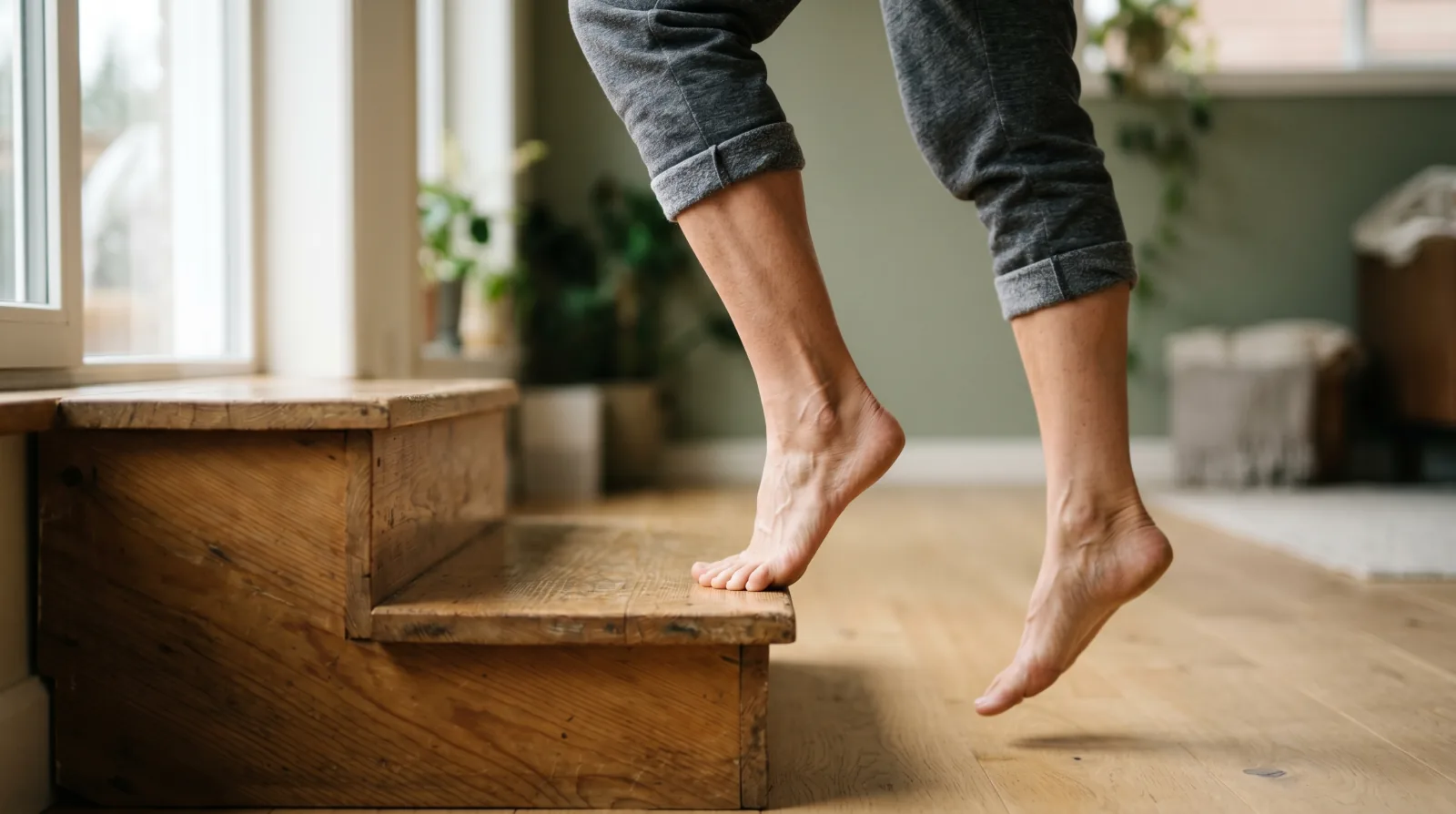
- Start heavy slow resistance calf raises. The Rathleff protocol uses single-leg calf raises with a folded towel under the toes (to keep them dorsiflexed), holding additional weight if tolerated. Three sets of 12 slow reps, performed every other day. Slow tempo: 3 seconds up, 2 seconds at the top, 3 seconds down.
- Daily plantar fascia and calf stretching. The plantar fascia stretch: cross the affected leg over the opposite knee, grasp the toes, and pull them back into dorsiflexion. Hold 10 seconds, repeat 10 times, perform several times per day, especially before getting out of bed in the morning.
- Footwear review. Replace shoes that are excessively worn or unsupportive for the patient's needs. Avoid prolonged barefoot weight-bearing during the rebuild.
- Pain monitoring. Pain during exercises up to 3 out of 10 is acceptable. Pain that lingers significantly past 24 hours is a sign to reduce load.
Weeks 3 to 4: Progress load, continue stretching
- Progress the calf raise program. Add weight, increase reps if tolerance is good. Consider adding a second variation: a bent-knee calf raise (which biases the soleus) and double-leg jump rope or heel-raise hops as load tolerance improves.
- Add foot intrinsic work. Short-foot exercises, toe-yoga, single-leg balance with foot intrinsic engagement. These are not glamorous and they matter for long-term recovery.
- Continue daily stretching. By weeks 3 to 4, ankle dorsiflexion range often improves measurably.
- Manual therapy as needed. Targeted soft-tissue work to the plantar fascia, calf complex, and intrinsic foot musculature. IMS or dry needling for highly reactive tissue. This is adjunctive, not the main intervention.
Weeks 5 to 6: Build capacity, plan return to load
- Continue progressive strength work. By weeks 5 to 6, most patients tolerate near-bodyweight or weighted single-leg calf raises with reduced morning pain.
- Re-introduce graded load: for runners, a structured return-to-run with 10% weekly progression. For standing-workers, gradual return to full days.
- Re-assess. By the end of week 6, most patients have meaningful improvement in morning pain, walking tolerance, and pain at end of day. Patients who haven't improved often have one of a small number of issues (see below).
When it isn't responding
If 6 weeks of structured care hasn't produced meaningful improvement, the common explanations:
- The load was never actually reduced. The patient continued the same standing or running volume that triggered the problem and expected the program to compensate. The rebuild and the load reduction work together; one without the other often stalls.
- Strength work was too light. Banded foot exercises and bodyweight calf raises are a starting point, not the program. Heavy slow resistance, meaning enough weight that the last few reps are genuinely hard, is what drives recovery in the literature.
- Footwear was a hidden contributor. A persistent worn shoe, an unsuitable barefoot/minimal shoe for a high-load presentation, or a new shoe with significantly different drop or stack height.
- There was a different driver. Plantar nerve entrapment (Baxter's nerve), tarsal tunnel syndrome, stress fracture of the calcaneus, or an inflammatory arthropathy can mimic plantar fasciitis. Re-assessment with attention to red flags is warranted.
- The condition has become chronic enough to warrant shockwave. Cases persisting beyond 3 to 6 months with appropriate care often respond to a course of radial shockwave therapy, typically 3 to 5 sessions one week apart. We cover the sessions, cost, and evidence in detail in shockwave for plantar fasciitis.
What about cortisone injection?
The conversation about cortisone for plantar fasciitis is similar to the conversation about cortisone for any tendinopathy: short-term pain reduction is real, medium-term outcomes are weak, and there is a small but real risk of plantar fascia rupture with injection. The current literature does not support cortisone as a first-line treatment. It is sometimes appropriate for cases that haven't responded to conservative care, in patients where short-term symptom control is needed for a specific reason. We cover the broader cortisone-vs-shockwave question in the shockwave vs cortisone piece.
Coverage in BC
- Extended health: most plans cover physiotherapy at a per-visit rate up to an annual maximum.
- MSP: limited physiotherapy visits per year for Supplementary Benefits enrolees.
- ICBC: if foot pain is related to a motor vehicle injury (direct impact to the foot, or compensatory loading from another injury) Enhanced Care covers physiotherapy.
- WorkSafeBC: if the foot pain is a workplace injury or developed through workplace standing demands, WorkSafeBC covers physiotherapy.
Where this connects
Plantar fasciitis often co-exists with calf, Achilles, and knee load-tolerance issues, particularly in runners. The runner's knee piece covers the related patellofemoral picture. The shockwave vs cortisone piece is the longer treatment of the cortisone question. And if the cause turns out to be referred from a low back nerve root rather than a true plantar issue, the lower back pain post is the place to start.
At Launch Rehab, the plantar fasciitis program pairs the heavy-slow calf protocol with a load diary the patient tracks between sessions, because the cases that stall are usually the ones where daily standing or running volume never actually came down while the strengthening was being added.
The shortest version: plantar fasciitis is a load-tolerance problem. The rebuild is heavy slow calf strengthening, dorsiflexed plantar fascia stretching, footwear and surface management, and time. Six weeks of this collapses the typical recovery from months to weeks. The cases that don't respond often have a specific identifiable reason, and most of those are treatable too.
Frequently asked questions
How long does plantar fasciitis take to heal?
Most acute cases improve meaningfully in 6 to 12 weeks with a structured program of heavy slow calf raises and plantar fascia stretching. Chronic cases (pain present for more than 3 to 6 months) take longer and often need shockwave therapy added to the program. The cases that drag on the longest are usually those where load was never reduced while treatment was attempted.
What exercises are best for plantar fasciitis?
Heavy slow resistance calf raises are the most evidence-supported exercise for plantar fasciitis. Single-leg raises performed slowly (3 seconds up, 3 seconds down) with a towel under the toes, three sets of 12, every other day, are the backbone of the program. Plantar fascia stretching, toes pulled into dorsiflexion before getting out of bed in the morning, is the second pillar.
Should I rest my foot completely with plantar fasciitis?
Complete rest is generally not recommended. Unloading the fascia while rebuilding calf and foot capacity is the right balance, since the strength deficit that allowed the problem to develop does not resolve on its own. Reducing high-impact load (running, prolonged standing) while replacing it with the strengthening program prevents deconditioning without prolonging the irritability, and it usually produces a faster overall recovery than rest alone.
Is cortisone injection a good treatment for plantar fasciitis?
Usually not as a first-line treatment. Cortisone provides moderate short-term pain relief but weak medium-term outcomes, and there is a small risk of fascial rupture with repeated injection. It may be appropriate in severe cases where someone genuinely cannot function. Heavy slow resistance loading has better long-term outcomes in the evidence.
Does ICBC or WorkSafeBC cover plantar fasciitis treatment?
If the foot pain developed from or was worsened by a motor vehicle injury, ICBC Enhanced Care covers physiotherapy. If it developed through workplace standing demands or a specific work incident, WorkSafeBC covers it. Most private extended health plans cover physiotherapy at a per-visit rate. Book an assessment and we will confirm coverage at your first visit.
Do orthotics fix plantar fasciitis?
Orthotics have moderate evidence as a short-to-medium-term adjunct, not as a stand-alone fix. They can reduce load on the fascia while the strength program does the longer-term work of building tolerance. Relying on an orthotic without the heavy slow resistance calf and foot program tends to leave the underlying strength deficit unaddressed, which is often why symptoms return once the orthotic comes out.
Why does plantar fasciitis hurt most with the first steps in the morning?
During sleep, the plantar fascia shortens slightly in a relaxed, non-weight-bearing position. The first steps after waking stretch that tissue suddenly under full body weight, which produces the sharp pain many people describe. This pattern is one of the more reliable clinical clues for plantar fasciitis and tends to ease within several minutes of walking as the tissue warms up and adapts to load.
Can plantar fasciitis affect both feet at the same time?
Yes, though it is more common for one foot to be more symptomatic than the other, particularly when a specific change in loading (a new running shoe, an increase in standing hours) affected one side more directly. Bilateral presentations sometimes point toward a systemic contributor, such as an inflammatory condition, and are worth flagging to your physiotherapist or physician if both feet are equally affected without an obvious loading explanation.
How is plantar fasciitis different from a heel spur?
A heel spur is a bony growth that can show up on an X-ray near the heel, while plantar fasciitis is a condition of the soft-tissue fascia itself. Many people with a heel spur on imaging have no pain at all, and many people with significant plantar fasciitis pain have no visible spur, so the two are not the same diagnosis and a spur finding does not change the treatment approach.
This article is general information, not personal medical advice. A regulated practitioner can confirm whether the patterns described apply to your specific presentation.
WRITTEN BY
Keane LeungBSCPT, CAFCI, Vestibular and Concussion Therapy (HE/HIM/HIS)
Physiotherapist
Practical recovery and training notes from the clinicians at our five Metro Vancouver studios.
READ FULL PROFILEFOUND THIS USEFUL?
Share it with your network on LinkedIn. We wrote a ready-to-post version for you.
FILED UNDER
- plantar-fasciitis
- foot-pain
- heel-pain
- physiotherapy
- rehab
- shockwave
- bc