
Shin Splints: Why They Keep Coming Back for Runners
Shin splints clear up, you start running again, and within a few weeks the same inner-shin ache is back. The cycle is almost always a load problem, not a stubborn injury. Here is how to read it and break it.
BY KEANE LEUNG
If your inner shin aches during or after every run, settles with a week off, then returns as soon as you build mileage back up, you are not dealing with bad luck. You are dealing with a load problem that keeps getting fed. Breaking the cycle starts with understanding what shin splints actually are.
What shin splints actually are
"Shin splints" is the casual name for medial tibial stress syndrome, or MTSS. The clinical picture is exercise-induced pain along the inner border of the shin bone, usually spread over a span of several centimetres rather than one sharp point. A 2025 scoping review in Cureus describes MTSS as one of the most common overuse injuries of the lower leg, and frames it as an early stress injury on the continuum that, left unmanaged, can progress toward a tibial stress fracture.
That continuum is the part most runners miss. MTSS is best understood as a bone and surrounding-tissue overload reaction, not a muscle strain you can stretch out. It sits at the milder end of a spectrum. A tibial stress fracture sits at the worse end. They are related, but they are not the same problem, and the gap between them is mostly a matter of how much load the tissue absorbed before someone backed off.
Two other things get confused with MTSS and matter for the plan. A tibial stress fracture produces focal pain over a small area that tends to worsen, not improve, the longer you run. Exertional compartment syndrome produces a tight, cramping, sometimes numb sensation that builds predictably with exercise and eases with rest. Sorting these out is the first job at assessment, because the management for each is different.
Why the same shin pain keeps coming back
The dominant driver of MTSS is a training-load error. The Cureus scoping review found higher risk tied to running volume, with more frequent and higher-mileage running among the exposures linked to the problem. In plain terms, the tissue was asked to absorb more than it was ready for, too soon.
The recurrence pattern follows from that. You rest, the symptoms calm down, and the calm reads as healed. But rest only removes the load. It does not raise the ceiling on how much load the shin can handle. So you return at roughly the same mileage that caused the problem, on a shin that is no stronger than before, and the overload starts again. Time off treats the flare. It does not treat the capacity gap underneath it.
This is why runners who only ever rest tend to live in a loop. The fix is not more rest. It is a smarter rebuild that raises capacity while symptoms settle, so the shin can carry the load you want to give it.
What the evidence says about treatment
Here is the honest version. A systematic review in Current Reviews in Musculoskeletal Medicine (2009) found limited evidence to support any single MTSS treatment, with most recommendations resting on expert opinion and clinical experience rather than strong randomized trials. That has not dramatically changed. No passive treatment, no single gadget, no stretch has been shown to be the answer on its own.
What that review does support is the unglamorous foundation: relative rest rather than total rest, training modification, and a gradual, staged return to activity. Relative rest means reducing load to a level the shin tolerates without flaring, not stopping entirely. The point is to keep the tissue working at a dose it can handle while you rebuild the rest.
So when a clinic sells you a specific machine as the cure for shin splints, the evidence does not back that framing. The treatments with the most support are load management and graded return. Anything passive is, at best, an adjunct that might make the rehab more comfortable, not a substitute for it.
How we approach the rebuild
In our clinic, an MTSS rebuild has a few moving parts, and the assessment sets the dose for each. The first is relative load reduction. We work out the running volume and intensity your shin can currently tolerate, drop to it, then build back in small, planned steps rather than jumping to your old mileage.
The second is strength. The calf complex and the foot muscles take a lot of the load when you run, and a shin that keeps breaking down is often attached to a calf that never got strong enough for the mileage. Loading those structures is a core part of raising the ceiling, and it is the half that rest alone never delivers. A kinesiologist often runs the progression once a physiotherapist has set the plan.
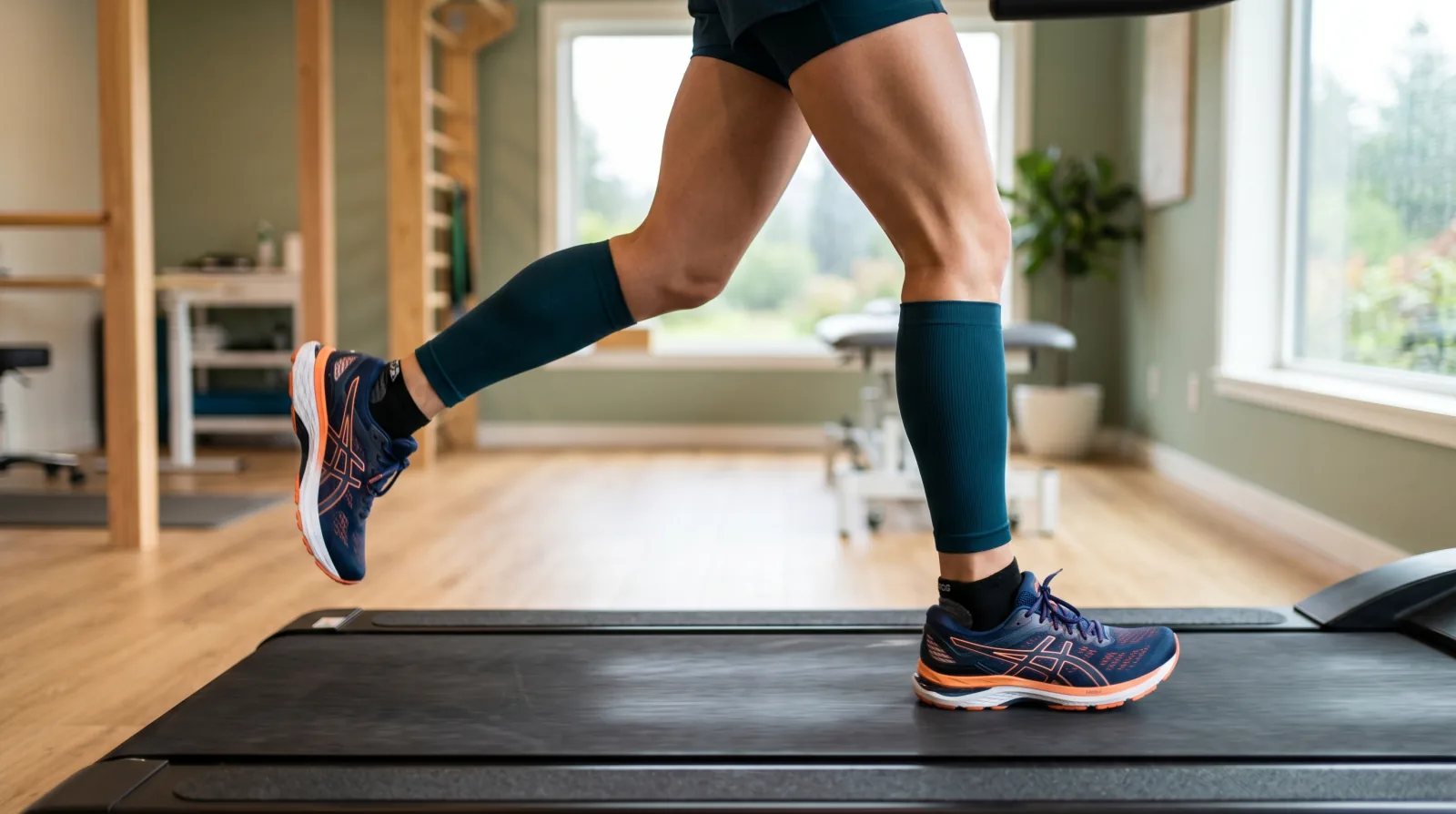
The third is how you run. A 2022 systematic review and meta-analysis in Sports Medicine - Open looked at changing running step rate, often called cadence. It found increasing step rate reduced loading at the knee and hip, though the authors were honest that the evidence for actually preventing injury was not yet strong. We treat cadence and gait tweaks as one possible lever, considered case by case, not a guaranteed fix bolted onto every runner. A running assessment is where those mechanics get looked at properly, on a treadmill, in your own shoes.
If this rebuild-not-rest logic sounds familiar, it is the same principle behind progressively loading a cranky Achilles. We walk through that in Achilles tendinopathy and why loading is the treatment, and the staged return-to-running idea also drives the runner's knee rebuild.
The red flag that changes everything
Most shin pain is MTSS and responds to a sensible rebuild. One pattern does not, and it needs ruling out before you do anything else. If your shin pain is focal, meaning you can cover the sore spot with a fingertip rather than spreading your hand over a band of it, and especially if it is getting worse the more you run or waking you at night, that points toward a possible tibial stress fracture.
A stress fracture is not a physio-only problem. It usually needs imaging and a physician to confirm, and the early management is genuine offloading, not a graded running return. Pushing through a stress fracture the way you might push through a mild shin ache can turn a manageable injury into a much longer layoff.
So the rule we use is simple. Diffuse ache that warms up and settles, improving over weeks of sensible loading, is the MTSS pattern we rehab. Focal, worsening, or night pain is a stop sign that warrants medical assessment first. When the picture is mixed, we send you for imaging rather than guess.
Why a physiotherapist is the right first call
Sorting MTSS from a stress fracture from compartment syndrome is exactly the screening a physiotherapist is trained to do. Per the College of Health and Care Professionals of BC, the regulator for physical therapists in the province, physios are qualified to assess and treat musculoskeletal conditions like this and to recognize when a presentation needs onward referral to a physician.
That screening matters more than the specific exercises that follow it. The exercises are not exotic. The judgment about how much to load, how fast to progress, when to hold, and when to send you for an X-ray is the part that actually breaks the recurrence cycle. Coverage for an assessment depends on your plan, and we keep current figures and direct-billing details on our rates and FAQ page rather than quoting them here.
How long this usually takes
Honest answer: it depends, and anyone giving you a fixed week count for shin splints is guessing. Recovery timelines for MTSS hinge on how long the symptoms have been present, your training history, how irritable the shin is at assessment, and how disciplined the graded return is. A shin that has flared once and gets a sensible rebuild behaves very differently from one that has been pushed through for a season.
What we can say is the shape of it. Symptoms usually settle first, capacity catches up second, and the mileage you can run without a flare is the real marker of recovery, not the absence of pain on an easy week. Returning to full mileage the moment the ache disappears is the single most common reason shin splints come back. At Launch Rehab, the return-to-run plan sets a mileage ceiling for the first two weeks back, even when the shin feels completely settled, because the tibia's capacity and the symptom level are rarely in the same place at the same time. Your therapist will set expectations against your specific picture after the first assessment.
Frequently asked questions
Are shin splints and medial tibial stress syndrome the same thing?
Yes. Shin splints is the everyday name for medial tibial stress syndrome, or MTSS, the clinical term for exercise-induced pain along the inner shin bone. Both terms describe the same overuse condition, and clinicians tend to use MTSS in notes and reports while runners generally know it as shin splints.
Can I keep running with shin splints?
Usually some running is fine, at a reduced level your shin tolerates without flaring, which is what relative rest means. But focal pain that worsens with running, or pain at night, is different and should be checked for a stress fracture before you run on it.
Will rest alone fix my shin splints?
No. Rest calms the flare but does not raise how much load the shin can handle, so returning at your old mileage usually restarts the problem. The fix is a graded rebuild with strengthening, not time off on its own. Relative rest, dropping mileage rather than stopping completely, tends to work better than a full break followed by a sudden return.
Do I need an X-ray for shin splints?
Not for typical diffuse shin ache that improves with sensible loading. Imaging and a physician's input are warranted when pain is focal, worsening, or waking you at night, which can signal a tibial stress fracture. Your physiotherapist can help decide whether your presentation fits the pattern that needs imaging.
Does changing my running cadence cure shin splints?
No. A 2022 review found increasing step rate reduces some lower-limb loading, but the evidence that it prevents injury is not yet strong. We treat it as one possible adjustment, considered case by case, not a standalone cure. Load management and a graded return still carry most of the weight in a shin splints rebuild.
Should I see a physiotherapist or just buy better shoes?
Footwear can be part of the picture, but it rarely fixes a load problem on its own. A physiotherapist screens for the cause, rules out a stress fracture, and builds the graded return that addresses why the pain keeps coming back, which a shoe change alone cannot do.
What is the difference between shin splints and a stress fracture?
Shin splints, or MTSS, produce a diffuse ache spread over several centimetres of the inner shin that you cannot pinpoint with one finger. A stress fracture produces focal pain over a small area that tends to worsen the longer you run and can wake you at night. The two sit on the same overload spectrum, but a stress fracture needs imaging and a physician's input rather than a graded running return, so telling them apart is the first job at assessment.
How much should I reduce my mileage if I have shin splints?
There is no universal number, since the right starting point depends on how irritable the shin currently is and your recent training history. The principle that guides it is relative rest, dropping to a running volume the shin tolerates without flaring rather than stopping entirely, then rebuilding in small, planned steps. A physiotherapist or a kinesiologist working from a physiotherapist's plan sets that starting dose after assessing your shin and your training log.
Does a kinesiologist help with shin splints recovery?
Yes, within a defined role. A kinesiologist often runs the strengthening and return-to-run progression once a physiotherapist has assessed the shin, ruled out a stress fracture, and set the plan. Kinesiology is not a regulated college in BC, so kinesiologists work alongside the diagnostic screening a physiotherapist provides rather than replacing it.
Can new running shoes prevent shin splints from coming back?
Footwear and surface changes can be one adjustment among several, but the evidence does not support any single passive change, including new shoes, as a standalone fix for MTSS. The factors with the strongest support are load management and a gradual, staged return to running volume. Treat shoe changes as a possible adjunct considered case by case, not the primary treatment.
This article is general information, not personal medical advice. A regulated practitioner can confirm whether the patterns described apply to you.
Sources
- Medial Tibial Stress Syndrome: A Scoping Review of Epidemiology, Biomechanics, and Risk Factors, Cureus, 2025
- Medial tibial stress syndrome: conservative treatment options, Current Reviews in Musculoskeletal Medicine, 2009
- What is the Effect of Changing Running Step Rate on Injury, Performance and Biomechanics? A Systematic Review and Meta-analysis, Sports Medicine - Open, 2022
- College of Health and Care Professionals of BC, physical therapists
WRITTEN BY
Keane LeungBSCPT, CAFCI, Vestibular and Concussion Therapy (HE/HIM/HIS)
Physiotherapist
Practical recovery and training notes from the clinicians at our five Metro Vancouver studios.
READ FULL PROFILEFOUND THIS USEFUL?
Share it with your network on LinkedIn. We wrote a ready-to-post version for you.
FILED UNDER
- shin-splints
- medial-tibial-stress-syndrome
- running
- running-injury
- physiotherapy
- bc