Shoulder Dislocation and Instability: Physiotherapy Rehab in BC
A dislocated shoulder gets put back in place at the hospital, not at physiotherapy. What happens after that first visit, and how likely the shoulder is to dislocate again, depends heavily on age. Here is what the recurrence data shows, how rehab is staged, and when instability needs an orthopedic opinion.
BY THE LAUNCH REHAB TEAM
Your shoulder came out of the socket. Someone put it back, probably in an emergency department, and now you are wondering what happens next and whether it will happen again. The reduction is already done by the time physiotherapy gets involved. What matters from here is rehab that respects healing tissue, and an honest look at how likely a repeat dislocation is, because that number depends heavily on your age.
What happens anatomically when a shoulder dislocates
The shoulder is a ball-and-socket joint: the head of the upper arm bone (the humeral head) sits in a shallow socket on the shoulder blade called the glenoid. The socket is shallow by design, which is what gives the shoulder its enormous range of motion, and also what makes it the most frequently dislocated major joint in the body.
More than 95% of shoulder dislocations are anterior, meaning the humeral head is forced out the front of the socket, usually from a fall onto an outstretched arm or a forced rotation with the arm lifted away from the body (Sports Medicine, Open, 2019). When that happens, the ligaments and the labrum (a ring of cartilage that deepens the socket) at the front of the joint are stretched or torn as the humeral head levers past them. Many anterior dislocations also produce a Bankart lesion, a tear of the labrum off the front-lower rim of the glenoid, sometimes with a small piece of bone attached (StatPearls, Anteroinferior Glenoid Labrum Lesion). The bone can also show a compression dent in the back of the humeral head where it struck the socket edge on the way out, called a Hill-Sachs lesion.
None of that gets fixed by physiotherapy. Reducing a dislocated shoulder, meaning putting the joint back into place, is an emergency medical procedure done by a physician, typically in an emergency department or urgent care, often with sedation or a nerve block to relax the surrounding muscle enough for the joint to slide back in safely (American College of Emergency Physicians, sports medicine section). If your shoulder is currently out of place, that is a same-day trip to the emergency department, not a physiotherapy booking. Physiotherapy's role starts after the joint is back in place and imaging or a physician has ruled out a fracture that needs a different plan.
Why re-dislocation risk depends so heavily on age
This is the single most important piece of information for anyone who has just had a first shoulder dislocation, and it is not close between age groups.
A study following 654 patients for a mean of 11.1 years found that at 10 years, patients aged 15 and under and those aged 16 to 20 had the highest rates of recurrent instability after non-operative management: 38.8% and 47.1% respectively (American Journal of Sports Medicine, 2020). In a separate five-year, multicenter study of patients aged 12 to 40, two or more repeat dislocations occurred in 55% of shoulders in patients 22 or younger, compared with 37% in patients aged 23 to 29, and 12% in patients aged 30 to 40 (PMC, epidemiology of primary anterior shoulder dislocations). The pattern holds across the literature: the younger the patient at the time of the first dislocation, the higher the odds of it happening again.
The likely reason is a combination of factors rather than one cause. Younger and more active patients tend to return to higher-demand sport and activity sooner, and the soft-tissue and bony changes from the first dislocation (a Bankart lesion, a Hill-Sachs lesion, or general capsular laxity) do not fully protect the joint from the same mechanism repeating itself. Age and activity level shape the conversation about what happens next as much as the injury itself does.
First-time traumatic dislocation versus recurrent instability
These are two different clinical situations, and they are treated differently.
A first-time traumatic dislocation is a single event, usually from a clear mechanism (a fall, a tackle, a hard rotational force). After reduction and a physician's clearance, physiotherapy for a first-time dislocation focuses on restoring motion and rebuilding strength around a joint that has structurally recovered its shape, even if the labrum has some damage.
Recurrent instability describes a shoulder that has dislocated, subluxed (partially slipped out and back), or felt like it was about to give way more than once. Once instability is recurrent, the conversation shifts. The soft-tissue restraints that normally keep the joint centred have failed enough times that physiotherapy alone is less likely to fully resolve the problem, and this is where an orthopedic opinion becomes a more prominent part of the discussion, particularly in younger and more active patients.
How physiotherapy rehab is staged after a dislocation
Rehab after a shoulder dislocation follows a staged approach, and the order matters because early tissue is still healing.
Early protected range of motion. In the first weeks, the priority is calming pain and protecting the healing capsule and labrum while gently restoring motion within a comfortable range. This typically includes pendulum movements, assisted range of motion in safe directions, and avoiding the specific position that caused the dislocation (commonly, the arm lifted out to the side and rotated backward) until the tissue has had time to settle (Current Reviews in Musculoskeletal Medicine, 2017). A sling is often used briefly for comfort, though prolonged immobilization is generally avoided because it costs range of motion and muscle activation that then have to be rebuilt.
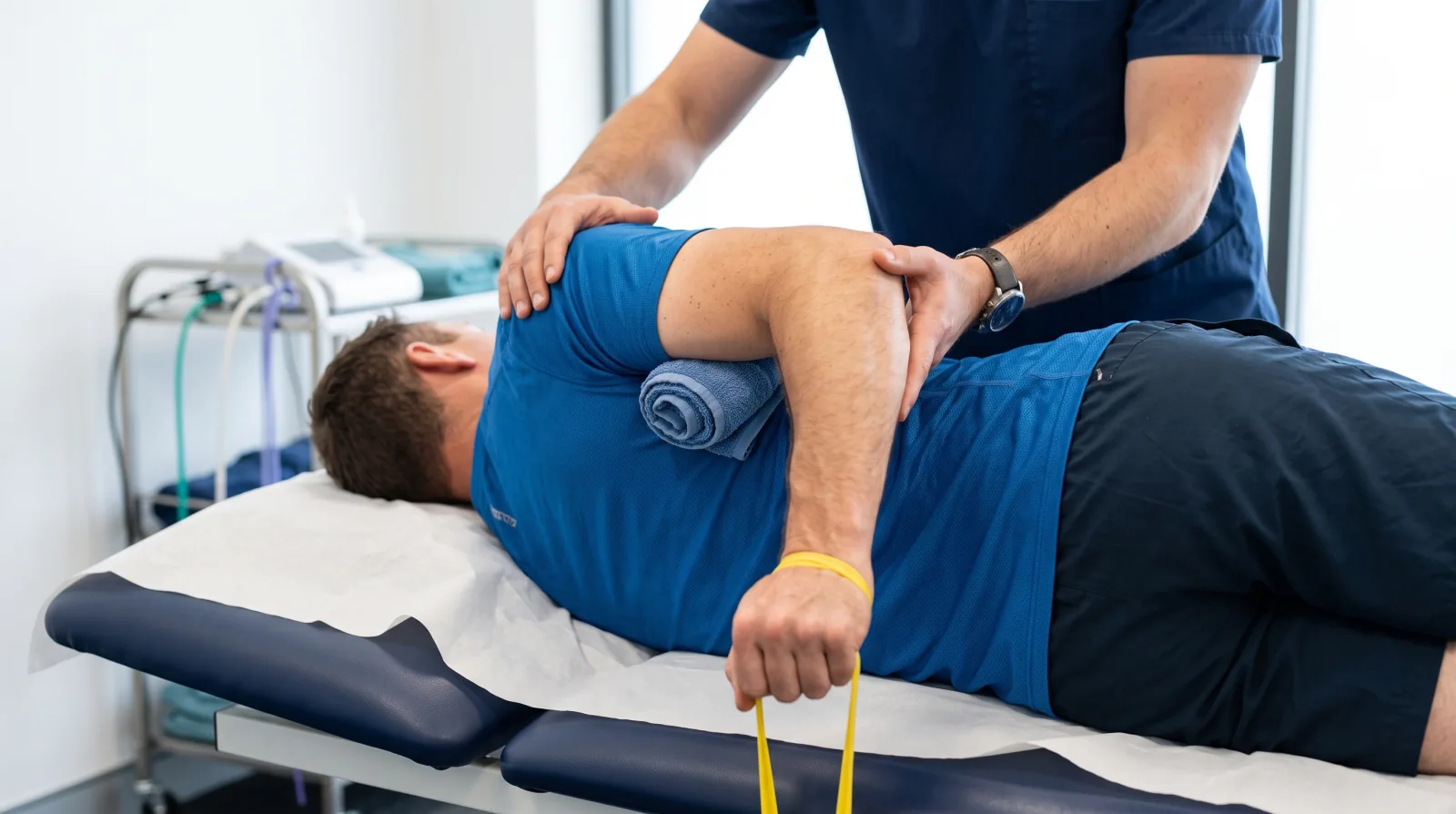
Progressive rotator cuff and scapular stabilizer strengthening. As pain settles and motion improves, the program shifts to strengthening the muscles that dynamically hold the humeral head centred in the socket: the rotator cuff, and the muscles that control the shoulder blade (scapular stabilizers) so the socket itself is positioned well under the arm during movement. This stage typically runs from several weeks out to around three months, progressing from isometric holds to resistance band work to more demanding strength and endurance training as the shoulder tolerates load.
Return-to-sport criteria. Before returning to a sport or activity with dislocation risk, the physiotherapy literature points to objective benchmarks rather than a fixed date. Commonly cited criteria include full, pain-free active range of motion, external rotation strength reaching 66 to 76% of internal rotation strength, and satisfactory dynamic stability on functional testing that replicates the demands of the specific sport (Current Reviews in Musculoskeletal Medicine, 2017). Contact and overhead sports generally require the higher end of this progression before clearance. Your physiotherapist sets the actual timeline based on how your shoulder responds at each stage, not from a generic chart.
This condition sits next to, but is distinct from, other shoulder problems we cover elsewhere. A separated shoulder from a fall onto the point of the shoulder is an injury to a different joint entirely, covered in our post on AC joint sprains. Pain and weakness with overhead reaching that develops gradually, without a dislocation event, is more likely impingement or a rotator cuff problem, covered in shoulder impingement versus rotator cuff tear. And a shoulder that has become progressively stiff and painful without an instability event is a different condition again, covered in our frozen shoulder guide.
When instability warrants an orthopedic surgical opinion
Physiotherapy is the starting point for most first-time dislocations, but there are specific situations where an orthopedic opinion, not more rehab, is the right next step.
Recurrent dislocation. If the shoulder has dislocated or subluxed more than once, particularly in a patient under 25, the odds that physiotherapy alone will prevent a further episode drop. A meta-analysis pooling 21 studies and 5,142 patients found re-dislocation rates of 16.08% after surgical stabilization compared with 24.84% after non-operative management in young adults following a first traumatic dislocation, with return to sport rates of 85.2% after surgery versus 78.3% without it (Shoulder & Elbow, 2024). That gap is a real factor in the conversation, particularly for younger athletes in collision or overhead sports, and it is a discussion to have with an orthopedic surgeon rather than a decision physiotherapy makes alone.
A confirmed Bankart lesion or significant labral tear. Labral tears often produce ongoing symptoms of catching, popping, or a feeling that the shoulder is not fully stable even after the acute pain resolves. Where a labral tear is confirmed on imaging and is contributing to ongoing instability, surgical repair is a more common recommendation, particularly when conservative strengthening has not resolved the instability feeling.
A large Hill-Sachs lesion or bone loss. When imaging shows a significant compression fracture on the humeral head or bone loss at the front of the glenoid socket, the mechanical stability of the joint is compromised in a way that muscle strengthening cannot fully correct. This is assessed by imaging and an orthopedic surgeon, not by symptoms alone.
A first dislocation in a younger, highly active patient. Given how strongly age predicts recurrence, some surgeons and physiotherapists discuss an earlier orthopedic consultation for younger athletes returning to high-demand or collision sport, rather than waiting for a second or third dislocation to happen. This is a shared decision between the patient, the physiotherapist, and the surgeon, weighing the recurrence data above against the individual's sport, goals, and how the shoulder responds to the first course of rehab.
If any of these apply to you, physiotherapy does not stop. Rehab continues alongside a surgical opinion, and if surgery does happen, a structured post-operative physiotherapy program is still the path back to full function.
What a first physiotherapy visit after a dislocation looks like
A first physiotherapy assessment after a dislocation starts with the mechanism of injury: how the arm was positioned, what force was involved, and whether this is a first-time event or a repeat episode. The physiotherapist will confirm that a physician has already ruled out a fracture and reduced the joint, and will ask what imaging, if any, has been done.
The exam covers range of motion, strength across the rotator cuff and scapular muscles, and specific tests for instability, such as checking how far the humeral head can be gently shifted within the socket compared with the other side. From there, your physiotherapist builds a staged plan and sets expectations for that specific stage of your recovery, rather than a fixed date pulled from an article.
Physiotherapy is a direct-access profession in British Columbia, regulated by the College of Health and Care Professionals of BC, so no physician referral is required to book an assessment once the acute emergency care is done. If the dislocation happened at work, a claim goes through WorkSafeBC. If it happened in a motor vehicle crash, ICBC funds a set number of physiotherapy visits. Coverage and current rates are on our rates and FAQ page.
This article is general information, not personal medical advice. A regulated practitioner can confirm whether the patterns described apply to you.
Frequently asked questions
Does physiotherapy put a dislocated shoulder back in place?
No. Reducing a dislocated shoulder is an emergency medical procedure performed by a physician, typically in an emergency department or urgent care, often with sedation or a nerve block. Physiotherapy begins after the joint has been reduced and a physician has ruled out a fracture. If your shoulder is currently dislocated, go to an emergency department rather than booking a physiotherapy visit.
How likely is my shoulder to dislocate again?
It depends heavily on your age at the time of the first dislocation. One study following patients for a mean of 11.1 years found recurrent instability rates of 38.8% in patients 15 and under and 47.1% in patients 16 to 20 after non-operative management. A separate study found two or more repeat dislocations in 55% of shoulders in patients 22 or younger, compared with 12% in patients aged 30 to 40. Younger patients and those returning to higher-demand sport carry meaningfully higher recurrence risk.
What is a Bankart lesion?
A Bankart lesion is a tear of the labrum, the ring of cartilage that deepens the shoulder socket, off the front-lower rim of the glenoid. It commonly occurs during an anterior shoulder dislocation and can contribute to ongoing instability. Where a Bankart lesion is confirmed and is driving continued instability, surgical repair is a more common recommendation, particularly if strengthening alone has not resolved the symptoms.
Do I need surgery after a first shoulder dislocation?
Not necessarily. Most first-time traumatic dislocations start with physiotherapy: protected motion, then rotator cuff and scapular strengthening, then a graded return to activity. A meta-analysis of young adults after a first dislocation found lower re-dislocation rates after surgery than after non-operative treatment, so the decision depends on your age, sport, and how the shoulder responds to a genuine course of rehab, made together with an orthopedic surgeon when that conversation is warranted.
When should physiotherapy hand off to an orthopedic surgeon?
Recurrent dislocation or subluxation, a confirmed Bankart lesion or significant labral tear that is not settling with rehab, and a large Hill-Sachs lesion or bone loss on imaging are the main reasons to bring in an orthopedic opinion. Younger, highly active patients returning to collision or overhead sport sometimes have this conversation earlier, given how strongly age predicts recurrence.
How soon can I return to sport after a shoulder dislocation?
There is no fixed timeline. Physiotherapy literature points to benchmarks instead of a date: full pain-free active range of motion, external rotation strength reaching 66 to 76% of internal rotation strength, and passing functional testing that replicates your sport's demands. Contact and overhead sports generally need the higher end of that progression before clearance. Your physiotherapist tracks these markers through your rehab rather than counting weeks.
What is the difference between a dislocated shoulder and a separated shoulder?
They involve different joints. A dislocated shoulder means the ball of the upper arm bone has come out of the socket at the glenohumeral joint, the joint that produces most of the shoulder's movement, and it needs a physician to put it back in place. A separated shoulder is a ligament injury to the acromioclavicular joint on top of the shoulder, where the collarbone meets the shoulder blade, and it does not involve the ball coming out of the socket. Our AC joint sprain guide covers that injury in detail.
Is it normal for my shoulder to feel unstable even after rehab?
A persistent feeling of the shoulder wanting to slip, catch, or give way after a genuine course of strengthening is worth raising with your physiotherapist and, often, an orthopedic surgeon. It can point to a labral tear or bone loss that muscle strengthening cannot fully correct on its own, and that is assessed with imaging rather than guessed at from symptoms.
Sources
- Management of primary anterior shoulder dislocations: a narrative review, Sports Medicine, Open (2019)
- Anteroinferior Glenoid Labrum Lesion (Bankart Lesion), StatPearls
- Pain Control Options for Shoulder Reduction, American College of Emergency Physicians, Sports Medicine Section
- Leland et al., An Age-Based Approach to Anterior Shoulder Instability in Patients Under 40 Years Old, American Journal of Sports Medicine (2020)
- The Epidemiology of Primary Anterior Shoulder Dislocations and Age-Stratified Risk of Recurrence, PMC
- Current Concepts in Rehabilitation for Traumatic Anterior Shoulder Instability, Current Reviews in Musculoskeletal Medicine (2017)
- A systematic review and meta-analysis of operative versus non-operative management for first time traumatic anterior shoulder dislocation in young adults, Shoulder & Elbow (2024)
- College of Health and Care Professionals of BC: Physical Therapists
WRITTEN BY
The Launch Rehab Team
Practical recovery and training notes from the clinicians at our five Metro Vancouver studios.
FOUND THIS USEFUL?
Share it with your network on LinkedIn. We wrote a ready-to-post version for you.
FILED UNDER
- shoulder-dislocation
- shoulder-instability
- bankart-lesion
- physiotherapy
- sports-injury
- bc