Ski and Snowboard Knee Injuries: Prevention and First Steps
Skiers hurt knees and snowboarders hurt wrists, and the reasons sit in how each sport attaches you to the snow. Here is what the two injury patterns look like, what preseason conditioning has to include, and what to do in the first 48 hours after a bad fall.
BY THE LAUNCH REHAB TEAM
The drive is the easy part. You leave Burnaby before six, you are parked at Cypress or Seymour by seven, and the first three runs feel like the reason you bought the pass. By run eleven your legs are further gone than you would like to admit, the light has gone flat, and you are still riding because you drove all that way.
That is where most knee injuries happen. They happen on a groomed run, at moderate speed, to someone who has been skiing or riding for years and who was tired.
This is written for the Metro Vancouver rider who does the local hills midweek and drives up to Whistler when the snow is right. What follows is why skiing and snowboarding break different body parts, what preseason work actually has to cover, what to do on the hill and the next morning, and what happens if it turns out to be a ligament.
Why skiers hurt knees and snowboarders hurt wrists
The difference comes from equipment, and it is worth understanding because it changes what you should train and what you should wear.
A skier stands on two separate skis. Each ski is roughly 165 centimetres of stiff lever bolted to a boot that runs halfway up the shin. When you fall, that lever keeps moving, and the twisting force travels up the leg to the first joint that can absorb it. The knee is that joint.
According to a 2018 review in Sports Health by Davey and colleagues, the knee is the most common site of injury in alpine skiing, with reports ranging from 27% to 41% of all injuries. Ligament injury leads that category, with either the medial collateral ligament or the anterior cruciate ligament described as the most commonly injured, accounting for 10% to 33% of all skiing-related injuries.
A snowboarder is bolted to one board with both feet, in bindings designed never to release. There is no independent lever, so the knee rarely takes a twisting load. What happens instead is that the board catches an edge, the rider goes down with almost no warning, and the hand goes out.
A 2025 meta-analysis in Shoulder & Elbow by Chauffard and colleagues pooled more than 750,000 upper extremity injuries across both sports. Wrist injuries made up 35% of upper limb injuries in snowboarding against 16% in skiing, with an odds ratio of 5.17 for snowboarders. Shoulder injury risk showed no statistical difference between the two sports, though shoulders made up a larger share of the skiing total at 37% against 27%.
So the prevention conversation splits. A skier is mainly protecting a knee. A snowboarder is mainly protecting a wrist, with the knee a secondary concern that still matters on landings and in deep snow.
The two knee mechanisms, in plain words
Most ski ACL injuries happen in one of a small number of recognisable positions. Two of them account for the bulk.
The phantom foot. You are off balance backwards, sitting back over the tails. Your weight ends up on the inside edge of the tail of the downhill ski while the uphill ski is unweighted and doing nothing. The tail of that downhill ski acts like a foot pointing in a direction your actual foot is not, which is where the name comes from. As you go down, the ski keeps carving and the knee rotates inward under you. The 2018 Sports Health review reports this mechanism at 22.5% of injuries in one study of injury frequencies.
It usually happens at low to moderate speed, which is why people are surprised by how badly a slow fall hurt them.
Valgus with external rotation. The knee collapses inward toward the other leg while the lower leg turns out. In skiing this is the classic caught inside edge: the ski edge bites, the tip goes across, and the knee folds inward. The same review reports valgus with external rotation as the most common mechanism at 32.9%.
Riders see the same knee position in a different setting: a hard landing off a jump or a drop, where the knee dives inward as you absorb the impact. The joint has less tolerance for that inward collapse than for almost anything else you can do to it.
Both mechanisms have the same practical lesson. The knee gets hurt when it is asked to control a rotating, collapsing position while the muscles around it are tired. That is the thing conditioning is meant to change.
What preseason and in-season conditioning actually has to include
The common preseason plan is to do nothing in October, ride hard for three days in December, and treat the resulting soreness as the conditioning. Your quadriceps will adapt to that. Your ability to control a knee at the end of a long day will not.
The 2016 review in Sports Medicine by Spörri and colleagues, looking at prevention in alpine ski racing, identified insufficient core strength and core strength imbalance as factors with statistical evidence linking them to injury risk, and named core strength training as a key prevention measure for ACL injuries. The same review notes that most injuries in racing occurred in the last quarter of the race, which points at fatigue, though the authors are careful to say that could also reflect greater risk-taking late on.
A reasonable plan for a recreational rider covers four things.
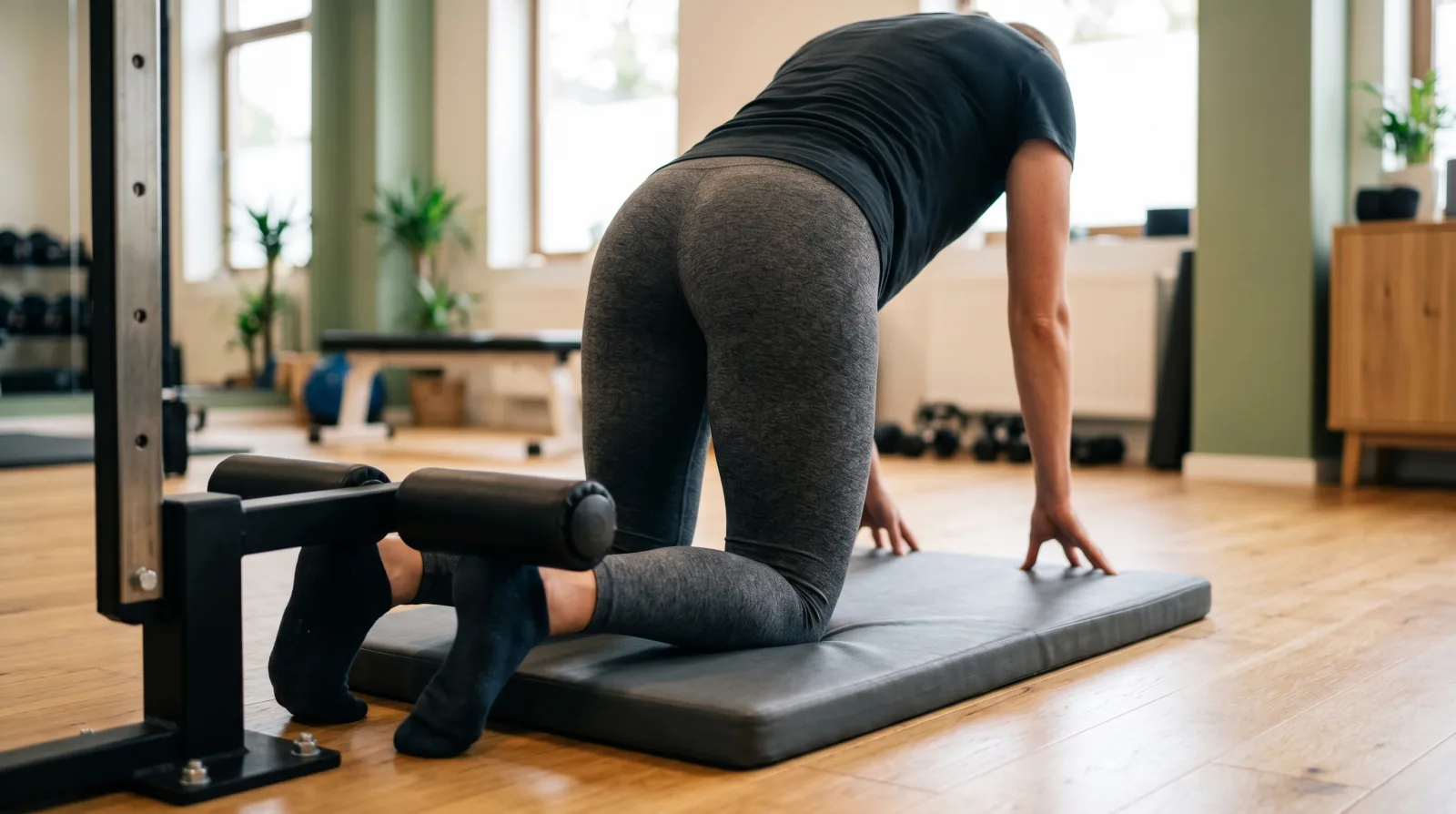
- Leg strength that goes deep. Squats, split squats, step-downs, and hinge work through full range, loaded enough that the last repetitions are hard. Skiing asks your legs to hold a bent position for minutes at a time, and that endurance is built from a base of strength.
- Single-leg control. Every ski turn is loaded on one leg. Single-leg squats, lateral step-downs, and single-leg balance on an unstable surface build the control the sport actually uses.
- Landing and deceleration practice. Jumping is the easy half. Landing quietly, with the knee tracking over the middle of the foot rather than diving inward, is the half that matters. Start with two-foot landings, progress to one foot, and film yourself from the front to see what the knee is doing.
- Something that builds fatigue resistance. Intervals on a bike, hill repeats, anything that leaves your legs working when they are already tired. The point is that your technique should hold at run eleven rather than run three.
Start eight to twelve weeks before your first day, two or three sessions a week. Starting later is still useful.
In-season, the thing that helps most is simple and unpopular: stop earlier. The last run of the day on tired legs, in flat light, is where the phantom foot lives. A run you skip costs you fifteen minutes. A torn ACL costs a season.
Equipment and bindings, stated carefully
Equipment matters, and the honest summary is narrower than what gets said in ski shops.
For skiers, binding release is the one piece with hard numbers behind it. The 2018 Sports Health review notes that failure of bindings to release has been identified as one of the main causes of lower leg injuries in skiing, and reports that more than 75% of equipment associated with lower leg injuries did not meet ISO standards. That is the clearest, cheapest prevention step available: get your bindings tested and adjusted by a certified shop technician each season, and tell them your current weight, height, age, boot sole length, and honest skier type. The settings that were right for you five years and ten pounds ago are not the settings you want now.
Worth saying plainly: a correctly set binding reduces lower leg and tibia injuries. It does not reliably prevent ACL injuries, because the phantom foot loads the knee in a direction most bindings are not designed to sense. Do the binding check for what it does do, and do the conditioning for the ACL.
On ski design, the 2016 Sports Medicine review is direct about how little is proven. In alpine ski racing, the only prevention measure the authors found to have demonstrated a positive impact on injury risk was less-shaped and longer skis with reduced profile width. That finding comes from racing, and reading it across to recreational skiing is a stretch. Treat ski geometry as an unsettled question rather than a purchase decision.
For snowboarders, wrist guards have the better evidence. A 2007 systematic review in Clinical Journal of Sport Medicine by Russell, Hagel and Francescutti concluded that wrist guards reduced the risk of wrist injuries among snowboarders, with a number needed to treat of 50, meaning one wrist injury avoided for every 50 riders wearing them. The authors treated the conclusion cautiously because the underlying studies varied in quality. If you are new to riding or spending time in the park, guards are a low-cost decision with real evidence behind it.
Helmets are separate from all of this and are a straightforward yes for both sports.
What to do on the hill, and the next morning
On the hill. If you cannot put weight through the leg, if the knee gave way underneath you, if you heard or felt a pop, or if the joint is swelling within the first hour, stop for the day and get down by toboggan rather than skiing out. Ski patrol at every local hill is trained for exactly this. Riding down on an unstable knee is how a ligament injury acquires a meniscus tear.
Rapid swelling matters more than pain level. A knee that fills up within a couple of hours usually means bleeding inside the joint, and that points toward a ligament or a fracture rather than a strain. Pain is a poor guide here, because plenty of complete ACL tears stop hurting much once the initial shock passes.
That evening and the next day. Keep moving within comfort, use crutches if you have them, and put weight through the leg as much as the knee allows. Ice and elevation help with swelling. The old advice to rest completely has been replaced by early gentle movement in most soft-tissue injury care.
Go to an emergency department or urgent care the same day if the knee is visibly deformed, if the kneecap has moved out of place, if you cannot bear any weight at all, if the leg is numb or cold, or if there was a significant head impact. Those need imaging and a physician.
Otherwise, book an assessment within the first few days. You do not need to wait for swelling to go down to be seen. An early assessment sets up the swelling management, the range of motion work, and the quadriceps activation that determine how the next three months go, and that is true whether the eventual answer is surgery or not.
If it turns out to be an ACL
A torn ACL is not the end of a skiing life, and it is not an automatic operation either. The decision depends on your age, what you want to go back to, whether the knee gives way in daily life, and what else was damaged at the same time.
What is consistent is that the rehab work comes first either way. Getting the swelling down, getting the knee fully straight, and waking up the quadriceps are the same jobs whether you are preparing for surgery or building a knee that will work without it. Going into an operation with a stiff, swollen, weak leg produces a worse outcome than going in with a calm one.
If you do have a reconstruction, the road is measured in milestones rather than weeks. We have written about what the ACL reconstruction rehab timeline actually looks like, and separately about the return to sport criteria that decide when you can ski again, which is a testing decision rather than a calendar one. If the imaging shows a meniscus tear alongside or instead of the ligament, the surgery versus physiotherapy decision for a torn meniscus runs on different logic again.
Coverage: if the injury happened on the hill, this is a private extended-health matter for most people. The Medical Services Plan covers physiotherapy only for people receiving premium assistance, at a partial rate. If you were injured in a vehicle crash on the way to or from the hill, ICBC funds a set number of treatments without pre-approval. If the injury happened at work, which applies to hill staff, WorkSafeBC is the payer. Check your extended-health plan for your annual physiotherapy maximum before you book, since that number sets the rhythm of your visits.
What a first visit looks like
A first physiotherapy assessment for a ski or snowboard knee starts with the story of the fall, because the mechanism narrows the list before anyone touches the knee. Your therapist will ask which way you were falling, whether the ski released, whether you heard anything, how fast the swelling came on, and whether the knee has given way since.
Then comes the examination: how much the knee bends and straightens compared with the other side, how much swelling is inside the joint, how the ligaments respond to specific tests, and whether the quadriceps will contract properly. That last one sounds minor and predicts a lot about the next three months.
You will leave with a plan for the first two weeks rather than a diagnosis carved in stone. Early findings shift as swelling settles, and a knee that is guarded and swollen hides information. Your therapist will tell you what would change the plan and what would prompt a referral for imaging or a surgical opinion.
Physiotherapy is a direct-access profession in British Columbia, regulated by the College of Health and Care Professionals of BC, so no physician referral is needed to book an assessment. Some extended-health plans require one for reimbursement, so check with your insurer before your first visit.
See a physician rather than booking physiotherapy if the knee is deformed, if you cannot bear weight at all, if the leg is numb, pale or cold, if you have a fever with a hot swollen joint, or if you took a significant blow to the head in the same fall. Those need medical assessment first.
This article is general information, not personal medical advice. A regulated practitioner can confirm whether the patterns described apply to you.
Frequently asked questions
Why do skiers get more knee injuries than snowboarders?
Because a skier's two independent skis act as long levers attached to stiff boots, so a twisting fall sends rotational force up the leg into the knee. A snowboarder has both feet fixed to one board, which removes that twisting lever. The 2018 Sports Health review by Davey and colleagues reports the knee as the most common injury site in alpine skiing at 27% to 41% of all injuries, with ligament injuries accounting for 10% to 33% of skiing injuries overall.
What is the phantom foot mechanism?
It is a fall where you are off balance backwards with your weight on the inside edge of the tail of the downhill ski, while the uphill ski is unweighted. The ski tail keeps carving and rotates the knee inward underneath you. The 2018 Sports Health review reports this mechanism at 22.5% of injuries in one study of injury frequencies. It typically happens at low to moderate speed, which is why people are surprised a slow fall caused a serious injury.
Do wrist guards actually work for snowboarding?
The evidence points that way. A 2007 systematic review in Clinical Journal of Sport Medicine by Russell, Hagel and Francescutti concluded that wrist guards reduced the risk of wrist injuries among snowboarders, with a number needed to treat of 50, meaning one wrist injury avoided per 50 riders wearing them. The authors treated the finding cautiously because the underlying studies varied in quality. For new riders and park riders the cost-to-benefit ratio is favourable.
Will correctly set bindings prevent an ACL tear?
Correctly set bindings reduce lower leg and tibia injuries, and the evidence for that is solid. The 2018 Sports Health review reports that more than 75% of equipment associated with lower leg injuries did not meet ISO standards. ACL injuries are a harder problem, because the phantom foot loads the knee in a direction most bindings cannot detect. Get the binding check done for what it reliably does, and rely on conditioning for the knee.
How long before the season should I start conditioning?
Eight to twelve weeks of two or three sessions a week is a reasonable target, covering leg strength through full range, single-leg control, landing practice, and something that builds fatigue resistance. Starting later still helps. The 2016 Sports Medicine review by Spörri and colleagues identifies insufficient core strength and core strength imbalance as factors with statistical evidence linking them to injury risk in alpine ski racing.
Why do injuries happen late in the day?
Fatigue changes how well you control a joint, and the positions that injure a knee are positions that require control. The 2016 Sports Medicine review notes that most injuries in alpine ski racing occurred in the last quarter of the race, while being careful to say this could reflect increased risk-taking as much as fatigue itself. For recreational riders, the practical version is that the last run on tired legs in flat light carries more risk than the same run at ten in the morning.
My knee swelled up an hour after the fall. Does that mean something serious?
Swelling that appears within the first one to two hours usually means bleeding inside the joint, which points toward a ligament tear or a fracture rather than a simple strain. It is a more useful warning sign than pain level, because many complete ACL tears stop hurting much once the initial shock passes. A knee that swells that quickly should be assessed, and same-day medical care is needed if you cannot bear weight at all.
Should I ski down after a bad knee fall?
No, if you cannot put weight through the leg, the knee gave way, you felt a pop, or the joint is already swelling. Ask for ski patrol and take the toboggan. Skiing or riding out on an unstable knee is a common way for a ligament injury to acquire a meniscus tear on top of it. If the knee feels stable and you can walk normally, getting down under your own power is reasonable, and you should still stop for the day.
Can I still ski after an ACL reconstruction?
Many people do. The timing is decided by testing rather than by the calendar, looking at strength compared with the other leg, hop test symmetry, and how the knee handles change of direction. Skiing adds its own demands on top of that, including long-duration bent-knee loading and the ability to control a fall. Your therapist and surgeon will set the criteria together, and returning before you meet them raises the risk of a second injury.
Does a torn ACL always need surgery?
No. The decision depends on your age, what activities you want to return to, whether the knee gives way in daily life, and whether other structures were damaged at the same time. What stays constant is that rehabilitation comes first either way: reducing swelling, restoring full extension, and restoring quadriceps function all improve the outcome whether you end up having a reconstruction or not.
Does MSP cover physiotherapy for a ski injury?
For most people, no. The Medical Services Plan covers physiotherapy only for people receiving premium assistance, and then at a partial rate per visit. Most skiers and riders use private extended-health benefits, which typically set an annual dollar maximum. If the injury happened in a vehicle crash, ICBC funds a set number of treatments without pre-approval, and if it happened at work, WorkSafeBC is the payer.
Do I need a referral to see a physiotherapist in BC?
No. Physiotherapy is a direct-access profession in British Columbia, regulated by the College of Health and Care Professionals of BC, so you can book an assessment directly without a physician's referral. Some extended-health insurance plans require a referral for reimbursement even though the profession does not, so confirm with your insurer before your first visit.
Sources
- Davey, Endres, Johnson, Shealy, "Alpine Skiing Injuries," Sports Health, 2018
- Chauffard, Traverso, Kaminski et al., "To ski or not to ski? A meta-analysis of more than 750,000 upper extremity injuries comparing skiing and snowboarding," Shoulder & Elbow, 2025
- Spörri, Kröll, Gilgien, Müller, "How to Prevent Injuries in Alpine Ski Racing: What Do We Know and Where Do We Go from Here?," Sports Medicine, 2016
- Russell, Hagel, Francescutti, "The effect of wrist guards on wrist and arm injuries among snowboarders: a systematic review," Clinical Journal of Sport Medicine, 2007
- College of Health and Care Professionals of BC, physiotherapist scope of practice
- Province of British Columbia, Medical Services Plan
- ICBC
- WorkSafeBC
WRITTEN BY
The Launch Rehab Team
Practical recovery and training notes from the clinicians at our five Metro Vancouver studios.
FOUND THIS USEFUL?
Share it with your network on LinkedIn. We wrote a ready-to-post version for you.
FILED UNDER
- skiing
- snowboarding
- acl
- knee-injury
- prevention
- bc