
WHAT TO EXPECT
What actually happens in a bike fit.
Ninety minutes, worked from the foot up, one change at a time, with video before and after each one.
THE SHORT ANSWER
What happens during a bike fit?
A Launch Rehab bike fit takes about 90 minutes and runs in a set order. It starts with your history and what hurts, then an off-bike physical assessment of hip rotation, hamstring and quadriceps length, ankle range, single-leg control and trunk control. Your bike then goes on a stationary trainer and we record baseline measurements and video from the side and the front while you pedal at a realistic effort. Adjustments follow from the foot up: cleats first, then saddle height, then saddle fore and aft and tilt, then reach, bar height and lever position. Each change is ridden and re-filmed before the next. You leave with every final measurement written down and a short program for anything the assessment found.
5
Steps, from your history to the written summary
90min
The initial fit, including the off-bike assessment and the written summary
20min
Spent off the bike being assessed before the bike is touched
60min
The follow-up, once you have ridden the new position for a few weeks
People are often surprised by how much of a bike fit happens away from the bike. Roughly the first third of the session is you on a mat and a plinth while a physiotherapist measures what your joints do.
That is deliberate, and it is the main thing separating this from a fit at a shop. The bike can be put almost anywhere. What it cannot do is give you hip range you do not have. Measuring the body first means the position is built around a real constraint rather than a guess.
The rest of the session is methodical rather than dramatic. Small changes, one at a time, each one ridden and filmed. Riders often expect a single revelation. What usually happens is six small corrections that add up.
AT A GLANCE
- Length
- 90 minutes for the initial fit
- Follow-up
- 60 minutes, after a few weeks of riding
- Where
- New Westminster studio, by appointment
- Bring
- Your bike, shoes, pedals and riding kit
STEP ONE
History and what you want from the bike
We start with a conversation, and it is more useful than it sounds. What hurts, where exactly, how far into a ride it starts, whether it eases when you stand, what you have already tried, and whether it has happened before.
We also ask what you actually ride: distance, frequency, terrain, and what you are training for if anything. A position for a two-hour weekend loop is not the same as one for a six-hour gravel day.
Injury history matters more than people expect. An ankle sprained years ago, a knee surgery, a hip that has never been quite right on one side. Those show up in how you pedal whether or not they currently hurt.
STEP TWO
The off-bike physical assessment
This is the physiotherapy part, and it takes about 20 minutes. We measure rather than eyeball, and the numbers get written down so we can compare against them at a follow-up.
The purpose is to establish the ceiling. If your hip flexes to a certain point and no further, then a position asking for more will hurt, no matter how good it looks on a fit chart.
Hip flexion and rotation
How far the thigh comes toward the chest, and how far the hip turns in and out. This sets how low and how far forward you can ride.
Hamstring and quadriceps length
Hamstring length limits how far the pelvis can tip forward, which decides whether your back rounds to reach the bars.
Ankle range
How far the ankle bends. A stiff ankle changes how the foot moves through the stroke and where the cleat should sit.
Single-leg control
Whether the knee stays on line under load or falls inward. Often the reason for outer knee pain.
Trunk control and endurance
Whether you can hold a forward position without the low back doing all of it.
Leg length and foot shape
Genuine differences are common and manageable, and they are worth knowing about before we set saddle height.
STEP THREE
Baseline on the trainer
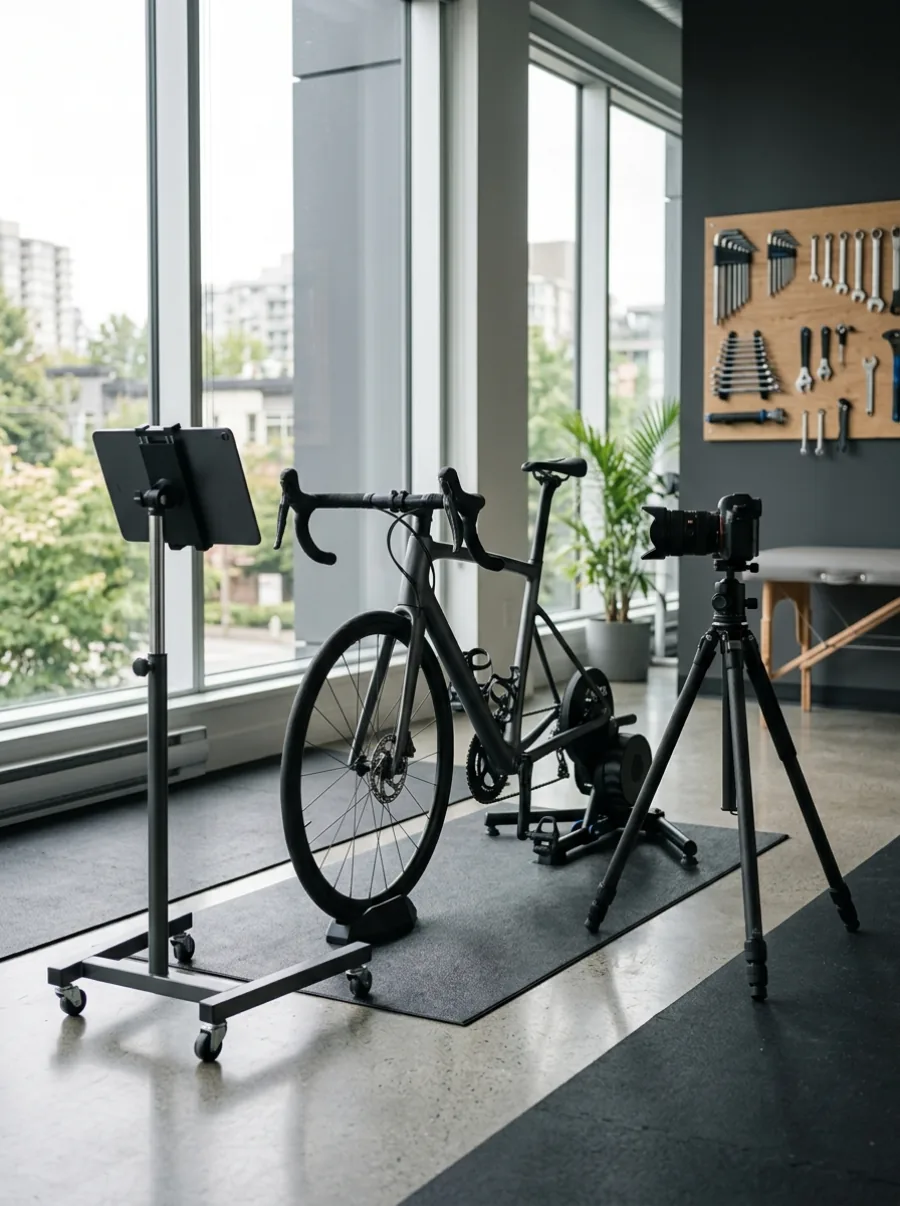
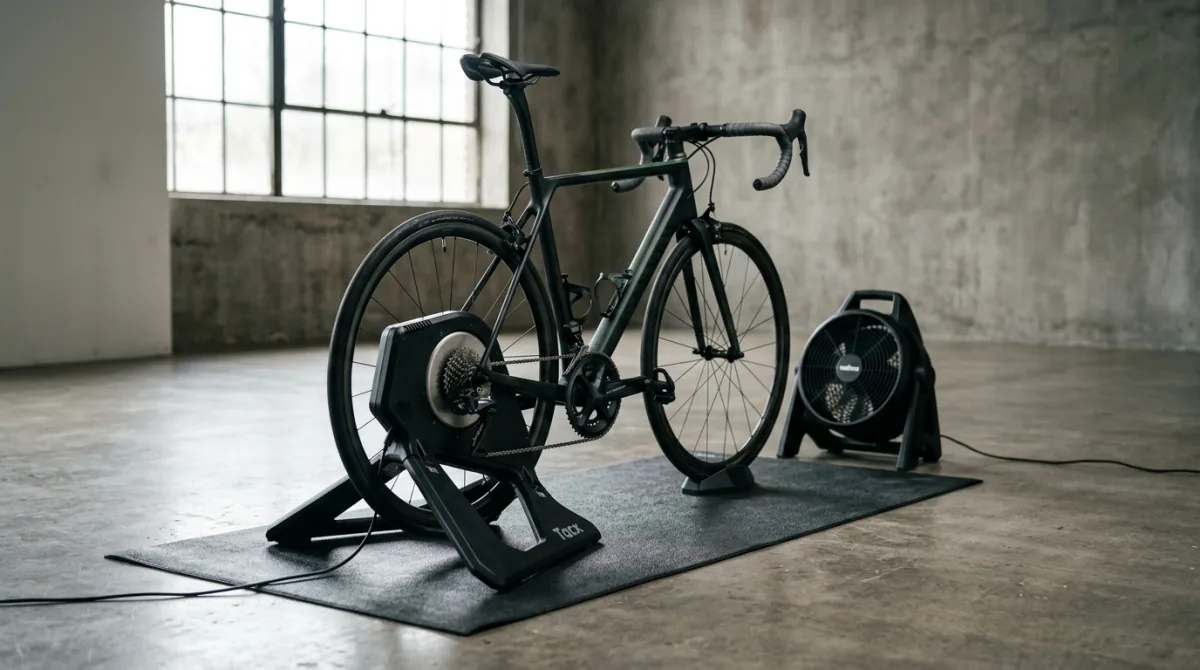
Your bike goes on a stationary trainer and you ride in your current position while we record it. We take the measurements as they are now and film from the side and from the front.
The effort matters. Riding gently produces a different position from riding at the effort you actually use, because under load the body settles into what it really does. So we ask you to work.
Recording the baseline properly is what lets us prove a change helped rather than just claim it did. At the end of the session you can see the before and after side by side.
STEP FOUR
The adjustments, foot upward
Everything on a bike is connected, so the order is fixed. Cleats change effective saddle height. Saddle position changes reach. Working bottom-up means each change is made once rather than revisited.
One variable at a time, ridden and re-filmed each time. It is slower than changing three things and seeing how it feels, and it is the only way to know which change did what.
Cleats
Fore and aft, rotation, and stance width. Set first because everything above the foot inherits them.
Saddle height
The most influential single number on the bike, checked on video from behind for any hip rocking.
Saddle fore and aft
Sets where the knee sits over the pedal and how weight is balanced between saddle and hands.
Saddle tilt
A degree or two decides whether you sit still or slide forward onto your hands for the whole ride.
Reach and bar height
Stem length and spacers, set against the hip and hamstring range measured earlier.
Bar width and levers
Shoulder comfort and wrist angle, and often the difference between numb hands and comfortable ones.
STEP FIVE
The written summary and what comes next
You leave with every final measurement recorded, so any bike shop can reproduce the position and you can transfer it to a future bike. Riders who lose these numbers end up paying for the same information twice.
Where the assessment found something, you also leave with a short program to address it. This is deliberately short and specific: usually two or three exercises aimed at the actual limitation, not a general routine.
If the assessment found something that needs treatment rather than exercises, we say so and can book a physiotherapy appointment at the same studio.
Your numbers
Saddle height, setback, tilt, reach, bar height and drop, cleat position, stance width.
What changed and why
So the position makes sense to you rather than being a set of numbers you are told to trust.
A short program
Two or three specific exercises for whatever the assessment found. Realistic to your week.
Whether you need treatment
An honest answer about whether the position was the whole story or only part of it.
AFTER THE FIT
The first few rides and the follow-up
A new position feels odd for a while, and that is normal rather than a sign something is wrong. Muscles have been working in a particular pattern and are being asked to work slightly differently. Give it two or three rides before judging.
What is not normal is new sharp pain, or the old pain getting clearly worse. If that happens, get in touch rather than pushing through or undoing everything yourself.
The 60-minute follow-up after a few weeks is where the refinement happens. Riding in a position reveals things a trainer session cannot, and small adjustments made with real ride feedback are often the ones that finish the job.
- Expect two or three rides of feeling slightly unfamiliar
- Build back up gradually rather than testing it on your longest ride
- Note what feels different and where, and bring that to the follow-up
- New sharp pain is a reason to call, not to push on
- Do the short program, since it is what makes the position sustainable
ENQUIRE IN NEW WESTMINSTER
Come prepared
- Bring the bike you actually ride, not a spare
- Bring your own shoes and pedals
- Wear riding kit you can move and pedal in
- Give the bike a rough clean beforehand
- Write down what hurts, which side, and how far into a ride
- Bring any numbers from a previous fit
LAUNCH REHAB NEW WESTMINSTER
Bike fitting runs from our New Westminster studio, by appointment. Tell us what happens on the bike and we will tell you whether you need a fit, a physiotherapy assessment, or both. It is a two-minute conversation and it saves booking the wrong thing.
- Address
- 219-800 Carnarvon St, New Westminster, BC V3M 0G3
- Getting here
- Inside Shops at New West, above New Westminster SkyTrain station
Bike fitting is by appointment only and books out during the spring and summer riding season. Enquire early if you have an event coming up. About the New Westminster studio.
FAQ
Common questions.
About 90 minutes for the initial fit. That covers the history, the off-bike assessment, the baseline video, the adjustments and the written summary. A follow-up after a few weeks of riding takes about 60 minutes and is where the fine tuning happens.
KEEP READING
More from the bike fitting guides.
- How a fit works
Physio fit vs shop fit
Both are real services. One starts at the bike, the other starts at your body. Which you need depends on whether something hurts.
READ - How a fit works
Saddle height
The most influential number on the bike, and the one most riders have wrong by more than they think.
READ - How a fit works
Cleat position
The smallest adjustment on the bike and the one everything above it inherits. We set it first.
READ
FROM THE JOURNAL
Related reading from our clinicians.
READY?
Book your bike fit in New Westminster.
By appointment at 219-800 Carnarvon St, New Westminster, BC V3M 0G3. Not sure which appointment you need? Call 604-519-0777 and describe what happens on the bike.