
SADDLE HEIGHT
How to set your saddle height.
One number changes knee load, hip rocking, back comfort and how much of your power reaches the pedals. Most riders are out by more than they expect.
THE SHORT ANSWER
How do I know if my saddle height is right?
The clearest signs are what happens when it is wrong. A saddle that is too low usually produces pain at the front of the knee, because the joint works through its most compressed range while pushing hard. A saddle that is too high usually produces pain behind the knee, hips that rock side to side as you pedal, and saddle soreness on one side. At a correct height your leg is close to but not fully straight at the bottom of the stroke, your hips stay level, and you do not have to point your toes to reach. Formulas based on inseam get you a starting point only, because they cannot account for ankle range, foot length, cleat position or shoe sole thickness.
5mm
How much to change saddle height at a time
90min
The initial fit, including the off-bike assessment and the written summary
1
Number that changes knee load, hip rocking and power all at once
60min
The follow-up, once you have ridden the new position for a few weeks
If you only change one thing on a bike, change this. Saddle height decides how much the knee bends at the top of the stroke, how far the leg reaches at the bottom, whether the hips stay level, and how much of your leg's strong range you actually use.
It is also the number most often carried over without thinking. Riders transfer it from an old bike, or set it once years ago, or copy a formula they read somewhere. Meanwhile the things that affect it, including shoes, cleats and their own flexibility, have all changed.
The formulas that circulate online are not useless. They are a starting point and nothing more, because they use leg length and ignore everything else that determines where your foot ends up.
AT A GLANCE
- Too low usually causes
- Pain at the front of the knee
- Too high usually causes
- Pain behind the knee and rocking hips
- Adjust by
- Five millimetres at a time, no more
- Set properly at
- New Westminster studio, by appointment
TOO LOW
What a saddle that is too low does
This is by far the more common error, particularly among commuters, e-bike riders and anyone who set their saddle so they could touch the ground.
A low saddle keeps the knee bent through its most compressed range while it is producing force. That combination, deep bend plus high force, is the one the front of the knee tolerates least. Over a few thousand pedal strokes it is a reliable way to produce pain around the kneecap.
It is also inefficient. The leg never gets to use its strongest range, so you work harder for the same speed and fatigue sooner.
Pain at the front of the knee
The classic sign, usually worse on climbs and into headwinds.
Feeling cramped
A sense of being folded up, particularly noticeable at the top of the pedal stroke.
Hip flexor tightness
The front of the hip stays short and working, which is why it feels permanently tight.
You can touch the ground while seated
If both feet go flat while you sit on the saddle, it is too low for pedalling. That is a stopping height, not a riding height.
TOO HIGH
What a saddle that is too high does
A saddle set too high makes you reach for the bottom of the pedal stroke. The leg extends further than it should, and if it cannot reach, the pelvis tips and rocks side to side to make up the distance.
That rocking is the tell. It causes rubbing at the saddle, which is why a recurring saddle sore on one side is so often a saddle height problem rather than a shorts problem. It also puts a small repeated twist through the low back.
Pain behind the knee
A pulling, tight ache from the hamstring and calf attachments being stretched at the bottom of the stroke.
Hips rocking side to side
Visible on video from behind, and the single clearest sign. Ask someone to watch you on a trainer.
Pointing your toes to reach
If you drop the heel and cannot reach the bottom comfortably, the saddle is too high.
Saddle soreness on one side
Rocking rubs, and it usually rubs unevenly. A recurring one-sided sore is a strong clue.
Sliding forward
Riders sometimes perch forward on the saddle to shorten the effective reach to the pedals.
THE FORMULAS
Why inseam formulas only get you close
The well-known formulas multiply your inseam by a number and give you a saddle height. They are a reasonable starting point and they are not an answer, because they only account for one variable.
Saddle height is really about where your foot ends up relative to your hip, and several things between the two are invisible to a formula.
Cleat position
Moving the cleat changes where the foot sits over the pedal, which changes the effective saddle height without touching the seatpost.
Shoe sole thickness
Different shoes have different stack heights. New shoes can change your effective height by several millimetres.
Ankle range and pedalling style
Riders who drop the heel need a different height from riders who keep the ankle steady or point the toes.
Foot length
Two riders with the same inseam and different foot sizes do not want the same saddle height.
Hip and hamstring range
Flexibility affects how the pelvis sits on the saddle, and therefore where the hip actually is.
How you measure inseam
The formula's accuracy depends on a measurement most people take slightly differently each time.
IF YOU ADJUST IT YOURSELF
How to change it without creating a new problem
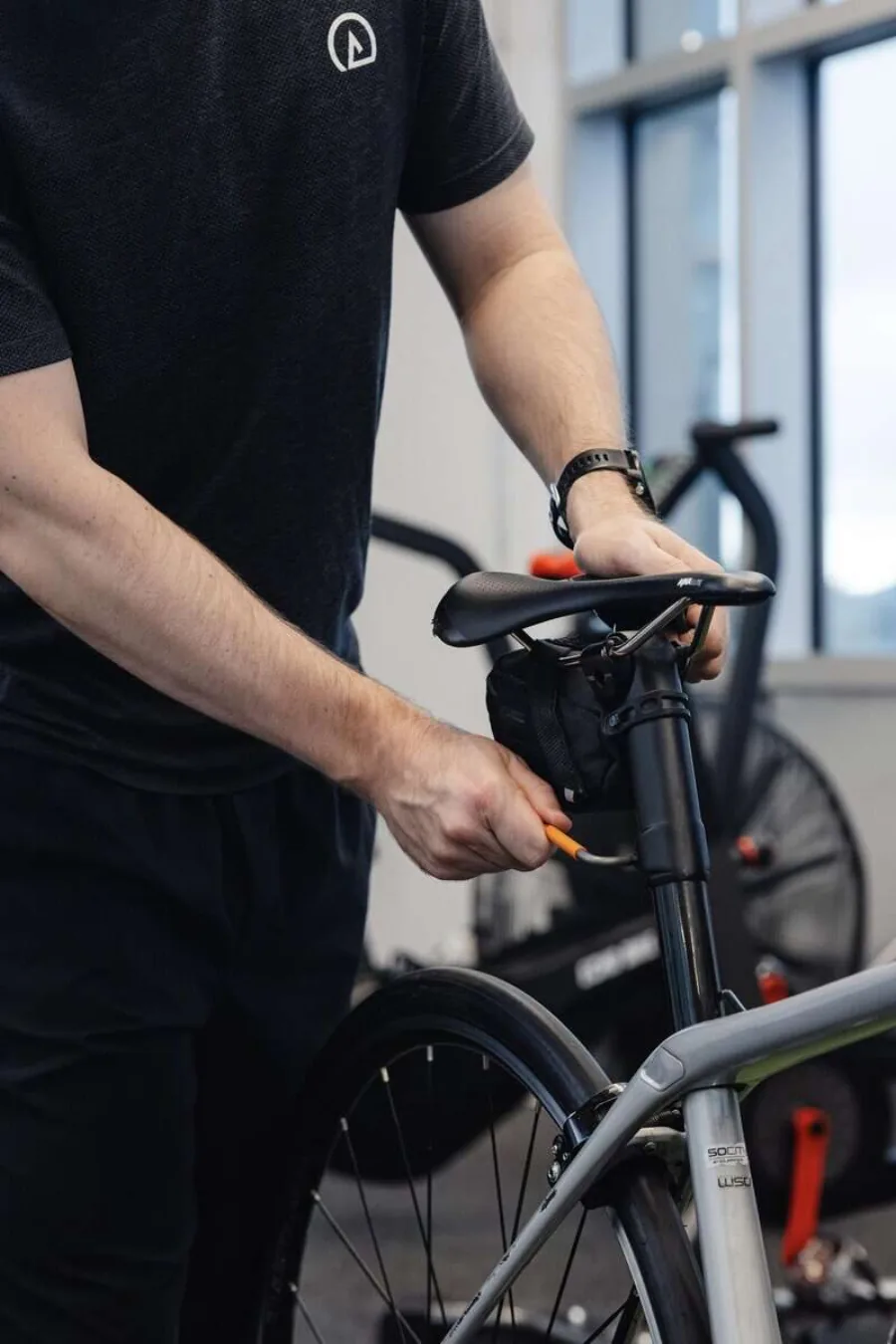
Adjusting your own saddle height is reasonable and worth doing carefully. The main mistake is changing too much at once, which trades one problem for another and makes it impossible to tell what helped.
Mark where it is now
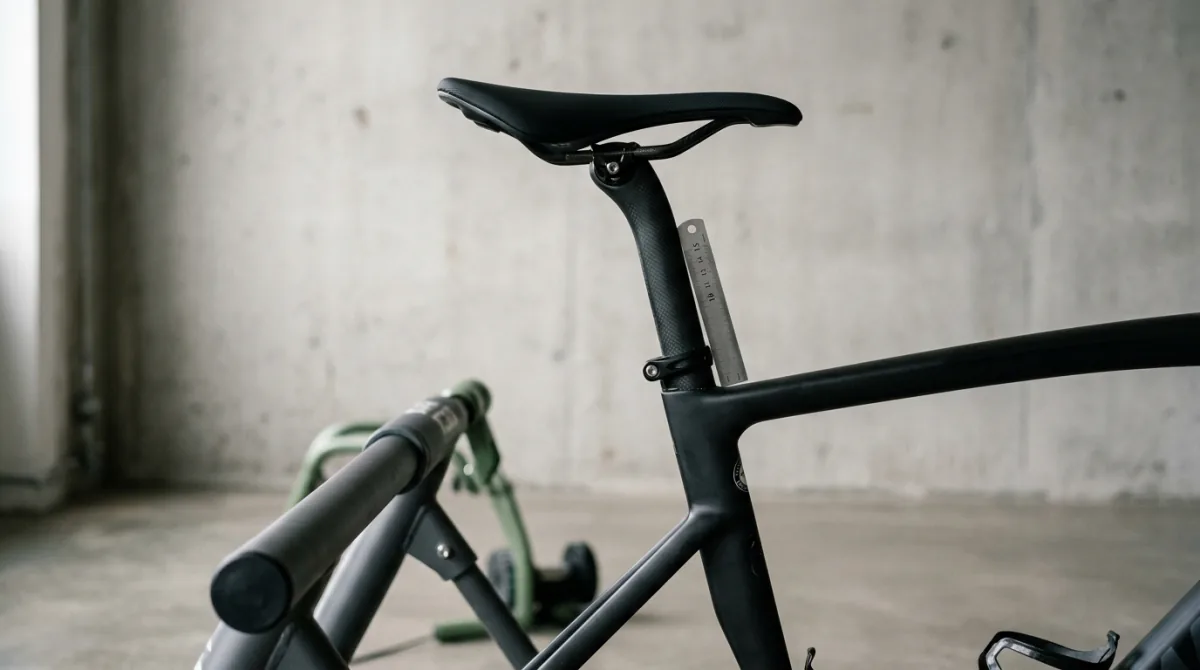
A piece of tape on the seatpost, or measure from the centre of the bottom bracket to the top of the saddle. So you can go back.
Move five millimetres at a time
No more. Five millimetres is noticeable and small enough not to cause a new problem.
Give it two or three rides
The first ride in any new position feels odd. Judge it on the third.
Change one thing only
Do not adjust height and fore and aft in the same week, because you will not know which did what.
Watch for the rocking
Film yourself from behind on a trainer. If the hips rock, come back down.
Redo it after new shoes
A different sole thickness changes your effective height. This catches out a lot of riders.
If you find yourself going up and down repeatedly without settling, stop. That usually means saddle height is not the only variable that is off, and height and fore and aft interact strongly. A fit resolves both together instead of chasing one with the other.
IN A FIT
How we set it, and why it is not just a number
In the session we measure your hip, hamstring and ankle range first, because those determine the range you can actually use. Then cleats are set, because they change the effective height. Only then do we touch the saddle.
We film from the side to check knee extension at the bottom of the stroke and from behind to check whether the pelvis stays level. Then you ride at a realistic effort and we look again, because a position that holds at low effort can collapse when you work.
The result is a height that suits how you actually pedal rather than a number from a chart. It gets written down, along with the reason, so it travels to your next bike.
ENQUIRE IN NEW WESTMINSTER
Book a fit if
- You have adjusted your saddle repeatedly and never settled
- You have pain at the front or the back of the knee
- Someone has told you your hips rock when you pedal
- You get a saddle sore in the same spot every time
- You have new shoes, new pedals or a new bike
- You can put both feet flat on the ground while seated
LAUNCH REHAB NEW WESTMINSTER
Bike fitting runs from our New Westminster studio, by appointment. Tell us what happens on the bike and we will tell you whether you need a fit, a physiotherapy assessment, or both. It is a two-minute conversation and it saves booking the wrong thing.
- Address
- 219-800 Carnarvon St, New Westminster, BC V3M 0G3
- Getting here
- Inside Shops at New West, above New Westminster SkyTrain station
Bike fitting is by appointment only and books out during the spring and summer riding season. Enquire early if you have an event coming up. About the New Westminster studio.
FAQ
Common questions.
No, it should be close to straight but keep a slight bend. A completely straight leg means you are reaching, which pulls behind the knee and makes the hips rock. A useful home check is to pedal with your heels on the pedals: at roughly the right height your legs will just straighten with the heels down, without the hips rocking. Treat that as a starting point rather than a final answer, because it does not account for cleat position or ankle style.
KEEP READING
More from the bike fitting guides.
- How a fit works
Cleat position
The smallest adjustment on the bike and the one everything above it inherits. We set it first.
READ - Pain and symptoms
Knee pain
Front, back, inside or outside. Where the pain sits narrows down which part of the setup is doing it.
READ - Pain and symptoms
Saddle pain
Rarely about how soft the saddle is. Almost always about where your weight lands and how long it stays there.
READ
FROM THE JOURNAL
Related reading from our clinicians.
READY?
Book your bike fit in New Westminster.
By appointment at 219-800 Carnarvon St, New Westminster, BC V3M 0G3. Not sure which appointment you need? Call 604-519-0777 and describe what happens on the bike.