
KNEE PAIN ON THE BIKE
Bike fit for knee pain when cycling.
The knee sits between the saddle and the pedal, so it takes the blame for both. Where the pain sits tells us which one to look at first.
THE SHORT ANSWER
Can a bike fit fix knee pain from cycling?
Often, yes. Most cycling knee pain is an overload problem rather than an injury, and saddle height, saddle fore and aft, cleat position and stance width all change how the knee is loaded on every pedal stroke. Pain at the front of the knee commonly relates to a saddle that is too low or too far forward. Pain at the back commonly relates to a saddle that is too high or too far back. Pain on the inside or outside more often tracks back to the cleat and how far apart your feet sit. A fit will not help if the knee is not tolerating your training load rather than your position, which is why a physiotherapist assessing the knee first matters.
5,100
Pedal strokes in an hour at 85 rpm, which is why a small error stops being small
90min
The initial fit, including the off-bike assessment and the written summary
4
Places knee pain sits, and each one points at a different part of the setup
60min
The follow-up, once you have ridden the new position for a few weeks
The knee is the joint cyclists complain about most, and it is easy to see why. It sits directly between the two things a bike fit controls: where your seat is and where your foot is clipped in. Move either one, and the knee bends through a different range, at a different angle, thousands of times an hour.
That is also the good news. Cycling knee pain rarely comes from a single dramatic moment. It builds up from a small fault repeated for a long time, which means it usually responds well to changing the fault. The job is working out which fault you have.
Where the pain sits is the most useful clue you can bring to an assessment. It is a starting point, not a diagnosis, and the patterns below overlap more in real life than they do on a page. But knowing roughly which corner of the knee hurts saves a lot of guessing.
AT A GLANCE
- Most common driver
- Saddle height and cleat position
- Where it is assessed
- New Westminster studio, by appointment
- Session length
- 90 minutes for the initial fit
- Who runs it
- A physiotherapist registered with CHCPBC
FRONT OF THE KNEE
Pain around or under the kneecap
This is the most common one by a distance. Riders describe an ache around or just under the kneecap that shows up on climbs, into a headwind, or any time the gear is heavy and the cadence is low. It often feels worse the day after a hard ride and eases once you are warmed up.
The pattern behind it is usually the same. The knee is being asked to push hard while it is bent deeply, which is the position that puts the most pressure through the joint at the front. Anything that increases how deeply the knee bends at the top of the pedal stroke, or that pushes you forward over the pedal, adds to it.
Saddle too low
The knee never gets to open up, so it works through its most compressed range on every stroke. This is the single most common cause we see.
Saddle too far forward
Puts your knee ahead of the pedal axle, which shifts load onto the front of the joint even if the height is right.
Cleat too far forward
Increases the leverage the foot has to apply, which asks more of the quadriceps and the front of the knee.
Grinding a big gear
Low cadence with high force is the loading pattern the front of the knee likes least. Sometimes the fix is gearing and cadence, not the bike.
A rapid jump in climbing
Metro Vancouver riders often get this in spring, when flat winter rides turn into hill repeats over two or three weeks.
BACK OF THE KNEE
Pain or tightness behind the knee
Pain behind the knee is close to the opposite problem. Instead of the joint being crushed at the top of the stroke, it is being stretched and pulled at the bottom. Riders describe a tight, pulling ache behind the knee, sometimes running down into the top of the calf, and sometimes with a feeling that they are reaching for the pedal.
A useful tell: if you notice your hips rocking side to side on the saddle, or you have to point your toes down at the bottom of the stroke to reach, the saddle is likely too high for you.
Saddle too high
The leg has to reach at the bottom of the stroke, which pulls on the hamstring attachments behind the knee.
Saddle too far back
Has a similar effect to a saddle that is too high, because the effective reach to the pedal increases.
Cleat too far back
Changes how much the calf works and can add to the pull behind the knee.
New shoes with a thinner sole
A quietly common cause. Different shoes change your effective saddle height without you touching the seatpost.
Swelling behind the knee, or a firm lump that has appeared there, is not a fit problem. Have it assessed by a physiotherapist or physician before you keep riding on it.
OUTSIDE OF THE KNEE
Pain on the outside of the knee
Outer knee pain in cyclists most often involves the iliotibial band, the thick sheet of tissue running down the outside of the thigh to just below the knee. It typically starts as a niggle at a predictable point in the ride, then arrives earlier and earlier over the following weeks until it stops you.
The distinguishing feature is how repeatable it is. Riders can often tell you almost to the kilometre when it will start. That predictability is what separates it from a joint problem.
Saddle too high
Increases how far the knee travels through its range, which increases the friction that irritates the band.
Cleat rotation
Forcing the foot straight when it naturally turns out puts a twist through the knee on every stroke.
Stance width too narrow
If your feet sit closer together than your hips want, the knee tracks inward and the outside of the joint takes the strain.
Hip strength
Often the knee is where you feel it and the hip is where the problem is. Weak hip control lets the knee fall inward under load.
This is general information, not a personal assessment. Nothing here replaces having the joint looked at. Stop any change that increases your pain, and see a regulated clinician if the pain is sharp, swelling, giving way, or getting worse week to week.
INSIDE OF THE KNEE
Pain on the inside of the knee
Inner knee pain almost always tracks back to the foot. If your cleats are set so your heels are pushed out, or your feet are held closer together than your hips are comfortable with, the knee gets a small twisting load on every stroke. A small twist multiplied by thousands of repetitions is enough.
This one is often the most satisfying to fix, because the change is usually a few millimetres at the cleat and riders feel the difference within one ride.
- Cleat rotated wrong. Set so the heel is pushed away from the frame, which forces the knee inward to compensate.
- Stance width too narrow. Common for riders with wider hips. Pedal spacers or a longer pedal axle often solve it.
- Knee collapsing inward under load. Visible on video from the front. Sometimes a fit issue, sometimes a hip strength issue, often both.
ONE SIDE ONLY
When only one knee hurts
One-sided knee pain deserves a proper assessment rather than a guess at the saddle height, because your saddle height is the same for both legs and only one is complaining. Something is different between your two sides, and finding out what is the whole job.
Nobody is symmetrical, and small differences are normal and harmless. The question is whether a difference has become big enough to matter for the hours you are riding.
An old injury
A previously sprained ankle, a knee surgery, or a hip problem changes how that leg moves and how much it contributes.
A real leg length difference
Genuinely common. It matters on a bike because the position is fixed, and it can often be managed with shims or cleat position.
Sitting slightly off centre
Many riders sit a little to one side without knowing. It changes the effective saddle height for each leg.
One-sided flexibility differences
A tighter hip or hamstring on one side changes what that leg can do at the top and bottom of the stroke.
This is general information, not a personal assessment. Nothing here replaces having the joint looked at. Stop any change that increases your pain, and see a regulated clinician if the pain is sharp, swelling, giving way, or getting worse week to week.
IN THE SESSION
How we work through knee pain in a fit
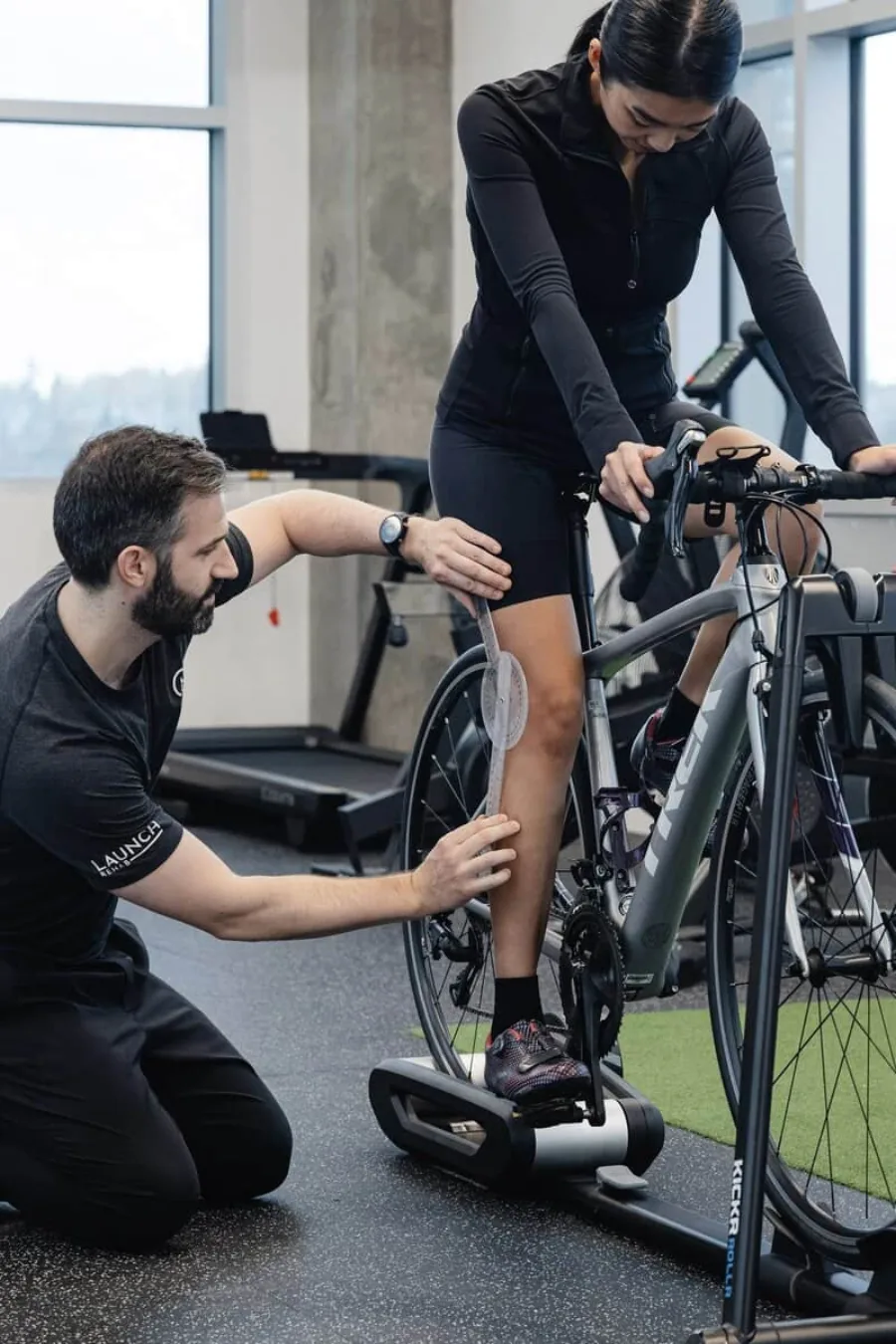
We start off the bike. Hip rotation, ankle range, hamstring and quadriceps length, single-leg control and your injury history all set the limits the position has to respect. If your hip only rotates so far, no saddle height will make that go away.
Then you ride on the trainer while we film from the side and the front, and take baseline numbers before touching anything. Cleats come first, then saddle height, then saddle fore and aft, then reach. One change at a time, each one ridden and re-filmed, so you can see what it did.
You leave with every number written down and, where the assessment found a strength or mobility gap, a short program to close it. If the knee needs actual treatment rather than a position change, we will tell you and book that separately.
ENQUIRE IN NEW WESTMINSTER
Book a fit if
- Knee pain shows up at a predictable point in every ride
- The pain started after a new bike, new shoes or a new saddle
- Only one knee hurts
- You have had a fit before and the knee still complains
- The knee settles with rest and comes straight back when you ride
- You are returning to cycling after a knee injury or surgery
LAUNCH REHAB NEW WESTMINSTER
Bike fitting runs from our New Westminster studio, by appointment. Tell us what happens on the bike and we will tell you whether you need a fit, a physiotherapy assessment, or both. It is a two-minute conversation and it saves booking the wrong thing.
- Address
- 219-800 Carnarvon St, New Westminster, BC V3M 0G3
- Getting here
- Inside Shops at New West, above New Westminster SkyTrain station
Bike fitting is by appointment only and books out during the spring and summer riding season. Enquire early if you have an event coming up. About the New Westminster studio.
FAQ
Common questions.
For most people it is one of the kinder things you can do for a knee, because your body weight is on the saddle rather than the joint and there is no impact. That is why cycling is so often used in knee rehabilitation. Cycling hurts knees when the position asks for a range the joint does not have, or when the training load rises faster than the tissue can adapt. Both are fixable.
KEEP READING
More from the bike fitting guides.
- How a fit works
Saddle height
The most influential number on the bike, and the one most riders have wrong by more than they think.
READ - How a fit works
Cleat position
The smallest adjustment on the bike and the one everything above it inherits. We set it first.
READ - Pain and symptoms
Hip pain
Pinching at the front, aching on the outside, or a hip that just will not let you get low.
READ
FROM THE JOURNAL
Related reading from our clinicians.
READY?
Book your bike fit in New Westminster.
By appointment at 219-800 Carnarvon St, New Westminster, BC V3M 0G3. Not sure which appointment you need? Call 604-519-0777 and describe what happens on the bike.