
HIP PAIN ON THE BIKE
Hip pain when cycling.
The hip is the joint that decides how low you can ride. When it runs out of range, the back and the knee pay for it.
THE SHORT ANSWER
Why do my hips hurt when cycling?
Cycling asks the hip to move through a repetitive, fairly small range while holding the pelvis rotated forward, and the more aggressive your position the more hip flexion it requires. Pinching at the front of the hip at the top of the pedal stroke usually means the position is asking for more hip flexion than the joint comfortably allows, which can relate to the shape of the joint itself. Aching on the outside of the hip is more often a tendon overload problem. Tight, cramping hip flexors usually reflect a saddle that is too low or too far forward. Raising or moving the saddle, shortening the reach, and improving hip range are the usual fixes.
3
Patterns we see: pinching at the front, aching outside, tight flexors
90min
The initial fit, including the off-bike assessment and the written summary
1
Joint that sets the ceiling on how low you can ride
60min
The follow-up, once you have ridden the new position for a few weeks
The hip does not complain as loudly as the knee, so riders often ignore it until it starts limiting what they can do. It deserves more attention than it gets, because the hip is the joint that sets the ceiling on your position.
Everything about how low and how far forward you can comfortably ride depends on how much your hip can flex and rotate. When it runs out of range, the movement does not stop. It gets borrowed from somewhere else, usually the lower back, sometimes the knee.
That means hip restriction often shows up as a different complaint. Plenty of riders we see for back pain actually have a hip problem, and the back is just where they feel it.
AT A GLANCE
- Most common driver
- Position asking for more hip range than you have
- Often mistaken for
- Low back pain or groin strain
- Where it is assessed
- New Westminster studio, by appointment
- Session length
- 90 minutes for the initial fit
FRONT OF THE HIP
Pinching at the front of the hip
A sharp pinch or block at the front of the hip or in the crease of the groin, felt at the top of the pedal stroke, is the pattern riders describe most often. It tends to be worse in a low position, worse on climbs where the knee comes higher, and better when they sit up.
The mechanism is straightforward. At the top of the stroke your thigh comes toward your chest, and if you are also leaning forward the total amount of hip flexion required is considerable. If the joint runs out of room before the pedal reaches the top, you get a pinch.
How much room a hip has varies between people for reasons that have nothing to do with fitness or flexibility. Hip joints are shaped differently, and some are simply built with less clearance in that direction. That is worth knowing, because it means the answer is often to change the position rather than to stretch harder.
Saddle too low
Increases how far the knee comes up at the top of the stroke, which uses more hip flexion on every rotation.
Saddle too far forward
Closes the angle between thigh and torso, so the hip reaches its limit sooner.
Reach too long or bars too low
Rotates the pelvis further forward, which uses up hip range before the pedal stroke has even started.
The shape of your hip joint
Some hips have less room at the front than others. It is common, it is not a fault, and it is a reason to adjust the position rather than force the range.
Deep hip or groin pain with clicking, catching, or a hip that feels like it gives way is worth a proper physiotherapy assessment rather than a position tweak. Those symptoms can point at something inside the joint.
OUTSIDE OF THE HIP
Aching on the outside of the hip
Pain on the bony point at the outside of the hip is usually a tendon overload problem rather than a joint one. Riders notice it lying on that side at night, getting out of a car, or on stairs, as well as on the bike.
On the bike, the usual contributors are a saddle that is too high, which makes the pelvis rock side to side, and a saddle that is too wide or too narrow for the way you sit. Both increase the side-to-side movement the tendon has to control.
This one responds well to a combination: reduce the mechanical irritation through the fit, then load the tendon progressively so it tolerates more. Rest alone tends to give short-term relief and a quick return of symptoms.
Saddle too high
Rocking hips are the most common contributor. Look for it on video from behind.
Sitting off-centre
Loads one side more than the other, which is why this is often one-sided.
A jump in training volume
Tendons object to sudden increases more than to high loads that arrive gradually.
Sitting cross-legged and standing on one hip
Habits off the bike that compress the same tendon and keep it irritated between rides.
HIP FLEXORS
Tight or cramping hip flexors
The sensation of the front of the hip being permanently tight, or cramping on long climbs, is common and often misread. Riders stretch it endlessly and it comes straight back, which is a good sign the muscle is not short but overworked.
The hip flexors work hardest when the position requires a lot of flexion and the glutes are not contributing much. A saddle that is too low or too far forward creates exactly that situation. So does a lot of time sitting during the week.
Saddle too low or too far forward
Puts the hip flexors in a shortened, working position for the whole ride.
Glutes not contributing
When the glutes are not doing their share of the pedal stroke, the front of the hip picks up the work.
A desk-heavy week
Hours of sitting followed by hours of riding in a similar hip angle. The tissue rarely gets to be long.
Stretching alone rarely fixes it
If the muscle is overworked rather than short, strengthening the glutes and changing the position does more than more stretching.
This is general information, not a personal assessment. Nothing here replaces having the joint looked at. Stop any change that increases your pain, and see a regulated clinician if the pain is sharp, swelling, giving way, or getting worse week to week.
WHAT WE TEST
Measuring what your hip actually allows
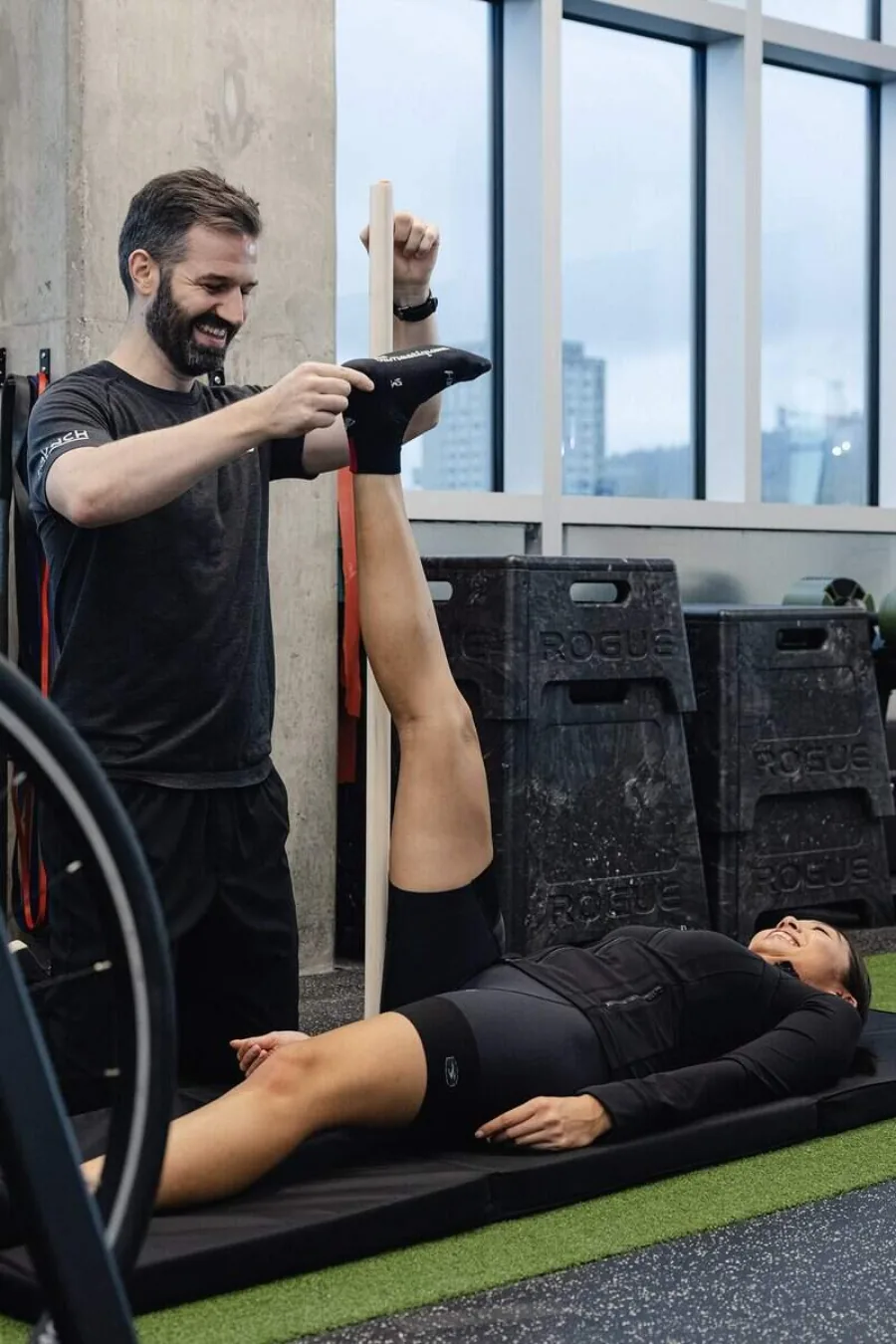
This is the part of a physiotherapy fit that a bike shop fit cannot do, and it is the reason we assess off the bike before touching the saddle. We measure how far the hip flexes, how far it rotates in each direction, hamstring length, and how well you control the pelvis under load.
Those numbers set the honest ceiling on your position. If your hip flexes to a certain point and no further, then a position requiring more than that will hurt regardless of how good it looks on paper. Knowing the ceiling means we can put you as close to it as is useful without going past it.
It also tells us what is worth working on. Some limits are structural and are best designed around. Others are soft tissue and strength, and those can be widened over a few months, which means the position can change with you.
ENQUIRE IN NEW WESTMINSTER
Book a fit if
- You feel a pinch at the front of the hip at the top of the pedal stroke
- Your hip aches on the outside and you cannot lie on that side at night
- Your hip flexors cramp on climbs no matter how much you stretch
- You cannot get comfortable in a low position and never have been able to
- Hip pain arrived alongside a lower saddle or a longer stem
- You have hip pain and back pain together
LAUNCH REHAB NEW WESTMINSTER
Bike fitting runs from our New Westminster studio, by appointment. Tell us what happens on the bike and we will tell you whether you need a fit, a physiotherapy assessment, or both. It is a two-minute conversation and it saves booking the wrong thing.
- Address
- 219-800 Carnarvon St, New Westminster, BC V3M 0G3
- Getting here
- Inside Shops at New West, above New Westminster SkyTrain station
Bike fitting is by appointment only and books out during the spring and summer riding season. Enquire early if you have an event coming up. About the New Westminster studio.
FAQ
Common questions.
Generally it is one of the better options, because there is no impact and the range used is moderate. Many people with hip osteoarthritis ride comfortably long after walking distances have become difficult, and cycling is often recommended as part of managing it. Position matters more than usual: a slightly higher saddle and a more upright position reduce how much hip flexion is required, which is often the difference between comfortable and not.
KEEP READING
More from the bike fitting guides.
- Pain and symptoms
Lower back pain
If the hips cannot rotate far enough to reach the bars, the low back rotates instead and holds it all ride.
READ - Pain and symptoms
Knee pain
Front, back, inside or outside. Where the pain sits narrows down which part of the setup is doing it.
READ - How a fit works
Saddle height
The most influential number on the bike, and the one most riders have wrong by more than they think.
READ
FROM THE JOURNAL
Related reading from our clinicians.
READY?
Book your bike fit in New Westminster.
By appointment at 219-800 Carnarvon St, New Westminster, BC V3M 0G3. Not sure which appointment you need? Call 604-519-0777 and describe what happens on the bike.