
CLEAT POSITION
Cleat position: fore and aft, rotation and stance width.
Three small adjustments at the smallest contact point on the bike. Everything above the foot inherits all of them.
THE SHORT ANSWER
Where should my bike cleats be positioned?
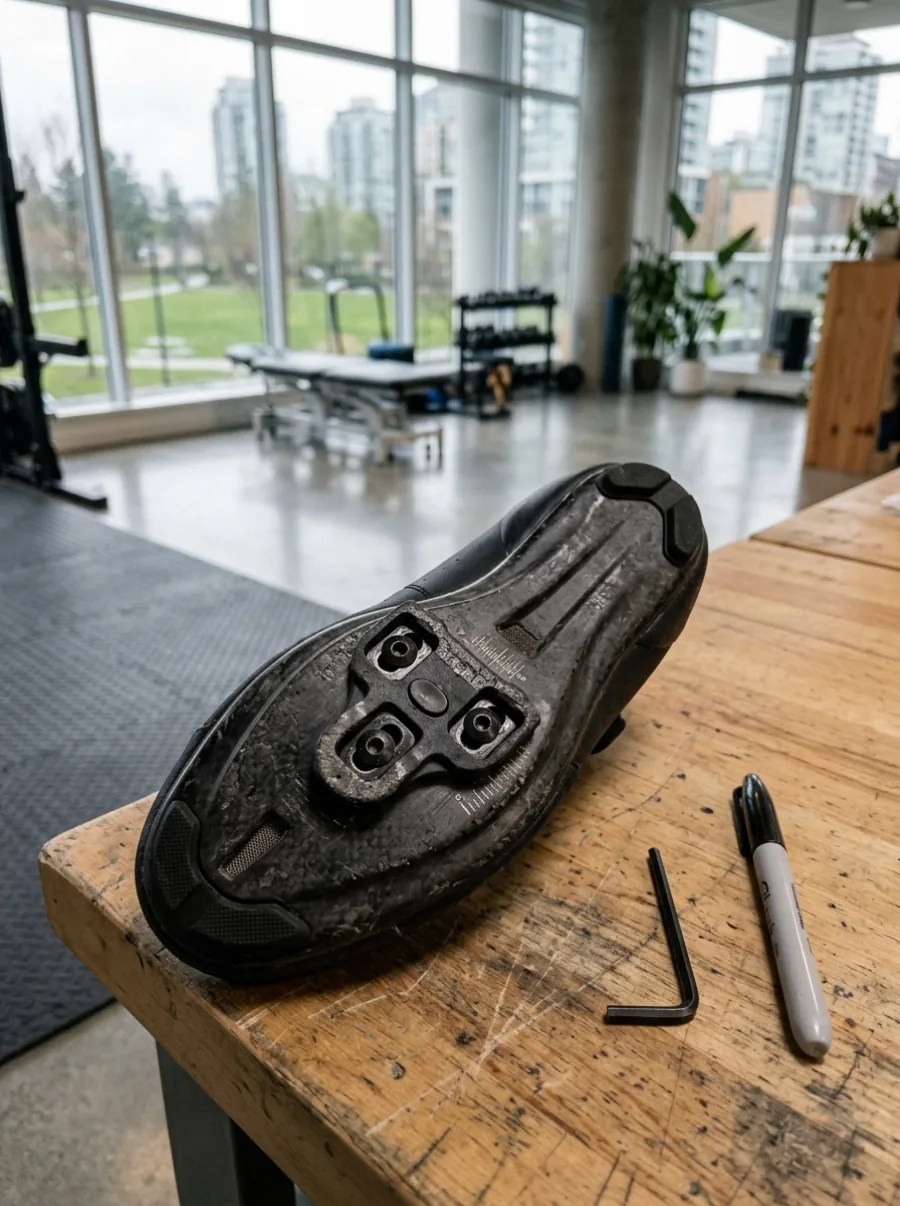
Cleat position has three parts. Fore and aft sets how far forward the cleat sits under the foot: the traditional starting point puts the pedal axle roughly under the ball of the foot, and modern practice often sits slightly behind that, which reduces calf and Achilles load and helps riders with hot foot. Rotation should match your foot's natural turnout, which is often different left to right, because forcing both cleats straight twists the knee on every stroke. Stance width, how far apart your feet sit, should let the knee track straight rather than falling inward, and can be widened with pedal spacers or a longer pedal axle. There is no universal correct number, which is why cleats are set individually and checked on video.
3
Adjustments: fore and aft, rotation, stance width
90min
The initial fit, including the off-bike assessment and the written summary
2 to 3mm
How far to move a cleat at a time
60min
The follow-up, once you have ridden the new position for a few weeks
The cleat is a piece of plastic the size of a matchbox and it has more influence on your fit than almost anything else on the bike. It decides where force enters the system, how much work the calf does, the path the knee travels, and the effective height of your saddle.
That is why we set cleats first in every fit. Change the cleat afterwards and the saddle height you carefully established is no longer right.
It is also the adjustment riders are most likely to have never touched. Cleats get bolted on when the shoes are new, at whatever position they happened to land, and stay there until the shoes wear out.
AT A GLANCE
- Set first in a fit
- Everything above the foot depends on it
- Three adjustments
- Fore and aft, rotation, stance width
- Move by
- Two to three millimetres at a time
- Set properly at
- New Westminster studio, by appointment
FORE AND AFT
How far forward the cleat sits
Fore and aft position controls how much leverage your foot has over the pedal, and therefore how much work your calf and ankle have to do to stabilise it.
The traditional starting point places the pedal axle roughly under the ball of the foot. Practice has drifted back from there over the years, and many riders are more comfortable with the cleat a few millimetres further back, particularly on longer rides.
There is no universally correct position, because it depends on foot length, how you pedal, what you ride and what your calf tolerates. There are clear directions to move for specific problems, which is the useful part.
Further forward
More leverage and more calf involvement. Suits short, high-intensity efforts and sprinting. Increases forefoot pressure.
Further back
Less calf work and less pressure on the ball of the foot. Suits long rides, and helps hot foot, calf cramping and Achilles trouble.
If you get hot foot
Move it back. Concentrating force under the forefoot is a common cause of burning feet on long rides.
If your calves cramp
Move it back. Less lever means less continuous calf work.
If your Achilles grumbles
Move it back, and expect it to be part of the answer rather than all of it. Tendons also need progressive loading.
Moving the cleat changes your effective saddle height. Move it back and the saddle is effectively slightly higher. If you make a meaningful cleat change, recheck saddle height afterwards.
ROTATION
Matching your foot's natural angle
Stand up, relax, and look at your feet. Most people's feet point slightly outward, and for many the angle is different on each side. That angle is normal and it is what your hip and knee are built around.
A cleat forces your foot to sit at whatever angle you bolted it to. If that angle does not match your natural one, the difference has to be absorbed somewhere, and it gets absorbed at the knee as a small twist on every pedal stroke.
This is one of the most common causes of inner and outer knee pain in cyclists, and one of the most satisfying to fix, because riders often feel the difference within a single ride.
Match your natural turnout
Not straight, unless straight is genuinely how you stand. Symmetry between the two shoes matters less than matching each foot.
Left and right will often differ
That is normal. Setting both cleats identically is a common error.
Inner knee pain
Often points at a cleat rotated so the heel is pushed away from the frame.
Outer knee pain
Often points at rotation the other way, or at not enough freedom to rotate while clipped in.
Watch where the heel sits
If your heel drifts toward or away from the crank arm while pedalling, the rotation is fighting you.
STANCE WIDTH
How far apart your feet sit
Stance width is the distance between your two feet as you pedal. It is set by where the cleat sits side to side in the shoe, by the pedal axle length, and by any spacers between pedal and crank.
Most bikes come with a stance width that suits an average build. Riders with wider hips are often too narrow, which makes the knees track inward toward the top tube. Riders with narrow hips can be too wide, which pushes the knees out.
It is checked on video from the front, because the knee's path under load is the honest test.
Too narrow
Knees track inward, and inner knee pain or a feeling of knocking the top tube are common. Widening usually helps.
Too wide
Knees splay outward and the hips work harder to control them. Less common but it happens.
How to widen it
Move the cleat toward the inside edge of the shoe, add pedal spacers, or use pedals with a longer axle.
How to narrow it
Move the cleat toward the outside edge of the shoe. Options are more limited in this direction.
Check it on video
Filming from the front while you pedal under load shows the knee path far more reliably than watching from beside the bike.
FLOAT
How much your foot can rotate while clipped in
Float is the number of degrees your foot can rotate while still clipped in. Different pedal systems and cleat colours offer different amounts, from essentially none to a wide range.
Some riders do well with very little float, because they have a consistent foot path and like the fixed feel. Others need more, because their foot naturally moves through the stroke, and locking it rigidly forces the knee to absorb that movement instead.
If your cleat rotation is well set, you need less float. If you are not sure, more float is the safer starting point.
Little or no float
Fixed and precise. Fine if your rotation is exactly right, unforgiving if it is not.
Moderate float
The usual default and a sensible starting point for most riders.
More float
Useful for riders whose foot moves through the stroke, or who are still working out the right rotation.
Float is not a fix for wrong rotation
It gives the foot somewhere to go. If the cleat is badly angled, the foot spends the whole ride at the end of the float, which is no better.
DOING IT YOURSELF
If you adjust your own cleats
Cleat adjustment is doable at home and it deserves care, because the knee is downstream of it. The main risk is moving too far at once and creating a new problem while solving an old one.
Mark the current position first
Draw around the cleat with a fine marker before you loosen anything, so you can always go back.
Two to three millimetres at a time
Small moves. The knee notices more than you expect.
One shoe at a time if only one side hurts
Otherwise you have changed two variables and cannot tell which mattered.
Ride a few times before judging
The first ride after a cleat change often feels strange regardless of whether it is better.
Recheck the bolts
Cleat bolts work loose, and a cleat that shifts mid-ride is both a fit problem and a safety one.
Recheck saddle height after a big move
Fore and aft changes alter the effective saddle height.
This is general information, not a personal assessment. Nothing here replaces having the joint looked at. Stop any change that increases your pain, and see a regulated clinician if the pain is sharp, swelling, giving way, or getting worse week to week.
ENQUIRE IN NEW WESTMINSTER
Book a fit if
- You get pain on the inside or outside of the knee
- Your feet burn or go numb on longer rides
- Your calves cramp or your Achilles is sore after riding
- You have never adjusted the cleats since the shoes were new
- You have new shoes and are guessing at the position
- One knee hurts and the other does not
LAUNCH REHAB NEW WESTMINSTER
Bike fitting runs from our New Westminster studio, by appointment. Tell us what happens on the bike and we will tell you whether you need a fit, a physiotherapy assessment, or both. It is a two-minute conversation and it saves booking the wrong thing.
- Address
- 219-800 Carnarvon St, New Westminster, BC V3M 0G3
- Getting here
- Inside Shops at New West, above New Westminster SkyTrain station
Bike fitting is by appointment only and books out during the spring and summer riding season. Enquire early if you have an event coming up. About the New Westminster studio.
FAQ
Common questions.
The traditional starting point puts the pedal axle roughly under the ball of the foot, and current practice often sits a few millimetres behind that. There is no single correct number, because it depends on your foot length, your riding and what your calf and Achilles tolerate. If you have hot foot, calf cramping or Achilles pain, moving back is the direction to try. If you sprint a lot and want more leverage, forward is the direction.
KEEP READING
More from the bike fitting guides.
- Pain and symptoms
Foot pain and hot foot
Burning across the ball of the foot, numb toes, or an Achilles that grumbles. Usually shoes and cleats.
READ - Pain and symptoms
Knee pain
Front, back, inside or outside. Where the pain sits narrows down which part of the setup is doing it.
READ - How a fit works
Saddle height
The most influential number on the bike, and the one most riders have wrong by more than they think.
READ
FROM THE JOURNAL
Related reading from our clinicians.
READY?
Book your bike fit in New Westminster.
By appointment at 219-800 Carnarvon St, New Westminster, BC V3M 0G3. Not sure which appointment you need? Call 604-519-0777 and describe what happens on the bike.