
FOOT PAIN AND HOT FOOT
Hot foot, numb toes and Achilles pain when cycling.
Your whole pedalling force goes through an area about the size of a business card. Small errors there are not small.
THE SHORT ANSWER
Why do my feet burn or go numb when cycling?
Hot foot, the burning or numb feeling across the ball of the foot on longer rides, is usually a pressure problem rather than a nerve disease. All your pedalling force passes through a small area of the forefoot, and your feet swell during long rides and in warm weather, so a shoe that fits at rest can be too tight after two hours. The common causes are a shoe that is too narrow or done up too tight, a cleat positioned too far forward, which concentrates force on the ball of the foot, and a stiff sole that focuses pressure in one spot. Loosening the shoe, moving the cleat back slightly, and going up a shoe width usually resolve it.
3
Cleat adjustments that change what your foot feels
90min
The initial fit, including the off-bike assessment and the written summary
2 to 3mm
How far to move a cleat at a time
60min
The follow-up, once you have ridden the new position for a few weeks
The foot is where every watt you produce leaves your body, and it does so through a contact area smaller than most people expect. That concentration is why foot problems on the bike feel so specific: riders can usually point to the exact spot.
It is also why the cleat is the adjustment we make first in a fit. Everything above the foot inherits the cleat's position. Move it and you change the calf's workload, the knee's path and the effective height of the saddle.
Most foot complaints in cyclists fall into three groups: burning or numbness across the ball of the foot, pain at the back of the heel or up the Achilles, and pain underneath the heel or arch. They have different causes and different fixes.
AT A GLANCE
- Most common driver
- Shoe width and cleat fore and aft
- Set first in a fit
- Cleats, because everything above depends on them
- Where it is assessed
- New Westminster studio, by appointment
- Session length
- 90 minutes for the initial fit
BURNING AND NUMBNESS
Hot foot: burning across the ball of the foot
Hot foot usually starts an hour or more into a ride as a warm spot under the ball of the foot, then builds into a burning ache and sometimes numbness in the toes. It eases within minutes of stopping and loosening the shoe, which is the clue that it is pressure rather than damage.
Two things combine to cause it. Force is concentrated through the forefoot, and your feet get bigger as you ride. Feet swell with heat and with the sustained low-level effort of cycling, so a shoe that felt right in the shop can be genuinely too small by hour two.
Shoe too narrow
The most common cause. Cycling shoes are often sized snug for efficiency, which leaves no room for the swelling that happens on every long ride.
Straps done up too tight
Riders tighten at the start and never loosen. Try backing the closure off a click at the top of a long climb.
Cleat too far forward
Places the pedal axle ahead of where the foot is built to take load, concentrating force on the ball of the foot.
Very stiff soles with no support
A stiff sole is efficient but spreads nothing. Without an insole matched to your arch, pressure lands on one small area.
Hot weather and long rides
Both increase swelling. Many riders only get hot foot in summer or on rides over three hours, which tells you it is swelling-related.
CLEAT POSITION
How the cleat changes what your foot feels
Cleat position is three separate adjustments, and each one changes something different. In a fit we set them in order and check each on video before moving on.
Fore and aft
How far forward the cleat sits under the foot. Further forward increases calf work and forefoot pressure. Further back reduces both and suits riders with hot foot, calf cramping or Achilles trouble.
Rotation
Your feet have a natural turnout and it is often different left to right. Forcing both cleats straight puts a twist through the knee thousands of times per ride.
Side to side, and stance width
How far apart your feet sit relative to your hips. Too narrow and the knees track inward. Pedal spacers or a longer axle widen it.
Float
How many degrees the foot can rotate while clipped in. Some riders need more than the pedal system gives them by default.
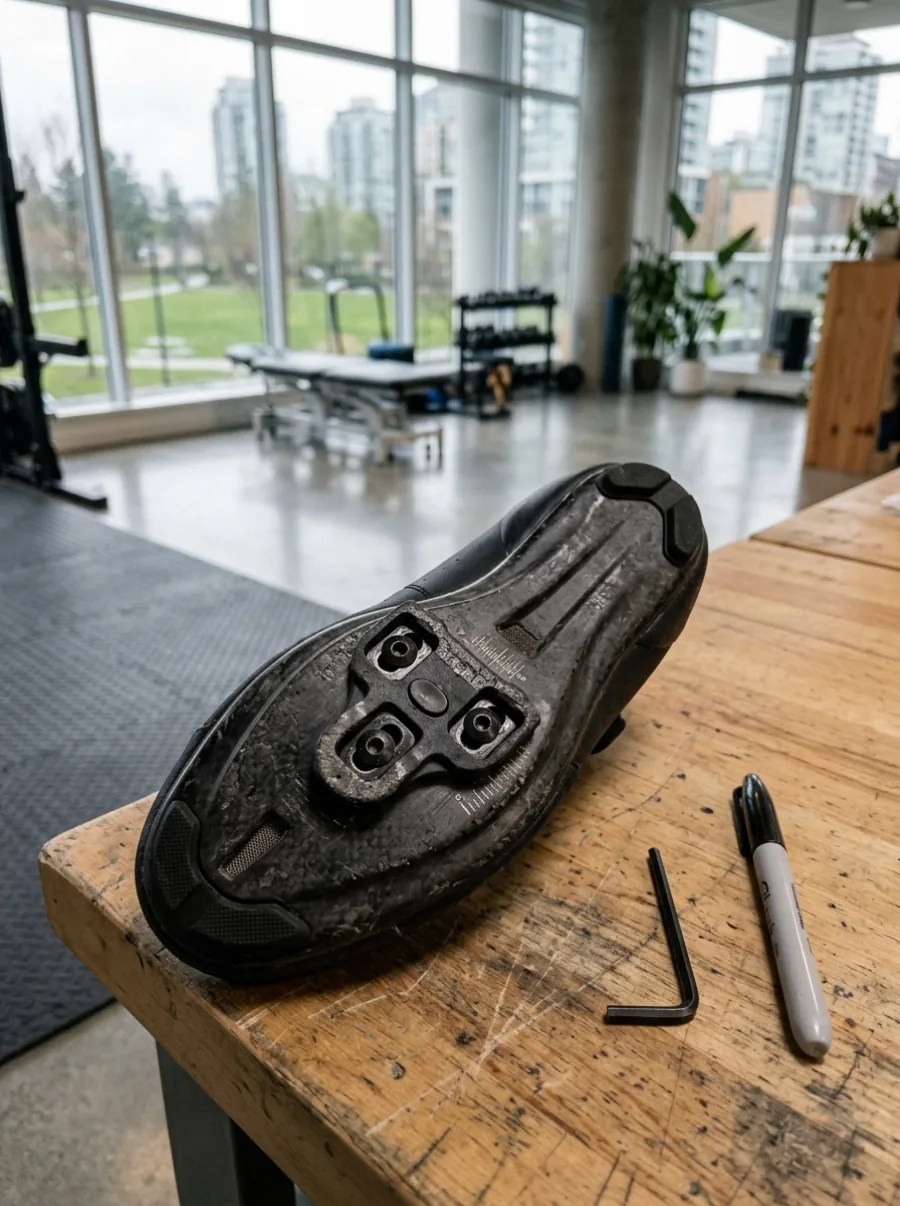
Move cleats in small increments, no more than two or three millimetres at a time, and mark the old position first. Cleat changes affect the knee, so a big move made all at once can create a new problem while solving an old one.
ACHILLES AND CALF
Achilles pain and calf cramping
Achilles pain in cyclists is less common than in runners, and when it appears the cleat is usually involved. A cleat set well forward makes the calf work harder on every stroke, because the ankle has to stabilise a longer lever. Over a few weeks of increasing mileage, that is enough to irritate the tendon.
Achilles tendon problems respond to progressive loading rather than rest, which means the answer is rarely to stop riding. It is usually to reduce the demand through the cleat position and build the tendon's tolerance with specific work.
Cleat too far forward
Increases calf and Achilles demand. Moving it back a few millimetres is often the first change.
Saddle too high
Makes you point the toes to reach the bottom of the stroke, which loads the calf continuously.
A rapid increase in climbing
Climbing seated at low cadence asks a lot of the calf. Spring in Metro Vancouver catches plenty of riders this way.
Ankle range
A stiff ankle changes how the foot moves through the stroke, and it is something we test off the bike.
This is general information, not a personal assessment. Nothing here replaces having the joint looked at. Stop any change that increases your pain, and see a regulated clinician if the pain is sharp, swelling, giving way, or getting worse week to week.
ARCH AND HEEL
Arch pain, heel pain and insoles
Pain under the heel or along the arch is less about the bike and more about what is inside the shoe. Cycling shoes usually come with a flat, thin insole that offers essentially no support, which is fine for many riders and not fine for others.
If your foot collapses inward under load, the arch is working continuously to resist that, and a stiff flat sole gives it nothing to work against. An insole that matches your arch spreads the pressure and reduces the work.
The stock insole
Usually a flat piece of foam. Replacing it with a supportive insole is a cheap change that helps many riders.
Arch support that matches your foot
The aim is contact along the arch, not the highest arch support you can buy. Too much is as uncomfortable as none.
Wedges under the cleat
For riders whose forefoot is angled, a small wedge lets the foot sit flat on the pedal instead of rolling to reach it.
Custom orthotics
Worth considering when the same problem appears in cycling, running and walking, which points at the foot rather than the bike.
ENQUIRE IN NEW WESTMINSTER
Book a fit if
- Your feet burn or go numb on rides over an hour
- You loosen your shoes mid-ride as a routine
- You get calf cramping or Achilles soreness after riding
- Foot pain appeared after new shoes, new pedals or a new bike
- One foot is affected and the other is not
- You have tried different insoles without a clear answer
LAUNCH REHAB NEW WESTMINSTER
Bike fitting runs from our New Westminster studio, by appointment. Tell us what happens on the bike and we will tell you whether you need a fit, a physiotherapy assessment, or both. It is a two-minute conversation and it saves booking the wrong thing.
- Address
- 219-800 Carnarvon St, New Westminster, BC V3M 0G3
- Getting here
- Inside Shops at New West, above New Westminster SkyTrain station
Bike fitting is by appointment only and books out during the spring and summer riding season. Enquire early if you have an event coming up. About the New Westminster studio.
FAQ
Common questions.
If you get hot foot regularly, it is one of the first things worth trying, and many riders are in shoes a size too narrow. Remember that the shoe has to fit your foot at hour three of a warm ride, not at the moment you try it on in a cool shop. A little room across the forefoot, with the heel still held securely, is the target.
KEEP READING
More from the bike fitting guides.
- How a fit works
Cleat position
The smallest adjustment on the bike and the one everything above it inherits. We set it first.
READ - Pain and symptoms
Knee pain
Front, back, inside or outside. Where the pain sits narrows down which part of the setup is doing it.
READ - How a fit works
What happens in a fit
The full 90 minutes, step by step, from the first question to the numbers you take home.
READ
FROM THE JOURNAL
Related reading from our clinicians.
READY?
Book your bike fit in New Westminster.
By appointment at 219-800 Carnarvon St, New Westminster, BC V3M 0G3. Not sure which appointment you need? Call 604-519-0777 and describe what happens on the bike.