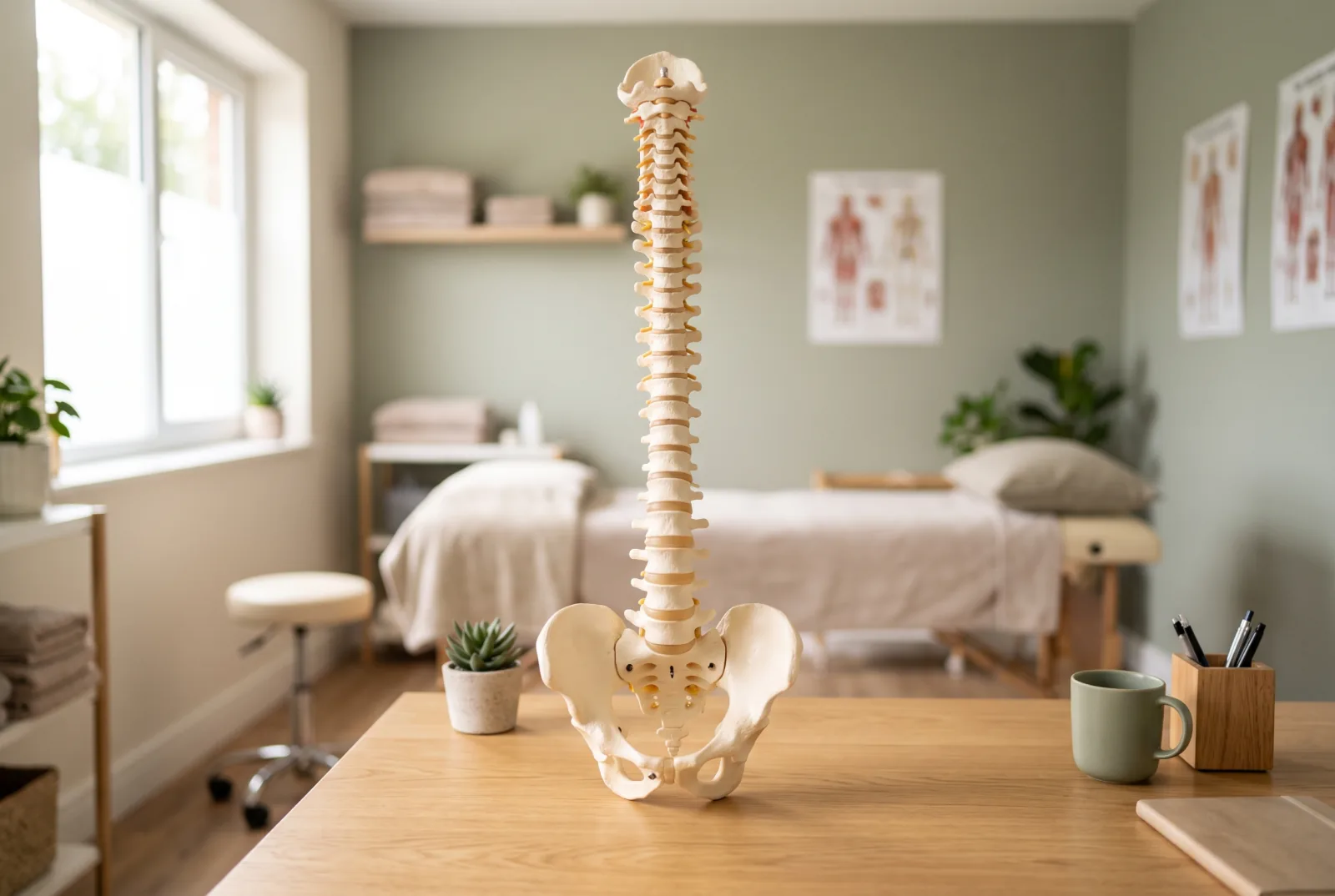

Cervical Radiculopathy: Neck Pain That Travels Down the Arm
When neck pain runs past the shoulder and into the arm or hand, a compressed or irritated nerve root is usually the reason. Here is what the research says about how it resolves, what physiotherapy targets, and which signs mean you should not wait.
BY THE LAUNCH REHAB TEAM
There is a meaningful difference between neck pain that stays in the neck and neck pain that travels. When it runs past the shoulder, down the arm, and sometimes into specific fingers, and when it brings numbness, pins and needles, or weakness with it, the likely explanation is a nerve root in the neck being compressed or irritated. That is cervical radiculopathy, and it behaves differently enough from ordinary mechanical neck pain that it is worth understanding on its own terms.
What a nerve root is and what irritates it
Nerve roots exit the spinal cord through small openings between the vertebrae and travel out to supply sensation and muscle power to specific territories of the shoulder, arm, and hand. Each root has a predictable territory, which is why the pattern of your symptoms tells a clinician a lot about which level is involved.
Two things commonly narrow the space a root passes through. In younger people it is more often a disc herniation, where material from a spinal disc bulges and presses against the root. In older people it is more often spondylosis, the gradual bony and degenerative changes that narrow the exit opening over years. Both produce the same downstream problem: a root that is mechanically irritated, inflamed, or both.
According to a 2016 review in Current Reviews in Musculoskeletal Medicine, the C7 nerve root is the one most frequently affected, followed by C6 and then C8. The same review reports that incidence peaks in the fourth and fifth decades of life, and makes a point worth repeating to anyone hunting for a cause: the incidence of trauma preceding the onset of cervical radiculopathy is low, and up to 30% of patients report the pain starting while sitting, walking, or standing. Most people cannot name the moment it began, and that is normal rather than a sign something has been missed.
The symptom pattern that separates it from ordinary neck pain
Mechanical neck pain tends to sit in the neck and upper shoulder, feels achy and diffuse, and changes with posture and position. Radicular pain has a different character:
- It travels past the shoulder and often past the elbow, following a band or stripe rather than a general area.
- It is frequently described as burning, electric, or shooting rather than aching.
- It commonly brings numbness or pins and needles in a specific part of the hand.
- It may come with genuine weakness in particular movements, such as straightening the elbow or gripping.
- It is often worse at night, and many people find it eases when they rest the affected arm on top of their head.
That last one has a name. Placing the hand on the head reduces tension on the nerve root, and clinicians take relief in that position as a useful pointer toward radiculopathy. Neck movement in one particular direction, usually bending and rotating toward the painful side, tends to make it worse.
This is a different problem from the tension-pattern neck pain covered in cervicogenic and tension headache and from the postural loading pattern in tech neck and persistent neck pain, although the same person can have more than one of these at once. In the lower back, the equivalent problem is the one described in sciatica: disc, piriformis, or something else. Same mechanism, different end of the spine.
What the recovery evidence actually shows
This is the part that changes how most people feel about their situation, and it is worth stating precisely.
A 2022 systematic review in Global Spine Journal reports that 83% of patients with symptomatic radiculopathy recover within 24 to 36 months, and cites follow-up research finding 90% had mild or no symptoms after 4 to 5 years. The 2016 review adds the detail that makes those numbers usable: at 4-year follow-up nearly 90% of patients were either asymptomatic or only mildly symptomatic, and substantial improvement generally arrives at 4 to 6 months and is broadly maintained over the following 2 to 3 years.
Read those together and the shape of a typical course becomes clear. The trajectory is genuinely favourable for most people, and the meaningful turn tends to come in months rather than weeks. Both facts matter. The first is a reason to be patient with a conservative plan instead of rushing toward surgery. The second is a reason to expect a slower course than a straightforward muscular neck strain, so that a plateau at week six does not read as failure.
The 2022 review also compared approaches directly. It concluded that conservative treatment remains beneficial while acknowledging that symptom relief is slow, and that surgery is not necessary for patients who do not need rapid pain relief. Surgery does provide faster pain relief. The review found no significant difference between the approaches in range of motion or mental health outcomes at 12-month follow-up. The trade-off is speed against the risks of an operation, and it is a conversation for you, your physician, and a surgeon if it comes to that.
What physiotherapy targets
A 2025 network meta-analysis in the Journal of Pain Research pooled 8 randomized controlled trials covering 632 participants with cervical radiculopathy, with interventions running 4 to 6 weeks. Manual therapy without traction had a 68.1% probability of producing the best improvement on the Neck Disability Index, compared with 29.1% for manual therapy combined with traction. On pain measured by visual analogue scale, the figures were 59.5% and 39.6% respectively.
Two cautions belong with those numbers. The difference between manual therapy with and without traction was not statistically significant on either outcome, so the ranking is suggestive rather than settled. And the authors listed real limitations: small sample sizes, poor data quality, complex intervention measures, and limited generalisability across healthcare settings. The honest reading is that manual therapy has support in this condition, and that adding mechanical traction has not been shown to improve on it.
In practice a physiotherapy plan for cervical radiculopathy usually works on several fronts at once. Your therapist confirms the pattern and identifies which root is most likely involved by testing sensation, reflexes, and strength in the territories each root supplies. Positions and movements that reduce your symptoms are identified and used deliberately, including how you sleep and how you set up your desk, because a nerve root that is irritated all night makes slower progress. Manual therapy to the neck and thoracic spine addresses the segments contributing to the load. Nerve mobility work, done at a dose that calms rather than provokes, is introduced when the presentation suits it. Strengthening for the deep neck flexors, the scapular muscles, and eventually the arm itself rebuilds the capacity that has been lost while you have been guarding.
Progression is guided by whether symptoms are centralising, meaning retreating from the hand back up toward the neck. That direction of change is a better indicator of progress than a pain score on any given day, and it is one of the main things your therapist tracks between visits.
Signs that mean do not wait
Most cervical radiculopathy is managed conservatively. Some presentations are not, and the 2016 review lists the concerning findings that warrant early intervention: progressive neurological deficits, signs of myelopathy, fractures or other signs of cervical instability or ligamentous injury, and osseous lesions or destruction.
In plainer terms, seek prompt medical assessment if you notice weakness that is getting worse rather than staying stable, changes in hand dexterity such as new difficulty with buttons or handwriting, a change in your walking or balance, numbness or symptoms in both arms or in the legs, or any change in bladder or bowel control. Those point toward compression of the spinal cord itself rather than a single nerve root, which is a different and more urgent problem. Severe pain following significant trauma also needs imaging before anyone starts treating.
Your physiotherapist screens for these at the first visit and will refer you on rather than treat if the picture calls for it. On the timing of the surgical conversation, one study cited in the 2022 literature recommended 6 months as the cutoff for non-operative management, and that decision belongs to you and a surgeon rather than to a physiotherapist.
What to expect from a first visit
A first physiotherapy assessment for arm pain of this kind spends most of its time on the neurological examination and on the history, because that is what separates radiculopathy from the several other things that send pain down an arm. Your therapist will ask what makes it worse and better, where exactly the symptoms reach, whether there is numbness or weakness, how you are sleeping, and what has changed since it started.
Imaging is not the automatic first step. Degenerative changes on a neck MRI are common in people with no symptoms at all, so a scan without a matching clinical picture can point in the wrong direction. Imaging becomes useful when the examination raises a specific question, when red flags are present, or when a surgical decision is being considered.
Physiotherapy is a direct-access profession in British Columbia, so you can book an assessment without a physician's referral, though some extended-health plans require one for reimbursement. If your neck and arm pain started in a motor vehicle crash, treatment is handled under the ICBC pathway described in what to expect in your first 12 weeks of ICBC physiotherapy, and a claim number gets you started.
This article is general information, not personal medical advice. A regulated practitioner can confirm whether the patterns described apply to you.
Frequently asked questions
What is cervical radiculopathy?
Cervical radiculopathy is pain, numbness, tingling, or weakness caused by compression or irritation of a nerve root as it exits the spine in the neck. Each root supplies a specific territory of the shoulder, arm, and hand, so the pattern of symptoms indicates which level is involved. The two common causes are a disc herniation pressing on the root, more often in younger people, and spondylosis narrowing the exit opening over years, more often in older people.
How do I know if my arm pain is coming from my neck?
Radicular pain typically travels past the shoulder and often past the elbow, follows a band or stripe rather than a general area, and is described as burning, electric, or shooting rather than achy. It commonly brings numbness or pins and needles in a specific part of the hand, and may come with weakness in particular movements. Many people find it eases when they rest the affected arm on top of their head, which reduces tension on the nerve root. A physiotherapist confirms the pattern by testing sensation, reflexes, and strength.
Will cervical radiculopathy go away on its own?
For most people it improves. A 2022 systematic review in Global Spine Journal reports that 83% of patients with symptomatic radiculopathy recover within 24 to 36 months, and cites research finding 90% had mild or no symptoms after 4 to 5 years. A 2016 review adds that substantial improvement generally occurs at 4 to 6 months and is broadly maintained over the following 2 to 3 years. Recovery tends to be slower than an ordinary muscular neck strain, so a plateau at six weeks is not a sign of failure.
Which nerve root is most commonly affected?
The C7 nerve root is most frequently involved, followed by C6 and then C8, according to a 2016 review in Current Reviews in Musculoskeletal Medicine. The same review notes that incidence peaks in the fourth and fifth decades of life, and that trauma preceding onset is uncommon. Up to 30% of patients report the pain starting while sitting, walking, or standing, so being unable to identify a triggering event is normal.
Does physiotherapy help cervical radiculopathy?
A 2025 network meta-analysis in the Journal of Pain Research pooled 8 randomized trials covering 632 participants and found manual therapy without traction had a 68.1% probability of producing the best improvement on the Neck Disability Index, versus 29.1% for manual therapy with traction. The difference between the two was not statistically significant, and the authors flagged small sample sizes and data quality as limitations. Conservative care generally is supported by the 2022 review, which concluded surgery is not necessary for patients who do not need rapid pain relief.
Do I need an MRI?
Not automatically. Degenerative changes on a neck MRI are common in people with no symptoms at all, so a scan without a matching clinical picture can point toward findings that are not causing your problem. Imaging becomes useful when the physical examination raises a specific question, when red flag signs are present, or when a surgical decision is being considered. Your physiotherapist will tell you if your presentation warrants referral for imaging.
When is surgery considered for cervical radiculopathy?
Surgery provides faster pain relief than conservative care, but the 2022 Global Spine Journal review found no significant difference between the approaches in range of motion or mental health outcomes at 12-month follow-up. That review concluded surgery is not necessary for patients who do not need rapid pain relief. One study cited in that literature recommended 6 months as a cutoff for non-operative management. Progressive neurological deficits or signs of spinal cord compression change that calculation and warrant earlier surgical assessment.
What symptoms mean I should not wait to be seen?
Seek prompt medical assessment for weakness that is getting worse rather than staying stable, new difficulty with fine hand tasks such as buttons or handwriting, a change in your walking or balance, symptoms in both arms or in the legs, or any change in bladder or bowel control. Those suggest compression of the spinal cord rather than a single nerve root, which is more urgent. Severe pain after significant trauma also needs imaging before treatment begins.
Why does my arm feel better when I put my hand on my head?
Raising the arm and resting the hand on the head reduces tension on the affected nerve root, which commonly eases radicular symptoms. Clinicians treat relief in that position as a useful pointer toward cervical radiculopathy during assessment. It is a diagnostic clue rather than a treatment, though many people adopt it for sleeping while symptoms are at their worst.
How is this different from a pinched nerve at the shoulder?
Cervical radiculopathy originates at the nerve root in the neck, so symptoms follow the territory that root supplies and neck movement typically changes them. Nerve irritation further down the arm, at the shoulder, elbow, or wrist, produces symptoms confined to that nerve's territory below the point of compression and is usually not altered by neck movement. Carpal tunnel syndrome is the common example at the wrist. Distinguishing them is a core part of the physiotherapy assessment, since the two can coexist.
Do I need a doctor's referral to see a physiotherapist in BC?
No. Physiotherapy is a direct-access profession in British Columbia, so you can book an assessment without a physician's referral. Some extended-health insurance plans require a referral for reimbursement even though the profession does not, so confirm with your insurer before your first visit. If the symptoms began in a motor vehicle crash, treatment falls under the ICBC pathway and a claim number gets you started.
Sources
- Iyer and Kim, "Cervical Radiculopathy," Current Reviews in Musculoskeletal Medicine, 2016
- "Management of Cervical Spondylotic Radiculopathy: A Systematic Review," Global Spine Journal, 2022
- "Manual Therapy for Cervical Radiculopathy: Effects on Neck Disability and Pain, A Systematic Review and Network Meta-Analysis," Journal of Pain Research, 2025
- College of Health and Care Professionals of BC, physiotherapist scope of practice
WRITTEN BY
The Launch Rehab Team
Practical recovery and training notes from the clinicians at our five Metro Vancouver studios.
FOUND THIS USEFUL?
Share it with your network on LinkedIn. We wrote a ready-to-post version for you.
FILED UNDER
- cervical-radiculopathy
- neck-pain
- arm-pain
- nerve-pain
- physiotherapy
- bc