
MLD GUIDE · CONDITIONS
Lymphedema: the swelling that does not go away on its own.
A plain-language guide to what lymphedema is, why it happens, and how it is managed long term. Written for people who just heard the word for the first time.
THE SHORT ANSWER
What is lymphedema?
Lymphedema is chronic swelling caused by a lymphatic system that can no longer drain tissue fluid properly, most often in an arm or leg. It commonly develops after cancer surgery or radiation that removes or damages lymph nodes, and it can also be present from birth. Lymphedema does not resolve on its own, but it can be managed well with compression, exercise, skin care and manual lymphatic drainage.
Lymphedema usually enters someone's life at a hard moment: during cancer treatment, after surgery, or after months of unexplained swelling and unhelpful appointments. The word sounds technical and the internet is full of alarming pictures. The reality is more manageable: lymphedema is a chronic condition, and like other chronic conditions, it responds to consistent, unglamorous management.
This guide explains the condition in plain language: what is happening in the tissue, the difference between primary and secondary lymphedema, the warning signs worth acting on early, and what Combined Decongestive Therapy actually involves. It is general information, not a diagnosis. Lymphedema should always be diagnosed by a physician.
AT A GLANCE
- What it is
- Chronic swelling from reduced lymphatic drainage capacity
- Where
- Most often an arm or leg; sometimes trunk, head or neck
- Common cause
- Cancer surgery or radiation affecting lymph nodes
- Course
- Long term. Manageable, and easier the earlier it is caught
- Core management
- Compression, exercise, skin care and MLD together (CDT)
THE MECHANISM
What is happening inside a lymphedema limb
Your lymphatic system normally drains the fluid that leaks from blood vessels into tissue. Lymphedema begins when part of that network loses capacity: nodes removed in surgery, vessels scarred by radiation or infection, or a network that developed differently from birth. Fluid keeps arriving at the tissue, but the drainage cannot keep up. The surplus stays, and the limb swells.
Protein makes this worse than ordinary swelling. Lymph carries proteins that only the lymphatic system can remove. When they accumulate, they hold water in the tissue and, over years, drive changes in the tissue itself: thickening, firmness and fat deposition. The NHS describes this progression as the reason early management matters so much.
That is why lymphedema behaves differently from a sprained ankle's swelling. It does not drain away with a weekend of rest and elevation, and untreated it tends to progress. The good news sits in the same fact: management that supports drainage, applied consistently, changes the course.
TWO TYPES
Primary and secondary lymphedema
Secondary lymphedema is by far the more common type. It develops when something damages a lymphatic system that used to work: cancer surgery that removes lymph nodes, radiation therapy, serious infection, major trauma, or severe vein problems. The Canadian Cancer Society lists lymphedema among the recognized side effects of cancer treatment, and breast cancer treatment involving armpit nodes is the best-known example.
Primary lymphedema is rarer. It comes from a lymphatic system that developed differently, due to genetic factors, and can appear at birth, in adolescence or in adulthood, sometimes without an obvious trigger. People often spend years without a name for their swelling before someone connects the dots.
Onset can be delayed, which surprises people. Secondary lymphedema can appear months or even years after the surgery or radiation that caused it. If you have had lymph nodes removed, that risk is worth knowing about, not to create fear, but because early signs caught early are much easier to manage.
CATCH IT EARLY
Early signs worth acting on
Lymphedema is graded in stages, and the earliest stage is the most reversible. The signs below, especially in an arm or leg on the side of a past surgery or radiation, deserve a conversation with your physician rather than a wait-and-see approach.
Heaviness or tightness
The limb feels full or heavy before any swelling is visible.
Jewelry and clothing clues
Rings, watches, sleeves or socks feel tighter on one side.
Pitting
Pressing the skin for a few seconds leaves a dent that is slow to fill back in.
Swelling that fluctuates
Puffiness that worsens through the day or in heat, and improves overnight, early on.
Recurring skin infections
Cellulitis in the same limb is both a warning sign and a risk of lymphedema.
Sudden swelling in one limb, especially with pain, heat or redness, can also signal a blood clot or infection. That combination needs same-day medical care, not a massage booking.
THE TREATMENT
Combined Decongestive Therapy, explained simply
The internationally recognized approach to lymphedema is Combined Decongestive Therapy (CDT). The name sounds complicated. The idea is not: several simple things, done together and consistently, each supporting drainage in a different way. No single component, including MLD, does the job alone.
CDT typically runs in two phases. An intensive phase aims to reduce the swelling: frequent MLD, compression bandaging, exercise and skin care over a period of weeks. A maintenance phase then protects the result long term: a fitted compression garment, self-care routines, ongoing exercise and periodic MLD as needed.
A 2015 Cochrane review by Ezzo and colleagues, looking at breast-cancer-related lymphedema, found MLD is safe and may add benefit to compression bandaging for reducing swelling, while calling for more and better research. That is an honest summary of the evidence: MLD earns its place inside CDT, and no serious clinician sells it as a standalone cure.
Manual lymphatic drainage
Therapist-delivered light technique that encourages fluid toward working pathways.
Compression
Bandages first, then fitted garments. Compression is the workhorse of lymphedema care.
Exercise
Muscle contraction pumps lymph. Movement programs are tailored to the limb and stage.
Skin care
Intact, moisturized skin prevents the infections that make lymphedema worse.
AT LAUNCH REHAB
What lymphedema care looks like here
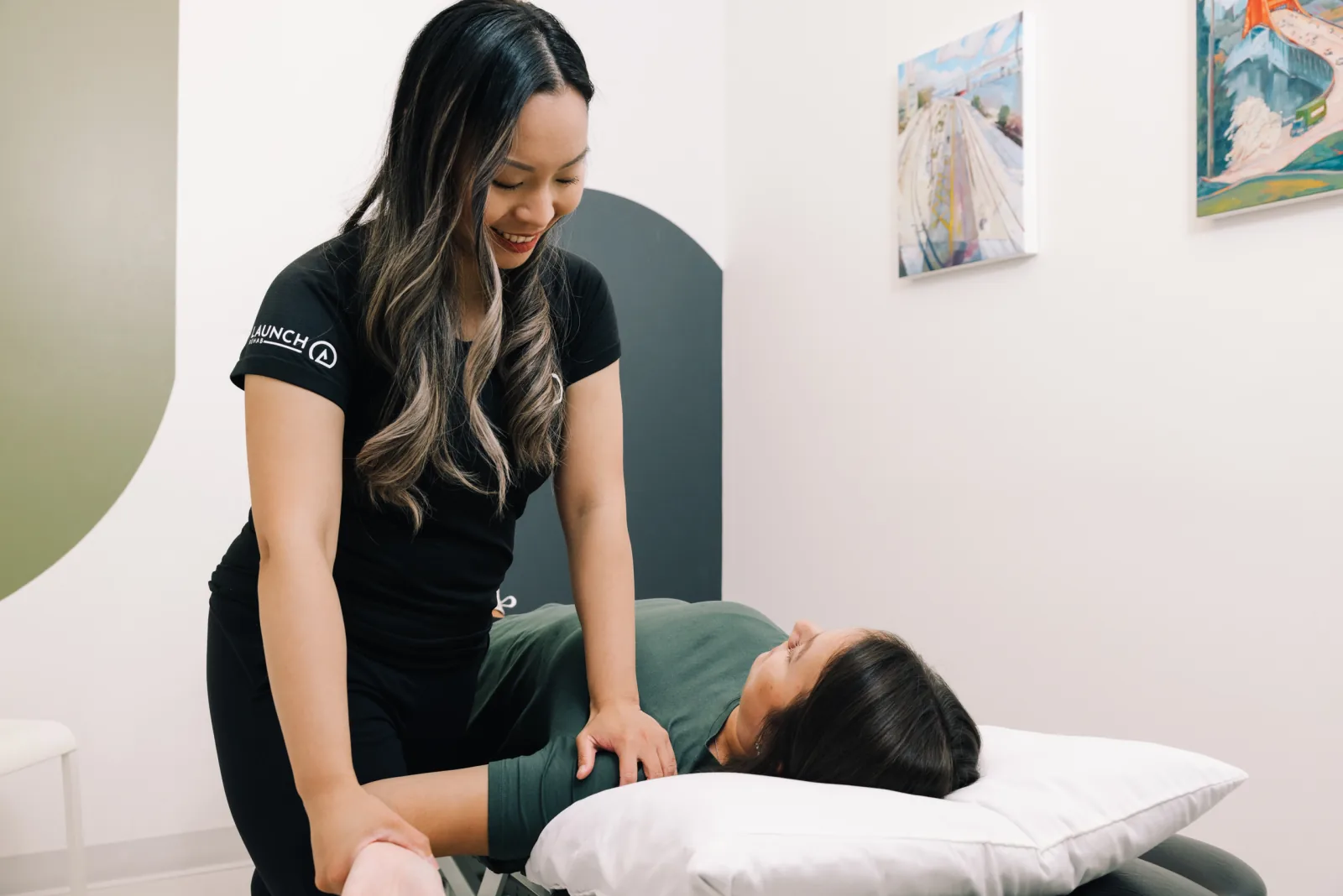
MLD at Launch Rehab is delivered by Arra Younus, a registered massage therapist trained in the Dr. Vodder method who is also a Certified Lymphedema Therapist (CLT). CLT training covers lymphedema management and Combined Decongestive Therapy: the manual work plus compression, bandaging, exercise and self-care education.
For diagnosed lymphedema, treatment starts with your diagnosis and any guidance from your medical team, then a health history and assessment of the limb. From there the plan is individualized: session frequency, which areas are treated, compression needs, and what you do between visits. Sessions run at the Lougheed (Burnaby) and New Westminster studios.
Two honest boundaries. First, diagnosis belongs to your physician; if your swelling has never been assessed, that is the first step, and we can be the second. Second, MLD here is one part of your management, alongside compression and whatever your medical team prescribes. Anyone promising to cure lymphedema with massage alone is overselling.
This page is general information. It does not replace assessment by a regulated practitioner. If a swollen limb becomes hot, red or painful, or swelling appears suddenly with shortness of breath or chest pain, seek urgent medical care rather than booking a massage appointment.
BOOK OR ASK
Book an assessment if
- A physician has diagnosed lymphedema and you need ongoing management
- You had lymph nodes removed or radiated and notice new heaviness or tightness
- One limb has stayed swollen for weeks without a clear injury
- Your compression garment routine needs support between fittings
- You want a home program for a limb at risk of lymphedema
MLD AT LAUNCH REHAB · TWO STUDIOS
Manual lymphatic drainage is delivered by Arra Younus, RMT, trained in the Dr. Vodder method and certified in lymphedema therapy. She treats at both studios below. Not sure MLD is the right booking? Call either studio and describe the swelling. It is a two-minute conversation.
FAQ
Common questions.
No. Lymphedema is a chronic condition, because the underlying lymphatic damage does not regrow. But it is very manageable. Combined Decongestive Therapy, which pairs compression, exercise, skin care and manual lymphatic drainage, reduces swelling and keeps it controlled long term, especially when management starts early.
SOURCES
Where the facts on this page come from.
- Lymphoedema (overview, symptoms, treatment) · NHS (UK National Health Service) · Accessed 27 August 2026
- Lymphedema (side effects of cancer treatment) · Canadian Cancer Society · Accessed 27 August 2026
- Ezzo J, et al. Manual lymphatic drainage for lymphedema following breast cancer treatment (Cochrane Review) · Cochrane Database of Systematic Reviews, via PubMed · Published 2015. Accessed 27 August 2026
- Physiology, Lymphatic System (StatPearls) · NCBI Bookshelf, U.S. National Library of Medicine · Accessed 27 August 2026
KEEP READING
More from the MLD guides.
- Start here
The lymphatic system
What lymph is, why it pools, and why the system needs movement to drain. The plain-language foundation for everything else in this hub.
READ - Swelling and conditions
Swelling after surgery
Post-surgical swelling is expected. MLD can help it settle, but timing and your surgeon's clearance decide when it is safe to start.
READ - Booking, cost and safety
Safety and who should wait
MLD is gentle, but gentle is not the same as harmless. The conditions that rule it out, the ones that need clearance first, and why.
READ
READY?
Book manual lymphatic drainage in Burnaby or New Westminster.
Delivered by a Vodder-trained RMT and Certified Lymphedema Therapist at our Lougheed and New Westminster studios. Not sure MLD fits your situation? Call 604-813-8885 (Lougheed) or 604-519-0777 (New Westminster) and describe the swelling.