
E-BIKE AND COMMUTER FITTING
E-bike and commuter bike fitting.
No warm-up, normal clothes, real traffic. And e-bike riders quietly ride further in a month than they used to in a year.
THE SHORT ANSWER
Do e-bikes and commuter bikes need a bike fit?
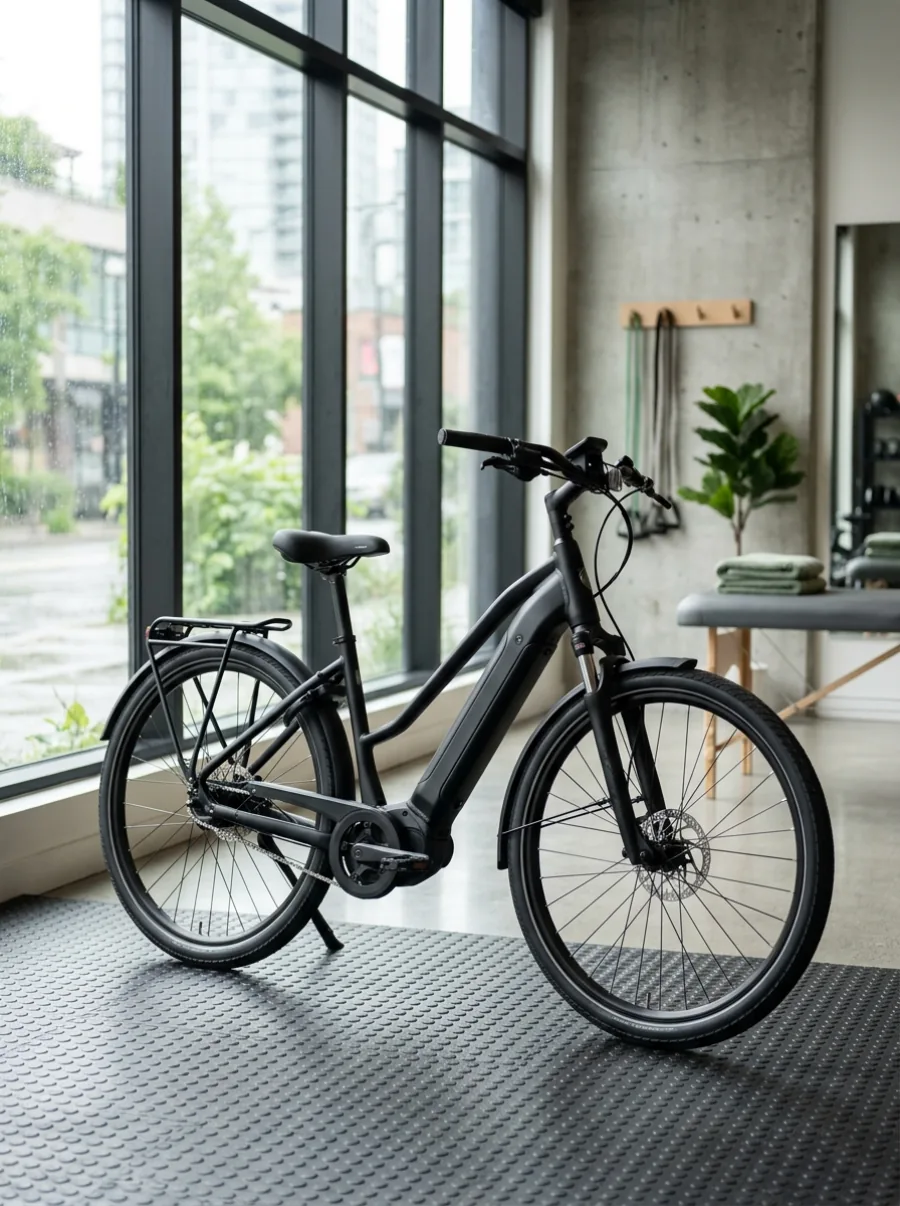
More often than riders expect. Two things make it worth doing. First, a commute has no warm-up: you get on cold, in work clothes, and ride straight into traffic, so the position has to be comfortable immediately and let you see around you properly. Second, e-bike riders typically ride much further and more often than they did before, at higher average speeds, which means the same repetitive loads that give road cyclists knee and back pain now apply to them. The most common e-bike complaints we see are knee pain from a saddle set too low and wrist pain from an upright position that puts weight straight down through the hands.
0
Feet that should reach the ground flat while you sit on the saddle
90min
The initial fit, including the off-bike assessment and the written summary
5mm
How much to raise a saddle at a time
60min
The follow-up, once you have ridden the new position for a few weeks
Commuter and e-bike riders are the group most likely to assume fitting is not for them, and the group whose problems are often easiest to fix. The bikes are set up in a shop for an average person, adjusted once, and then ridden for years.
The saddle-too-low problem is close to universal. Riders set the saddle so they can put both feet flat on the ground at a stop, which feels safe and puts the knee through a deeply bent range on every single pedal stroke. Over a few thousand commuting kilometres that is a reliable way to produce knee pain.
E-bikes add a twist worth naming. The motor removes the effort that used to limit how far people rode. Riders who did 15 kilometres a week now do 80, and every setup error is now being repeated five times as often.
AT A GLANCE
- Most common problem
- Saddle set too low for the knee
- E-bike specific
- Far higher mileage than riders expect
- Where
- New Westminster studio, above the SkyTrain station
- Session length
- 90 minutes for the initial fit
THE BIG ONE
The saddle is almost certainly too low
If you can sit on the saddle and put both feet flat on the ground, your saddle is too low for pedalling. That is not a judgement, it is just geometry: a leg that is comfortable flat-footed at a stop is a leg that never straightens at the bottom of the pedal stroke.
The knee then works through its most compressed range thousands of times per commute, which is exactly the pattern that produces pain at the front of the knee. It is also inefficient, so you work harder for the same speed.
The safe alternative is a saddle at a proper pedalling height, and sliding forward off the saddle to put a foot down at lights. It takes a few days to become automatic and then it is invisible.
Raise it gradually
Five millimetres at a time, over a week or two. A big jump feels alarming and can pull behind the knee.
Slide forward to stop
Come off the front of the saddle and put one foot down. This is what everyone on a road bike does and it is completely stable.
If it feels too high, it may be
Hips rocking side to side or pain behind the knee mean you have gone past. Come back down a few millimetres.
Step-through frames still apply
A low top tube is about getting on the bike, not about saddle height. You can still have a proper pedalling height.
THE UPRIGHT POSITION
Why upright is not automatically comfortable
Commuter bikes are usually sold on being upright, and upright genuinely helps you see traffic and be seen. It has trade-offs worth knowing about.
Bolt upright means all your weight goes straight down through the saddle and the spine, with no support from your arms and no ability to absorb bumps through your hips. On a rough road that is a lot of jolting straight into the low back. It also puts your wrists at a sharp angle if the bars are high and close, which is a common source of commuter wrist and hand pain.
A slight forward lean, enough that your arms carry a little weight and your hips can absorb bumps, is more comfortable for most riders than fully vertical.
A slight forward lean
Enough that the arms take a small share and the hips can act as suspension over bumps.
Grip angle
Flat bars with the wrist bent sharply back are a common cause of commuter hand numbness. Ergonomic grips or a swept bar help.
Bar height and reach
High and close is not automatically right. Too close cramps the shoulders and pushes weight onto the wrists.
Tyre pressure
On an upright bike your body cannot absorb much, so the tyres have to. Most commuters run pressures far too high for comfort.
E-BIKE SPECIFIC
What changes when there is a motor
E-bikes are genuinely good for people. They get riders out who would otherwise not ride, they flatten the hills that put people off, and they turn a car trip into a bike trip. We see the flip side in clinic, which is a specific and predictable set of complaints.
The pattern is almost always volume. A rider who used to ride occasionally now rides daily, further, at higher average speeds. Nothing about their setup has changed. What has changed is that it is now being repeated many times more often.
Much higher mileage
The most important factor. Any position error is now repeated far more, which is why overuse problems appear.
Higher average speed
More time at speed means more wind resistance and more weight going onto the hands in an upright position.
Heavier bikes
E-bikes are heavy. Lifting them onto racks, up steps or onto transit is a back and shoulder issue in its own right.
Cadence habits
Many e-bike riders pedal slowly in a heavy gear and let the motor do the rest. Low cadence with force is the pattern the front of the knee likes least.
Longer time in one position
A 15-minute ride tolerates a lot. An hour on the same bike does not.
PRACTICAL
Fitting for a real commute
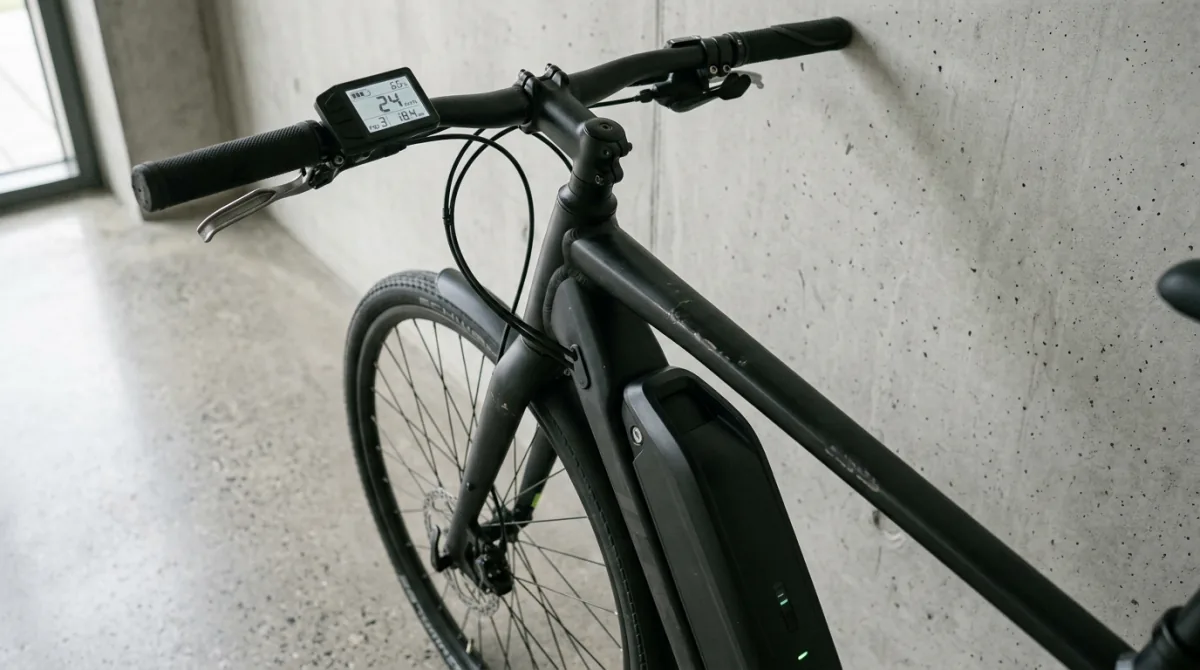
A commute is not a training ride and the fit should reflect that. You are riding in whatever you wear to work, without a warm-up, in traffic, often with a load on the bike or your back.
That means the position has to be comfortable from the first pedal stroke, has to let you turn your head properly to check traffic, and has to work when you are carrying things.
Comfortable cold
No warm-up means the position must be within easy range immediately, not something you ease into over 20 minutes.
You have to see behind you
A position that makes shoulder checks awkward is a safety problem, not just a comfort one.
Get the load off your back
A backpack puts all its weight through your shoulders and low back. Panniers put it on the bike. This is one of the highest-value changes a commuter can make.
Clothes you actually wear
If you commute in work trousers or a skirt, the position has to work in them. Tell us and we will fit for it.
Both directions
If your ride home is uphill, the position has to work for climbing too, not just the easy direction.
GETTING HERE
Bringing a commuter or e-bike to New Westminster
Our studio sits inside Shops at New West, directly above New Westminster SkyTrain station, with elevator access from the platform. For a commuter that is about as convenient as it gets, and many clients ride in, get fitted, and ride straight to work afterwards.
E-bikes are heavy, so if you are travelling by transit it is worth checking TransLink's current rules on bikes at peak hours before you set out. If you are driving, Carnarvon Street parking and the mall parkade are both a short distance away.
ENQUIRE IN NEW WESTMINSTER
Book a fit if
- You can put both feet flat on the ground while sitting on the saddle
- Your knees ache after commuting
- Your hands or wrists go numb on the way to work
- You have started riding much further since getting an e-bike
- Your low back is sore after riding on rough roads
- Your bike was set up once in a shop and never adjusted since
LAUNCH REHAB NEW WESTMINSTER
Bike fitting runs from our New Westminster studio, by appointment. Tell us what happens on the bike and we will tell you whether you need a fit, a physiotherapy assessment, or both. It is a two-minute conversation and it saves booking the wrong thing.
- Address
- 219-800 Carnarvon St, New Westminster, BC V3M 0G3
- Getting here
- Inside Shops at New West, above New Westminster SkyTrain station
Bike fitting is by appointment only and books out during the spring and summer riding season. Enquire early if you have an event coming up. About the New Westminster studio.
FAQ
Common questions.
It depends on frequency more than distance. Ten times a week for years adds up to a lot of repetitions, and commuters are the group most likely to be riding a bike that was set up once and never revisited. If nothing hurts, you may not need one. If your knees or wrists complain after riding, the setup is usually the reason and it is usually fixable.
KEEP READING
More from the bike fitting guides.
- Pain and symptoms
Knee pain
Front, back, inside or outside. Where the pain sits narrows down which part of the setup is doing it.
READ - Pain and symptoms
Numb hands
Which fingers go numb tells us where the pressure is landing, and that points straight at the fix.
READ - How a fit works
Saddle height
The most influential number on the bike, and the one most riders have wrong by more than they think.
READ
FROM THE JOURNAL
Related reading from our clinicians.
READY?
Book your bike fit in New Westminster.
By appointment at 219-800 Carnarvon St, New Westminster, BC V3M 0G3. Not sure which appointment you need? Call 604-519-0777 and describe what happens on the bike.