
BFR GUIDE · THE BASICS
How blood flow restriction training builds muscle with light weights.
A cuff on the upper arm or thigh, a weight you could normally lift thirty times with ease, and your muscle responds as if you had lifted heavy. Here is why.
THE SHORT ANSWER
What does blood flow restriction training actually do?
Blood flow restriction (BFR) training uses a pneumatic cuff, inflated to a pressure set for your limb, to reduce blood flow into a working arm or leg and limit blood flow out of it. You then lift a light weight, 20 to 40 percent of your one-repetition maximum, for many repetitions. The muscle runs low on oxygen quickly, tires early, and signals for growth much as it would under a heavy load. That is why BFR is used when heavy lifting is painful, unsafe or not yet allowed.
If a physiotherapist has suggested blood flow restriction for your knee, your shoulder or your recovery after surgery, the idea can sound backwards. Squeezing a limb and then exercising it does not seem like a way to get stronger. It is, and the mechanism is well enough understood to explain in a few minutes.
This guide covers what the cuff does, what happens inside the muscle while it is on, and where the standard numbers come from. Everything here traces to the 2019 international position stand on BFR exercise or to the review papers listed at the foot of the page. Once you see the logic, the rest of this hub, from ACL rehab to safety screening, makes sense.
AT A GLANCE
- The tool
- A wide pneumatic cuff at the top of the arm or thigh
- The load
- 20 to 40 percent of your one-repetition maximum
- The pressure
- 40 to 80 percent of the pressure that would fully block arterial flow
- The volume
- 75 repetitions across four sets: 30, then 15, 15 and 15
- The result
- Muscle growth similar to heavy training, at far lower joint load
THE STARTING POINT
Muscle was thought to need heavy loads to grow
For decades, strength science taught a simple rule: to build muscle you had to lift heavy. The 2015 review by Pearson and Hussain in Sports Medicine describes the traditional belief that resistance training only produces muscle growth when the load is above 65 percent of your one-repetition maximum (1RM). Your 1RM is the heaviest weight you can lift once with good form. Anything lighter was for endurance, not size or strength.
That rule is a problem for a lot of the people we see. A knee six weeks out from ACL reconstruction cannot take a heavy squat. An arthritic knee hurts at heavy loads. A tendon in the middle of a flare protests. An older adult recovering from a fall is nowhere near a heavy leg press. Under the old rule, all of those people had to wait for strength work until they could tolerate heavy weight, and they lost muscle while they waited.
The same review notes that low-intensity exercise under blood flow restriction has, as its authors put it, consistently produced muscle growth at loads under 50 percent of 1RM. That finding is the reason BFR moved from Japanese training rooms into physiotherapy clinics. It offers a way to send the growth signal without the load.
THE CUFF
The cuff reduces blood flow in and traps blood in the muscle
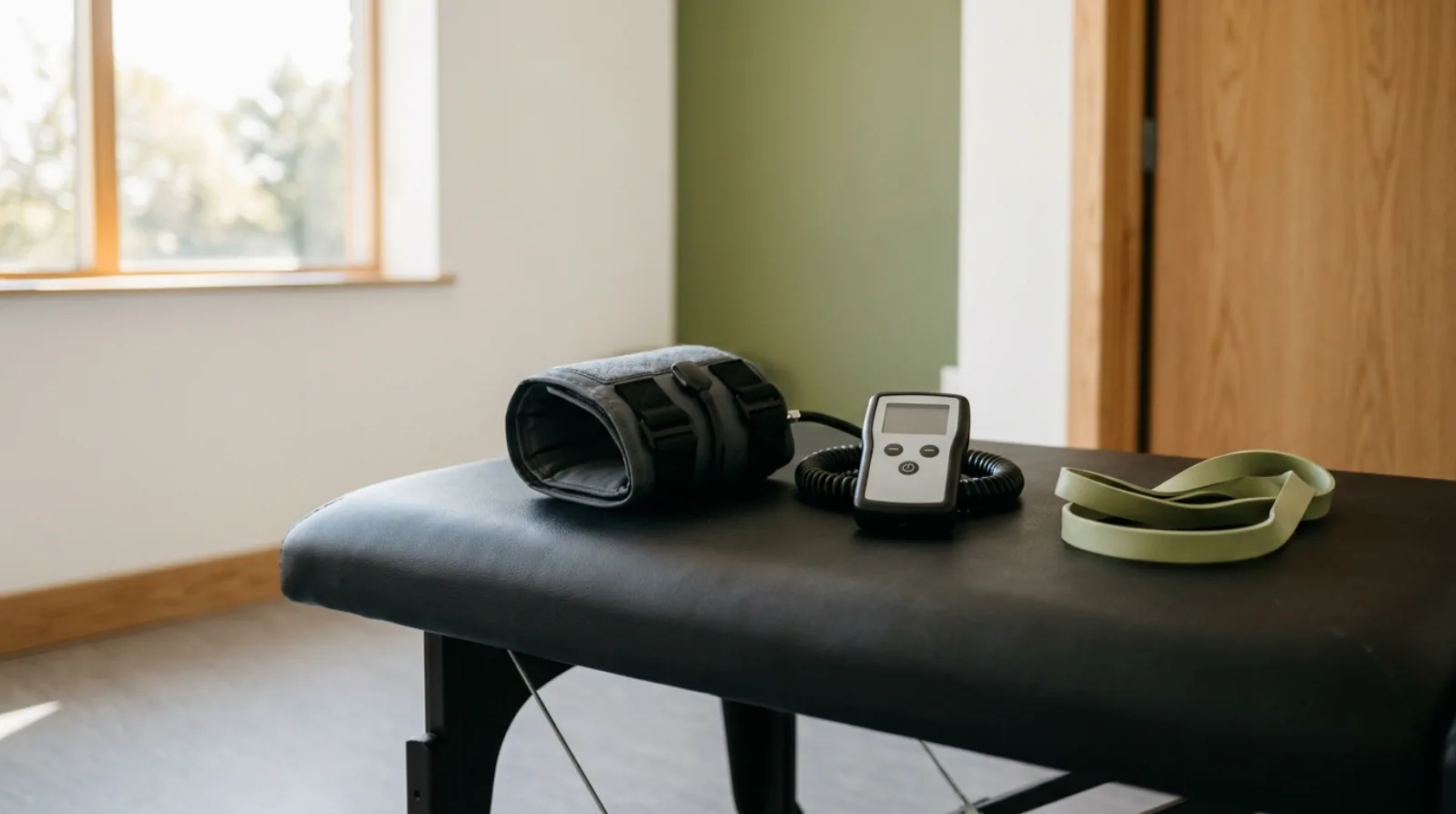
The cuff sits at the top of the limb, above the muscles you are working. It is inflated to a pressure that partly restricts the arteries bringing blood in, and more fully restricts the veins carrying blood out. Fresh, oxygen-rich blood still reaches the muscle, but less of it. Used blood, carrying the by-products of muscle work, cannot leave as freely. The limb below the cuff fills, and the working muscle becomes a low-oxygen environment quickly.
The pressure is the part most people worry about, and it is the part that has been standardised. The 2019 position stand, written by fourteen researchers from the field and published in Frontiers in Physiology, recommends setting the pressure at 40 to 80 percent of your arterial occlusion pressure (AOP). AOP is the pressure at which blood flow into that limb would stop completely, and it is measured on you, on the day, with a Doppler probe or the cuff's own sensor. Your physiotherapist then inflates to a fraction of that number.
Setting pressure this way matters because limbs differ. A large thigh needs a higher absolute pressure than a slim arm to reach the same restriction. The position stand notes that a wide range of cuff widths can be used as long as the pressure is set from AOP, and that wider cuffs reach the target restriction at lower absolute pressures. A fixed number applied to everyone would over-restrict some people and under-restrict others.
THE MECHANISM
Low oxygen makes a light weight feel heavy to the muscle
Muscle fibres come in two broad types. Slow fibres run on oxygen and handle light, long work. Fast fibres produce more force, tire faster, and are the ones that grow most in response to training. Under normal conditions, a light weight is handled by the slow fibres and the fast fibres are never asked to work. That is why light training alone does little for muscle size.
Under the cuff, the slow fibres run short of oxygen within the first set and start to fail. The nervous system has no choice but to recruit the fast fibres to keep the movement going, even though the weight is light. Pearson and Hussain list this increased fast-twitch fibre recruitment as one of the main proposed mechanisms, alongside the build-up of metabolic by-products in the trapped blood, swelling of the muscle cells, and hormone and signalling responses to that stress.
The review is careful to say the exact contribution of each mechanism is still being worked out. What is settled is the outcome: the pattern of fatigue and signalling under BFR looks more like heavy training than like light training, and the growth that follows does too. The next guide in this hub puts numbers on how close that comparison gets.
THE NUMBERS
Where the standard protocol comes from
Because BFR grew up in research labs before it reached clinics, the protocol is unusually well defined. The 2019 position stand sets out the values below for resistance exercise with BFR. Your physiotherapist adapts them to your injury, your stage of recovery and how you respond, but this is the shape of a standard session.
Load: 20 to 40 percent of 1RM
A weight you could lift thirty or more times without the cuff. Heavier than this and the cuff adds little; lighter and the growth signal fades.
Pressure: 40 to 80 percent of AOP
Measured on your limb that day. The lower end is used more often for the arms and for people newer to BFR.
Volume: 75 repetitions in four sets
30 repetitions, then 15, 15 and 15. The first set is long on purpose: it is what empties the oxygen from the muscle.
Rest: 30 to 60 seconds between sets
The cuff usually stays inflated through the rest. Deflating between sets reduces the metabolic build-up the method depends on.
Frequency: 2 to 3 sessions a week
In clinical settings the position stand also describes 1 to 2 sessions a day for a short block of 1 to 3 weeks, for example straight after surgery.
Time under the cuff
Short. A full four-set exercise takes a few minutes, and the cuff comes off between exercises. It is never left inflated for a long, continuous period.
BEYOND WEIGHTS
The cuff also works with walking and cycling
BFR is usually paired with resistance exercise, but the same position stand describes a second use: low-intensity walking or cycling with the cuffs on. The guidance is exercise below 50 percent of your maximal aerobic capacity, or below 50 percent of your heart rate reserve, with the cuffs inflated for 5 to 20 minutes per bout.
This version is useful for people who cannot manage even light resistance work yet, and for older adults. The 2019 meta-analysis by Centner and colleagues in Sports Medicine, covering 11 studies and 238 older participants, found that adding BFR to walking produced larger strength gains than walking alone, with a pooled effect size of 3.09, and larger muscle mass gains too. Numbers that large in a meta-analysis usually reflect small studies, and the authors call for more research, but the direction is consistent.
In our clinic, walking BFR is a tool for the earliest phase of a recovery, when the goal is to slow muscle loss rather than to build. Once you can tolerate light resistance exercise, that becomes the main event.
This page is general information. It does not replace assessment by a regulated practitioner. Blood flow restriction is applied and supervised by a physiotherapist after a health screen. Do not buy a cuff and copy a protocol from this page. If a limb becomes swollen, hot, red or painful, or you have chest pain or shortness of breath, seek urgent medical care.
WHY SUPERVISED
Why the pressure is measured, not guessed
The cuffs sold online are often elastic straps with no pressure gauge and no way to measure AOP. The position stand links two of the common side effects, numbness and disproportionate soreness, to practitioners applying pressures that fall outside the research guidelines. A strap pulled tight by feel is exactly that.
A 2024 survey of 397 allied health practitioners, published in the Journal of Strength and Conditioning Research, found that 81.1 percent of those using BFR set the pressure relative to arterial occlusion pressure, and 68.2 percent screen for contraindications before applying it. Those are the two habits that separate a clinical application from a gym experiment.
At Launch Rehab, BFR is delivered inside a physiotherapy appointment at our New Westminster studio, by a registered physiotherapist who measures your AOP, sets the pressure from it, chooses the load, and watches how you respond set by set. The rest of this hub covers where the research supports it, what a session looks like, and who needs a closer screen first.
BOOK OR ASK
Worth asking about BFR if
- You are recovering from knee surgery and cannot load the leg heavily yet
- An arthritic knee or hip hurts too much for heavy strength work
- A tendon flares every time you try to progress the load
- You have lost muscle during a period of injury or immobilisation
- You want to keep strength while a painful joint settles
BFR AT LAUNCH REHAB · NEW WESTMINSTER ONLY
Blood flow restriction is used inside a physiotherapy visit at our New Westminster studio, by Alex Carrod, registered physiotherapist. Book a physiotherapy initial assessment and mention BFR, or call the studio and describe the injury. There is no separate BFR appointment type and no separate BFR fee.
New Westminster
219-800 Carnarvon St, New Westminster, BC V3M 0G3
Inside Shops at New West, above New Westminster SkyTrain station
About this studioFAQ
Common questions.
No. Blood flow restriction training uses partial restriction. The 2019 position stand recommends inflating the cuff to 40 to 80 percent of the pressure that would fully block arterial flow into the limb. Blood still reaches the muscle, in a reduced amount, and the cuff comes off between exercises.
SOURCES
Where the facts on this page come from.
- Patterson SD, et al. Blood Flow Restriction Exercise: Considerations of Methodology, Application, and Safety · Frontiers in Physiology, 2019;10:533 · Published 15 May 2019. Accessed 22 September 2026
- Pearson SJ, Hussain SR. A review on the mechanisms of blood-flow restriction resistance training-induced muscle hypertrophy · Sports Medicine, 2015;45(2):187-200, via PubMed · Published February 2015. Accessed 22 September 2026
- Centner C, et al. Effects of Blood Flow Restriction Training on Muscular Strength and Hypertrophy in Older Individuals: A Systematic Review and Meta-Analysis · Sports Medicine, 2019;49(1):95-108, via PubMed · Published January 2019. Accessed 22 September 2026
- Scott BR, et al. Current Implementation and Barriers to Using Blood Flow Restriction Training: Insights From a Survey of Allied Health Practitioners · Journal of Strength and Conditioning Research, 2024;38(3):481-490, via PubMed · Published March 2024. Accessed 22 September 2026
- Takarada Y, et al. Applications of vascular occlusion diminish disuse atrophy of knee extensor muscles · Medicine and Science in Sports and Exercise, 2000;32(12):2035-2039, via PubMed · Published December 2000. Accessed 22 September 2026
KEEP READING
More from the BFR guides.
- Start here
BFR vs heavy lifting
Heavy training still wins for pure strength. BFR matches it for muscle size at a fraction of the joint load. When each one is the right call.
READ - Booking, cost and safety
Your first BFR session
The screen, the pressure measurement, the first set of thirty, and what your leg feels like afterwards. What to expect, step by step.
READ - Booking, cost and safety
Safety and who should not do BFR
The side effects with their measured rates, the clot question answered from the data, and the conditions that rule the cuff out or call for a closer screen.
READ
FROM THE JOURNAL
Related reading from our clinicians.
READY?
Book blood flow restriction physiotherapy in New Westminster.
Applied by a registered physiotherapist inside a physiotherapy visit at our New Westminster studio, after a health screen. Not sure BFR fits your injury? Call 604-519-0777 and describe what heavy loading does to the joint.