
BFR GUIDE · SAFETY
Is blood flow restriction safe? Side effects, clot risk, and who should not do it.
Restricting blood flow on purpose sounds risky. The measured rates say it is safe in screened people. This page gives the numbers and the screen.
THE SHORT ANSWER
Is blood flow restriction training safe?
In screened people, under a physiotherapist, with pressure set from arterial occlusion pressure, the measured rates of serious harm are low. A 2006 Japanese survey of 12,642 people reported venous thrombosis in 0.055 percent and pulmonary embolism in 0.008 percent. A 2020 systematic review of 19 clinical studies found people doing BFR were no more likely to have an adverse event than people doing exercise alone. Bruising under the cuff, in 13.1 percent, and short-lived soreness are the common effects. Certain clot, heart, vascular and infection conditions rule the cuff out or need clearance first.
The reasonable worry about BFR is the blood clot. Slowing blood flow in a limb is one of the things that can cause a deep vein thrombosis, and here is a method that does it on purpose. This page takes that worry seriously and answers it from the data rather than reassurance: the largest survey, the pooled clinical trials, and the blood tests researchers have run to look for clotting changes.
It then covers the common side effects with their measured rates, the conditions that rule BFR out for now, the conditions that call for a closer screen or a physician's clearance, and the warning signs that mean stop. This is the screen your physiotherapist runs before the cuff goes on, so you can see the reasoning behind each question.
AT A GLANCE
- Largest survey
- 12,642 people, 105 facilities, Japan, 2006
- Venous thrombosis
- 0.055 percent in that survey; pulmonary embolism 0.008 percent
- Clinical trials
- 19 studies, 322 people: no higher adverse event rate than exercise alone
- Common effects
- Bruising under the cuff 13.1 percent; numbness 1.297 percent; soreness
- Rule-outs
- Untreated or recent clot, active limb infection, certain heart and vessel conditions
THE BIG QUESTION
Does the cuff cause blood clots? What the data says
The largest safety dataset is a 2006 national survey by Nakajima and colleagues in Japan, published in the International Journal of KAATSU Training Research, covering 105 of the 195 facilities then using the method and 12,642 people trained. Venous thrombus was reported in 0.055 percent, pulmonary embolism in 0.008 percent, and rhabdomyolysis, a breakdown of muscle tissue, in 0.008 percent. Worsening of ischemic heart disease was reported in 0.016 percent.
The 2019 position stand reviewed the clot question directly. Its authors report that the totality of the literature shows minimal adverse events relating to venous thromboembolism, that acute studies have not shown a rise in D-dimer, a blood marker of clot formation, after BFR exercise, and that studies running 4 to 12 weeks likewise showed no rise in clotting markers. They also note that BFR exercise increases tissue plasminogen activator, a protein the body uses to break clots down.
The 2020 systematic review by Minniti and colleagues in the American Journal of Sports Medicine pooled 19 studies in people with musculoskeletal conditions, 322 people in total. Nine studies reported no adverse events. Three reported rare events, including one deep vein thrombosis in an arm and one case of rhabdomyolysis. In the randomised trials, people doing BFR were no more likely to have an adverse event than people doing exercise alone: rare events occurred in 3 of 168 BFR participants and 0 of 154 controls, and any adverse event in 10 of 168 and 4 of 154.
READING THE NUMBERS
Low is not zero, and the screen is why it stays low
Those rates are low, and they are not zero. Seven people in the Japanese survey had a venous thrombus. One person in the pooled trials had a deep vein thrombosis. The authors of the Minniti review say plainly that more research is needed to work out who is at risk of the rare events, and that BFR appears safe for knee-related conditions while other conditions need more data.
The rates also come from screened populations. The people in the trials passed a health screen first, and the 2024 practitioner survey found 68.2 percent of clinicians using BFR screen for contraindications before applying it. The safety record is a record of BFR done properly: screened people, measured pressure, supervised sessions. It says nothing about a strap pulled tight at home.
So the honest summary is this. In a screened person, with pressure set from arterial occlusion pressure and a physiotherapist watching, the serious risks of BFR are rare and the pooled trials show no excess over ordinary exercise. The screen below is how the risk stays that low, and the conditions on it are exactly the ones that raise clot, heart and vascular risk on their own.
COMMON EFFECTS
The side effects you are likely to notice
The common effects of BFR are the ones you would guess from a tight cuff and a hard set. In the Japanese survey the most frequent was subcutaneous haemorrhage, bruising under the cuff, at 13.1 percent, followed by numbness at 1.297 percent, cerebral anaemia, which means feeling faint, at 0.277 percent, and a cold feeling in the limb at 0.127 percent. Fainting and low blood sugar were reported in rare cases.
The position stand adds the effects seen in the research trials. Muscle swelling is consistently raised straight after a session and back to baseline by 24 to 48 hours. Muscle soreness in the days after is consistently raised above baseline and returns to baseline quickly. The authors link the numbness reported in some settings to practitioners applying pressures that fell outside the research guidelines, which is one reason pressure is measured rather than guessed.
Bruising under the cuff: 13.1 percent
Marks where the cuff sat. Fades over days. More likely on blood thinners, which the screen asks about.
Numbness or pins and needles: 1.297 percent
Not an expected sensation. Report it at once; the pressure is lowered or the cuff removed.
Feeling faint: 0.277 percent
Usually on standing after a hard set. Sit, let it pass, and say so. Persistent faintness is a stop sign.
Muscle soreness and swelling
Expected for a day or two. Swelling back to baseline within 24 to 48 hours per the position stand.
THE SCREEN
Conditions that rule BFR out, and conditions that need a closer look
The position stand does not publish a fixed contraindication list, and says the decision rests with the clinician. It does identify the risk factors that matter most: the conditions associated with venous thromboembolism in general, including a prior deep vein thrombosis or pulmonary embolism, major surgery, immobility and cancer. Clinical screens build on those. Below is the shape of ours. It is a screen, and every item on it starts a conversation rather than a verdict.
BFR is not applied while
You have an untreated or recently diagnosed deep vein thrombosis or pulmonary embolism; an active infection, open wound or cellulitis in the limb; an unstable heart condition; or a condition your physician has said rules out restricted blood flow.
A closer screen or physician clearance first
A history of blood clots or a known clotting disorder; anticoagulant medication; blood pressure that is not well controlled; peripheral vascular disease or varicose veins in the limb; cancer under treatment; pregnancy; sickle cell disease; recent major surgery with restricted mobility.
Also raised at the screen
Diabetes with nerve or circulation changes; lymphedema or a history of lymph node removal in the limb; a vascular access such as a fistula; nerve injury in the limb; and any medication that affects bleeding or clotting.
Re-checked at every visit
A new medication, a surgical date, a new symptom in the limb, a pregnancy or a change in blood pressure can move you between these groups. The screen is repeated each session, not filed once.
This page is general information. It does not replace assessment by a regulated practitioner. Blood flow restriction is applied and supervised by a physiotherapist after a health screen. Do not buy a cuff and copy a protocol from this page. If a limb becomes swollen, hot, red or painful, or you have chest pain or shortness of breath, seek urgent medical care.
WHEN TO STOP
Warning signs during and after a session
During a session, stop signs are numbness, pins and needles, or a cold or pale hand or foot below the cuff; chest pain or shortness of breath; faintness that does not pass with the cuff released; and limb pain that feels different from muscle burn. Your physiotherapist releases the cuff, assesses, and decides whether to continue at a lower pressure or end the BFR portion.
After a session, the signs that need same-day attention are the signs of a clot or an infection: a calf or limb that is swollen, warm, red or tender in one area and stays that way, especially with pain that worsens rather than settles; and chest pain, shortness of breath or coughing blood, which are a 911 call. Our post on DVT precautions after joint replacement, linked below, covers these signs in detail for the post-surgical period, when the baseline risk is highest.
Ordinary muscle soreness, a limb that feels heavy for the evening, and marks or bruising where the cuff sat are expected and settle. If you are unsure whether what you feel is expected, call the studio and describe it. Bringing a question to us is always the right call.
IN THE CLINIC
What a safe application looks like at Launch Rehab
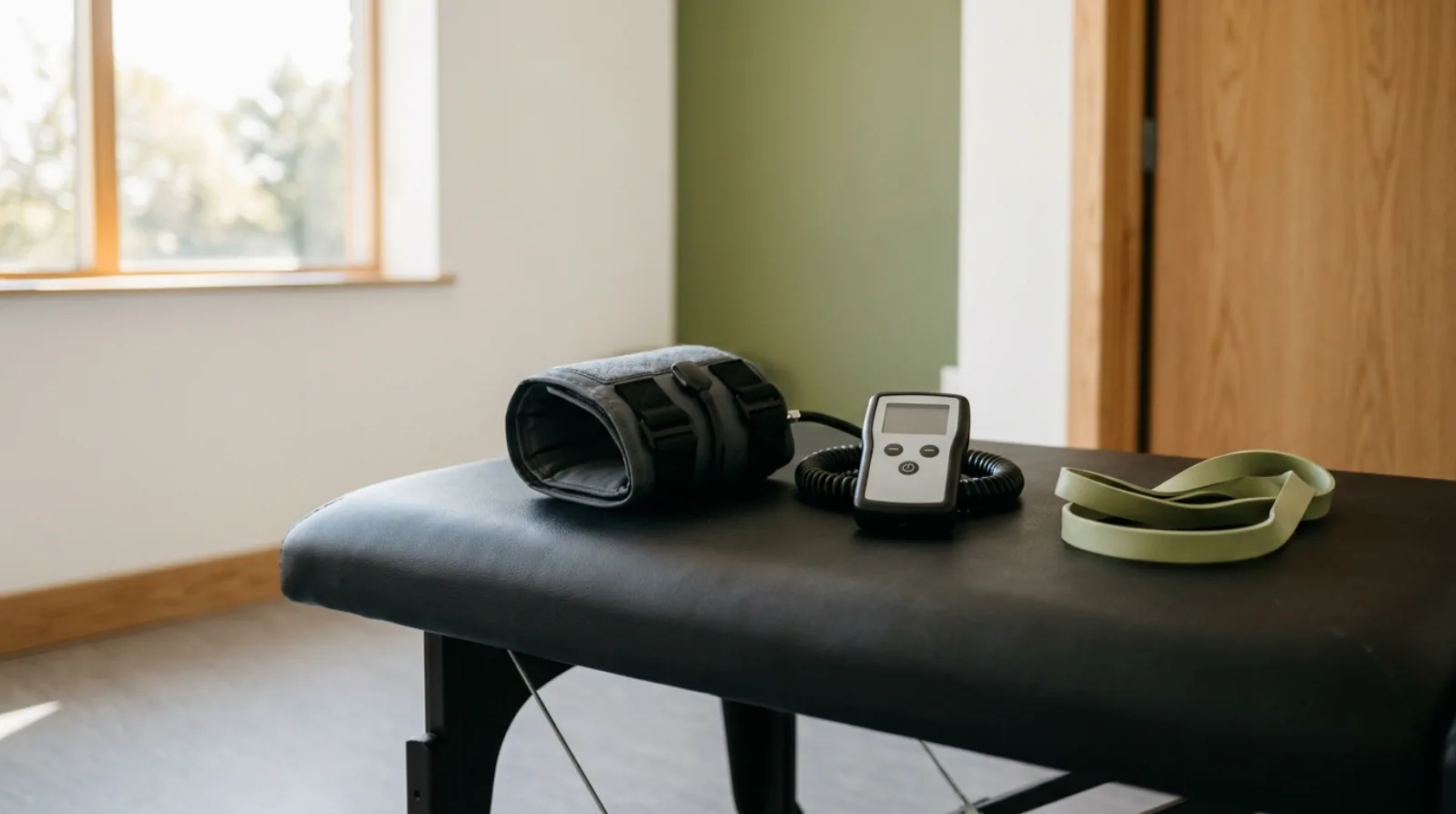
BFR at Launch Rehab is applied by a registered physiotherapist, regulated by the College of Health and Care Professionals of BC, inside a physiotherapy visit at the New Westminster studio. The screen above runs before the first application and is re-checked at each visit. The cuff is a pneumatic system, the pressure is set as a percentage of your measured arterial occlusion pressure, and the cuff is released between exercises.
The 2024 survey of allied health practitioners found that safety concerns were a barrier to using BFR for 31.8 percent of those who had not adopted it, and that the practitioners using it mostly followed the guidelines: 81.1 percent set pressure relative to arterial occlusion pressure. Following the guidelines is what the safety record rests on, and it is how we apply it.
If anything in your history sits on the screen, expect a conversation and possibly a note to your physician before the cuff is used. That is the method working as intended. The rest of this hub covers what the cuff does, where the evidence supports it, and what a session looks like once the screen is clear.
BOOK OR ASK
Tell your physiotherapist before BFR if you have
- Any history of a blood clot, or a family history of clotting disorders
- Blood thinners or any medication that affects clotting
- A heart or blood vessel condition, or blood pressure that is not controlled
- Surgery, a hospital stay or a period of immobility in the last few months
- Pregnancy, cancer treatment, or an infection or wound in the limb
BFR AT LAUNCH REHAB · NEW WESTMINSTER ONLY
Blood flow restriction is used inside a physiotherapy visit at our New Westminster studio, by Alex Carrod, registered physiotherapist. Book a physiotherapy initial assessment and mention BFR, or call the studio and describe the injury. There is no separate BFR appointment type and no separate BFR fee.
New Westminster
219-800 Carnarvon St, New Westminster, BC V3M 0G3
Inside Shops at New West, above New Westminster SkyTrain station
About this studioFAQ
Common questions.
Rarely, in the data. The 2006 Japanese survey of 12,642 people reported venous thrombosis in 0.055 percent. The 2020 Minniti review found one deep vein thrombosis among 168 BFR participants in 19 clinical studies, and no excess of adverse events over exercise alone. The screen exists to keep people with raised clot risk from having the cuff applied without a closer look.
SOURCES
Where the facts on this page come from.
- Nakajima T, et al. Use and safety of KAATSU training: Results of a national survey · International Journal of KAATSU Training Research, 2006;2:5-13, via J-STAGE · Published 2006. Accessed 22 September 2026
- Minniti MC, et al. The Safety of Blood Flow Restriction Training as a Therapeutic Intervention for Patients With Musculoskeletal Disorders: A Systematic Review · American Journal of Sports Medicine, 2020;48(7):1773-1785, via PubMed · Published June 2020. Accessed 22 September 2026
- Patterson SD, et al. Blood Flow Restriction Exercise: Considerations of Methodology, Application, and Safety · Frontiers in Physiology, 2019;10:533 · Published 15 May 2019. Accessed 22 September 2026
- Scott BR, et al. Current Implementation and Barriers to Using Blood Flow Restriction Training: Insights From a Survey of Allied Health Practitioners · Journal of Strength and Conditioning Research, 2024;38(3):481-490, via PubMed · Published March 2024. Accessed 22 September 2026
- Lin Q, et al. Effects of Low-Load Blood Flow Restriction Training on Muscle Volume After Anterior Cruciate Ligament Reconstruction: A Systematic Review and Meta-analysis · Orthopaedic Journal of Sports Medicine, 2024;12(12), via PubMed · Published December 2024. Accessed 22 September 2026
- College of Health and Care Professionals of BC (physiotherapist regulator) · CHCPBC · Accessed 22 September 2026
KEEP READING
More from the BFR guides.
- Booking, cost and safety
Your first BFR session
The screen, the pressure measurement, the first set of thirty, and what your leg feels like afterwards. What to expect, step by step.
READ - Start here
How BFR works
A cuff, a light weight, and a lot of repetitions. Why muscle grows under partial blood flow restriction, in plain language.
READ - Knees, surgery and tendons
BFR after ACL surgery
The strongest evidence for BFR is in the weeks after ACL reconstruction, when the quad shrinks fast and the surgeon restricts heavy loading.
READ
FROM THE JOURNAL
Related reading from our clinicians.
READY?
Book blood flow restriction physiotherapy in New Westminster.
Applied by a registered physiotherapist inside a physiotherapy visit at our New Westminster studio, after a health screen. Not sure BFR fits your injury? Call 604-519-0777 and describe what heavy loading does to the joint.