Shockwave Therapy for Achilles Tendinopathy: What the Evidence Says
Shockwave gets recommended for stubborn Achilles pain, but the newest, largest reviews do not agree with the older ones. Here is what shockwave actually does, what the current evidence supports, and where it fits if your Achilles has stalled on loading alone.
BY THE LAUNCH REHAB TEAM
If your Achilles has been sore for months and a loading program has not finished the job, shockwave therapy is probably one of the options someone has floated. The honest answer on how well it works has shifted recently, and it is worth knowing before you book a course.
What shockwave therapy for Achilles tendinopathy actually is
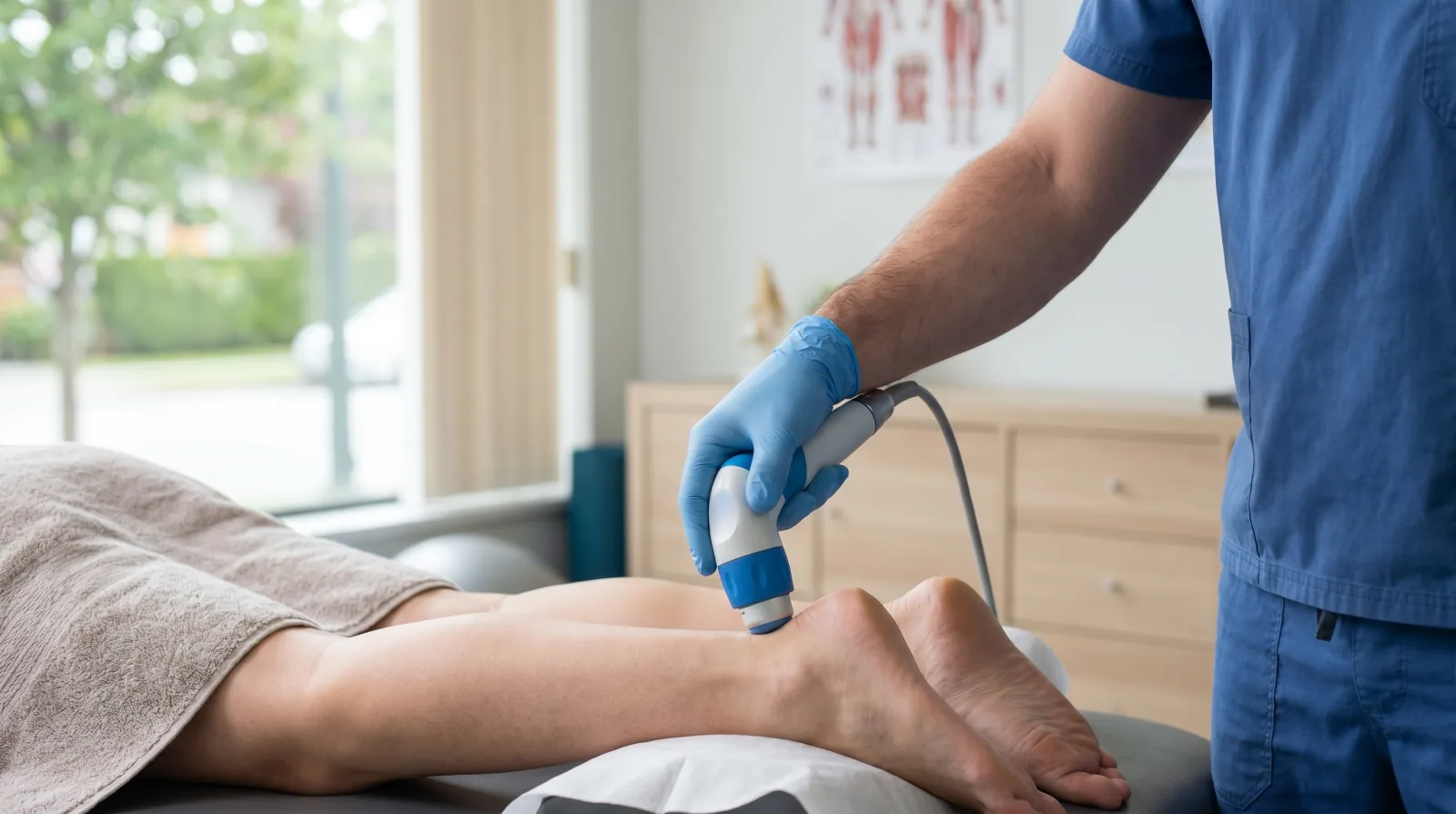
Shockwave therapy delivers acoustic pressure waves into the tendon through a handheld applicator pressed against the skin over the sore area. At Launch Rehab, shockwave therapy is delivered by physiotherapists and chiropractors as part of an integrated treatment plan, not as a stand alone walk in service. Physiotherapists are regulated by the College of Health and Care Professionals of BC (CHCPBC), and chiropractors by the College of Complementary Health Professionals of BC (CCHPBC). The same clinician who confirms your tendinopathy diagnosis also delivers the shockwave sessions and prescribes the loading program around them.
The mechanical stimulus appears to trigger a low grade inflammatory response and increase local blood flow in the treated tissue. That is the proposed mechanism for restarting a tendon that has stalled in a degenerative state rather than an actively inflamed one, and it holds up reasonably well at the tissue level. Whether it turns into a meaningfully better outcome for Achilles pain is a separate question. The evidence on that has shifted, and shifted recently.
What the older evidence found
Through the 2010s and early 2020s, several reviews reported real benefit. A 2020 meta-analysis in the Journal of Foot and Ankle Surgery pooled 8 studies and 442 patients with midportion Achilles tendinopathy and found shockwave produced lower pain scores than comparison treatments, with a mean difference on the visual analog pain scale of negative 2.14 points, and the benefit held at both short term and long term follow up.
A 2022 systematic review of 7 randomized trials split the picture by location on the tendon. For midportion Achilles tendinopathy, adding shockwave to a tendon loading program produced a clinically meaningful improvement on the VISA-A function questionnaire, a gain of just over 10 points on a 100 point scale, when three trials were pooled. Shockwave alone, without a loading program running alongside it, showed no benefit over standard care. For insertional Achilles tendinopathy, where the tendon attaches to the heel bone, the same review found the evidence was very low quality and the added benefit was minimal to none. That distinction, midportion versus insertional, is one a shockwave conversation should always include, because the two respond differently.
What the newest, larger trials found
Two reviews published in early 2026, both larger and more methodologically rigorous than most of what came before, reached a different conclusion. A January 2026 meta-analysis of 8 randomized trials and 458 patients compared real shockwave against a sham version of the same procedure and found no statistically significant difference in pain or function at any follow up point. The one exception was a small, transient pain reduction at 1 and 3 months in patients whose symptoms had lasted under 12 months, an effect the authors describe as needing cautious interpretation given how it emerged from a secondary analysis rather than the trial's main comparison.
A March 2026 systematic review and meta-analysis in the Journal of Orthopaedic and Sports Physical Therapy, pooling 9 randomized trials and 557 patients, found no clinically meaningful benefit of shockwave over sham for either midportion or insertional Achilles tendinopathy, across every outcome and every follow up point measured. The review also reported two Achilles tendon ruptures among patients who received focused (as opposed to radial) shockwave, a safety signal that had not been prominent in earlier, smaller trials. The authors concluded that shockwave should not be treated as a routine treatment for Achilles tendinopathy at this time, and that other options should be tried first.
Why the picture changed
Sham controlled trials are the tougher test. They account for the placebo effect, which is real and substantial in any hands on treatment a patient expects to help. Several of the earlier, more favorable studies compared shockwave against no treatment, or against a different active treatment, not against a realistic sham. Run it against a convincing sham instead, and the gap mostly disappears. That pattern shows up periodically across musculoskeletal treatments. It is why one older meta-analysis should never be the last word.
We are not going to bury the newer evidence because it complicates a service we offer. If your Achilles has plateaued on loading alone, we would rather say plainly that the newest trials found shockwave unlikely to beat a sham, than sell a course on the strength of older data that has since been challenged. We covered the broader shockwave versus cortisone decision in shockwave therapy vs cortisone injection, and that comparison still holds up for tendons where shockwave has stronger support, plantar fasciitis being the main one.
What a course of shockwave looks like when we do use it
Where shockwave is still part of the plan, a typical course runs three to six weekly sessions, each 10 to 15 minutes, delivered inside a regular physiotherapy appointment rather than as its own booking category. The applicator is placed over the tender area of the tendon and a calibrated dose of acoustic pulses is delivered. Most people describe the sensation as deep, focal pressure that borders on sharp at higher settings, and the intensity is part of the conversation with your clinician at each session.
Shockwave without a loading program is incomplete treatment. That much does not depend on which body of evidence you find convincing. The trials that reported benefit paired shockwave with exercise. Even the newest trials, the ones that found no added benefit, still had every participant doing loading or standard care throughout. If you take one thing from a course of shockwave, make it the exercise program.
When shockwave is not appropriate
A few situations rule shockwave out entirely or require physician input first: active infection at the treatment site, a suspected fracture, a blood clotting disorder being treated with anticoagulant medication, and pregnancy over the treatment area. It is also not used directly over certain nerves, blood vessels, or growth plates in younger patients. Your clinician screens for these at the first visit.
For 24 hours after a shockwave session, avoid high intensity loading of the treated tendon, avoid icing the area, and avoid anti inflammatory (NSAID) medication. Icing and NSAIDs blunt the low grade inflammatory response the treatment is trying to provoke, so using either undoes some of what the session was meant to do.
Coverage and where shockwave is offered
Shockwave is billed under physiotherapy, which most extended health plans cover. Full current pricing is on our rates page. ICBC pre-approves shockwave for accepted post motor vehicle accident claims when clinically indicated, and WorkSafeBC coverage requires adjudicator approval before the sessions are billed to a claim.
Shockwave therapy is currently offered at our Lougheed and New Westminster studios. If you are at Coquitlam, Richmond, or North Burnaby and think shockwave might fit your Achilles plan, ask at booking. We can tell you where the nearest studio offering it is, and whether the loading side of your plan can start at your home studio in the meantime.
The decision that actually matters
Loading is the foundation for Achilles tendinopathy no matter what else joins the plan. We wrote about that progression in detail in Achilles tendinopathy: load it, don't just rest it. Shockwave is a reasonable thing to try once your Achilles has been through a genuine, several month run of progressive loading and has stopped improving. The downside for most people is discomfort and a cost, not a real risk of making the tendon worse. Walk into that conversation expecting a possible boost, not a guaranteed one, and keep the loading program running either way.
Frequently asked questions
Does shockwave therapy work for Achilles tendinopathy?
The evidence is mixed and has shifted. Older, smaller reviews found real pain and function benefit, particularly for midportion Achilles tendinopathy combined with a loading program. Two larger, more rigorous trials published in early 2026, comparing shockwave against a realistic sham procedure, found no clinically meaningful benefit over sham for either midportion or insertional Achilles tendinopathy.
How many shockwave sessions does a course for Achilles tendinopathy take?
A typical course runs three to six sessions, spaced about a week apart, each 10 to 15 minutes, delivered inside a regular physiotherapy appointment. Some presentations need more, and the exact number is set based on how the tendon responds during the course, not fixed in advance.
Is shockwave therapy painful?
Yes, to a degree. Most people describe it as deep, focal pressure that borders on sharp at higher intensity settings. The intensity is adjustable and is part of the ongoing conversation with your clinician at each session, so it is dosed to what you can tolerate rather than a fixed setting for everyone.
Who delivers shockwave therapy at Launch Rehab?
Shockwave is delivered by physiotherapists and chiropractors at Launch Rehab, as part of an integrated treatment plan. Physiotherapists are regulated by the College of Health and Care Professionals of BC (CHCPBC), and chiropractors by the College of Complementary Health Professionals of BC (CCHPBC). The same clinician confirms the tendinopathy diagnosis, delivers the shockwave sessions, and prescribes the loading program that runs alongside them.
Which studios offer shockwave therapy for Achilles tendinopathy?
Shockwave therapy is currently offered at our Lougheed and New Westminster studios. It is not currently offered at Coquitlam, Richmond, or North Burnaby. If your home studio does not offer it, ask at booking about the nearest studio that does and about starting the loading side of your plan locally in the meantime.
Is shockwave therapy covered by insurance in BC?
Shockwave is billed under physiotherapy, which most extended health plans cover up to your plan limit. ICBC pre-approves shockwave for accepted post motor vehicle accident claims when clinically indicated, and WorkSafeBC coverage requires adjudicator approval before sessions are billed to a claim. Full current pricing is on our rates page.
What is the difference between midportion and insertional Achilles tendinopathy for shockwave treatment?
Midportion Achilles tendinopathy affects the tendon a few centimetres above the heel bone, while insertional Achilles tendinopathy affects the tendon where it attaches to the heel. A 2022 systematic review found shockwave combined with loading produced a meaningful function improvement for midportion cases, while the evidence for insertional cases was very low quality with minimal added benefit. The newest 2026 trials found no meaningful benefit over sham for either location.
What should I do at home for 24 hours after a shockwave session?
Avoid high intensity loading of the treated tendon, avoid icing the area, and avoid anti inflammatory (NSAID) medication for 24 hours after a session. Icing and NSAIDs blunt the low grade inflammatory response the treatment is intended to provoke, so using either in that window works against what the session was trying to do.
Are there risks to shockwave therapy for Achilles tendinopathy?
Most people tolerate shockwave without lasting problems, and it does not involve needles or sedation. A March 2026 systematic review of 9 randomized trials reported two Achilles tendon ruptures among patients who received focused shockwave specifically, which is a safety signal worth knowing about even though it was uncommon across the pooled trials. Your clinician screens for factors that would make shockwave inappropriate before the first session.
Should I keep doing my loading exercises during a course of shockwave?
Yes. Every trial that found benefit from shockwave paired it with a loading program, and even the newest trials that found no added benefit still had participants doing loading or standard care throughout. Shockwave without the exercise side is incomplete treatment regardless of which body of evidence proves correct over time.
This article is general information, not personal medical advice. A regulated practitioner can confirm whether the patterns described apply to you.
Sources
- Extracorporeal shockwave therapy versus sham extracorporeal shockwave therapy for chronic Achilles tendinopathy: a meta-analysis of randomized controlled trials, PeerJ, January 2026
- Shockwave Therapy for Midportion and Insertional Achilles Tendinopathy: A Nail in the Coffin? A Systematic Review With Meta-Analysis, Journal of Orthopaedic and Sports Physical Therapy, March 2026
- Extracorporeal Shockwave Therapy for Mid-portion and Insertional Achilles Tendinopathy: A Systematic Review of Randomized Controlled Trials, 2022
- Efficacy of Extracorporeal Shock Wave Therapy for Achilles Tendinopathy: A Meta-analysis, Journal of Foot and Ankle Surgery, 2020
WRITTEN BY
The Launch Rehab Team
Practical recovery and training notes from the clinicians at our five Metro Vancouver studios.
FILED UNDER
- shockwave
- achilles-tendinopathy
- tendon-pain
- physiotherapy
- bc