Shockwave Therapy for Tennis Elbow and Golfer's Elbow
If a loading program has stalled your tennis elbow or golfer's elbow, shockwave therapy is one of the options that comes up next. Here is what it does mechanically, what the trials on the elbow actually show, and what a course looks like at Launch Rehab.
BY THE LAUNCH REHAB TEAM
If a properly run loading program for tennis elbow or golfer's elbow has plateaued, shockwave therapy is usually the next thing that comes up. It is a tool for the tendon that has stopped responding to loading alone, added alongside the exercise work that rebuilds the tendon rather than in place of it.
What shockwave therapy does to a tendon
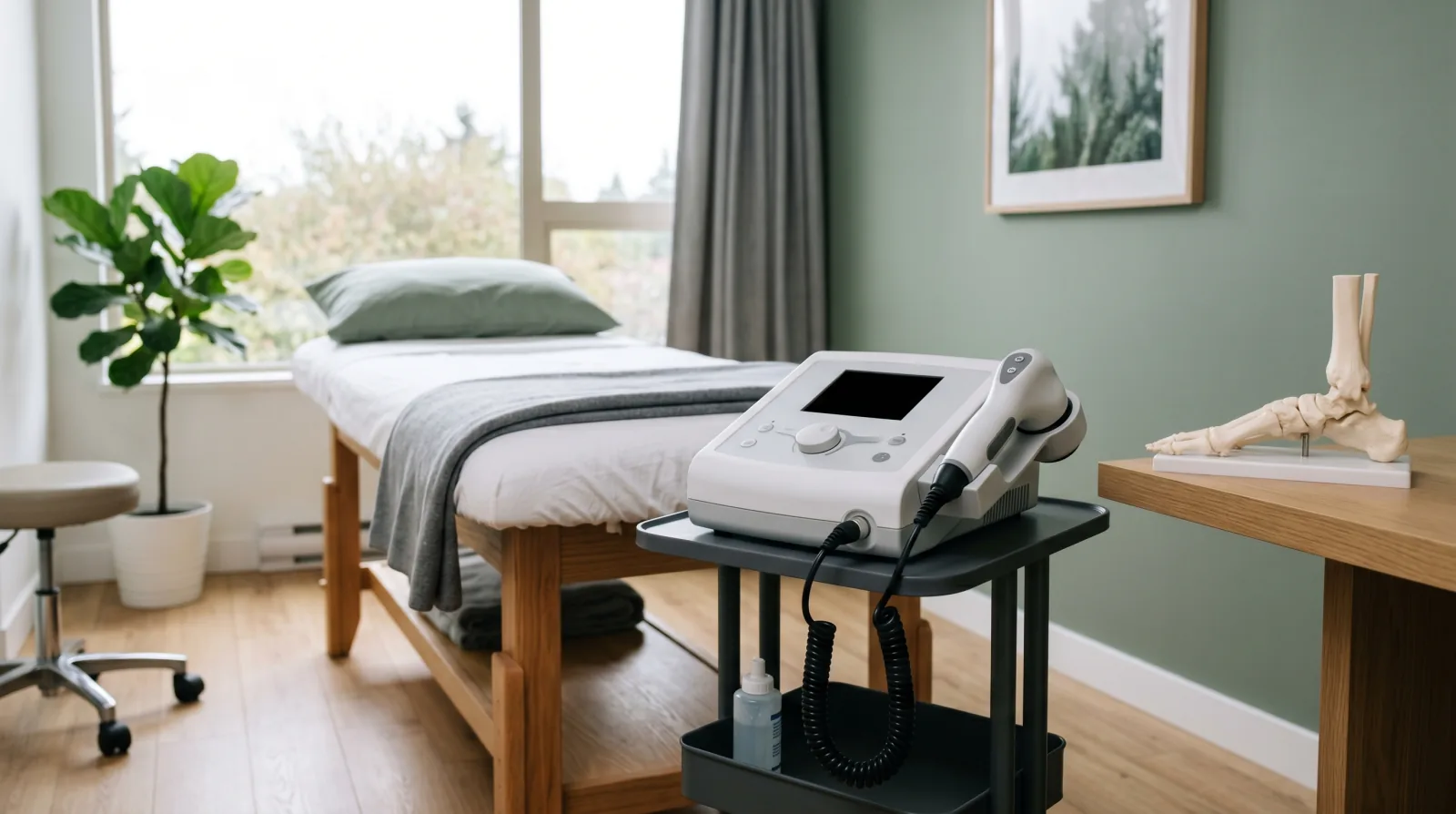
Shockwave delivers acoustic-pressure waves into the tissue through a handheld applicator pressed against the skin. No needle, no incision. The mechanism is mechanical rather than chemical: the pulses appear to trigger a low-grade inflammatory response and increase local blood flow in a tendon that has stalled in a degenerative state, which restarts the healing process a chronic tendinopathy has stopped completing on its own.
That mechanism is why timing matters so much. A fresh, acutely irritable tendon does not need a new inflammatory stimulus added to it. Shockwave earns its place later in the plan, once a real run of progressive loading has been tried and the tendon is still not finishing the job.
What the trials on lateral epicondylitis actually show
Tennis elbow, formally lateral epicondylitis, has the deeper evidence base of the two conditions. A 2024 systematic review and meta-analysis of 6 randomized controlled trials, covering 276 patients, compared shockwave against local corticosteroid injection. Corticosteroid won on pain and grip strength at 1 month. Shockwave reversed that pattern at 3 and 6 months, with the review reporting a meaningfully larger drop in pain score in the shockwave group by that point. Both treatments carried a similarly low rate of adverse events, and every reported side effect was mild.
An earlier 2020 systematic review and meta-analysis of 13 randomized trials, 1,035 patients total, found shockwave produced statistically significant reductions in pain and improvements in grip strength compared with the pooled set of comparison treatments across those trials. The same review flagged a real limitation: protocols and devices varied across the included studies, and the authors called for more high-quality trials before treating the result as settled.
Read together, the two reviews point the same direction without overselling it. Shockwave has a real, time-dependent effect on lateral epicondylitis: slower to help than an injection, but the advantage holds up longer once it appears.
What the evidence says about golfer's elbow specifically
Medial epicondylitis, golfer's elbow, is a smaller research literature than tennis elbow. Most of the shockwave trials enrol lateral epicondylitis specifically, and the medial-elbow evidence available at the time of writing is thinner and lower quality by comparison. The mechanism is the same tendon problem on the flexor side of the elbow rather than the extensor side, which is why clinicians extend the lateral-elbow findings cautiously to golfer's elbow in practice, but that extension is a clinical judgment call, not a result any trial has directly confirmed for the medial tendon.
That gap is a reason to keep expectations grounded rather than a reason to avoid the treatment. Your clinician will explain, at assessment, that the golfer's elbow evidence is a step behind the tennis elbow evidence, and will decide with you whether shockwave is worth adding to your specific plan on that basis.
What a course of shockwave looks like at Launch Rehab
At Launch Rehab, shockwave is delivered by physiotherapists and chiropractors as part of an integrated treatment plan. The same clinician who confirms your tendinopathy diagnosis also delivers the shockwave sessions and writes the loading program around them. Shockwave for tennis elbow and golfer's elbow is currently available at our Lougheed and New Westminster studios.
A typical course runs 3 to 6 weekly sessions, each 10 to 15 minutes, delivered inside a regular physiotherapy appointment rather than as its own long visit. The applicator is placed over the tender spot on the outer or inner elbow and a calibrated dose of pulses is delivered. Most clients describe it as deep, focal pressure that is uncomfortable but tolerable, and your clinician adjusts the intensity to what you can manage rather than applying a fixed setting to everyone.
Full detail on how shockwave is priced, billed, and works as a treatment across conditions is on our shockwave therapy page, and the wider elbow conditions themselves are covered in tennis elbow: why rest alone won't fix it and golfer's elbow: what actually rebuilds medial elbow pain.
Why loading does not stop once shockwave starts
Shockwave without a loading program running alongside it is incomplete therapy for either elbow tendon. The pulses create a stimulus for the tendon to remodel. The loading program is what actually asks the tendon to remodel into something that can carry your grip, your lifting, and your typing again. Skipping the exercise side and expecting the machine alone to fix a tendon is one of the more common reasons a course underdelivers.
Your clinician calibrates the loading dose to the day, heavier on weeks the tendon is tolerating well, lighter the day after a session when some soreness is expected. That soreness is normal and usually settles within a day or two.
Who should not get shockwave, and who decides
Shockwave is not used over an active infection, a suspected fracture, a blood-clotting disorder being treated with anticoagulant medication, or during pregnancy over the treatment area. It is also avoided directly over certain nerves, blood vessels, and growth plates in younger patients. Your clinician screens for these factors at the first visit, before any shockwave is delivered, and will tell you plainly if it is not the right tool for your presentation.
The decision to add shockwave to your plan happens after a diagnosis is confirmed and a genuine period of progressive loading has been tried. It is not offered at a first visit for a fresh elbow flare, and it is not appropriate for every sore elbow. If your elbow pain is new, the first weeks belong to identifying the tendon involved and starting a loading program.
This article is general information, not personal medical advice. A regulated practitioner can confirm whether the patterns described apply to you.
Frequently asked questions
What is shockwave therapy for tennis elbow and golfer's elbow?
Shockwave therapy delivers acoustic-pressure waves through a handheld applicator into the tendon at the elbow, tennis elbow on the outer side and golfer's elbow on the inner side. The mechanical pulses appear to trigger a low-grade inflammatory response and increase local blood flow in a tendon that has stalled in a chronic, degenerative state, which is thought to restart the healing process the tendon has not completed on its own.
Does shockwave therapy for tennis elbow actually work?
The evidence for lateral epicondylitis (tennis elbow) is reasonably solid. A 2024 meta-analysis of 6 randomized trials found shockwave outperformed corticosteroid injection on pain and grip strength at 3 and 6 months, after the injection had the early advantage at 1 month. A 2020 review of 13 trials, over 1,000 patients, also found significant pain and grip strength improvements with shockwave compared with other treatments tested against it in those studies.
Is there evidence for shockwave on golfer's elbow specifically?
The research base for medial epicondylitis (golfer's elbow) is thinner and lower quality than the tennis elbow literature, since most shockwave trials enrol lateral epicondylitis specifically. Clinicians often extend the lateral-elbow findings to the medial tendon because the underlying tendinopathy mechanism is the same, but that extension is a clinical judgment rather than a result any trial has confirmed directly for golfer's elbow.
How many shockwave sessions will I need for my elbow?
A typical course at Launch Rehab runs 3 to 6 weekly sessions, each 10 to 15 minutes, delivered inside a regular physiotherapy appointment rather than as a separate long visit. Some chronic cases benefit from a second course after a rest period if progress has plateaued again, which your clinician reassesses rather than assumes.
Where can I get shockwave therapy for tennis elbow or golfer's elbow at Launch Rehab?
Shockwave for tennis elbow and golfer's elbow is currently available at our Lougheed and New Westminster studios, delivered by physiotherapists and chiropractors as part of an integrated treatment plan. It is not offered as a stand-alone walk-in service at either location, and the same clinician who confirms your diagnosis also delivers the sessions and writes the loading program around them.
Does shockwave therapy hurt?
It is uncomfortable, usually described as deep, focal pressure or an intense tapping sensation directly over the tender spot on the elbow. The intensity is adjustable, and your clinician starts lower and increases the dose as you tolerate it rather than using a fixed setting for everyone. A day or two of mild post-treatment soreness at the elbow is expected and usually settles on its own.
Should I keep doing my elbow exercises during a course of shockwave?
Yes. Shockwave without a loading program running alongside it is incomplete therapy for tennis elbow or golfer's elbow. The pulses create a stimulus for the tendon to remodel, and the loading program is what determines whether the tendon actually rebuilds into something that can tolerate your grip and lifting demands again. Your clinician calibrates the exercise dose to how the tendon responded to that week's session.
Is shockwave therapy covered by insurance for tennis elbow or golfer's elbow?
Shockwave is billed under physiotherapy, which most extended-health plans cover as part of the physiotherapy benefit. ICBC pre-approves shockwave for accepted post-motor-vehicle-accident claims when it is clinically indicated, and WorkSafeBC coverage requires adjudicator approval before treatment starts. Current session pricing is on our rates page, and a client care coordinator verifies your specific coverage before the first appointment.
Are there reasons someone should not get shockwave therapy on their elbow?
Yes. Shockwave is not used over an active infection, a suspected fracture, a blood-clotting disorder being treated with anticoagulant medication, or during pregnancy over the treatment area, and it is avoided directly over certain nerves, blood vessels, and growth plates in younger patients. Your clinician screens for these factors at the first visit and will tell you directly if shockwave is not the right tool for your elbow.
How is shockwave for tennis elbow different from a cortisone injection?
Corticosteroid injection reduces pain faster in the first month after treatment, but a 2024 meta-analysis of 6 randomized trials found shockwave overtakes it on pain and grip strength by 3 and 6 months. Cortisone is a strong anti-inflammatory that can give rapid short-term relief but does not itself improve tendon structure, while shockwave aims at the underlying tendinopathy by stimulating a slower healing response that tends to last longer once it takes hold.
Sources
- Zhang et al., "Extracorporeal Shock Wave Therapy Versus Local Corticosteroid Injection for Chronic Lateral Epicondylitis: A Systematic Review with Meta-Analysis of Randomized Controlled Trials," Orthopaedic Surgery, 2024
- "Efficacy of Extracorporeal Shock Wave Therapy for Lateral Epicondylitis: A Systematic Review and Meta-Analysis," BioMed Research International, 2020
- College of Health and Care Professionals of BC, physiotherapist scope of practice
- College of Complementary Health Professionals of BC, chiropractor scope of practice
WRITTEN BY
The Launch Rehab Team
Practical recovery and training notes from the clinicians at our five Metro Vancouver studios.
FOUND THIS USEFUL?
Share it with your network on LinkedIn. We wrote a ready-to-post version for you.
FILED UNDER
- shockwave
- tennis-elbow
- golfers-elbow
- lateral-epicondylitis
- medial-epicondylitis
- tendinopathy
- physiotherapy
- bc