

RUNEASI GUIDE · THE MEASURES
What Runeasi measures: stability, impact and symmetry.
Three measures make up your running quality score. Step data such as cadence adds context.
THE SHORT ANSWER
What does Runeasi measure?
Runeasi measures three things while you run. Dynamic stability is how well you control side-to-side hip movement. Impact loading is how much impact reaches your body and how well you absorb it. Symmetry is the difference between your left and right legs. It also records step data: cadence, ground contact time and flight ratio.
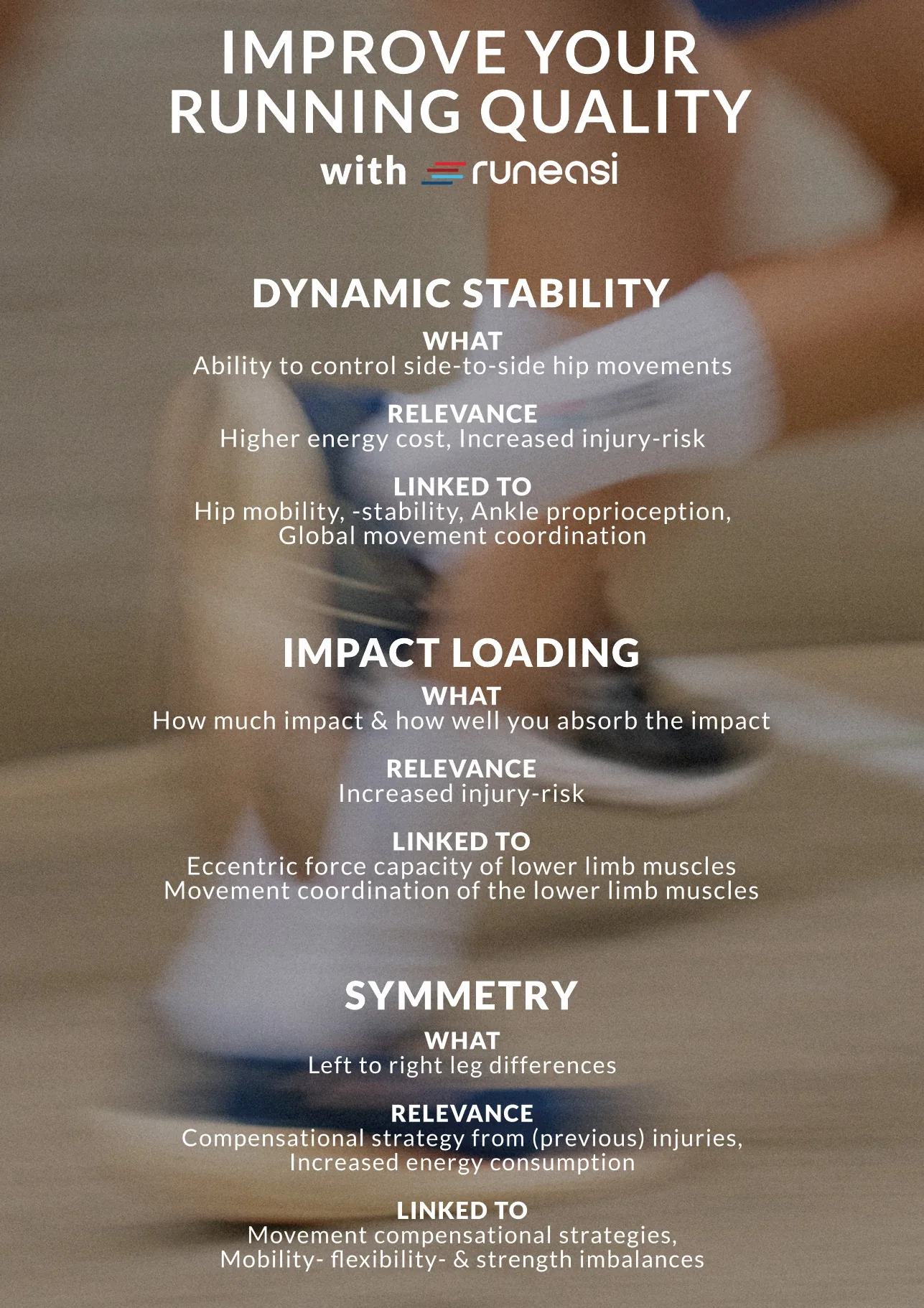
Runeasi turns the sensor data into a small set of measures. Its poster answers three questions for each one: what it is, why it matters, and what it is linked to.
AT A GLANCE
- Dynamic stability
- Side-to-side hip control
- Impact loading
- How big the impact is and how fast it arrives
- Symmetry
- Left and right leg differences
- Step data
- Cadence, ground contact time, flight ratio
- Score
- The three measures combine into one score from 0 to 100%
MEASURE 1
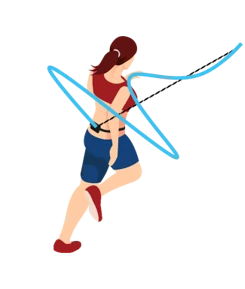
Dynamic stability: how well you control your hips.
Dynamic stability is your ability to control side-to-side hip movement. The sensor measures how much your pelvis moves sideways while your foot is on the ground. The app calls the opposite reading dynamic instability.
- Why it matters
- More sideways movement is linked to a higher energy cost and a higher injury risk
- Linked to
- Hip mobility and stability, your sense of where your ankle is, and overall movement coordination
- Studies Runeasi cites
- Schütte and colleagues, 2014, 2016 and 2017
MEASURE 2
Impact loading: how much impact, and how well you absorb it.
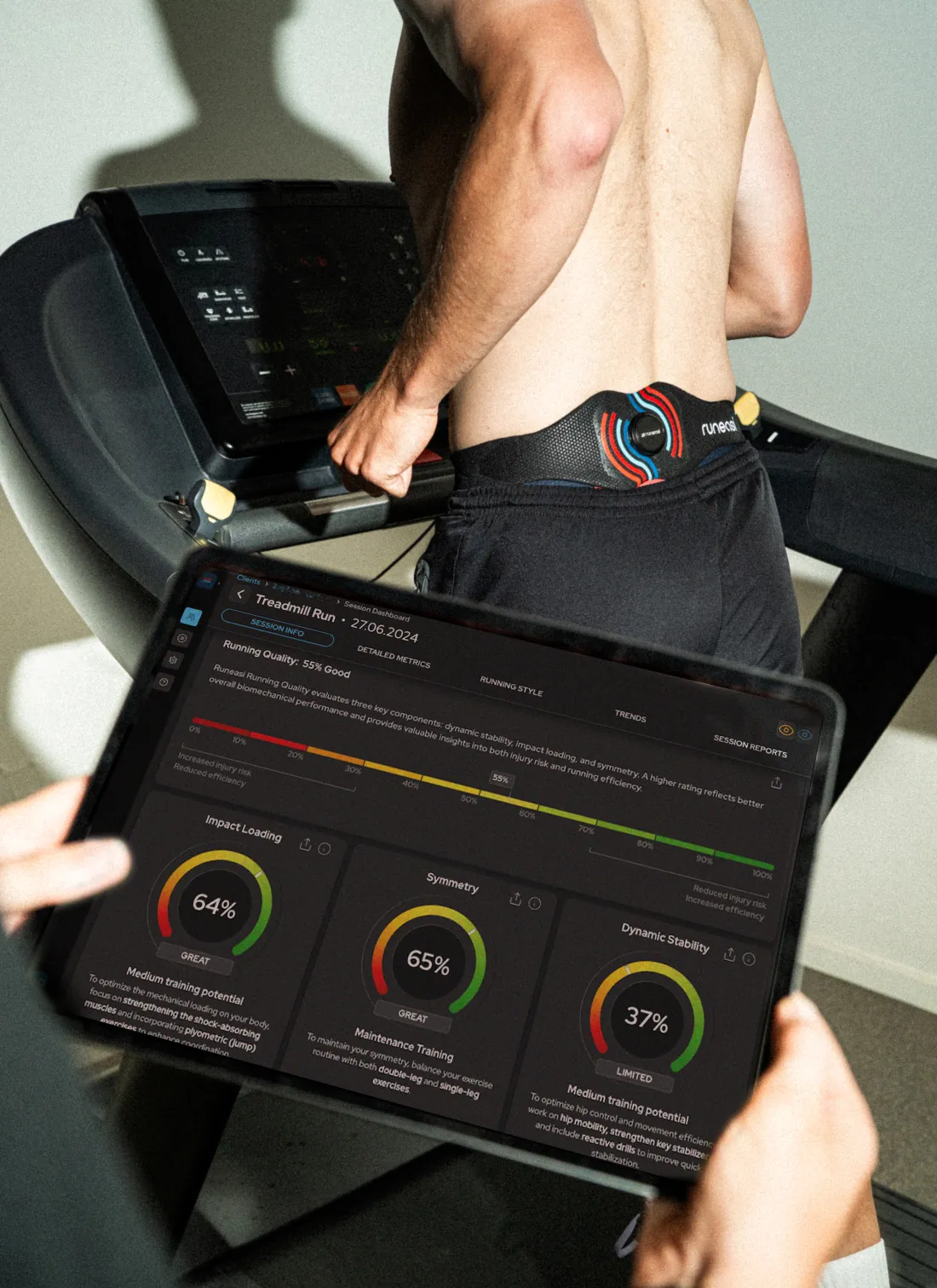
Each time your foot lands, a shock travels up through your legs. Runeasi measures how big that shock is when it reaches your pelvis (impact magnitude) and how fast it gets there (impact duration). Together they show how well your lower legs handle load.
- Why it matters
- Poor impact absorption is linked to a higher injury risk
- Linked to
- The strength your leg muscles have while they lengthen to absorb a landing, and how well those muscles work together
- Study Runeasi cites
- Burke and colleagues, 2022

MEASURE 3
Symmetry: your left leg compared with your right.
Symmetry compares your left and right legs. The app shows each difference as a percentage, with the side it points to. In Runeasi's football example, a fast run showed 13.7% to the right.
Some difference between sides is natural. The app shows a warning when a difference goes beyond natural asymmetry.
- Why it matters
- A difference can be the body protecting an old injury, and it can raise the energy you use
- Linked to
- Ways the body works around a problem, and differences in mobility, flexibility and strength between sides
- Studies Runeasi cites
- White and colleagues, 2013; Thomson and colleagues, 2018; Melo and colleagues, 2020
Runeasi says left and right differences can show early signs of compensation.
CONTEXT
Step data: cadence, contact time and flight ratio.
Runeasi also records step data, which gives the three measures context:
- Cadence: your steps per minute
- Ground contact time: how long each foot stays on the ground, in milliseconds
- Flight ratio: how much of each step you spend in the air
Runeasi says these help adjust parts of your running. It cites Patoz and colleagues (2020), Lussiana and colleagues (2019), Bonnaerens and colleagues (2020) and Hanley and colleagues (2022).
TOGETHER
The three measures make one score.
Dynamic stability, impact loading and symmetry combine into your Runeasi running quality score, from 0 to 100%.
FREE PDF GUIDE
Would you like the full Runeasi guide as a PDF?
Every page of this guide in one file, with all the photos: the test, the measures, your score, the belt, the uses, the case examples and the research. Leave your name and email and the download is ready right away.
PDF, made by Launch Rehab
FAQ
Common questions.
Some of them. A therapist can see signs such as a knee that moves inward. The forces acting on a runner cannot be seen by eye, and the sensor measures those.
The sensor sits near the body's centre of mass, at the pelvis. Measuring there shows how much of each landing's shock gets through your legs.
In Runeasi's app examples, the advice includes strength work for the muscles that absorb shock and jump exercises. Your therapist picks the exercises that fit you.
The app's advice for this measure includes hip mobility work, strength work, and reactive stability drills.
The app suggests working on left and right imbalances, with a mix of exercises on both legs and on one leg at a time.
From Runeasi's research at KU Leuven and Stellenbosch University. The booklet names the studies behind each measure, and the research page lists them.

SOURCES
Where the facts on this page come from.
- Runeasi, “Improve your running quality” (A1 poster). Supplied October 2026.
- Runeasi, info booklet (24 pages). Supplied October 2026.
- Runeasi app screens and photos (media folder). Supplied October 2026.
Facts about the Runeasi system, the company and its case examples are Runeasi's own statements. The studio facts are Launch Rehab's.

NEW WESTMINSTER ONLY
Book a running assessment with Runeasi.
Runeasi is offered at the Launch Rehab New Westminster studio, 219-800 Carnarvon St. Prices and session lengths are on the running assessment page.