Acupuncture vs Massage for Chronic Pain: Which One to Try First
Both acupuncture and massage therapy can help with chronic pain. They work through different mechanisms and suit different problems. Here is how to decide which one fits your situation, from a clinic that offers both.
BY THE LAUNCH REHAB TEAM
Acupuncture or massage for chronic pain: which should you try first?
Start with massage therapy if the pain lives in a specific muscle or region and you can locate it with your hand. Start with acupuncture if the pain spreads, has a nerve quality, or has not shifted with hands-on soft-tissue work. Both are delivered by regulated health professionals in BC, both are covered by most extended health plans, and neither requires a doctor's referral.
We have both registered acupuncturists and registered massage therapists at Launch Rehab, so when a patient with chronic pain asks which to book, the answer we give comes from the problem, not from which calendar has an opening.
Quick comparison:
| Acupuncture | Registered Massage Therapy (RMT) | |
|---|---|---|
| Main mechanism | Alters pain signal processing; reduces inflammation | Releases soft tissue; reduces muscle tension and guarding |
| Best fit | Spreading, nerve-like, or inflammation-driven pain | Localised muscle or fascial tension |
| Session feel | Quiet, still, light needle sensation | Hands-on throughout, varying pressure |
| Results timeline | Often 4 to 8 sessions for chronic conditions | Often 1 to 3 sessions to assess response |
| ICBC/WorkSafeBC | ICBC pre-approved; WSBC case-by-case | ICBC pre-approved; WSBC not accepted at Launch Rehab |
| Extended health | Usually covered (acupuncture pool) | Usually covered (massage pool) |
| Referral needed | No | No |
What acupuncture actually does for chronic pain
Registered acupuncturists in BC are regulated by the College of Complementary Health Professionals of BC (CCHPBC), which sets the standards for both registered acupuncturists and traditional Chinese medicine practitioners. The needle stimulates tissue at specific points and, through that stimulus, appears to shift how the central nervous system processes pain signals.
The mechanism that has attracted the most research interest is the effect on endogenous opioids and serotonin. When a needle activates a point, the body releases natural pain-inhibiting compounds that work at the spinal cord and brain level, not just at the site of the needle. A 2017 meta-analysis in the Journal of Pain (individual patient data from nearly 21,000 participants in randomised trials) found acupuncture superior to both sham acupuncture and usual care for chronic back, neck, shoulder, and head pain, and concluded the effects were not fully explained by placebo. The effect size was modest but consistent across studies.
This matters for chronic pain because pain that has persisted for months tends to involve changes in how the nervous system amplifies signals, a process called central sensitisation. Hands-on soft-tissue treatment does not directly address that amplification; acupuncture has evidence for doing so.
Acupuncture also has a specific application in inflammatory conditions. For tendinopathies, trigger points, and inflammatory joint conditions, needling can reduce the local inflammatory response without the risks that come with repeated cortisone injections.
What massage therapy actually does for chronic pain
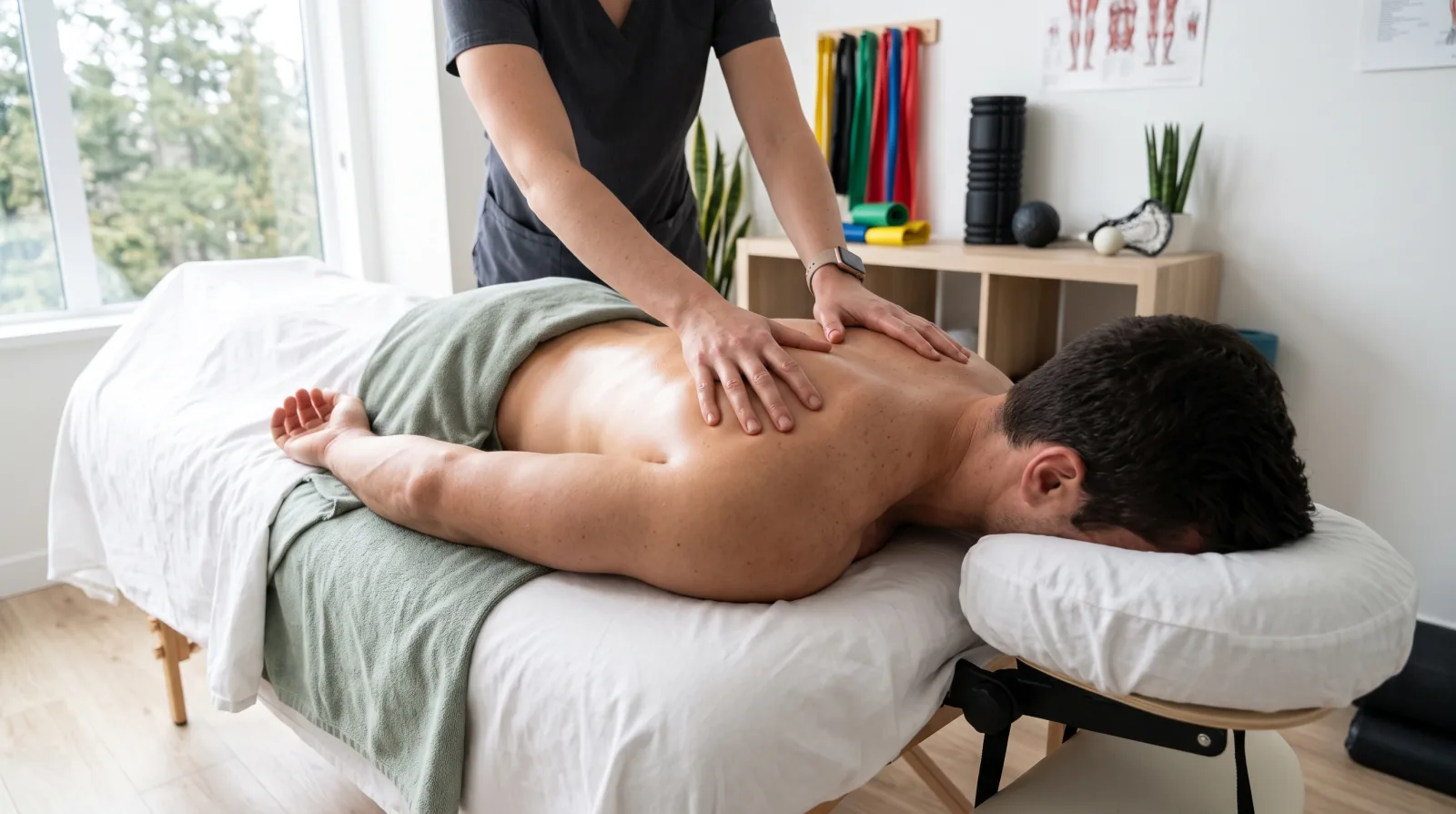
Registered massage therapists in BC are regulated by the College of Complementary Health Professionals of BC (CCHPBC), and their scope centres on the assessment and treatment of soft tissue and joints. For chronic pain, the primary mechanism is mechanical: hands-on pressure releases overactive muscle tissue, breaks down adhesions in fascia, and improves blood flow to areas that have been guarded and underloaded.
The nervous system response is real too. Deep pressure activates mechanoreceptors that trigger a parasympathetic (rest and digest) response. People feel calmer and sleep better after massage, and for chronic pain driven by persistent stress or autonomic nervous system activation, that response is a genuine part of the treatment.
Where massage has a clear advantage over acupuncture is in specificity to one region. If the pain is in the upper trapezius from desk posture, in the hip flexors from a long recovery, or in the gluteals from running load, massage can target that tissue directly with techniques scaled to what it can accept.
The evidence for each in chronic pain
| Pain type | Acupuncture evidence | RMT evidence |
|---|---|---|
| Chronic low back pain | Strong: multiple systematic reviews and the 2017 JAMA meta-analysis | Moderate: positive short-term effects, limited long-term data |
| Chronic neck pain | Strong: cited in the 2017 meta-analysis; superior to sham | Moderate: comparable short-term relief to acupuncture |
| Chronic headache / migraine | Strong: Cochrane review finds acupuncture reduces migraine frequency; comparable to preventive drugs | Moderate: positive for tension headache, less evidence for migraine |
| Fibromyalgia | Moderate: positive but small trials | Limited: RCT evidence is thin for this condition specifically |
| Knee osteoarthritis | Moderate: reduces pain and improves function, especially short-term | Limited: mostly anecdotal in OA, better evidence for specific muscle targets around the joint |
| Tendinopathy | Moderate: reduces local inflammation; dry needling (a physiotherapy-delivered variation) has stronger evidence | Moderate: soft-tissue release helps fascial restriction around tendons |
How we triage between them in clinic
A few patterns from our clinical teams, offered as observations:
Book acupuncture if:
- The pain spreads, radiates, or has a burning or electric quality
- It has been present for over six months and has not changed with hands-on treatment
- Inflammation keeps returning to the same structure
- You are sensitive to pressure and cannot tolerate deep soft-tissue work
Book massage therapy if:
- You can point to a specific muscle or region that holds the tension
- Stress is a clear driver, and you feel the problem in your body when anxious or tired
- You already know the area from past treatments, and massage has given you durable relief before
- Movement restriction is the main complaint, not pain sensitivity
When the answer is both: many patients with chronic pain benefit from running them together or in close sequence. A common combination is acupuncture to shift the pain sensitivity and reduce the inflammatory response, then massage to release the soft tissue that has been guarded for months. Having both practitioners in the same building means the plan can coordinate without sending you across the city.
Coverage differences worth knowing
Extended health plans in BC typically separate acupuncture and massage therapy into their own annual pools, so using one does not reduce what you have available for the other. Check your plan booklet for each line separately. Current rates for both at Launch Rehab are on our rates page.
For ICBC claims, both acupuncture and registered massage therapy are pre-approved in the first 12 weeks of recovery. WorkSafeBC claims are handled differently: Launch Rehab accepts WorkSafeBC claims for physiotherapy but not for massage therapy; acupuncture through WorkSafeBC is case-by-case, so confirm with the front desk before booking. If you are managing a motor vehicle claim and unsure which professions apply, our ICBC physio vs RMT vs chiro guide covers the billing split in detail.
What to consider before your first session
For new or changing chronic pain, a physiotherapy assessment first makes sense. The physiotherapist can name what is actually driving the pain, which makes both the acupuncture and the massage more targeted. "This person's chronic neck pain is driven by cervicogenic referral" changes what the acupuncturist focuses on. "The hip pain is from a loaded tendon, not a muscle" changes how the RMT approaches pressure. The chronic pain management hub covers how a physiotherapist builds that assessment-led plan, and when adding acupuncture, RMT or counselling is the right next step.
For established chronic pain where you already know the pattern, booking directly with either practitioner is reasonable. Both professions do their own intake and can refer internally if the picture is more complicated than expected.
Frequently asked questions
Is acupuncture or massage better for chronic pain?
Neither is universally better. Acupuncture has stronger evidence for chronic pain that involves the nervous system, like widespread pain, nerve-quality symptoms, or pain that has not shifted with hands-on treatment. Massage therapy has a clearer advantage for localised muscle tension, stress-driven pain, and movement restriction in a specific region. For many chronic pain presentations, both are useful at different stages of recovery.
How many sessions of acupuncture do you need for chronic pain?
Most research on acupuncture for chronic pain uses 6 to 10 sessions. For an established chronic condition, a meaningful response usually takes longer than a single session. The 2017 Journal of Pain meta-analysis used 6 to 15 sessions across its trials. At Launch Rehab, your acupuncturist will typically suggest a trial of 4 to 6 sessions and reassess how the pain is responding before recommending more.
How many massage therapy sessions are needed for chronic pain?
There is no fixed number. For chronic tension with a clear regional cause, some patients feel a meaningful change in 2 to 4 sessions. For pain that has been present for years, a longer course is more realistic, and maintaining gains often means ongoing treatment spaced further apart rather than a fixed endpoint. One session usually tells you whether massage is the right tool for your specific pattern.
Can I do acupuncture and massage on the same day?
Yes. There is no clinical reason to space them out, and some patients book both within the same visit when both practitioners are available. If they are being used for the same region, some prefer to leave a day between them to assess each response separately. Talk to your practitioner about what makes sense for your situation.
Is acupuncture covered by extended health insurance in BC?
Most extended health plans in BC include acupuncture in a separate annual pool from massage therapy. Coverage limits and eligible provider types vary by plan. Check your booklet for the acupuncture line and confirm the provider's credentials qualify, as some plans specify a registered acupuncturist rather than a physiotherapist delivering dry needling.
Does massage therapy help with nerve pain?
Massage therapy can help reduce muscle guarding and tension around a nerve that is irritated, which sometimes reduces nerve-quality symptoms downstream. It does not treat the nerve directly. For pain that is clearly nerve-driven, such as sciatica, cervical radiculopathy, or widespread sensitisation, acupuncture or physiotherapy tends to be a better primary treatment, with massage as a support.
Which is more relaxing: acupuncture or massage?
Both can reduce the nervous system's alarm response. Massage tends to feel more immediately relaxing because of the sustained contact and the parasympathetic response it triggers. Acupuncture involves less movement and can produce a calm, sometimes heavy sensation during the session, but the relaxation tends to develop more over a course of treatment than in a single session.
Do I need a referral for acupuncture or massage therapy in BC?
No. Both are direct-access professions. You can book either without a physician's referral. Some extended health plans require a physician note for reimbursement, so check your plan booklet before booking if you intend to claim the cost.
Book with a Launch Rehab practitioner
We offer acupuncture at New Westminster, Richmond, North Burnaby, and Coquitlam, and registered massage therapy across all five Metro Vancouver studios. Current fees are on the rates page. If you are unsure which practitioner to start with, any studio can help you triage at the first visit.
Book acupuncture in New Westminster, acupuncture in Richmond, or start with registered massage therapy in Coquitlam.
This article is general information, not personal medical advice. A regulated practitioner can confirm whether the patterns described apply to you.
Sources
- Acupuncture for Chronic Pain: Individual Patient Data Meta-analysis, Journal of Pain, 2012 (updated 2017)
- Acupuncture for prevention of episodic migraine, Cochrane Review, 2016
- CCHPBC: Registered Acupuncturists and TCM Practitioners
- CCHPBC: Registered Massage Therapists
- ICBC: Accessing treatment during your first 12 weeks of recovery
WRITTEN BY
The Launch Rehab Team
Practical recovery and training notes from the clinicians at our five Metro Vancouver studios.
FOUND THIS USEFUL?
Share it with your network on LinkedIn. We wrote a ready-to-post version for you.
FILED UNDER
- acupuncture
- massage-therapy
- rmt
- chronic-pain
- scope-of-practice
- bc