
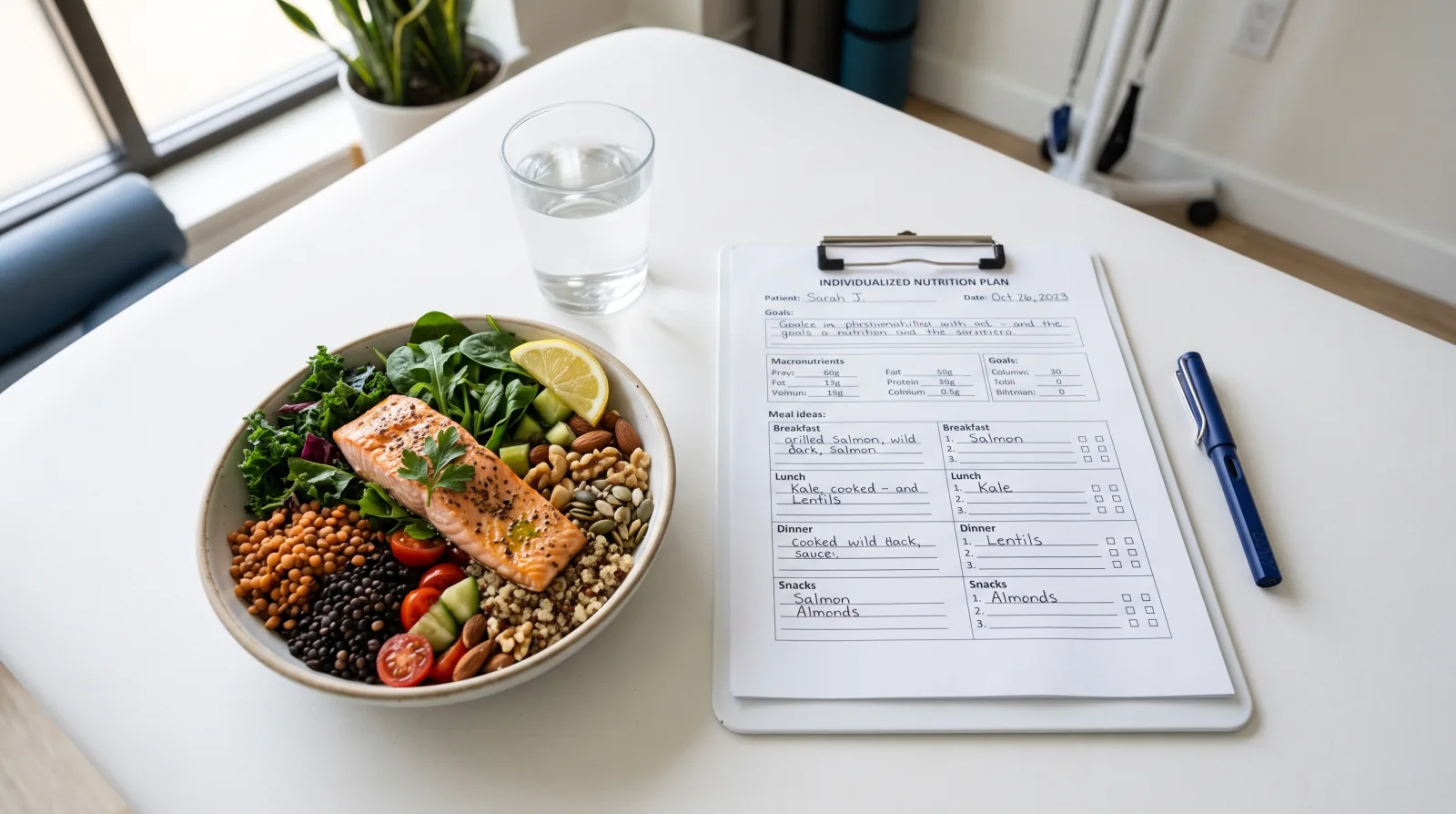
Sports Nutrition for Injury Prevention: Fuelling a New Training Plan
Most people who ramp up a January training plan think about the workouts and skip the fuelling. Under fed tissue adapts poorly to new load. Here is what the sports nutrition evidence says about energy intake, protein, and hydration before an injury happens, not after.
BY THE LAUNCH REHAB TEAM
Every January, gyms fill up and running clubs add new faces. Most of the advice people get is about the workout: how many sets, how many kilometres, how many days a week. Almost nobody tells them what to eat to support that jump in training load, and it is one of the more overlooked pieces of injury prevention for anyone starting or restarting a fitness plan.
This article covers the fuelling side, not the recovery side. If you are already injured and want to know how nutrition supports healing, see nutrition for injury recovery. This is about lowering the odds of getting hurt in the first place while training load goes up.
Why under fuelling raises injury risk beyond fatigue
When someone starts a new training plan, the assumption is usually that eating less and moving more is the winning formula. For general health goals that can be reasonable. For a body that is also asking its tendons, muscles, and bones to adapt to new mechanical load, it works against the goal.
A 2024 systematic review and meta-analysis in Sports Medicine examined low energy availability, the state where energy intake falls short of what training and daily function together require, across 59 studies and more than 6,000 athletes (Sports Medicine, 2024). Most of the studies found that athletes with low energy availability had impaired bone health and a higher risk of bone stress injury. The review also found decreased training response, endurance performance, and coordination in athletes with low energy availability, alongside more absence from training due to illness. The relationship between low energy availability and injury risk generally, beyond bone, was mixed across studies rather than uniform.
The practical read for someone starting a new plan is that tissue undergoing new mechanical load needs the energy and nutrients to adapt to that load, and cutting food intake at the same time volume goes up removes the material the body needs for that adaptation. The Academy of Nutrition and Dietetics, Dietitians of Canada, and the American College of Sports Medicine make the same point in their joint position statement: nutrition strategies that match intake to training demand support both performance and the tissue adaptation that underlies it (Thomas, Erdman, Burke, Medicine and Science in Sports and Exercise, 2016).
Our article on bone stress injury and energy availability in runners covers this territory in more depth for athletes already training at volume. This section is aimed at people at the other end of the timeline: the first weeks of a new or restarted program, before an injury has occurred, when the eating pattern is still something you can adjust.
What protein intake has to do with tissue adaptation
Muscle and tendon do not get stronger from the workout itself. They get stronger from the repair and remodelling that happens afterward, and that process runs on protein. When someone increases training volume without a matching increase in protein intake, the raw material for that adaptation falls short of demand.
The joint position statement from the Academy of Nutrition and Dietetics, Dietitians of Canada, and the American College of Sports Medicine addresses this directly for people in general training, not only elite athletes: adequate protein intake, spread appropriately across the day, supports the muscle protein synthesis that new training load depends on (Thomas, Erdman, Burke, 2016).
The International Society of Sports Nutrition's position stand on protein and exercise gives a more specific range. For most people who exercise regularly, the position stand recommends a daily protein intake of 1.4 to 2.0 grams per kilogram of body weight to build and maintain muscle mass, with intake spread across meals rather than concentrated in one sitting (Jäger et al., Journal of the International Society of Sports Nutrition, 2017). That is a wide range, and where a given person falls within it depends on training volume, body size, and goals, which is exactly the kind of individual assessment a registered dietitian does rather than a blanket number applied to everyone.
Someone starting from a low baseline of activity and adding several sessions a week is asking their muscle and tendon to adapt faster than their previous eating pattern was built for. Reviewing whether protein intake has kept pace with the new training plan is a reasonable first check.
Why hydration is not just a performance issue
Hydration tends to get filed under performance and comfort, not injury prevention, but the two are connected. The American College of Sports Medicine's position stand on exercise and fluid replacement describes how even modest fluid loss, in the range of 2 percent of body weight, reduces exercise capacity and affects thermoregulation (Sawka et al., Medicine and Science in Sports and Exercise, 2007).
Muscle and tendon rely on adequate hydration for normal mechanical properties and function during loading. A person training in a dehydrated state is asking those tissues to tolerate load under conditions they are not adapted for, on top of whatever fatigue is already present from the session. The ACSM position stand recommends individualized fluid replacement based on sweat rate rather than a single fixed volume for everyone, since sweat losses vary between people and conditions.
For someone building a new training habit in the winter months, this is easy to underestimate. Thirst cues are less reliable in cooler weather, and indoor training in a heated gym can produce meaningful sweat losses that go unnoticed.
The scope difference between a dietitian and a physiotherapist
A physiotherapist screens how your joints, tendons, and movement patterns are tolerating a new or increasing training load, and builds a progression plan around what they find. A registered dietitian assesses what you are actually eating and drinking relative to what that plan demands, and builds a nutrition plan around that gap. Both are relevant to injury prevention, and neither substitutes for the other.
In BC, registered dietitians are regulated by the College of Health and Care Professionals of BC (CHCPBC), the same college that regulates physiotherapists following the 2024 college amalgamation. A registered dietitian's scope covers nutrition assessment, medical nutrition therapy, and structured eating plans. It does not include diagnosing a musculoskeletal injury, prescribing exercise progressions, or treating tissue directly. Those decisions sit with a physiotherapist or physician. For a fuller explanation of what separates a registered dietitian from an unregulated "nutritionist" title in BC, see our guide on registered dietitians versus nutritionists.
A physiotherapist cannot tell you whether your intake matches your training demand any more precisely than asking a general question about your eating habits. That is outside physiotherapy scope, and it is exactly where a dietitian consult adds something a physio screen does not cover.
When a dietitian consult alongside a physio screen makes sense
Not everyone starting a new fitness plan needs a dietitian visit before their first workout. A few situations make the case stronger.
Someone increasing training volume noticeably over a few weeks, particularly running or jump-based training, is a reasonable candidate given the bone health findings in the low energy availability research above. Someone who has cut calories at the same time as increasing exercise, intentionally or by not adjusting food intake for the new activity level, is another. A person with a history of a stress fracture or a slow-healing soft tissue injury may also benefit from a nutrition review alongside a physiotherapy assessment, since past injury pattern is one of the things worth checking against current eating habits.
If none of that applies and someone is simply starting a moderate walking or beginner strength program, the priority is usually a sensible progression plan from a physiotherapist or trainer rather than a dietitian consult on day one. The two professions are complementary, not sequential gatekeepers of each other.
For anyone returning to exercise after months of inactivity, our guide on new year training injuries and a safer return to exercise covers the load-progression side of this decision in detail.
What a first conversation with a dietitian actually covers
A first visit with a registered dietitian is not a supplement recommendation or a generic meal plan handed over on a printout. It starts with a detailed look at what you currently eat, how that has changed or not changed as your training has changed, and what your goals are for the months ahead.
From there, a dietitian identifies specific gaps relative to training demand rather than making blanket suggestions. That might mean protein spread across the day rather than concentrated at dinner, a look at whether total energy intake has kept pace with a new training volume, or a hydration strategy suited to your sweat rate and the conditions you train in. The plan is built around your schedule and food preferences, not a generic athlete template.
The practical next step
If you are ramping up a training plan this January, the strongest starting point is usually a physiotherapy screen to check how your current tissue tolerance matches the plan you want to build, paired with an honest look at whether your eating has kept pace with what that plan will ask of your body. Neither piece replaces the other, and getting both right early costs less than treating an injury that under fuelling helped cause.
This article is general information, not personal medical advice. A regulated practitioner can confirm whether the patterns described apply to you.
Frequently asked questions
Can eating too little actually cause an injury?
Eating too little does not directly cause an injury the way a fall or a sudden overload does, but a 2024 systematic review and meta-analysis in Sports Medicine found that athletes with low energy availability had impaired bone health and a higher risk of bone stress injury. The relationship with injury risk generally, beyond bone specifically, was less consistent across studies. Matching intake to training demand supports the tissue adaptation new training load requires.
How much protein should I eat if I am starting a new training plan?
The International Society of Sports Nutrition's position stand on protein and exercise recommends 1.4 to 2.0 grams of protein per kilogram of body weight per day for most people who exercise regularly, spread across meals rather than concentrated in one sitting. Where you fall in that range depends on your training volume, body size, and goals, which is the kind of individual question a registered dietitian can assess.
Is hydration connected to injury risk, or just performance?
Both. The ACSM position stand on exercise and fluid replacement describes how even modest dehydration, around 2 percent of body weight, reduces exercise capacity. Muscle and tendon depend on adequate hydration for normal function during loading, so training in a dehydrated state adds strain on top of the load itself. Individualized fluid replacement based on your sweat rate is what the position stand recommends, rather than one fixed volume for everyone.
What is the difference between this article and your nutrition for injury recovery article?
This article covers nutrition before an injury happens, aimed at reducing injury risk while training load increases. Our nutrition for injury recovery article covers nutrition after an injury has already occurred, focused on supporting tissue healing during physiotherapy. The two are related but answer different questions at different points in a training or recovery timeline.
Should I see a dietitian or a physiotherapist first when starting a new training plan?
Neither one has to come first. A physiotherapist screens how your tissue is tolerating your current or planned training load and builds a progression plan. A registered dietitian assesses whether your eating matches what that plan demands. They answer different questions, so many people benefit from both around the same time rather than treating one as a prerequisite for the other.
Are registered dietitians and nutritionists the same thing in BC?
No. In BC, registered dietitian is a protected title regulated by the College of Health and Care Professionals of BC, requiring an accredited degree, a supervised internship, and a national registration exam. Nutritionist is not a protected title in BC, so training varies widely. Our registered dietitian versus nutritionist guide covers this distinction and how to verify credentials.
Does low energy availability only matter for elite athletes?
No. The research on low energy availability comes largely from athlete populations, but the underlying mechanism, energy intake falling short of what training and daily function require, applies to anyone increasing exercise volume without a matching increase in food intake. Someone starting a new January training plan while also trying to eat less is creating the same gap, at a smaller scale, that the research describes in athletes.
What does a registered dietitian actually do in a sports nutrition consult?
A registered dietitian reviews your current eating pattern in detail, compares it against what your training plan demands, and identifies specific gaps such as inadequate protein, insufficient total energy, or a hydration strategy that does not match your sweat rate. The plan that follows is built around your schedule, food preferences, and goals rather than a generic template handed to every athlete.
Sources
- Low Energy Availability and Relative Energy Deficiency in Sport: A Systematic Review and Meta-analysis, Sports Medicine (2024)
- Thomas, Erdman, Burke, "American College of Sports Medicine Joint Position Statement: Nutrition and Athletic Performance," Medicine and Science in Sports and Exercise (2016)
- Jäger et al., "International Society of Sports Nutrition Position Stand: protein and exercise," Journal of the International Society of Sports Nutrition (2017)
- Sawka et al., "American College of Sports Medicine position stand: Exercise and Fluid Replacement," Medicine and Science in Sports and Exercise (2007)
- College of Health and Care Professionals of BC (CHCPBC): regulator of dietitians and physiotherapists in British Columbia
- Nutrition for injury recovery: what a registered dietitian adds to your physio plan
- Registered dietitian vs nutritionist in BC
WRITTEN BY
The Launch Rehab Team
Practical recovery and training notes from the clinicians at our five Metro Vancouver studios.
FOUND THIS USEFUL?
Share it with your network on LinkedIn. We wrote a ready-to-post version for you.
FILED UNDER
- sports-nutrition
- injury-prevention
- dietitian
- protein-intake
- hydration
- new-years-resolution
- bc